
"Open book" sounds like it should make the SAP certification exam easier. It does not. Every candidate who sits the SAP performance-based assessment and underestimates the open-book format faces the same problem: you have 2 hours, a live system or AI avatar waiting for you to perform, and zero room for hesitation.
The candidates who pass are those who prepare most effectively for a format that rewards applied competency, fast navigation, and confident execution. This guide gives you every practical tip you need to succeed.
The Most Important Open-Book Exam Truth
Open book means you can look up the answer, not learn the concept. You have 2 hours to complete system tasks or respond to business scenarios with architectural solutions. If you spend 40 of those minutes finding a basic document you have never seen before, you will fail on time alone.
The new SAP exam format — fully launched by end-March 2026 — is a performance-based assessment in two types:
-
System-Based (e.g., C_ADBTP BTP Administrator): Execute technical tasks directly in a live SAP environment. Graded automatically by system output.
-
Scenario-Based (e.g., P_BTPA BTP Architect, P_BTPA): Engage with an AI avatar acting as your client. Propose and defend SAP solutions under live cross-examination.
Both formats are open-book. Both are strictly 2 hours. Both are unproctored — you take them from your own workspace. And both require a fundamentally different approach than traditional exam preparation.
What Resources Are You Actually Allowed to Use?
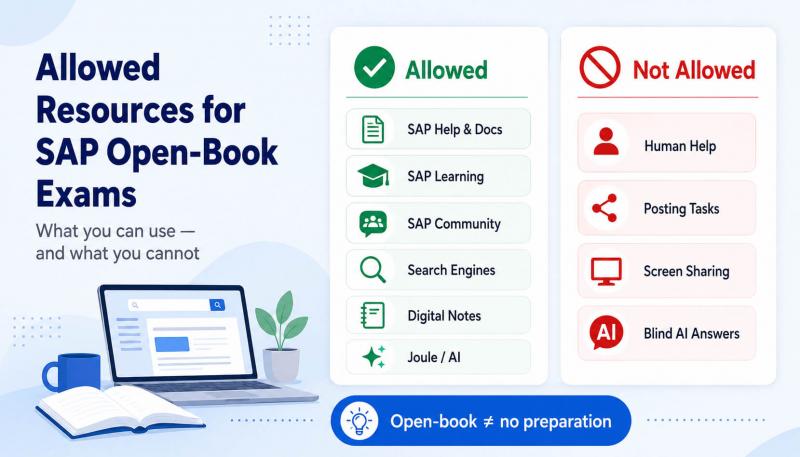
According to SAP's official practical exam FAQ, you may access:
| Allowed | Notes |
|---|---|
| SAP Help Portal (help.sap.com) | Full documentation access |
| SAP Learning site (learning.sap.com) | Learning Journeys, course materials |
| SAP Community (community.sap.com) | Blog posts, Q&A threads |
| SAP Discovery Center | Service catalogue and reference architectures |
| SAP Joule for Consultants | AI assistant (where applicable to your cert) |
| General search engines | Google, Bing — public web |
| Your own digital notes | Notion, OneNote, local files |
| SAP BTP Documentation | help.sap.com/docs/btp |
What is strictly NOT allowed:
- Asking another human for help via chat, Slack, Teams, or any messaging platform
- Posting exam tasks or scenarios in public or private forums during the exam
- Sharing screen with another person
- Using AI tools to submit answers without understanding and validating them
Tip 1: Build Your Reference Kit Before the Exam Starts
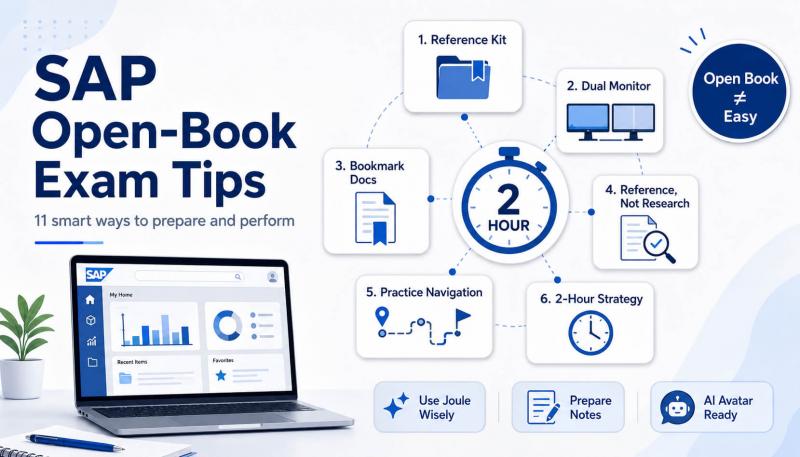
The most powerful open-book strategy is pre-organized access. Before your exam begins, create a dedicated bookmark folder in your browser specifically for this exam. Organize it by topic area so you can navigate to the right document in under 30 seconds.
For most SAP Associate-level certifications, your essential reference kit should include:
-
Primary certification guide: The official SAP Learning Journey for your cert (available via your Learning Hub subscription)
-
Module help documentation: The specific help.sap.com page for your exam's core module (e.g., SAP S/4HANA Financial Accounting → help.sap.com/docs/SAP_S4HANA)
-
Security documentation: IAS, authorization objects, role assignment guides (relevant for most admin and associate certs)
-
SAP Joule quick guide: If your exam permits Joule — know the most effective prompts before exam day
-
Your personal notes file: A single document with key configuration steps, transaction codes (if relevant), and decision trees you have built during preparation
For Professional-level certs like P_BTPA, your reference kit should be architecturally organized:
-
ISA-M integration style guide (SAP Discovery Center)
-
Clean core extensibility decision chart
-
BTP service portfolio overview
-
Key methodology comparison table (ISA-M vs AEM vs SAP Activate)
Tip 2: Use a Dual-Monitor Setup
A dual-monitor setup is highly recommended by SAP and by experienced candidates. Here is the optimal layout:
-
Monitor 1: Your active exam — the SAP system environment (system-based exam) or the AI avatar interface (scenario-based exam)
-
Monitor 2: Your reference materials — SAP Help Portal, SAP Discovery Center, your notes file, and a browser tab with your bookmark folder open
This mirrors how you actually work on SAP projects. The exam is unproctored and designed to reflect real project conditions — consulting that SAP documentation tab during implementation is exactly what you do on the job. Set it up the same way for the exam.
If you do not have a physical second monitor, a second device (tablet, laptop) works. The key is keeping your exam view and reference view simultaneously visible without switching between windows.
Tip 3: Bookmark Key SAP Help Portal Sections Before Exam Day
Navigating the SAP Help Portal cold during a 2-hour exam wastes minutes you cannot recover. The Help Portal is a vast documentation ecosystem. Know where your relevant content lives before you need it.
Bookmark the following structure (adjust the specific sections to your certification):
SAP Exam Reference Kit — [Your Cert Name]
├── SAP Help Portal → [Module Name] → Getting Started
├── SAP Help Portal → [Module Name] → Configuration Guide
├── SAP Help Portal → Security → [Relevant auth docs]
├── SAP Discovery Center → [Service] → Mission Catalog
├── SAP Learning Journey → [Your cert path] → Key exercises
└── Personal Notes → [Your pre-built reference doc]
For the SAP S/4HANA Finance track (C-TS4FI), key sections include:
-
Financial Accounting → New Asset Accounting
-
Universal Journal (ACDOCA) documentation
-
Business Partner concept
-
Month-end / year-end close process guides
For SAP BTP Administrator (C_ADBTP):
-
BTP Cockpit → Global Account setup
-
Identity Authentication Service → Administration Guide
-
Cloud Foundry → Developer guide
-
SAP Joule setup documentation
Tip 4: Know the Difference Between Reference and Research
During the exam, you are referencing, not researching. This distinction is everything.
Referencing: You know the general concept and need to confirm a specific parameter, syntax, transaction code, or service name. You go directly to the right document section. You are in and out in 60–90 seconds.
Researching: You do not understand the concept and need to read multiple pages to figure out what to do. This takes 10–20 minutes per concept — time you cannot afford.
The preparation rule that follows from this: build your conceptual understanding during your study phase, before the exam. The open-book access is your backup for edge cases and parameter verification. It is not a substitute for knowing your SAP module.
The SAP Learning Journeys available through your Learning Hub subscription are structured to build exactly this conceptual foundation — go through every module, complete the practical exercises, and arrive at exam day with the concepts locked in.
Tip 5: Practice SAP System Navigation Until It Is Automatic
For system-based exams, cockpit navigation speed matters. The C_ADBTP administrator exam places you in a live SAP BTP cockpit and asks you to complete specific tasks. If you cannot find the right menu path quickly, you lose precious minutes.
Before your exam, practice navigating these paths until they are automatic:
-
Global Account → Subaccount → Cloud Foundry Org → Space
-
BTP Cockpit → Security → Trust Configuration → Add Identity Provider
-
Service Marketplace → Enable Service → Create Instance → Bind to App
-
BTP Cockpit → Entitlements → Manage Assignments → Add Service Plan
-
Cloud Foundry → Deploy Application → Set Environment Variables
For S/4HANA finance exams, practice navigating the SAP Fiori Launchpad and the SAP S/4HANA system without hesitation. Know your transaction codes and where the equivalent app-based paths are in the Fiori UI.
ERPPrep's practice exams for your specific certification include scenario-based questions that build this navigation familiarity. Explore SAP S/4HANA practice exams and SAP BTP practice exams to validate your readiness before exam day.
Tip 6: Manage Your 2-Hour Window Strategically
Two hours is enough time — if you plan how to use it. Here is a time allocation framework for the two exam types:
System-Based Exam (e.g., C_ADBTP)
| Phase | Time | Action |
|---|---|---|
| Task Review | 0–10 min | Read all task instructions; plan execution order |
| Core Tasks (high confidence) | 10–80 min | Execute the tasks you know well first |
| Verification | 80–95 min | Check system state matches expected outputs |
| Remaining Tasks | 95–110 min | Address any tasks you deferred |
| Final Review | 110–120 min | Confirm all tasks are in correct final state |
Scenario-Based Exam (e.g., P_BTPA)
| Phase | Time | Action |
|---|---|---|
| Scenario Analysis | 0–10 min | Read carefully; identify the core business requirement |
| Solution Framing | 10–20 min | Map to BTP capabilities; structure your response |
| Delivery | 20–80 min | Present your solution to AI avatar; respond to cross-examination |
| Refinement | 80–100 min | Address follow-up questions; strengthen justifications |
| Buffer | 100–120 min | Handle unexpected scenario pivots or clarifications |
The critical rule: start with the tasks or scenarios you are most confident about. Confidence builds momentum. Struggling with a difficult task first drains time and focus from the tasks you could complete easily.
Tip 7: Learn How to Query SAP Joule Effectively
SAP Joule for Consultants is one of the most underutilized resources in the open-book exam. Where it is permitted, Joule can accelerate reference lookup significantly — but only if you know how to prompt it effectively.
Effective Joule queries during the exam:
-
"What is the recommended approach for integrating IAS with SAP BTP?"
-
"List the steps to assign a role collection to a user in SAP BTP cockpit"
-
"What are the four SAP BTP extensibility types and when to use each?"
-
"Explain the ISA-M integration domains for a B2B procurement scenario"
The key is that you must evaluate, validate, and implement Joule's suggestions yourself. As SAP's official exam guidance notes, the exam tests your judgment — not the AI's output. If Joule suggests an approach that does not fit the specific scenario, you need to know why and correct it.
Practice using Joule during your preparation phase so you are comfortable with its response patterns and limitations before exam day.
Tip 8: Prepare Your Personal Notes Document
A well-structured personal notes document is your most valuable open-book asset. Build this during your preparation, not on exam day.
What to include in your notes document:
For system-based exams:
-
Step-by-step configuration checklists for the most common task types
-
Key transaction codes or Fiori app names for your module
-
Decision tree: which service/app/configuration to use in which scenario
-
Common error patterns and their resolution steps
For scenario-based exams:
-
ISA-M integration style matrix: which scenario → which integration style
-
Extensibility decision tree: side-by-side vs. key user vs. developer
-
Standard architecture patterns for the most common BTP use cases
-
One-page BTP service catalog organized by category
Structure your notes document with a clear table of contents so you can navigate to the right section in seconds. Notion, OneNote, or even a well-organized Google Doc all work — the key is that you can search it and jump to the relevant section instantly.
Tip 9: Understand the AI Avatar Cross-Examination Pattern
For scenario-based exams, the AI avatar is not passive. It will challenge your proposed solution, ask for justifications, and probe your reasoning. Understanding how the cross-examination works lets you prepare for it specifically.
Typical AI avatar interaction patterns:
-
Clarifying question: "Can you explain why you chose Integration Suite over Point-to-Point connectivity for this scenario?"
-
Alternative challenge: "What if the organization also needs to integrate with third-party B2B partners — how would your architecture handle that?"
-
Trade-off probe: "What are the trade-offs between the side-by-side extensibility approach you recommended and key user extensibility?"
-
Depth question: "Walk me through the specific BTP services you would use to implement the HR extension you described."
The best preparation: practice explaining SAP solutions out loud, as if presenting to a client. Practice saying your reasoning explicitly — not just the conclusion, but the "because" that follows it. The AI evaluates reasoning quality, not just answer correctness.
Tip 10: Take the ady, Not When You Feel Anxious
One significant benefit of the unproctored format: you choose when to start. The SAP performance-based format lets you initiate your exam when you are ready — on your schedule, at your peak performance time.
Use this to your advantage:
-
Take the exam at your peak cognitive performance time (morning for most people)
-
Ensure your technical setup is confirmed the day before — internet stability, second monitor, browser bookmarks
-
Have your reference kit fully organized before you start the timer
-
Block 2.5 hours in your calendar — 2 hours for the exam, 30 minutes buffer for technical issues
Do not start the exam at a time when you expect interruptions. Close all notification apps (Slack, Teams, email) before beginning. The exam is unproctored, but you are being evaluated — treat it with the same focus you would give a proctored assessment.
Tip 11: Use the FAQs About SAP Certification Practical Exams as Reference
ERPPrep's dedicated content on the SAP practical exam format covers the specific scenarios and question types you will encounter. Reading FAQs about SAP certification practical exams before your exam date ensures you are not surprised by the format on exam day.
Similarly, what's new in the SAP exam format provides a structured preparation roadmap that aligns your study time to the new format's demands.
5-Week Open-Book Exam Preparation Plan
| Week | Focus | Key Activities |
|---|---|---|
| Week 1 | Conceptual foundation | Complete SAP Learning Journey modules; take notes on key concepts |
| Week 2 | System hands-on | Practice in free SAP BTP trial or relevant system; build cockpit navigation speed |
| Week 3 | Reference kit building | Build bookmark folder; create personal notes document; organize documentation |
| Week 4 | Scenario practice | Work through ERPPrep practice exams; practice explaining solutions out loud |
| Week 5 | Simulation | Take 2-hour timed practice sessions; test reference kit under time pressure |
Frequently Asked Questions
Q: What resources can I use during the SAP open-book exam?
A: You may use the SAP Help Portal, SAP Learning site, SAP Community, SAP Discovery Center, SAP Joule for Consultants (where applicable), general search engines, and your own pre-prepared digital notes. You may NOT ask another human for help via any messaging platform during the exam.
Q: Is the SAP certification exam really open-book?
A: Yes. All SAP certifications since the 2026 performance-based format rollout are fully open-book. You can consult documentation, notes, and search engines during the exam. The format tests applied competency and execution — not memorization.
Q: How long is the SAP performance-based exam?
A: The active exam time is strictly 2 hours. The SAP portal may display a "24-hour activity window" — this refers to the window during which you must start and complete the exam, not the exam duration itself. Once you begin, you have exactly 2 hours.
Q: Do I need a dual-monitor setup for the SAP certification exam?
A: SAP and experienced candidates recommend a dual-monitor setup: one screen for the exam portal or live SAP system, and one screen for your reference materials. It is not mandatory, but it significantly improves your ability to reference documentation without disrupting your exam workflow.
Q: What should I include in my personal notes for the SAP exam?
A: Include step-by-step checklists for common task types, key transaction codes or Fiori app paths, decision trees for common scenario choices (e.g., which integration style, which extensibility type), and one-page reference tables for your exam's domain content. Build this during your preparation, not on exam day.
Q: How does the AI avatar work in scenario-based SAP exams?
A: The AI avatar acts as your client or stakeholder and presents a business scenario. You propose your SAP solution and justify your choices. The AI cross-examines you — asking follow-up questions about trade-offs, alternative approaches, and implementation specifics. You can also submit a video recording instead for human expert review.
Q: How many attempts do I get for the SAP open-book exam?
A: You are allowed a maximum of 4 attempts per certification within any 12-month period. If you fail all four, you must wait 12 months before retaking that specific certification.
Q: What is the most common mistake candidates make in the open-book format?
A: Treating open-book as a substitute for preparation. The most common failure mode is spending 30–60 minutes searching for fundamental concepts during the exam and running out of time. Open-book access is for reference verification, not for learning unfamiliar content during the exam.
Q: Can I use ChatGPT or other AI during the SAP exam?
A: General search engines and publicly available AI tools are permitted during the exam, provided you are using them as reference aids rather than directly submitting AI-generated answers without understanding them. SAP Joule for Consultants is explicitly permitted where applicable to your certification. Using AI to answer exam tasks without personal understanding and validation is against the exam candidate agreement.
Q: How is the SAP open-book exam scored?
A: System-based exams are scored automatically by evaluating whether your system configuration matches the expected outputs defined in the task instructions. Scenario-based exams are scored by AI evaluation (results in ~15 minutes) or by human expert review (up to 10 business days for video submissions). Passing score is approximately 60% in the current rollout phase.
Q: Should I practice with ERPPrep before the open-book exam?
A: Yes — but with the right expectations. ERPPrep's practice exams are designed to build your applied SAP knowledge and scenario reasoning, not to simulate the exact open-book interface. They prepare you to understand concepts deeply enough that during the exam you only need to reference documentation for verification, not to learn. Practice tests are most effective when you actively work through the reasoning for each question rather than pattern-matching answers.
Q: What happens if I have a technical issue during the SAP exam?
A: Document the issue with screenshots immediately. SAP has a technical support process for exam disruptions — submit a support case through the SAP Learning platform. The unproctored format means you can contact SAP support during the exam if needed, provided you are not seeking help with exam content.
Practice Like You'll Be Tested
The SAP open-book exam rewards candidates who practice the right way — applying knowledge to scenarios and tasks, not memorizing definitions. Every ERPPrep practice question is built to simulate this applied judgment process: you must work through the reasoning, not just recognize the answer.
Practice with ERPPrep's realistic mock exams and pass your SAP certification on the first try. Explore the full SAP practice exam library for every major certification track — backed by our 100% money-back guarantee.
This content is for exam preparation and educational purposes only. Always refer to official SAP training resources at training.sap.com for the most current exam objectives, rules, and requirements.


