

SAP certifications by solution area: a 2026 buyer's guide
A map of the SAP certification landscape by solution area — Finance, Supply Chain, HR, Development, Analytics, Platform, Procurement — with the lead exam for each and where to go deeper.
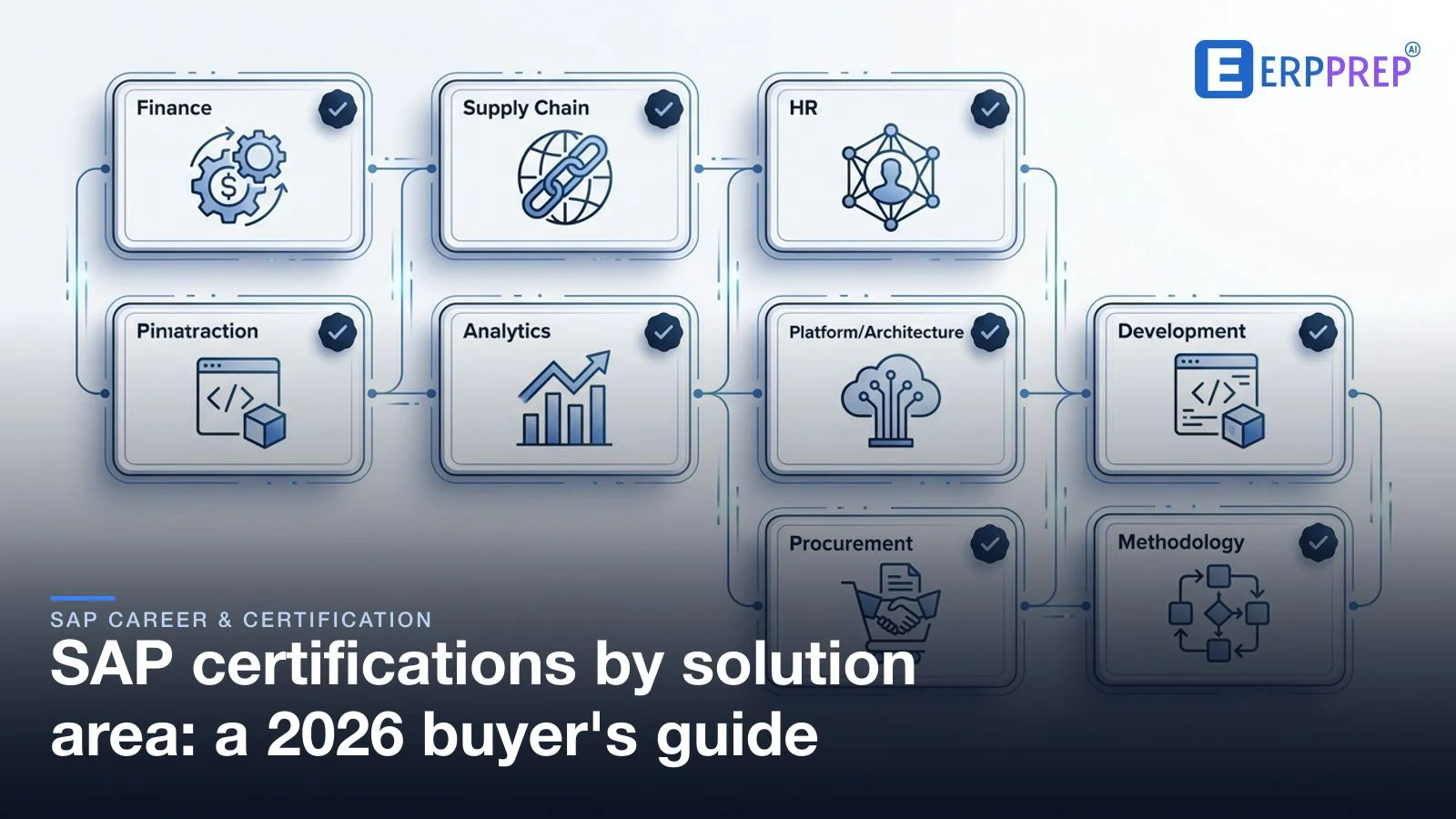
SAP certifies by solution area, not by one master exam. The map has eight practical areas: Finance (C_TS4FI), Supply Chain & Manufacturing (C_S4EWM), HR/SuccessFactors (C_THR81), Development (C_ABAPD), Analytics (C_SAC), Platform & Architecture (C_ADBTP), Procurement (C_ACDET), and Methodology (C_ACT). Pick the area that matches your work, then choose the exam inside it.
"Which SAP® certification should I get?" almost always starts as a list-shaped search — people want the full catalogue laid out so they can find their place in it. But SAP doesn't sell one master exam; it certifies by solution area, and each area holds several exams split by product, deployment, and role. This guide is the map. It groups the live certifications into eight practical areas, names the lead exam in each, and points you to the exam hub and the deeper comparison where you'll make the final call. For the bigger "is any of this worth it" question, start with whether SAP certification is worth it and how to choose.
Key takeaways
- There is no single "SAP certification" — there are eight solution areas, each with its own exams by product and role.
- Functional areas (Finance, Supply Chain, HR, Procurement) certify configuring a business process; technical areas (Development, Platform & Architecture, Analytics) certify building or running the systems.
- Most exams are associate-level (C_ codes); a few architect exams are professional-level (P_ codes) you grow into.
- Exams use SAP's 2026 performance-based formats — System-Based (SyBA) or Scenario-Based (SBA) — so hands-on fluency beats memorization.
- Choose the area first, then let the module, edition, and role tag point you to the exact exam code.
How the map works
Every SAP exam is published with a product (what it covers) and a role (consultant, developer, administrator, analyst, architect) at SAP's learning site (SAP, learning.sap.com). Those two tags are how you locate yourself. The solution areas below are simply a friendlier lens over that catalogue: pick the area that matches the work you do or want to do, and the product-plus-role tag almost always resolves to a single exam code. For the fuller route-by-route index, the 2026 certification tracks map runs alongside this one.
Finance
Finance is the most-searched entry point into SAP, and for good reason — nearly every S/4HANA project has a finance workstream. The core associate exam is C_TS4FI, which verifies financial accounting skills in SAP S/4HANA Cloud Private Edition: configuration, record-to-report, and the accounting backbone. It's a System-Based Assessment, so you complete real tasks in a live environment rather than answering multiple-choice questions about them. If your organization runs the Public Edition instead, C_S4CFI is the implementation- consultant counterpart for that deployment.
The Private-vs-Public choice is the one thing to get right here, because the two editions differ in how much you configure and how you extend the core. The Finance Private vs Public comparison walks through which fits which project, and the finance career guide maps how the path progresses once you're certified.
Supply Chain & Manufacturing
This is the broadest area, because "supply chain" spans the whole physical flow of a business. Warehousing is certified by C_S4EWM (Extended Warehouse Management) and transportation by C_S4TM (Transportation Management). On the plant side, C_TS422 covers production planning and manufacturing. The order-to-cash and procure-to-pay edges are certified by C_TS462 (Sales) and C_TS452 (Sourcing and Procurement), the latter carrying a notably high cut score, which signals an exam that rewards precise configuration knowledge.
Because the modules touch each other, choosing between them is the real task. The logistics and supply-chain comparison lays the modules side by side; the EWM vs TM guide separates warehousing from transportation, and MM vs SD separates procurement from sales. If you're still deciding at the area level, the supply-chain career guide frames the whole area.
HR / SuccessFactors
Human resources is where SAP's cloud portfolio is most modular, so this area holds the most exams. The common foundation is C_THR81 — SuccessFactors Employee Central Core and Position Management — with specialist exams stacked around it: C_THR82 (Performance and Goals), C_THR84 (Recruiting), C_THR92 (Reporting), and C_THR94 (Time Management). For payroll run inside SAP S/4HANA rather than the cloud suite, there's C_HCMP (HCM Payroll). A couple of the Employee Central and talent exams have been moving to SAP's newer performance-based format, so confirm the current assessment style on each exam's page before you book.
The trap in HR is trying to certify the whole suite. Pick the module you actually configure. The SuccessFactors certification map shows how the modules relate; the HCM Payroll vs SuccessFactors guide settles the cloud-vs-core question, and the HR career guide frames the sequence.
Development
The Development area certifies the people who write and run SAP's software rather than configure its business processes. Back-end developers take C_ABAPD — ABAP Cloud — which is built around the clean-core approach where you extend the system without modifying the standard. Front-end and UI developers take C_FIORD (Fiori Application Developer), a Scenario-Based exam covering Fiori and UI5 app building. Running the Fiori launchpad and landscape — an administration role, not a coding one — is certified separately by C_FIOAD (Fiori System Administration).
The two decisions here are back-end vs platform and developer vs administrator. The ABAP vs BTP developer comparison covers the first, and the Fiori developer vs administrator guide covers the second, so you don't book the wrong Fiori exam. The developer career guide ties the whole area together.
Not sure a technical area is for you? A free sample shows the doing-over-recalling style before you pick a lane. Try a free sample.
Analytics
Analytics sits between the functional and technical worlds — it's about turning SAP data into decisions. The data-analyst path is C_SAC (SAP Analytics Cloud), a Scenario-Based exam for building dashboards, stories, and planning models on top of business data. The data-engineering path is C_BW4H (SAP BW/4HANA), a System-Based exam for the modelling and pipelines that feed those analytics. One is closer to the business consumer of data; the other is closer to the plumbing that delivers it.
If you enjoy dashboards and stakeholder-facing reporting, lean toward C_SAC; if you enjoy modelling and data flows, lean toward C_BW4H. The analytics and data certifications comparison contrasts the two directly, and the data and analytics career guide shows where each path leads.
Platform & Architecture
This area covers the technical foundation everything else runs on, plus the architect tier that designs it. On the platform side, C_ADBTP (BTP Administrator) certifies running SAP Business Technology Platform and is notable for a very high cut score, meaning it rewards precise, hands-on command rather than partial familiarity. Database administration is certified by C_DBADM (SAP HANA), and system security by C_SEC (Security Administrator). Above the associate tier sit two professional-level architect exams: P_BTPA (BTP Solution Architect) and P_SAPEA (Enterprise Architect), both Scenario-Based and aimed at design roles.
Because these paths overlap, several comparisons help you choose: the BTP Administrator vs HANA DBA guide, the security and system-administration overview, and, for the professional tier, the Solution Architect vs Enterprise Architect guide. The architect certification path shows how the associate and professional tiers connect.
Procurement
Procurement deserves its own area because SAP certifies it in two different products. Inside S/4HANA, sourcing and procurement is part of the supply-chain module set (that's C_TS452). But strategic sourcing on SAP's dedicated procurement cloud is certified separately by C_ACDET — configuring the Ariba Strategic Sourcing suite. If your work is spend management, supplier negotiation, and sourcing events on the cloud platform, Ariba is your exam; if it's purchasing embedded in the S/4HANA core, the supply-chain procurement exam fits better.
Getting this distinction right saves booking the wrong exam entirely. The S/4HANA sourcing vs Ariba comparison spells out which certification matches which kind of procurement role.
Methodology & Transformation
The last area isn't a module at all — it's about how SAP projects are delivered. Project managers take C_ACT (Project Manager, SAP Activate), which certifies the delivery methodology SAP implementations run on. Transformation and migration work is certified by C_STC (Solution Transformation Consultant with SAP Cloud ALM), covering the tooling and process of moving a landscape forward. Both are Scenario-Based, reflecting that delivery is about reasoning across a connected situation rather than isolated system tasks.
This area suits people whose value is orchestration rather than configuration — leading a rollout, managing scope, running a transformation. The project-manager career guide and the project-management public-vs-private comparison go deeper on where the methodology path leads.
How to choose your area
The map is only useful if you can locate yourself on it, so work through three questions in order. First, which side of the line are you on — do you configure business processes (functional: Finance, Supply Chain, HR, Procurement) or build and run systems (technical: Development, Platform, much of Analytics)? Second, which process or layer do you already touch, or want to move into next? That names your area. Third, which product and role — deployment edition, module, consultant vs developer vs administrator — which resolves the exact exam code inside the area.
Notice that difficulty is not one of the three questions. Cut scores vary widely — some exams pass at a modest threshold, others demand near-perfect task completion — but because every exam is performance-based, the headline percentage matters far less than hands-on fluency in your area. If you're starting from zero and can't yet answer question one, the which certification to take first guide and the best module for beginners guide are the right place to begin.
Preparing once you've chosen an area
Here's the reassuring part: the areas differ in content, but they share a preparation habit. Whether you land on Finance, a warehouse module, a SuccessFactors exam, or an architect path, SAP's 2026 exams reward the same three things — working in a realistic environment, understanding whole flows rather than isolated facts, and rehearsing under time pressure so accuracy holds when the clock runs. Learn to prepare for the performance-based format once and the technique carries across every area on this map.
That's also why practising the format matters more than picking the "easiest" area — the format is the constant, the domain is the variable. Once you've located your area above and opened its exam hub, the fastest way to know whether you're on track is to try the real assessment style for yourself. Try a free sample and see the doing-over-recalling approach that every SAP solution area now shares.
Frequently asked questions
- How many SAP certification areas are there?
- SAP's catalogue is large, but for buying decisions it groups into a handful of practical solution areas. This guide uses eight: Finance, Supply Chain & Manufacturing, HR/SuccessFactors, Development, Analytics, Platform & Architecture, Procurement, and Methodology/Transformation. SAP itself organizes exams by product and role at learning.sap.com; the areas here are a navigational lens over that catalogue so you can find the right exam faster.
- Which SAP certification area is right for a finance professional?
- The Finance area. The core associate exam is C_TS4FI, which covers financial accounting on S/4HANA Cloud Private Edition; C_S4CFI is the Public Edition counterpart. Both are System-Based Assessments where you complete configuration and accounting tasks in a live system. If you work in controlling, accounts, or record-to-report, Finance is your starting area — then choose Private or Public Edition to match the deployment you'll support.
- Which SAP certification area should someone in HR choose?
- The HR/SuccessFactors area, which spans several exams because SuccessFactors is modular. Employee Central (C_THR81) is the usual foundation; performance and goals (C_THR82), recruiting (C_THR84), reporting (C_THR92), and time management (C_THR94) each certify a module. For on-premise-style payroll there's HCM Payroll for SAP S/4HANA (C_HCMP). Pick the module you actually configure rather than trying to cover the whole suite at once.
- Which SAP certification area is best for a developer?
- The Development area. Back-end developers start with ABAP Cloud (C_ABAPD); front-end and UI developers take Fiori Application Developer (C_FIORD); and Fiori System Administration (C_FIOAD) covers running the launchpad rather than writing app code. All are associate-level. Choose by the layer of the stack you build in — business logic, the user-facing app, or the administration around it.
- How do I choose an SAP solution area?
- Start from the work, not the badge. Ask which business process or technical layer you already touch, or want to move into next: finance postings, warehouse flows, people processes, code, dashboards, the platform, sourcing, or delivery methodology. That answer names your area. Only then narrow to the specific exam inside it — deployment edition, module, or role usually decides the exact code.
- What is the difference between functional and technical certification areas?
- Functional areas — Finance, Supply Chain, HR, Procurement — certify that you can configure and run a business process in SAP. Technical areas — Development, Platform & Architecture, and much of Analytics — certify that you can build, administer, or architect the systems underneath. Many careers blend both over time, but your first certification should sit clearly on one side so it signals a specific, hireable skill.
- Should I pick a certification by module or by role?
- Both, in sequence. The solution area and module tell you what you'll be tested on; the role — consultant, developer, administrator, analyst, architect — tells you which exam within that area fits your seat on a project. SAP tags every exam with a product and a role at learning.sap.com, so once you've chosen an area, the role tag usually points to the exact exam without ambiguity.
- Are all these SAP certifications associate level?
- Most are associate-level exams (the C_ codes) — that's the tier you enter and build a career on. A few are professional-level (the P_ codes), such as the BTP Solution Architect and Enterprise Architect exams, which assume real delivery experience and target design roles you grow into. Start associate in your chosen area, then move toward the professional tier as your responsibility widens.
- Where should a complete beginner start across these areas?
- Choose one area that matches a job you can realistically get, then take its foundational associate exam rather than sampling several. A finance background points to C_TS4FI; an HR background to C_THR81; a coding background to C_ABAPD. If you're unsure which area fits at all, work through a cross-exam starting-point guide first, then commit to a single area and its lead exam before you book anything.
ERPPrep is an independent platform and is not affiliated with, endorsed by, or sponsored by SAP SE. SAP and other SAP products are trademarks of SAP SE, referenced here only to describe the certification exams ERPPrep helps you prepare for.
Ready to practise the way the exam tests?
ERPPrep provides original, performance-style scenarios and skill drills built for the 2026 SyBA and SBA formats. Try a free sample and judge the quality yourself.
Practice for these exams
Related guides
SAP Activate and project management certifications
How the SAP Activate credential, the S/4HANA Cloud delivery exams and the lifecycle-tooling certification fit together — and which one your role needs.
SAP modules explained — and how to choose yours
A plain-English map of the SAP module landscape — functional, HR, technical, analytics and cross-cutting — plus a practical framework for choosing yours.
SAP end-to-end vs single-module certification: breadth or depth?
SAP's End-to-End Business Processes certification (C_IEE2E) proves integration breadth, while a single-module cert like C_TS4FI proves configuration depth. Breadth spans finance, HR, procurement, sales and service — and which fits your career.