

The SAP architect certification path: developer to enterprise architect
How the SAP architect ladder works — from the associate BTP administrator foundation (C_ADBTP) up through the professional BTP solution architect (P_BTPA) and enterprise architect (P_SAPEA) — and which rung to target next.
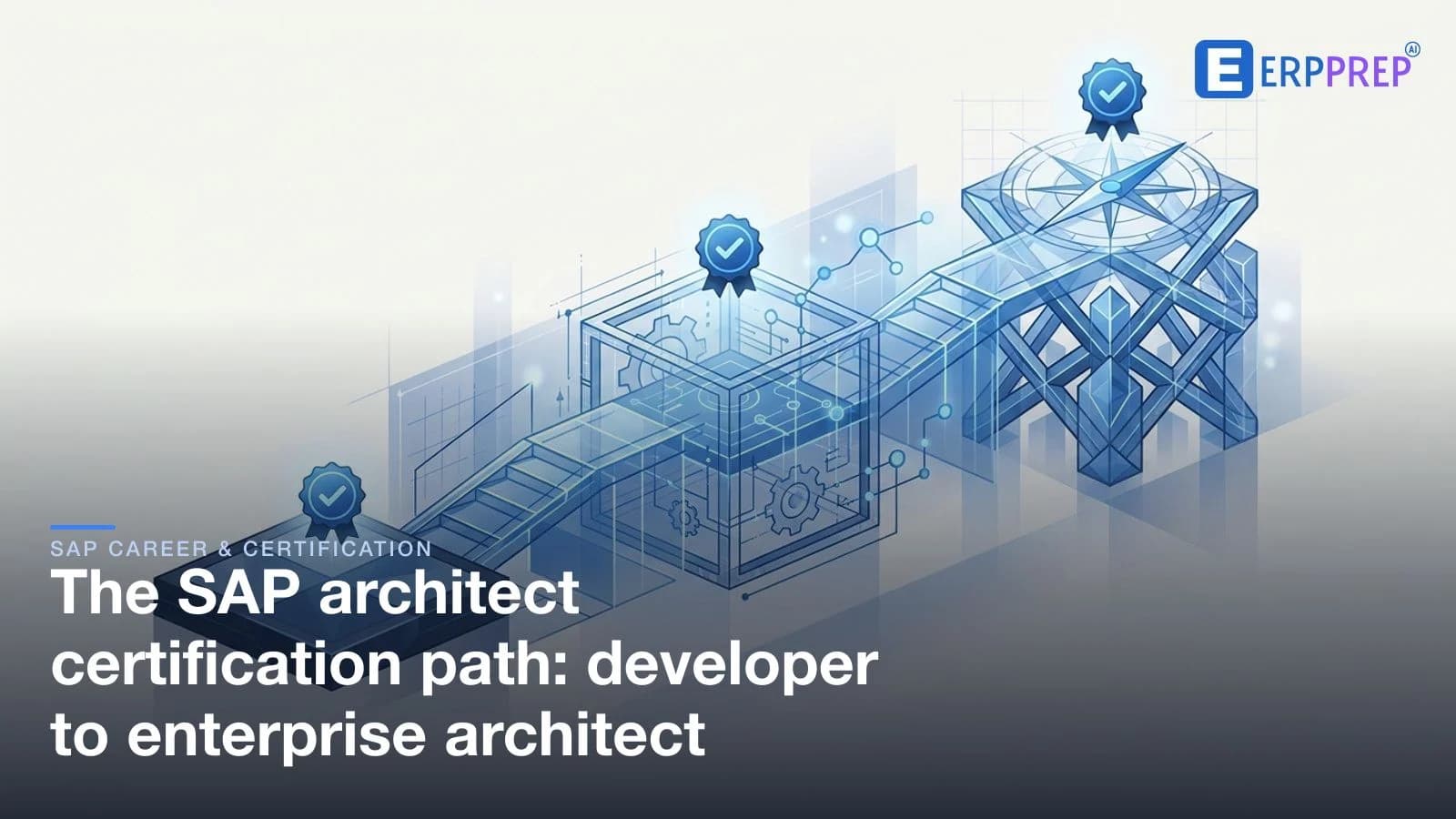
The SAP architect path climbs three rungs: start with the associate BTP Administrator certification (C_ADBTP) for hands-on platform grounding, move to the professional Solution Architect – SAP BTP (P_BTPA) to design end-to-end BTP solutions, then reach the professional Enterprise Architect (P_SAPEA) to align architecture with business strategy. You rarely need all three at once — target the rung that matches your current role.
"How do I become an SAP® architect?" sounds like one question, but it's really about a ladder — a progression from doing the hands-on technical work to shaping the architecture an entire enterprise runs on. SAP's certifications map that climb across three exams: C_ADBTP at the associate tier, then P_BTPA and P_SAPEA at the professional tier. This guide walks the ladder rung by rung, shows how the tiers differ, and helps you decide which one to target next. For the wider "is certification worth it and how do I choose" framing, start with whether SAP certification is worth it and how to choose.
Key takeaways
- The architect path is a three-rung ladder, not a single exam: platform foundation → solution architecture → enterprise architecture.
- C_ADBTP is associate and System-Based (SyBA) — hands-on command of SAP BTP administration.
- P_BTPA and P_SAPEA are professional and Scenario-Based (SBA) — they test design and governance judgment, not just mechanics.
- You don't need all three. Each maps to a distinct role; target the rung that matches your current or intended remit.
- Climb bottom-up as responsibility grows — associate first for grounding, professional as you take on design and strategy.
Why the architect route is a ladder, not a jump
Becoming an architect isn't a single promotion — it's a shift in altitude that happens in stages. You start close to the system, operating and configuring it. Then you move up to designing how the pieces fit into a working solution. Finally you rise to the level where you're aligning technology decisions with a company's business strategy. SAP's certification tiers deliberately mirror that climb, which is why the honest answer to "which architect certification" is almost always "the one that matches the altitude you're working at now."
The two tiers do different jobs. Associate certifications (the C_ codes) confirm you can perform the hands-on work of a role. Professional certifications (the P_ codes) assume you already have that delivery experience and test something harder to fake: judgment under competing constraints. That distinction is the backbone of the whole path — and it's why jumping straight to the top rung rarely works, because the professional exams reward experience you can only build lower down. If you want the tiers spelled out in general, the SAP certification levels explained guide covers associate, specialist, and professional across the catalog.
The architect path at a glance
Each rung certifies a different altitude of architecture work, sits on one of SAP's learning journeys (SAP, learning.sap.com), and points to one exam. Read it bottom-up — it's the order most careers actually take:
| Rung | Certification | Tier & format |
|---|---|---|
| 1 — Platform foundation | C_ADBTP — SAP BTP Administrator | Associate; System-Based (SyBA). Notably a 100% cut score — every scored task must land. |
| 2 — Solution architecture | P_BTPA — Solution Architect – SAP BTP | Professional; Scenario-Based (SBA), around a 60% cut score. Design across the platform. |
| 3 — Enterprise architecture | P_SAPEA — SAP Enterprise Architect | Professional; Scenario-Based (SBA), around a 60% cut score. Aligns IT with business strategy. |
Confirm the current format and cut score on each exam's page at learning.sap.com before you book — SAP adjusts these as products and journeys evolve.
Rung 1 — C_ADBTP: the hands-on platform foundation
Every architect who works with SAP Business Technology Platform benefits from first understanding how it's actually run. That's what the C_ADBTP certification (SAP BTP Administrator) certifies: the ability to set up and operate a BTP environment — account structure, identity and access management, entitlements, connectivity through the Cloud Connector, observability, and cost management. It's the ground floor of the ladder, and it's where the platform stops being abstract and becomes something you can actually configure.
C_ADBTP is associate-level and uses the System-Based Assessment (SyBA) format, so you complete tasks in a live environment rather than answering questions about them. It carries a striking detail: a 100% cut score, meaning every scored task must be correct to pass. That's a strong signal the exam rewards precise, hands-on command of the platform rather than partial familiarity — exactly the kind of grounding a future architect wants before designing on top of it. For many people this is the right first certification on the architect track, and it's also a natural landing spot for developers moving toward the platform; the ABAP Cloud vs BTP Administrator comparison shows how it fits alongside core development.
Rung 2 — P_BTPA: designing solutions across the platform
Once you can operate the platform, the next altitude is designing with it. The P_BTPA certification (Solution Architect – SAP BTP) targets exactly that: translating business requirements into an end-to-end solution blueprint that spans application development and workflow automation, integration, analytics, and AI capabilities on SAP BTP. Where the administrator keeps the platform running, the solution architect decides what to build on it and how the pieces connect — including methodologies like integration and data-advisory approaches, plus cost estimation for the design.
This is where the tier changes. P_BTPA is professional-level and uses the Scenario-Based Assessment (SBA) format, with a cut score around 60%. Instead of completing isolated system tasks, you reason through a connected scenario: stakeholder goals, competing recommendations, trade-offs, and governance tension. It assumes you've already done delivery work — which is precisely why the associate rung underneath it is such a useful runway. P_BTPA sits alongside the broader BTP and AI architect landscape; the BTP, AI & architect certification paths map shows where it fits among the platform's design credentials.
Curious how a Scenario-Based exam actually feels? A free sample shows the reason-through-a-scenario style before you commit to a professional rung. Try a free sample.
Rung 3 — P_SAPEA: the enterprise-architecture summit
The top rung steps beyond any single platform. The P_SAPEA certification (SAP Enterprise Architect) validates the ability to shape a comprehensive architecture blueprint tied to the organisation's business strategy — ensuring the whole IT landscape supports the organization's goals. At this altitude the questions are no longer "how do I configure this?" but "what should the architecture be, and how does it serve the business?" It draws on the SAP Enterprise Architecture Framework, a tailored application of the widely used TOGAF architecture method, covering business, application, data, and technology architecture plus roadmap development.
P_SAPEA is professional-level and Scenario-Based (SBA), with a cut score around 60%, and its learning journey is pitched at an advanced level. Many candidates find it the most demanding of the three rungs — not because the facts are harder, but because success depends on breadth of enterprise experience and the judgment to align technology with strategy. It's the summit of this particular ladder, and it's a role you grow into rather than test into cold. If you're weighing the two professional rungs directly, the solution architect vs enterprise architect comparison breaks down which fits which role.
Which rung should you target?
The best way to choose is to look at what you do today, not at which exam looks most impressive. Work up from your current altitude:
- You operate and administer the platform. Target C_ADBTP. It proves the hands-on command that everything above it assumes.
- You design solutions that span services on SAP BTP. Target P_BTPA. It certifies end-to-end solution design across the platform.
- You set architecture direction across the enterprise. Target P_SAPEA. It certifies the business-aligned, whole-landscape view.
Notice the pattern: you rarely pursue more than one rung at a time, because each maps to a distinct role you actually occupy. The certifications have no published hard prerequisite chain — you're not blocked from booking a professional exam without the associate one — but the professional rungs quietly assume the experience the associate rung represents. So the recommended order (C_ADBTP → P_BTPA → P_SAPEA) mirrors career progression, not a technical dependency. An architect with years of delivery behind them might legitimately target a professional exam directly.
How to prepare as you climb
Preparation changes shape as you move up the ladder, and matching your prep to the tier matters more than sheer study hours. At the associate rung, the work is hands-on: C_ADBTP is System-Based, so time inside a real BTP environment — setting up accounts, wiring identity and access, operating the Cloud Connector — beats reading about it. At the professional rungs, the work is judgment: P_BTPA and P_SAPEA are Scenario-Based, so you practice reasoning through connected situations where several answers look plausible and the "best" one depends on constraints and governance.
That's a real shift in study technique, and it's worth learning deliberately. The habit that transfers across every rung is the same: rehearse in a realistic setting, understand whole flows rather than isolated facts, and practice under time pressure so accuracy holds when the scenario gets complex. Learn to prepare for the performance-based format once and the technique carries from the associate System-Based exam up to the professional Scenario-Based ones — the domain deepens, but the exam skill is portable.
Choosing your next rung on the architect path
The SAP architect path isn't a race to the top — it's a sequence of roles, each with a certification that fits it. Start where your responsibility actually sits: hands-on platform work points to C_ADBTP, solution design across SAP BTP points to P_BTPA, and enterprise-wide architecture points to P_SAPEA. Each exam hub above holds the scenarios, skill drills, and exam facts for that specific certification, so you can dig into the one that matches your next move.
Whichever rung you target, the fastest way to know whether you're ready is to practice the format itself rather than re-read notes. Try a free sample and feel the difference between the hands-on associate style and the reason-through-a-scenario professional style before you commit to a rung.
Frequently asked questions
- What is the SAP architect certification path?
- It's a three-rung ladder from technical delivery to enterprise strategy. You begin at the associate tier with the SAP BTP Administrator certification (C_ADBTP) to prove hands-on platform command, step up to the professional Solution Architect – SAP BTP (P_BTPA) to design end-to-end BTP solutions, and finally reach the professional Enterprise Architect (P_SAPEA), which aligns the whole IT architecture with business strategy. Each rung reflects a real role, not just a harder exam.
- What is the difference between associate and professional SAP certifications?
- Associate certifications (C_ codes like C_ADBTP) validate that you can do the hands-on work of a role — configuring, operating, and delivering within a defined scope. Professional certifications (P_ codes like P_BTPA and P_SAPEA) assume you already have that delivery experience and test design judgment: trade-offs, governance, and end-to-end architecture decisions. The architect path deliberately puts the associate rung first because the professional exams build on real project experience.
- Do I need all three SAP architect certifications?
- No. The three exams map to three distinct roles, so most people target the one rung that matches where their career is now rather than collecting the full set. A platform administrator earns C_ADBTP; someone designing BTP solutions targets P_BTPA; an enterprise architect aligning IT with strategy targets P_SAPEA. You climb as your responsibilities grow — you don't need to hold every rung simultaneously.
- In what order should I take the SAP architect exams?
- Bottom-up, following the way responsibility usually grows: C_ADBTP first for hands-on BTP grounding, then P_BTPA to move into solution design across the platform, then P_SAPEA for enterprise-wide architecture. That said, the exams have no formal chain of prerequisites, so an experienced architect could target a professional exam directly. The recommended order mirrors career progression, not a hard technical dependency.
- Are there prerequisites for the professional SAP architect exams?
- SAP does not publish a hard certification prerequisite for the professional architect exams — you're not blocked from booking P_BTPA or P_SAPEA without holding C_ADBTP first. In practice, though, both professional exams assume seasoned experience: they test design and governance judgment that's hard to demonstrate without real delivery time. The associate rung is the practical, not mandatory, foundation. Always confirm current requirements on learning.sap.com.
- How long does the SAP architect certification path take?
- It depends far more on experience than on study hours. The associate BTP foundation can be reached in a few months of focused, hands-on practice. The professional rungs typically follow after a year or more of real architecture work, because they reward judgment you build on projects rather than facts you memorize. Treat the path as a multi-year career arc, with each rung pursued when your role reaches it.
- Is the SAP Enterprise Architect certification (P_SAPEA) the hardest?
- It's the most strategic and abstract of the three. P_SAPEA is a professional, Scenario-Based exam built on the SAP Enterprise Architecture Framework — a tailored take on the TOGAF method — so it tests holistic, business-aligned architecture judgment rather than platform mechanics. Many candidates find it the most demanding rung because success depends on breadth of enterprise experience, not on how well you know one product. Verify the current format on learning.sap.com.
- Which SAP architect certification fits my career?
- Match the rung to your day job. If you operate and administer the platform, C_ADBTP fits. If you design solutions that span integration, data, and AI services on SAP BTP, P_BTPA is your target. If you set architecture direction across the enterprise and align IT with business strategy, P_SAPEA is the rung. Start where your current responsibility sits and climb as your remit widens.
ERPPrep is an independent platform and is not affiliated with, endorsed by, or sponsored by SAP SE. SAP and other SAP products are trademarks of SAP SE, referenced here only to describe the certification exams ERPPrep helps you prepare for.
Ready to practise the way the exam tests?
ERPPrep provides original, performance-style scenarios and skill drills built for the 2026 SyBA and SBA formats. Try a free sample and judge the quality yourself.
Practice for these exams
Related guides
The best SAP certification for a cloud-architect career in 2026
A role-first guide to SAP cloud-architect certification: the BTP platform foundation, the professional solution-architect tier, and the LeanIX enterprise-architecture tool — and how to sequence them.
SAP salary by module and role: what really drives it
What really drives SAP pay — by module and area, and by role and seniority — plus the five multipliers that move you inside any band. No invented numbers.
SAP BTP certifications explained: which one is right for you
A map of the SAP BTP certification family — administrator, architect, integration, ABAP and generative-AI developer, LeanIX EA — and how to choose.