

The best SAP certification for a cloud-architect career in 2026
A role-first guide to SAP cloud-architect certification: the BTP platform foundation, the professional solution-architect tier, and the LeanIX enterprise-architecture tool — and how to sequence them.
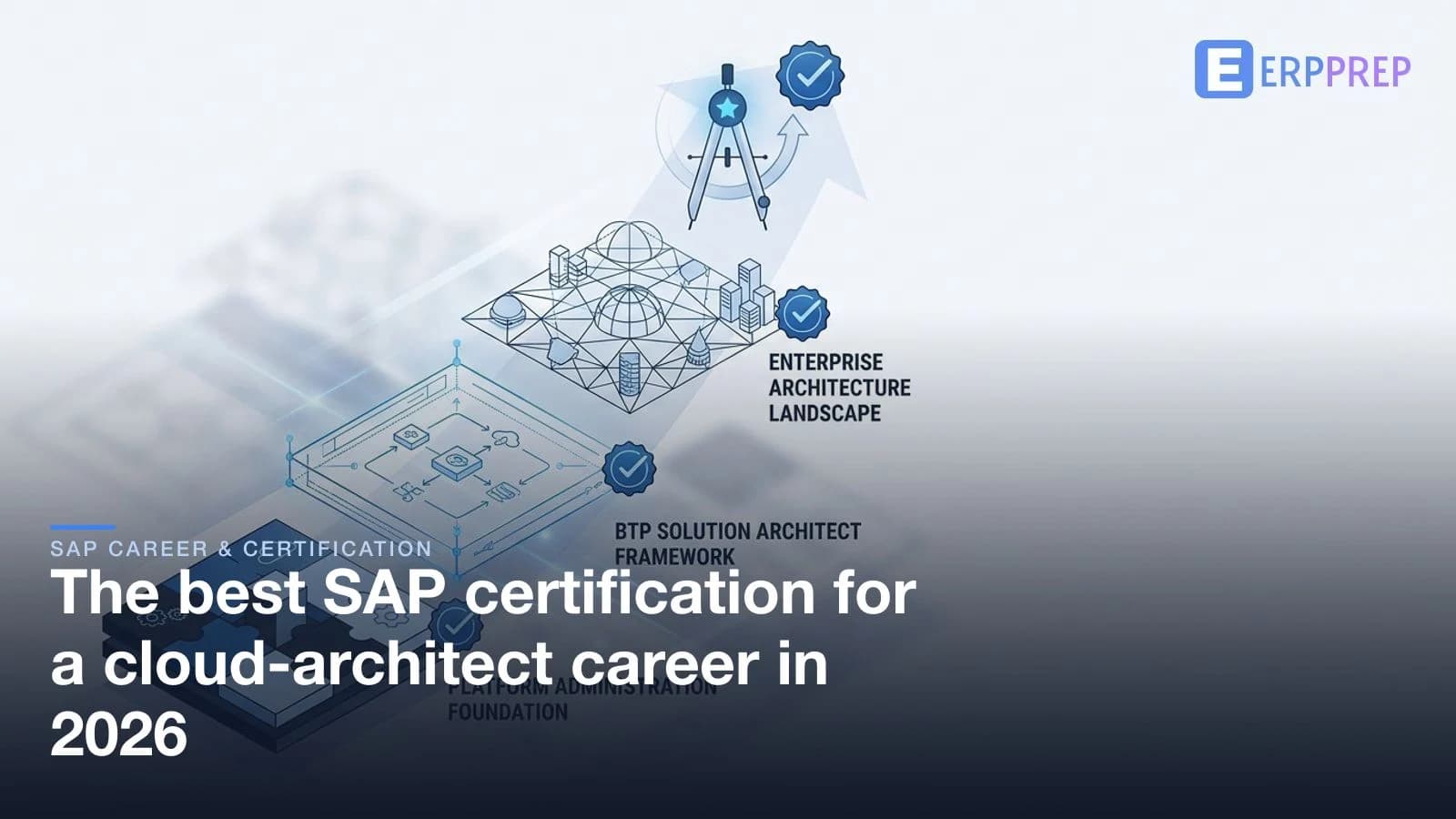
For a cloud-architecture career, there is no single best SAP certification — there is a progression. Build the platform foundation with BTP Administrator (C_ADBTP), grow into the professional Solution Architect – SAP BTP credential (P_BTPA) as you own end-to-end design, and add Enterprise Architecture with SAP LeanIX (C_LIXEA) for portfolio-level architecture tooling. Choose by where you are on that arc.
"Which SAP® certification should I get to become a cloud architect?" is one of the most common questions from consultants and platform engineers looking to move up — and it has a better answer than a single exam code. Cloud architecture in the SAP world is a role you grow into, so the useful question is not "which badge" but "where am I on the arc from operating the platform to designing on it to shaping the whole portfolio?" This guide leads from that role, maps three certifications onto it, and routes each to its exam hub. For the wider "is certification worth it and how do I choose" framing, start with whether SAP certification is worth it and how to choose your path.
For a cloud-architecture career, there is no single best SAP certification — there is a progression. Build the platform foundation with BTP Administrator (C_ADBTP), grow into the professional Solution Architect – SAP BTP credential (P_BTPA) as you own end-to-end design, and add Enterprise Architecture with SAP LeanIX (C_LIXEA) for portfolio-level architecture tooling. Choose by where you are on that arc, not by badge count.
Key takeaways
- There is no single "best" cloud-architect certification — there is a three-step progression, one credential per stage of the role.
- BTP Administrator (C_ADBTP) is the associate platform foundation — you learn to operate the cloud you will later design on.
- Solution Architect – SAP BTP (P_BTPA) is the professional-tier design credential — the step where you own end-to-end solutions.
- Enterprise Architecture with SAP LeanIX (C_LIXEA) adds portfolio and landscape tooling for architecture at scale.
- The tier is in the code: C_ is associate, P_ is professional. Sequence by the work you do now, and grow the next credential as your scope widens.
Cloud-architect certifications at a glance
Each credential certifies a different altitude of the same career — running the platform, designing on it, and steering the portfolio — and each sits on its own learning journey published by SAP, the official SAP learning site. Start from where your work sits today:
| If your work is about… | Certification | Tier & format |
|---|---|---|
| Setting up and operating the cloud platform | C_ADBTP — BTP Administrator | Associate; System-Based (SyBA), a 100% cut score — every scored task must land. |
| Designing end-to-end solutions across the SAP portfolio | P_BTPA — Solution Architect – SAP BTP | Professional; Scenario-Based (SBA), around a 60% cut score. |
| Managing the application portfolio and architecture landscape | C_LIXEA — Enterprise Architecture (LeanIX) | Associate; Scenario-Based (SBA), around a 50% cut score. |
Confirm the current format and cut score on each exam's page at learning.sap.com before you book — SAP adjusts these as the products and journeys evolve.
What an SAP cloud-architect career actually looks like
"Cloud architect" is not one fixed job — it is an altitude you climb. At the base, someone has to make the platform real: accounts and subaccounts, identity and access, connectivity back to on-premise systems, runtime environments, cost and governance. A level up, someone decides what to build and how the pieces fit — which integration approach, which application-development model, how AI and data services connect, how the whole thing stays sustainable and secure. Higher still, someone looks across the entire application portfolio and decides what to keep, retire, or consolidate. Those are three distinct kinds of work, and the three certifications map cleanly onto them.
That is why the "best certification" question is really a "where am I" question. A platform administrator and a solution architect are both part of a cloud-architecture career, but their strongest next credential is different. The rest of this guide walks the arc in the order most careers actually take it — foundation first, design next, portfolio tooling as scope grows.
BTP Administrator: the platform foundation
You cannot design well on a platform you cannot operate. That is why BTP Administrator — the C_ADBTP credential — is the pragmatic first step for a cloud-architecture career. Its learning journey is built around actually running SAP Business Technology Platform: structuring accounts, managing identity and access, wiring up connectivity through the Cloud Connector, operating the different runtime environments, and keeping an eye on cost, observability, and governance. Even automation-as-code with Terraform shows up. This is the ground truth an architect draws on when they later decide how a solution should be shaped.
C_ADBTP is associate-level and uses the System-Based Assessment (SyBA) format, so you complete tasks in a live environment rather than answering multiple-choice trivia about them. It carries a striking detail: a 100% cut score, meaning every scored task must be correct to pass. That is a strong signal the exam rewards precise, hands-on command of the platform rather than partial familiarity — exactly the discipline you want before you start making design decisions for other people to build on. The certification is framed around being able to contribute as a capable member of a project team, which is precisely what a foundation-tier credential should certify.
Solution Architect – SAP BTP: the design tier
Once you can operate the platform, the next move is to design on it — and that is where the professional Solution Architect – SAP BTP credential, P_BTPA, sits. Note the code: the P_ prefix marks it as professional tier, a step above the associate credentials. Its focus is the architect's real job — translating business requirements into an end-to-end solution blueprint that spans the SAP cloud portfolio, weighing integration strategy, application-development approach, data and analytics, AI services, and solution governance, and keeping the result scalable and sustainable. It is aimed at people who bridge business strategy and technical execution rather than those focused on a single layer.
P_BTPA uses the Scenario-Based Assessment (SBA) format with a 60% cut score, so you reason through a realistic advisory situation and choose the strongest direction rather than completing isolated system tasks — which fits a role that is fundamentally about judgement and trade-offs. Because it is a professional credential, the practical expectation is meaningful hands-on experience; it is not usually a first exam. If you are weighing how the solution-architect role differs from the broader enterprise-architect one, the solution architect vs enterprise architect comparison draws that line clearly.
Curious how a Scenario-Based exam actually feels? A free sample shows the reason-through-the-scenario style before you commit to the architect path. Try a free sample.
Enterprise Architecture with SAP LeanIX: portfolio-level tooling
At the widest altitude, architecture is about the whole application landscape, not one solution — and that is the layer the Enterprise Architecture Consultant – SAP LeanIX credential, C_LIXEA, addresses. Its learning journey centres on using SAP LeanIX for enterprise-architecture management: modelling fact sheets, importing and quality-checking data into the inventory, and running practical use cases such as application-portfolio assessment and application rationalization — the decisions about which systems to keep, invest in, or retire. For a cloud architect, this is the tooling that turns portfolio strategy into something teams can actually see and manage.
C_LIXEA is associate-level and, like the professional credential, uses the Scenario-Based Assessment (SBA) format — here with a 50% cut score. Despite the associate tier, it is not "beginner" in career terms; it is a specialised tool credential you add when enterprise-architecture management becomes part of your remit, which is often after you have design experience rather than before. Because LeanIX is one of a couple of SAP enterprise-architecture tools, it is worth knowing where it fits versus the process-focused alternative — the Signavio vs LeanIX certification comparison explains which tool credential matches which kind of architecture work.
How the three fit together as a progression
The clearest way to read these three is as a single career arc rather than three competing choices. You operate the platform (C_ADBTP), then you design solutions on it (P_BTPA), then — as your scope reaches the whole estate — you steer the portfolio with enterprise-architecture tooling (C_LIXEA). Two of the three are associate (the C_ codes) and one is professional (the P_ code), and that mix is deliberate: the foundation and the tooling are things you can pick up as a contributing team member, while the design-level credential assumes you have delivered real architecture already.
It also matters that the platform foundation and the design credential share a product world — SAP Business Technology Platform — so the knowledge compounds. What you learn operating accounts, connectivity, and runtimes for C_ADBTP is exactly the substrate the solution-architect exam expects you to design across. If you want the fully-mapped version of this climb, including where the adjacent architecture and AI tracks branch off, the SAP architect certification path lays out the whole progression, and the BTP and AI architect paths cover where cloud architecture meets the newer AI-architecture work.
Choose C_ADBTP if… choose P_BTPA if… choose C_LIXEA if…
Work backwards from what your job is now. Choose C_ADBTP if you operate or want to operate the platform — you set up accounts, manage identity and connectivity, and keep runtimes healthy — and you want the foundation every cloud-architecture role builds on. It is also the most sensible first credential if you are switching into the SAP cloud world and need a grounded, hands-on starting point.
Choose P_BTPA if you already have delivery experience and your work is moving toward end-to-end design — picking integration and application approaches, connecting data and AI services, and owning solution governance. It is the professional-tier step that signals you can architect across the portfolio, not just within one layer. Choose C_LIXEA if enterprise-architecture tooling is part of your remit — you model the application landscape, run portfolio assessments, and drive rationalization decisions with SAP LeanIX. Many architects reach it after the design tier rather than before.
How to prepare, whichever stage you are at
The three exams use two different performance-based formats — C_ADBTP is System-Based (SyBA), while P_BTPA and C_LIXEA are Scenario-Based (SBA) — but the preparation habit that works is the same across all of them: practise the way the exam actually tests you. For the SyBA foundation, that means rehearsing real platform tasks until precise, correct execution is automatic — which matters more than usual given that 100% cut score. For the SBA design and tooling exams, it means reasoning through connected scenarios and choosing the strongest recommendation under realistic constraints, rather than memorising definitions.
The good news is that the underlying technique transfers along the whole arc: build in a realistic environment, understand whole flows rather than isolated facts, and rehearse under time pressure so your accuracy holds. Learn to prepare for the performance-based format once and it carries from the BTP foundation up through the solution-architect and LeanIX exams — the domain changes, the exam technique does not. For the professional tier specifically, the guide to preparing for a professional SAP architect certification goes deeper on the judgement-heavy scenario style.
Your next step on the cloud-architect path
Pin down where you are on the arc, then aim at the matching credential. If you operate or want to operate the platform, start with C_ADBTP. If you are ready to own end-to-end design, aim at P_BTPA. If portfolio tooling is your world, it is C_LIXEA. Each exam hub above holds the scenarios, skill drills, and exam facts for that specific certification, so you can go from "which one" to actually practising in a couple of clicks.
When you have settled on a stage, the fastest way to know whether you are ready is to practise the format itself rather than read about it. Try a free sample and see the performance-based style — System-Based tasks and Scenario-Based reasoning alike — the way a cloud architect actually meets it.
Frequently asked questions
- What is the best SAP certification for a cloud architect?
- There isn't a single answer — it depends on where you are in the role. The platform foundation is BTP Administrator (C_ADBTP), an associate credential covering how SAP Business Technology Platform is set up and run. The design-level credential is the professional Solution Architect – SAP BTP (P_BTPA), for owning end-to-end solutions. Enterprise Architecture with SAP LeanIX (C_LIXEA) adds portfolio-level architecture tooling. Most cloud-architecture careers move through them in that order rather than picking just one.
- What is the difference between the associate and professional SAP architect certifications?
- The tier is encoded in the exam code. Associate credentials use a C_ prefix — C_ADBTP (BTP Administrator) and C_LIXEA (LeanIX) both sit here and certify that you can contribute as part of a project team. The professional tier uses a P_ prefix — P_BTPA (Solution Architect – SAP BTP) is aimed at seasoned practitioners who design and orchestrate solutions across the SAP landscape. Professional credentials assume real delivery experience; associate ones establish it.
- Which SAP architect certification should I take first?
- For most people building toward cloud architecture, BTP Administrator (C_ADBTP) is the natural first step — you cannot design well on a platform you cannot operate, and it grounds you in accounts, identity, connectivity, and runtimes. From there the professional Solution Architect – SAP BTP (P_BTPA) is the design-level move, and LeanIX (C_LIXEA) is added when your work reaches portfolio and landscape decisions. Confirm current exam details on learning.sap.com before you book.
- Do I need all three SAP cloud-architect certifications?
- No. They form a progression you move along as your role grows, not a checklist to collect at once. Many practitioners hold only the platform foundation (C_ADBTP) for years while they build delivery experience, then add the professional Solution Architect credential (P_BTPA) when they start owning end-to-end design. LeanIX (C_LIXEA) is relevant specifically when enterprise-architecture tooling is part of your job. Pick the one that matches your current work.
- Do SAP architect certifications require experience?
- The professional tier effectively does. Solution Architect – SAP BTP (P_BTPA) is positioned for experienced practitioners who translate business requirements into end-to-end solution blueprints, so it assumes real design and delivery background. The associate credentials — C_ADBTP and C_LIXEA — are framed around contributing as part of a project team, so they are more accessible as entry points. SAP does not publish rigid prerequisites, so verify the current expectations on each exam page at learning.sap.com.
- Is an SAP cloud-architect certification a good career move?
- For people who want to design cloud solutions rather than only build or operate them, yes — the architect track is where platform, integration, and portfolio decisions get made. The role suits practitioners who enjoy trade-offs, governance, and connecting business goals to technology. If you are earlier in your journey, the platform foundation (C_ADBTP) is the pragmatic on-ramp; the professional and enterprise-architecture credentials follow as your scope widens.
- What are the prerequisites for the SAP Solution Architect certification?
- SAP does not publish a hard prerequisite list for P_BTPA, but it is a professional-tier credential aimed at seasoned architects, so the practical expectation is meaningful hands-on experience with the SAP cloud portfolio — integration, application design, and solution governance. Grounding in the platform itself (the ground the BTP Administrator credential covers) is a sensible base. Always confirm the current, exact requirements on the exam page at learning.sap.com before booking.
- How long does it take to become an SAP cloud architect?
- There is no fixed timeline, because architecture is an experience role, not a single exam. A common arc is to earn the platform foundation (C_ADBTP) early, spend a period delivering real projects, then move toward the professional Solution Architect credential (P_BTPA) once you own end-to-end design — often over a few years rather than months. The certifications mark stages of that growth; the delivery experience between them is what actually makes an architect.
ERPPrep is an independent platform and is not affiliated with, endorsed by, or sponsored by SAP SE. SAP and other SAP products are trademarks of SAP SE, referenced here only to describe the certification exams ERPPrep helps you prepare for.
Ready to practise the way the exam tests?
ERPPrep provides original, performance-style scenarios and skill drills built for the 2026 SyBA and SBA formats. Try a free sample and judge the quality yourself.
Practice for these exams
Related guides
The SAP architect certification path: developer to enterprise architect
How the SAP architect ladder works — from the associate BTP administrator foundation (C_ADBTP) up through the professional BTP solution architect (P_BTPA) and enterprise architect (P_SAPEA) — and which rung to target next.
SAP BTP certifications explained: which one is right for you
A map of the SAP BTP certification family — administrator, architect, integration, ABAP and generative-AI developer, LeanIX EA — and how to choose.
How to prepare for an SAP professional architect certification
A practical study guide for the professional-tier SAP architecture exams (P_SAPEA and P_BTPA) — why they assume delivery experience, and how to rehearse for the scenario-based format.