

SAP CAP vs ABAP back-end developer certification: C_CPE vs C_ABAPD
Two SAP back-end developer certifications, two runtimes. C_CPE (CAP — SAP's cloud application framework in Node.js/Java) vs C_ABAPD (ABAP Cloud, using RAP). What each covers, the format, the cut score, and which to choose.
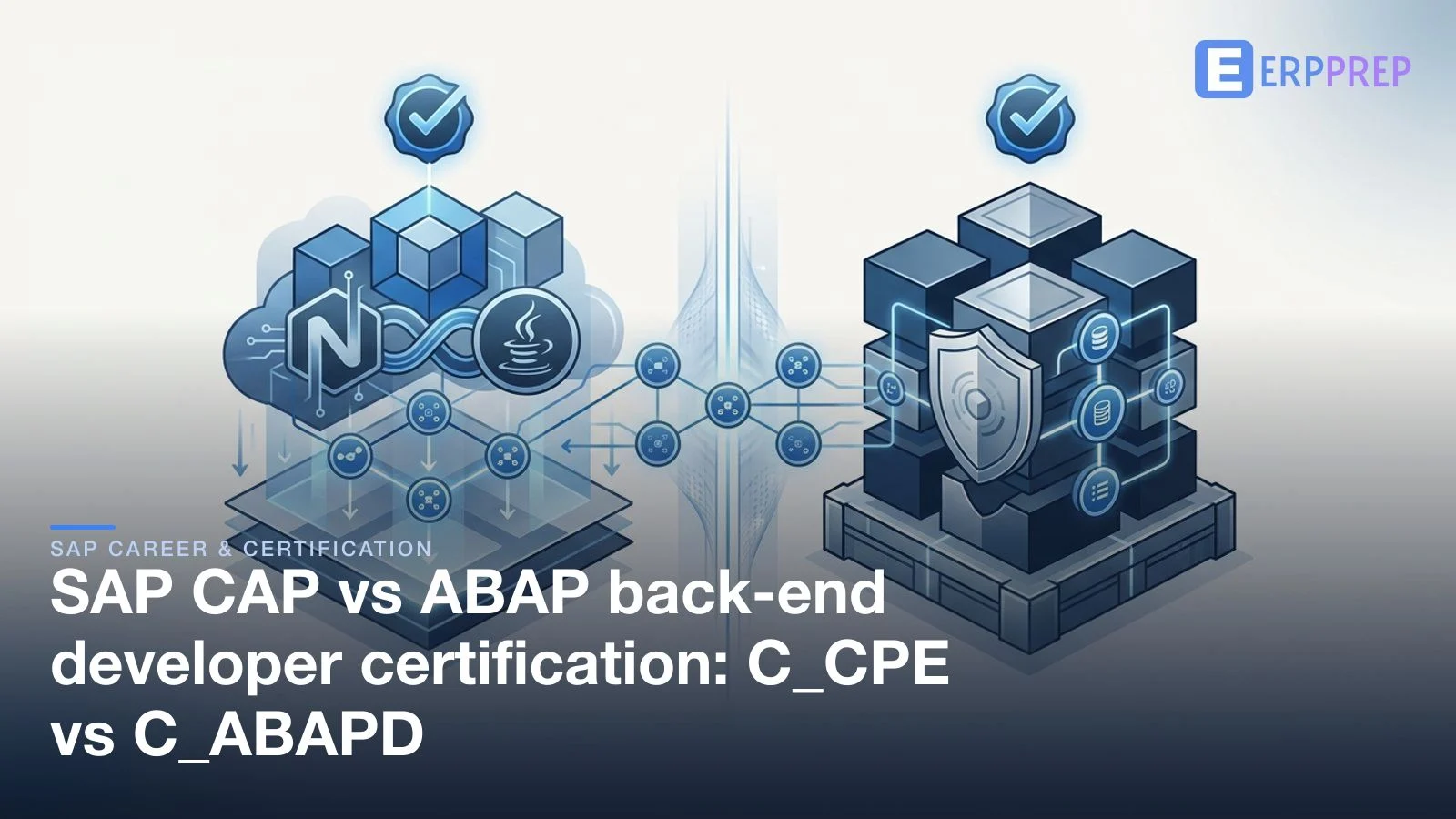
C_CPE certifies back-end development with CAP — SAP's cloud application framework — using Node.js or Java services, Core Data Services, and deployment to SAP BTP. C_ABAPD certifies ABAP Cloud development built on RAP (the ABAP RESTful programming model), CDS, and clean-core extensibility. Both are associate System-Based Assessments; both use CDS. Choose by your language and runtime: cloud-native polyglot on BTP, or modern ABAP on the ABAP platform.
SAP® now certifies back-end developers on two very different technology stacks, and at a glance the two exams can look interchangeable — both are back-end, both lean heavily on Core Data Services (CDS), both target extensions to SAP S/4HANA. C_CPE certifies CAP — SAP's Cloud Application Programming Model — a cloud-native, polyglot framework you code in Node.js or Java — while C_ABAPD certifies ABAP Cloud, the modern ABAP approach built on the RESTful Application Programming Model (RAP). This guide compares what each certifies, the format and cut score, and how to choose. For the wider question of which developer path fits your career, see whether SAP certification is worth it and how to choose.
C_CPE certifies back-end development with CAP — SAP's cloud application framework — using Node.js or Java services, Core Data Services, and deployment to SAP BTP. C_ABAPD certifies ABAP Cloud development built on RAP (the ABAP RESTful programming model), CDS, and clean-core extensibility. Both are associate System-Based Assessments; both use CDS. Choose by your language and runtime: cloud-native polyglot on BTP, or modern ABAP on the ABAP platform.
Key takeaways
- C_CPE is the CAP track — cloud-native back-end services in Node.js/JavaScript or Java, modelled with CDS and deployed to SAP BTP as side-by-side extensions.
- C_ABAPD is the ABAP Cloud track — modern ABAP with the RESTful Application Programming Model (RAP), the ABAP Dictionary, CDS, and clean-core extensibility.
- Both are System-Based Assessments (SyBA), the hands-on performance format — but the pass bar differs: C_CPE publishes a 100% cut score and C_ABAPD a 67% cut score in its Beta form at the time of writing.
- The real divider is language and runtime, not subject: polyglot on BTP versus ABAP on the ABAP platform. Both share CDS as a common data-modelling layer.
- They map to different developer profiles: a JavaScript/Java cloud developer versus an ABAP developer moving to clean-core, in-stack extensibility.
C_CPE vs C_ABAPD at a glance
Both certifications sit on official SAP learning journeys (SAP, learning.sap.com) and share the performance-based System-Based Assessment style — but the stack underneath is different. Here they are side by side:
| C_CPE — CAP back-end | C_ABAPD — ABAP Cloud back-end | |
|---|---|---|
| Language | Node.js / JavaScript or Java | ABAP (modern, object-oriented) |
| Programming model | CAP — Cloud Application Programming | ABAP RESTful Application Programming Model (RAP) |
| Data modelling | Core Data Services (CDS) | ABAP Dictionary + ABAP CDS |
| Runtime / deploy | SAP BTP — Cloud Foundry and Kyma runtimes | SAP BTP, ABAP environment / the ABAP platform |
| Tooling | SAP Business Application Studio, Fiori elements, Git | ABAP development tools; AI assistance for developers |
| Format | System-Based Assessment (SyBA) | System-Based Assessment (SyBA) — Beta |
| Cut score | 100% | 67% (Beta) |
Formats and cut scores can change, and C_ABAPD is currently a Beta exam, so treat the table as a snapshot and confirm the live details on each exam's page before you book.
What C_CPE (SAP Cloud Application Programming Model) covers
C_CPE is a cloud-native, polyglot certification. It verifies that you can design and build extension applications for existing SAP solutions — SAP S/4HANA Cloud in particular — using the side-by-side extensibility approach on SAP BTP. The emphasis is on building services with CAP in JavaScript/Node.js or Java, adding a user interface with Fiori elements, and standing the whole thing up on the platform.
In practice the module walks a CAP application from an empty project to a deployed extension:
- CAP fundamentals and project setup — the side-by-side extensibility idea, the OData protocol, defining data models and services with CDS, and serving them.
- Custom business logic — event handling in CAP, where and why to add your own code, and error handling.
- Security and trust — authorization and trust management, and defining CDS-level restrictions and roles.
- Consuming external services — connecting to and integrating other services, plus writing unit tests around them.
- Deployment and runtimes — deployment options for CAP, the SAP BTP Cloud Foundry runtime, and containerised delivery on the Kyma (Kubernetes-based) runtime, including scaling and lifecycle concerns.
The through-line is that a CAP developer is a cloud-native builder: comfortable in JavaScript or Java, fluent with Git and a modern development environment, and able to reason about how a service is modelled, secured, and deployed on a multi-cloud platform. Two threads run through the whole module. The first is the framework doing the heavy lifting — CAP gives you a lot of behaviour out of the box, so much of the skill is knowing what to model declaratively in CDS versus when to drop into custom event handlers. The second is runtime awareness: the same application can target different SAP BTP runtimes, and a strong candidate can explain the trade-offs rather than treating deployment as an afterthought. That judgement — model first, extend deliberately, deploy knowingly — is exactly what a hands-on System-Based Assessment is built to probe.
What C_ABAPD (ABAP Cloud) covers
C_ABAPD certifies modern ABAP. It verifies that you understand the core principles of the ABAP language and can build robust applications with RAP — the ABAP RESTful Application Programming Model — while respecting clean-core principles so that extensions stay upgrade-safe. It also reflects SAP's push toward AI-assisted development, with the learning path covering how a generative AI assistant for developers can help generate, explain, and refine ABAP code.
The module is broad, moving from language basics through data modelling to clean-core extensibility:
- ABAP language foundations — data types and objects, control structures, internal tables, local classes, and reading data from the database with ABAP SQL.
- Object-oriented and robust code — inheritance, interfaces, factory methods, exception classes, and code-quality tooling such as the test cockpit and ABAP Unit.
- RAP business objects — analysing a business object, applying EML (the entity-manipulation language), and implementing database updates through the programming model.
- Data modelling — defining tables in the ABAP Dictionary and building views with ABAP CDS, including associations, code pushdown, and access controls.
- Clean-core extensibility — the clean-core approach, key-user, developer, and side-by-side extensibility options, released APIs, and building extensions for SAP S/4HANA Cloud that stay upgrade-stable.
An ABAP Cloud developer, then, owns in-stack extensions that must stay clean: the exam leans on writing correct, well-structured ABAP that respects released APIs instead of modifying the core. What makes this demanding is that the pieces are layered — a Dictionary table feeds a CDS view; a CDS view feeds a RAP business object; the business object is consumed by a service and, ideally, an AI assistant accelerates the plumbing without you losing sight of what the generated code does. If CAP rewards knowing a cloud-native framework, ABAP Cloud rewards knowing the language deeply and applying clean-core discipline on top of it.
The real divider: language and runtime
The single most useful way to tell these apart is to stop thinking about what they build and look at how. Both produce back-end services for SAP extensions, and both use CDS to model data — that shared vocabulary is exactly why they can look similar on a catalogue. The difference is the language you write and the runtime you target.
C_CPE is polyglot and cloud-native. You bring JavaScript/Node.js or Java, you lean on a framework that generates a lot of standard behaviour, and you deploy to SAP BTP across the Cloud Foundry and Kyma runtimes. It suits a developer who thinks in terms of services, containers, Git workflows, and platform deployment — the side-by-side world that sits alongside the SAP core rather than inside it.
C_ABAPD is ABAP and in-stack. You write ABAP with RAP, model with the ABAP Dictionary and CDS, and stay within clean-core extensibility on the ABAP platform. It suits a developer who is close to the SAP S/4HANA core and wants to modernise how they extend it — keeping the core clean while still writing the language they already know.
There is a career-shape difference too. CAP skills travel well beyond SAP: the instinct for building and deploying cloud-native services in mainstream languages is useful anywhere, so a CAP developer can move fluidly between SAP extension work and general cloud engineering. ABAP Cloud skills are deeper in the SAP core: they make you the person who can extend SAP S/4HANA the modern, upgrade-safe way — scarcer and highly valued inside SAP-centric shops, but more tightly bound to the ecosystem. Neither is "better"; they are different bets on where you want your expertise to compound. If you are weighing a related choice, the SAP Fiori developer vs ABAP developer comparison looks at another fork in the same developer landscape.
Not sure how a System-Based Assessment feels? A free sample shows the hands-on, do-the-work style before you commit to a stack. Try a free sample.
Format and cut score: both SyBA, different bars
Both C_CPE and C_ABAPD use the System-Based Assessment (SyBA) format — SAP's performance-based style where you carry out a hands-on activity rather than answer isolated multiple-choice trivia. That is where the shared ground ends. C_CPE publishes a 100% cut score at the time of writing, meaning the system activity is expected to be completed correctly and completely; there is little room for partial credit. C_ABAPD publishes a 67% cut score in its current Beta form, a more conventional threshold — but Beta exams can change before general release.
Because the mechanics are hands-on, preparation for either is the same in spirit: practise doing the work, not just reading about it. For CAP that means actually building and deploying a service; for ABAP Cloud it means writing RAP business objects and CDS views by hand. If you want the technique for this exam family, the guide to the performance-based exam format covers how System-Based Assessments are built and how to work them under time pressure. Whatever the published numbers say today, confirm the current format, activity count, and cut score on each exam's page at learning.sap.com before you book, especially while C_ABAPD remains in Beta.
Which one should you choose?
Work backwards from the stack your projects actually run on, not from the exam that looks easier — a hands-on assessment rewards real fluency either way. Three rules of thumb:
- Choose C_CPE if your world is cloud-native and polyglot. You write JavaScript/Node.js or Java, you like framework-driven development, and you build side-by-side extensions that deploy to SAP BTP. CAP is also the more transferable of the two if you see yourself moving between SAP and general cloud engineering.
- Choose C_ABAPD if your world is ABAP and the S/4HANA core. You already know ABAP, you work close to SAP S/4HANA, and you want to modernise how you extend it with RAP and clean-core discipline. ABAP Cloud is the deeper in-stack specialism.
- Consider both only for a genuinely mixed landscape. If your projects extend SAP S/4HANA with both side-by-side CAP apps and in-stack ABAP Cloud, being fluent across runtimes is a real edge. Most people, though, lead with the stack they use daily and stop there.
Still mapping out the developer options? The SAP ABAP and BTP developer certifications overview places these two alongside the wider set of developer paths, and each exam hub below carries the scenarios, skill drills, and exam facts for that specific certification.
Can you hold both — and how to prepare
You can certainly earn both, and in a mixed SAP landscape that breadth is valuable: a team extending SAP S/4HANA sometimes needs both a side-by-side CAP service on BTP and a clean-core ABAP Cloud extension in the same programme, and a developer fluent in both runtimes is rare. That said, most people do not need the pair. The two certify different languages and runtimes, so the usual move is to certify the stack you work in and go deep, rather than spread across both at associate level.
Once you have chosen, prepare by doing the work in a realistic setting. For C_CPE, build a CAP application end to end — model with CDS, add custom logic and security, consume an external service, and deploy it to a BTP runtime — so the hands-on activity feels routine. For C_ABAPD, write real ABAP: Dictionary tables, CDS views, RAP business objects, and clean-core extensions, and get comfortable with the code-quality tooling. Trace whole tasks from data model to deployed service, and rehearse under time pressure so your accuracy holds when it counts. Start from the exam hub for your stack, try a free sample to feel the System-Based style, and build from there.
Frequently asked questions
- What is the difference between C_CPE and C_ABAPD?
- C_CPE certifies back-end development with CAP — SAP's cloud application framework — where you build services in Node.js or Java, model data with Core Data Services, and deploy to SAP BTP. C_ABAPD certifies ABAP Cloud development built on RAP (the ABAP RESTful programming model), the ABAP Dictionary, CDS, and clean-core extensibility. Both are back-end developer credentials and both use CDS — the difference is the programming language and the runtime you build on.
- What exam format does C_CPE use?
- C_CPE is a System-Based Assessment (SyBA), the performance-based format built around a hands-on system activity rather than isolated multiple-choice recall. Confirm the current activity count and any updates on the exam's page at learning.sap.com.
- What exam format does C_ABAPD use?
- C_ABAPD is also a System-Based Assessment (SyBA), and at the time of writing it is published as a Beta version. Beta exams can change before general release, so check the current status, activity count, and any updates on the exam's page at learning.sap.com before you book.
- What is the cut score for C_CPE and C_ABAPD?
- C_CPE publishes a 100% cut score at the time of writing — you are expected to complete the system activity correctly and completely. C_ABAPD publishes a 67% cut score in its Beta form. Because these differ from most associate exams and can change, always confirm the current cut score on each exam's page before booking.
- What is the difference between CAP and ABAP Cloud in these exams?
- CAP (the SAP Cloud Application Programming Model, tested by C_CPE) is a cloud-native, polyglot framework: you write service logic in Node.js/JavaScript or Java, model with CDS, and run on SAP BTP across Cloud Foundry or Kyma. ABAP Cloud (tested by C_ABAPD) is the modern ABAP approach: you write ABAP with the RESTful Application Programming Model (RAP), model with the ABAP Dictionary and CDS, and stay within clean-core extensibility on the ABAP platform. Both build back-end services; the split is language and runtime.
- Do I need both C_CPE and C_ABAPD?
- Most developers do not need both. They certify different technology stacks, so people usually pick the one that matches their team and codebase. Holding both makes sense mainly if you work in a genuinely mixed landscape — for example, extending SAP S/4HANA with both side-by-side CAP apps on BTP and in-stack ABAP Cloud extensions — where being fluent across runtimes is a real advantage.
- Which SAP back-end certification fits my career?
- If you come from a JavaScript or Java background and want cloud-native, side-by-side extension work on SAP BTP, C_CPE (CAP) fits best. If you have an ABAP background or work close to the SAP S/4HANA core and want modern, clean-core in-stack development, C_ABAPD (ABAP Cloud) is the stronger match. Both are associate-level back-end developer roles, so choose by the stack your projects actually run on.
- What are the prerequisites for C_CPE and C_ABAPD?
- Neither exam is gated behind a formal prerequisite certification, but each assumes real developer grounding. C_CPE expects comfort with JavaScript/Node.js or Java plus general cloud and Git basics; its learning journey builds a CAP application end to end on SAP BTP. C_ABAPD expects ABAP fundamentals — data types, internal tables, object-oriented ABAP, CDS, and RAP. Check each exam's learning journey on learning.sap.com to confirm what is assumed.
ERPPrep is an independent platform and is not affiliated with, endorsed by, or sponsored by SAP SE. SAP and other SAP products are trademarks of SAP SE, referenced here only to describe the certification exams ERPPrep helps you prepare for.
Ready to practise the way the exam tests?
ERPPrep provides original, performance-style scenarios and skill drills built for the 2026 SyBA and SBA formats. Try a free sample and judge the quality yourself.
Practice for these exams
Related guides
SAP BTP certifications explained: which one is right for you
A map of the SAP BTP certification family — administrator, architect, integration, ABAP and generative-AI developer, LeanIX EA — and how to choose.
SAP BTP administrator vs HANA DBA certification: C_ADBTP vs C_DBADM
Two SAP administrator certifications, two very different technical careers. C_ADBTP (SAP BTP administration) vs C_DBADM (SAP HANA database administration) — what each covers, the format, the cut score, and which to choose.
SAP developer certifications: ABAP Cloud vs BTP Administrator
Two technical SAP certifications, two different roles: C_ABAPD certifies an ABAP Cloud backend developer, C_ADBTP a SAP BTP administrator. Formats, cut scores, prerequisites, difficulty, and how to choose the one that matches your technical career.