

SAP Fiori developer vs ABAP developer certification: C_FIORD vs C_ABAPD
Front-end or back-end SAP development? C_FIORD (SAP Fiori Application Developer, SAPUI5) vs C_ABAPD (Back-End Developer, ABAP Cloud) — what each covers, the format, the cut score, and which to choose.
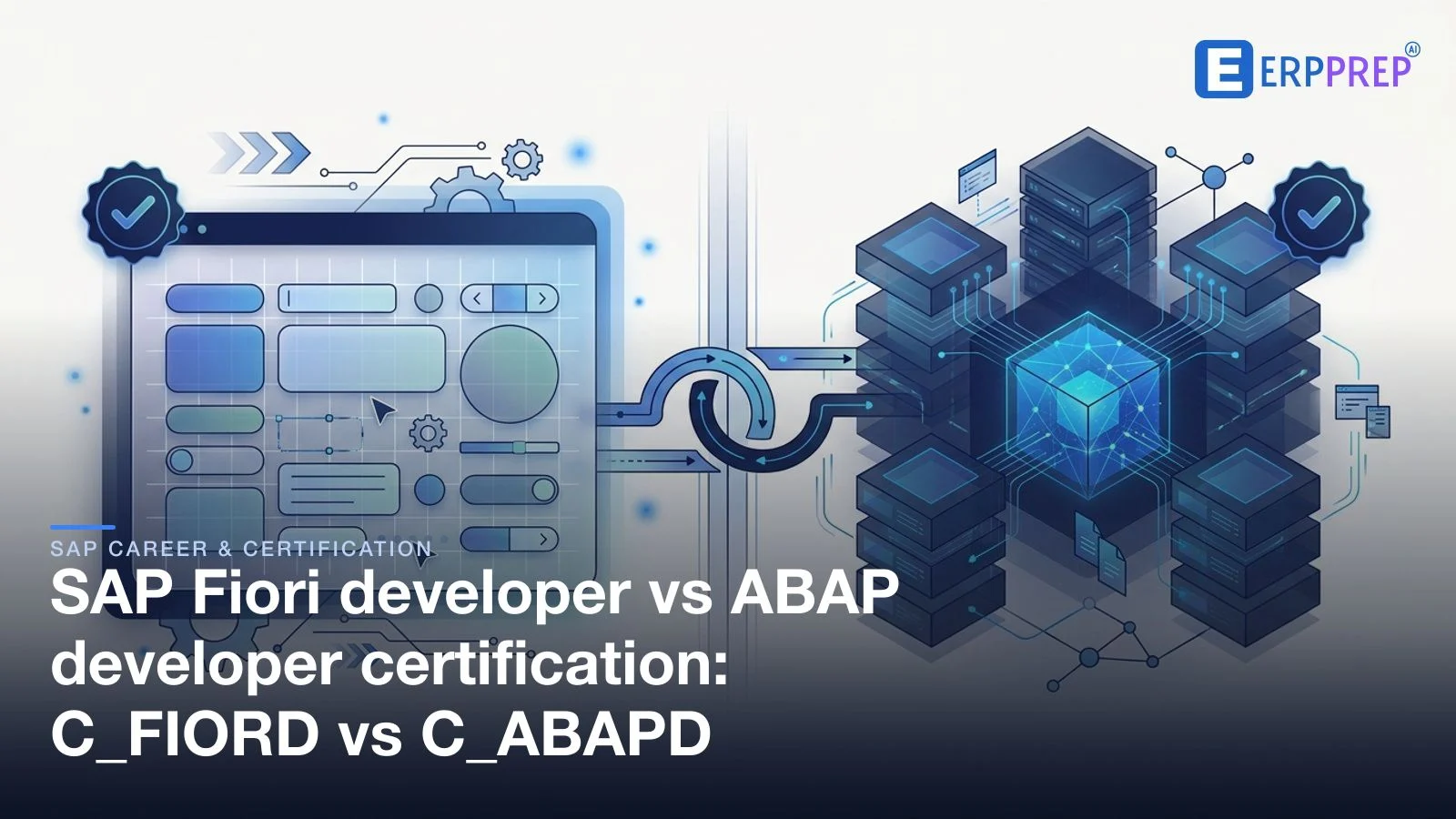
C_FIORD (SAP Fiori Application Developer) certifies front-end work — SAPUI5, SAP Fiori elements, OData binding, and the Fiori launchpad; it is a Scenario-Based Assessment with a 60% cut score. C_ABAPD (Back-End Developer — ABAP Cloud) certifies server-side ABAP: the RESTful Application Programming Model, CDS data models, and clean-core extensibility; it is a System-Based Assessment with a 67% cut score. Choose by the layer you build.
SAP® development splits cleanly into two layers, and it certifies them separately. C_FIORD covers the SAP Fiori Application Developer — the front-end, the part a user actually sees and clicks — while C_ABAPD covers the Back-End Developer — ABAP Cloud — the server-side business logic and data model behind it. They look like siblings on the catalogue, but they point at two different developer careers. This guide compares what each certifies, the format and cut score, and how to choose. For the wider question of which SAP credential fits your path, see whether SAP certification is worth it and how to choose.
Key takeaways
- C_FIORD is the front-end track — it certifies building the user interface with SAPUI5 and SAP Fiori elements, bound to data through OData.
- C_ABAPD is the back-end track — it certifies the server side: the ABAP RESTful Application Programming Model (RAP), Core Data Services (CDS), the ABAP Dictionary, and clean-core extensibility.
- The formats differ: C_FIORD is a Scenario-Based Assessment (SBA), C_ABAPD is a System-Based Assessment (SyBA) — and the cut scores differ too (60% vs 67%).
- They map to different developer roles: a UI / UX engineer versus a back-end / data-model engineer.
- The toolchains diverge — SAPUI5 and Fiori tools on one side, the ABAP language and RAP on the other — though they meet around OData and RAP-driven Fiori elements apps.
C_FIORD vs C_ABAPD at a glance
Both certifications sit on official SAP learning journeys (SAP, learning.sap.com) and both are associate developer exams — but they build opposite ends of the same application. Here they are side by side:
| C_FIORD — Fiori App Developer | C_ABAPD — Back-End / ABAP Cloud | |
|---|---|---|
| Layer | Front-end (user interface) | Back-end (business logic and data model) |
| What it covers | SAPUI5, SAP Fiori elements, OData data binding, views and controllers, the Fiori launchpad | ABAP language, the RESTful Application Programming Model (RAP), CDS views, the ABAP Dictionary, clean-core extensibility |
| Core language / tooling | SAPUI5 (JavaScript, XML), SAP Fiori tools | ABAP, with Joule for developers assisting the workflow |
| Format | Scenario-Based Assessment (SBA) | System-Based Assessment (SyBA) |
| Cut score | 60% | 67% |
| Best for | UI / UX-focused developers | Back-end / data-model developers |
What C_FIORD (Fiori Application Developer) covers
The Fiori certification is about building the screen. It validates that you can develop applications the business actually uses, following SAP's user-experience guidelines, and it is described as an entry-level credential that builds on formal training and, ideally, some mentored project experience. The earned skills sit in the interface space — user interface design, UI/UX design systems, software-development method, and cloud application development.
In practice the module works up from the fundamentals of the framework to complete, data-bound applications:
- SAPUI5 fundamentals — bootstrapping the framework, defining and using modules, and structuring an app into components, assuming you already know web technologies such as HTML and JavaScript.
- Views, controllers, and fragments — building XML views, wiring up controller logic, and reusing UI parts as fragments.
- Models and data binding — working with models, aggregation and element binding, data types, formatters, and reading or creating data through an OData model.
- Routing, localization, and responsiveness — navigating between routes, adapting to device types, and translating an app through a resource model.
- SAP Fiori elements — assembling List Report, Object Page, and Analytical List Page floorplans on top of an OData service, and extending them through the flexible programming model.
- The Fiori launchpad and design guidelines — publishing apps, configuring the launchpad, applying the SAP Fiori design rules, and extending existing apps with SAPUI5 flexibility.
The through-line is that a Fiori developer is a builder of experiences: someone who takes a data service and turns it into an app that is responsive, translatable, and consistent with SAP's design language. Two threads run through the whole module and the exam probes them hard. The first is the boundary between the framework and your code — Fiori elements gives you a great deal for free through annotations, so a strong candidate knows when to configure the standard floorplan versus when to reach for a custom control or an extension point, rather than hand-coding what the framework already provides. The second is the data-binding contract with the back end: the UI is only as good as the OData service beneath it, so much of the work is binding controls to the right entities and reasoning about how the service shapes what the screen can show. That judgement — the right floorplan, the right extension, the right binding — is exactly what a Scenario-Based Assessment is designed to test.
What C_ABAPD (Back-End Developer — ABAP Cloud) covers
C_ABAPD is the server side. It validates that you understand the core principles of the ABAP language and can build robust applications with the ABAP RESTful Application Programming Model (RAP), and it explicitly folds in clean-core discipline — writing extensions that keep the digital core upgrade-safe. It also recognises the modern, AI-assisted workflow, validating that you can use Joule for developers to help generate, explain, and optimise code. The earned skills reflect the back-end weight: ABAP itself, SQL, object-oriented design, full-stack and cloud application development. (At the time of writing the exam is a beta version, so confirm the live details before booking.)
The module is broad, moving from language basics through to data models and clean-core extensibility:
- Core ABAP — data objects and types, control structures, internal tables, local classes, and debugging, then reading data from the database with SELECT and CDS views.
- The RESTful Application Programming Model (RAP) — analysing a business object, applying EML (the entity-manipulation language), and understanding the programming model's architecture and how to add logic to it.
- Robust, testable code — the ABAP Test Cockpit and ABAP Unit, type-conversion pitfalls, string and date processing, code pushdown in ABAP SQL, and internal-table performance with sorted, hashed, and secondary-key techniques.
- Object-oriented design and error handling — inheritance, interfaces, factory methods, and exception classes.
- Data modelling with CDS and the ABAP Dictionary — defining tables, domains, and data elements, building CDS views with associations and code pushdown, and protecting data with access controls.
- Clean-core extensibility — key-user, developer, and side-by-side extension options for SAP S/4HANA Cloud, using released APIs and following clean-core best practice.
A back-end developer, then, owns the correctness of the thing: the data model, the business logic, and the discipline that keeps the core clean so upgrades do not break. What makes the module demanding is that the pieces are layered. A dictionary table underpins a CDS view; the CDS view feeds a RAP business object; the business object exposes behaviour that a Fiori app or an API consumes; access controls guard every layer; and clean-core rules decide which extension technique is even allowed. Change one layer and the effect propagates, so the exam rewards a developer who can reason about the whole stack rather than a single statement in isolation. If Fiori rewards knowing the framework and the design rules, ABAP Cloud rewards knowing the data model, the language, and the governance that keeps a system maintainable.
The very different developer roles
The clearest way to choose is to look at who actually does each job. On a real project team they are usually two different people, and often two different personalities.
A Fiori developer is a front-end / UX engineer. The work is interface-shaped: understand what the user needs to do, build a responsive and accessible app for it, bind it to the data service, and keep it consistent with the design guidelines. If you already think in HTML, JavaScript, and components — or you came from web development and want an SAP specialism — this is the natural home, and the skills travel well beyond SAP toward front-end engineering generally.
An ABAP Cloud developer is a back-end / data engineer. The work is logic-and-model-shaped: design the data model, write the business logic, guard access, and extend the system without breaking the core. It suits someone who likes precise, testable server-side code where correctness is defensible and the cost of a wrong data model is concrete. It sits closer to the heart of the business process and to the wider SAP platform, and the clean-core discipline it teaches is increasingly what employers screen for.
There is a career-shape difference too. Front-end skills are more transferable outside the SAP world — the instinct for building a clean, responsive, well-bound interface is useful anywhere the web runs, so a Fiori developer can drift toward general front-end engineering over time. Back-end ABAP skills are deeper but more SAP-bound: they make you the person a project cannot deliver without when the data model and business logic are in scope, and that scarcity has its own value, but the expertise is more tightly coupled to the SAP platform. Neither is "better" — they are simply different bets on how you want your expertise to compound.
Not sure how a performance-based exam feels? A free sample shows the reason-through-a-scenario style before you commit to a track. Try a free sample.
Format and cut score: SBA at 60% vs SyBA at 67%
This is where the two exams genuinely diverge, and it tells you something about each role. C_FIORD uses the Scenario-Based Assessment (SBA) — the format SAP uses when the skill is applied judgement, where you work through a connected application situation and choose the best approach rather than recalling isolated facts. Its cut score is 60%. C_ABAPD uses the System-Based Assessment (SyBA) — the format built around realistic system work, closer to sitting in the tool and producing or validating an artefact — with a higher 67% cut score.
The practical takeaway is that the two demand slightly different preparation rhythms. An SBA rewards reasoning fluently across a scenario; a SyBA rewards being genuinely comfortable doing the work — writing the code, building the view, validating the result — so you can move quickly and accurately through system-style tasks. Either way, the winning method is the same: practise doing, not just reading. For the mechanics of both performance-based styles and how to work them under time pressure, the guide to the performance-based exam format breaks down how SBA and SyBA are built.
Can you hold both?
Yes — and for a certain kind of developer it is a strong combination. A full-stack SAP developer, or a consultant on a small team who owns an application end to end, benefits from certifying both layers, because the two meet in the middle more than the split suggests. A SAP Fiori elements app is frequently driven by CDS annotations that a back-end developer defines; the RAP business object that C_ABAPD teaches is exactly what a Fiori front end consumes. Understanding both sides makes you faster at the seam where most integration bugs live.
That said, most people should not chase both at once. Depth in one layer is more valuable early on than a thin coverage of both, and each exam is broad enough to reward focus. The sensible pattern is to lead with the layer you work in today, certify it, get real project exposure, and only then add the second once you find yourself regularly crossing the boundary. Neither is a formal prerequisite for the other, so there is no forced order — the order is simply whichever layer you build first.
For a fuller map of how developer credentials sit alongside the functional and platform tracks, the best SAP certification for developers hub places these two among the wider set of technical options.
Prerequisites and who each exam is for
Neither exam is gated behind a formal prerequisite certification. C_FIORD is positioned as an entry-level credential that builds on formal SAP training and, ideally, some mentored experience in a Fiori project team, and it assumes you already know web technologies like HTML and JavaScript. C_ABAPD validates that you can contribute to a delivery team under mentorship, working with today's AI-assisted ABAP tooling. Both are, in other words, associate exams designed for developers getting established rather than veterans.
The realistic entry signal is your existing instinct. If you reach for the browser dev tools and think in components and layouts, C_FIORD will feel like home. If you reach for the data model and think in tables, types, and logic, C_ABAPD will. Where you genuinely have no lean yet, note that the ABAP journey is the larger body of material to absorb — the language, RAP, CDS, and clean core are a lot of ground — while the Fiori journey concentrates on a smaller toolset used with real depth. Match your study plan to the track you pick rather than assuming they take the same effort.
Which one should you choose?
Work backwards from the layer you build or want to build, not from the cut score. Three rules of thumb:
- Choose C_FIORD if you build the interface. You write SAPUI5, think in views and components, and want the app to be responsive and on-brand. Fiori is also the more transferable of the two if you see yourself moving toward front-end engineering generally.
- Choose C_ABAPD if you build the logic and the data. You write ABAP, design CDS models, and care about clean-core, testable, upgrade-safe extensions. Back-end is the deeper SAP-platform specialism.
- Consider both — in sequence — for a full-stack role. On a small team the layers complement each other, because a Fiori elements app is driven by the CDS and RAP artefacts a back-end developer builds. Lead with the layer you already touch daily, then add the second once you regularly cross the seam.
Still weighing SAP development against other tracks entirely? The guide to choosing an SAP certification places these developer exams among the wider set of options, and each exam hub below carries the scenarios, skill drills, and exam facts for that specific certification.
Prepare for whichever you pick
Once you have chosen, the approach rhymes even though the formats differ, because both are performance-based. Practise doing the work in a realistic setting rather than only reading — build the SAPUI5 views, Fiori elements floorplans, and OData bindings for C_FIORD, or write the ABAP, CDS views, and RAP business objects for C_ABAPD. Trace whole scenarios end to end — from the data model up to the screen — and rehearse under time pressure so your accuracy holds when it counts. Start from the exam hub for your track, try a free sample to feel the performance-based style, and build from there.
Frequently asked questions
- What is the difference between C_FIORD and C_ABAPD?
- C_FIORD certifies the SAP Fiori Application Developer role — the front-end layer, built with SAPUI5, SAP Fiori elements, OData data binding, and the Fiori launchpad. C_ABAPD certifies the Back-End Developer — ABAP Cloud role — the server side, built with the ABAP RESTful Application Programming Model (RAP), Core Data Services (CDS), the ABAP Dictionary, and clean-core extensibility. One builds the user interface; the other builds the business logic and data model behind it.
- What exam format does the SAP Fiori developer certification (C_FIORD) use?
- C_FIORD uses the Scenario-Based Assessment (SBA) format — a performance-based style where you reason through a connected application-development situation rather than answering isolated trivia. Confirm the current activity count and any updates on the exam page at learning.sap.com.
- What exam format does the ABAP developer certification (C_ABAPD) use?
- C_ABAPD uses the System-Based Assessment (SyBA) format — a performance-based style built around realistic system work such as writing and validating ABAP artefacts, CDS views, and RAP business objects. It is currently a beta-version exam, so verify the live details on the exam page at learning.sap.com before you book.
- What is the cut score for C_FIORD and C_ABAPD?
- C_FIORD publishes a 60% cut score and C_ABAPD publishes a 67% cut score at the time of writing. They are different, so the pass mark itself is one small factor to weigh, though the harder part is the breadth of each subject. Always check the current cut score on each exam's page before booking.
- Which SAP developer certification should I take first?
- Lead with the layer you already work in or want to work in. If you build user interfaces and know HTML and JavaScript, start with C_FIORD (front-end). If you write server-side logic, data models, and extensions, start with C_ABAPD (back-end). Neither is a formal prerequisite for the other, so there is no fixed order.
- Do I need both the Fiori and ABAP developer certifications?
- Not for one role. Most developers specialise in either front-end or back-end and certify accordingly. Holding both suits a full-stack developer or a small-team consultant who owns an application end to end, since a Fiori elements app is often driven by CDS annotations that a back-end developer defines. Lead with your primary layer, then add the second once you have real project exposure.
- Is SAP front-end or back-end development the better career choice?
- Neither is objectively better — they are different bets. Front-end (C_FIORD) rewards UX judgement, SAPUI5 fluency, and skills that travel toward web development generally. Back-end (C_ABAPD) rewards data-modelling and clean-core discipline and sits closer to core business logic and the wider SAP platform. Pick the work you enjoy and the layer your projects need most.
- What languages and tools does each certification cover?
- C_FIORD centres on SAPUI5 (JavaScript, XML views, OData) with SAP Fiori tools and SAP Business Application Studio, and assumes familiarity with web technologies like HTML and JavaScript. C_ABAPD centres on the ABAP language, the ABAP RESTful Application Programming Model, CDS, and the ABAP Dictionary, with Joule for developers used to accelerate coding. They share touch points around OData and RAP but use different toolchains.
- Are C_FIORD and C_ABAPD associate-level certifications?
- Yes. Both are associate-level developer certifications positioned as entry points that let you contribute to a project team in a mentored role. C_FIORD is described as an entry-level certification, and C_ABAPD validates the knowledge to work effectively under guidance. Neither is a professional or specialist tier exam.
ERPPrep is an independent platform and is not affiliated with, endorsed by, or sponsored by SAP SE. SAP and other SAP products are trademarks of SAP SE, referenced here only to describe the certification exams ERPPrep helps you prepare for.
Ready to practise the way the exam tests?
ERPPrep provides original, performance-style scenarios and skill drills built for the 2026 SyBA and SBA formats. Try a free sample and judge the quality yourself.
Practice for these exams
Related guides
SAP consultant vs SAP developer: certification paths compared
Two SAP career forks, two kinds of certification. The functional-consultant path (e.g. C_TS4FI) configures business processes; the developer path (e.g. C_ABAPD) writes code. What each role does, what its exams look like, and how to choose.
SAP Fiori certifications: developer vs administrator
SAP's two Fiori certifications split by role — C_FIORD (Application Developer) builds Fiori/UI5 apps, C_FIOAD (System Administration) runs the launchpad and landscape. Build vs run, formats, cut scores, career paths, and how to pick.
SAP developer certifications: ABAP Cloud vs BTP Administrator
Two technical SAP certifications, two different roles: C_ABAPD certifies an ABAP Cloud backend developer, C_ADBTP a SAP BTP administrator. Formats, cut scores, prerequisites, difficulty, and how to choose the one that matches your technical career.