

SAP consultant vs SAP developer: certification paths compared
Two SAP career forks, two kinds of certification. The functional-consultant path (e.g. C_TS4FI) configures business processes; the developer path (e.g. C_ABAPD) writes code. What each role does, what its exams look like, and how to choose.
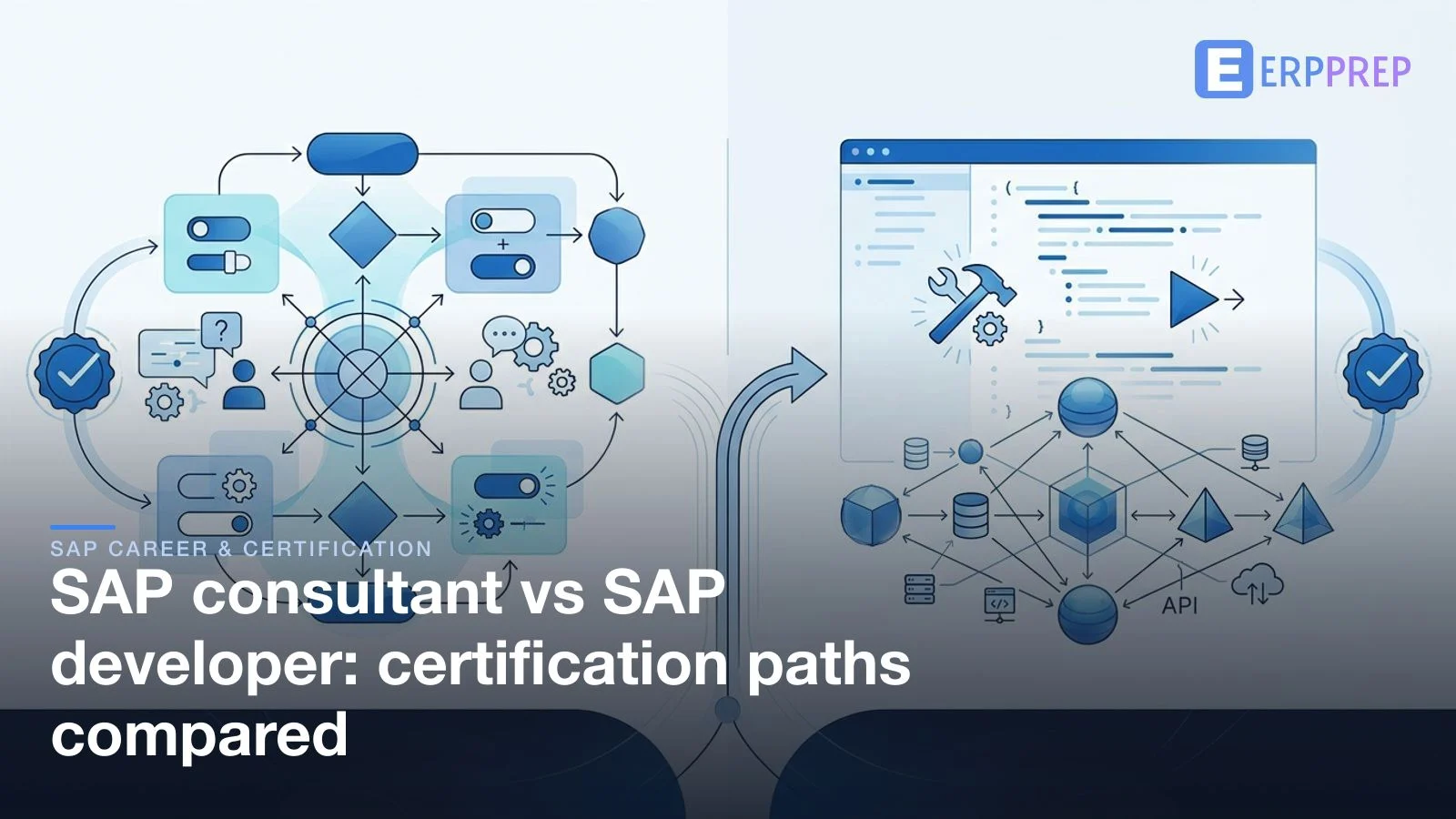
An SAP functional consultant configures business processes — a certification like C_TS4FI (S/4HANA Financial Accounting) proves you can set up and run a module without coding. An SAP developer builds software — a certification like C_ABAPD (ABAP Cloud back-end developer) proves you can program on the platform. Both are System-Based Assessments. Choose the consultant path if you like business problems and configuration; the developer path if you like writing code.
One of the first real forks in an SAP career is not which module to learn — it is whether you want to be a consultant who configures the system or a developer who writes code for it. The two roles work on the same projects, but they own different craft, study different material, and sit different certifications. This guide compares them using two representative associate exams: C_TS4FI, the SAP® S/4HANA Financial Accounting certification that stands in for the functional-consultant path, and C_ABAPD, the ABAP Cloud back-end developer certification that stands in for the developer path. Each is only one example of its track — the consultant path spans many business modules and the developer path spans several technical stacks — but together they make the fork concrete. For the wider question of whether SAP certification is worth it at all, see how to choose an SAP certification for your career.
An SAP functional consultant configures business processes — a certification like C_TS4FI (S/4HANA Financial Accounting) proves you can set up and run a module without coding. An SAP developer builds software — a certification like C_ABAPD (ABAP Cloud back-end developer) proves you can program on the platform. Both are System-Based Assessments. Choose the consultant path if you like business problems and configuration; the developer path if you like writing code.
Key takeaways
- Consultant = configure the business process. The functional-consultant path (represented here by C_TS4FI) is about customizing and running a module — organizational units, master data, ledgers, closing, reporting — largely through settings, not code.
- Developer = build the software. The developer path (represented by C_ABAPD) is about writing programs, data models, and extensions — object-oriented ABAP, SQL, and the RESTful Application Programming model — on the platform.
- Each track is a family, not a single exam. There is a consultant certification per business module and several developer certifications per stack. C_TS4FI and C_ABAPD are examples, not the only choices.
- Both example exams are System-Based Assessments (SyBA), so the format is not the differentiator — the work is. C_TS4FI publishes a 60% cut score; C_ABAPD publishes a 67% cut score and is a Beta-version exam at the time of writing (confirm both on learning.sap.com).
- You can cross over. Modern SAP extensibility puts functional and developer work side by side, so switching tracks is a reskill, not a restart — and doing both is valuable.
Consultant vs developer at a glance
Both certifications sit on official SAP learning journeys (SAP, learning.sap.com) and, as it happens, share an assessment format — but they point at two very different jobs. Here they are side by side, each standing in for its wider track:
| Consultant path — e.g. C_TS4FI | Developer path — e.g. C_ABAPD | |
|---|---|---|
| Core craft | Configure and run a business module (Financial Accounting) — settings, master data, process design | Write software on the platform — ABAP programming, data models, extensions |
| Primary role | Consultant | Developer (also relevant to consultants) |
| Do you code? | Largely no — configuration, not production code | Yes — programming is the job |
| Example skills earned | System configuration, Financial Accounting, Record to Report, financial reporting | ABAP, SQL, object-oriented design, cloud application development |
| Format | System-Based Assessment (SyBA) | System-Based Assessment (SyBA) |
| Cut score | 60% (confirm on learning.sap.com) | 67%, Beta version (confirm on learning.sap.com) |
What an SAP consultant actually does
A functional consultant is the bridge between a business and the system. The job is to understand how a customer works — how it books revenue, pays suppliers, closes its books — and then shape SAP so it supports that, ideally by staying close to standard rather than bending the software out of shape. The C_TS4FI certification is a clean picture of this track: it verifies that you can customize and perform the core of Financial Accounting in S/4HANA, spanning organizational units and master data, the general ledger, accounts payable and receivable, asset accounting, the period- and year-end close, and financial reporting. The skills it names — financial accounting and management, the record-to-report flow, general accounting, and hands-on system configuration — describe someone who owns a business process, not someone who writes code.
In day-to-day terms, a consultant spends a lot of time with people: gathering requirements in fit-to-standard workshops, deciding which standard configuration meets a need, testing that the process behaves correctly, and explaining trade-offs to finance stakeholders. The measure of good work is a process that runs correctly and cleanly — the right posting hits the right account, the close completes, the report reconciles. When the standard genuinely cannot meet a requirement, the consultant specifies an extension — and hands that build to a developer. The consultant defines what the system should do; they rarely write the code that does it.
Because a consultant certification is anchored to a business module, the domain knowledge matters as much as the SAP knowledge. C_TS4FI leans on real accounting understanding — document splitting, currency valuation, accruals, intercompany reconciliation — so the exam rewards someone who grasps finance and the configuration that implements it. That is why the consultant path is a natural home for people arriving from a business background.
What an SAP developer actually does
A developer builds the software. The C_ABAPD certification represents this track through modern ABAP: it verifies that you grasp the fundamentals of the ABAP language and can build robust applications with RAP — the ABAP RESTful programming model (RAP), following clean-core principles so extensions stay sustainable. The skills it names — ABAP, SQL, object-oriented design, cloud application development, and full-stack development — describe an engineer. Its learning journey moves through writing and debugging programs, working with classes and interfaces, reading from the database with CDS views, testing and profiling code, and building data models and clean-core extensions for S/4HANA Cloud. It even folds in using SAP’s generative-AI assistant to accelerate coding — a sign of how current the developer track is.
A developer’s day looks like a software engineer’s day anywhere: writing code, running unit tests, chasing a performance problem, reviewing a colleague’s change, refactoring something brittle. The measure of good work is code that is correct, maintainable, and clean-core compliant — an extension that survives the next upgrade rather than breaking it. Developers take the requirements a consultant specifies and turn them into working software: a custom app, a data model, an integration, an enhancement that standard configuration could not deliver.
Note one thing the C_ABAPD page makes explicit: the certification is relevant to both developers and consultants. That is a hint about where SAP is heading — the line between configuring and coding is blurring at the edges, and a functional consultant who understands how developers extend the system collaborates far better. But make no mistake about the centre of gravity: this is a programming certification, and the developer path is a coding career.
The two career shapes
The clearest way to choose is to picture the working life each track leads to, because they diverge well beyond the first exam.
A consultant career tends to deepen into a module and then broaden across a business area. You might start in Financial Accounting, add controlling or treasury, become the person who can run a finance implementation end to end, and grow toward solution architecture or a lead functional role. Your value compounds as business-process expertise: you are trusted because you understand how finance actually works and how to make SAP serve it. The work stays close to people and process, and much of it transfers across SAP releases because business logic changes more slowly than technology.
A developer career deepens into engineering craft and platform mastery. You grow from writing programs to designing them, to owning the architecture of extensions, to setting standards for a team. Your value compounds as technical depth: you are trusted because your code is correct, fast, and clean. Some of that skill — programming instincts, data modelling, testing discipline — travels beyond SAP entirely, which gives the developer path a different kind of portability. The trade-off is that technical stacks evolve, so you reinvest in staying current more often than a functional consultant does.
There is a related but distinct split inside the consulting world — functional versus technical consultant — which is easy to confuse with this one. If that is the comparison you actually want, the functional vs technical consultant guide covers it directly; this article is the broader fork of consulting versus building software.
Want to feel the exam style before you commit? Both tracks are assessed in SAP’s performance-based format, and a free sample lets you experience how a System-Based Assessment reasons before you pick a direction. Try a free sample.
The certification paths, compared
Neither track is a single exam — each is a family, and picking the right member matters as much as picking the track.
The consultant path offers roughly one associate certification per business module. C_TS4FI covers Financial Accounting, but there are parallel associate exams for management accounting / controlling, sourcing and procurement, sales, HR with SuccessFactors, and many more. You choose the module that matches the business area you want to work in, and the certification proves you can configure and run that process. Because the domain is the point, your accounting, logistics, or HR knowledge is a genuine head-start on the matching module.
The developer path is organised around programming and platform skills rather than business modules. C_ABAPD centres on back-end development with ABAP Cloud and the RAP model, and it sits alongside other technical certifications for the broader platform and its newer development tools. Here you choose by the technology stack you want to build on, not by an accounting or logistics domain. A software background is the head-start.
Both example exams are delivered as System-Based Assessments (SyBA) — SAP’s performance-based format that tests whether you can do the work in a realistic setting rather than recall isolated facts. C_TS4FI publishes a 60% cut score; C_ABAPD publishes a 67% cut score and is currently a Beta-version exam, so its details are especially worth confirming on its page at learning.sap.com before you book. The shared format is a useful reminder that the choice between the tracks is about the content of the work, not the mechanics of the test. For how this exam style works and how to prepare for it, the guide to SAP’s performance-based exam format walks through the technique.
Which path should you choose?
Work backwards from the day you want, not from a guess about pay — as the pay question below explains, earnings track depth and demand more than the track label. Three rules of thumb:
- Choose the consultant path if you like business problems. You enjoy sitting with users, translating a requirement into configuration, and owning a process end to end. A background in finance, logistics, procurement, or HR makes the matching module an easier on-ramp — C_TS4FI, for instance, rewards real accounting fluency.
- Choose the developer path if you like writing code. You enjoy building, testing, and refactoring software, modelling data, and solving technical problems. A programming or computer-science background is the natural head-start, and C_ABAPD meets you where modern, AI-augmented ABAP development lives.
- Consider both if you want to be rare. The people who can configure a process and extend it in code are unusually valuable, because SAP’s clean-core, extensibility-first direction increasingly asks projects to blend the two. Most people lead with the track that fits their background, then add a foothold in the other.
Can you cross over later?
Yes — and it is more common than the tidy fork suggests. The two tracks share one platform, and modern SAP extensibility deliberately places functional and developer work next to each other, which is exactly why the C_ABAPD certification is flagged as relevant to consultants as well as developers. Consultants frequently learn enough development to specify and sanity-check extensions, and some move fully into building. Developers frequently absorb a module’s business logic so they build the right thing, and some grow into functional-technical hybrid roles.
Be honest that a full switch is a real reskill, not a relabelling: a consultant becoming a developer must genuinely learn to program, and a developer becoming a functional consultant must genuinely learn the business domain. But because you already understand the platform, the project rhythm, and how the other half works, crossing over is far faster than starting from zero — and every step toward the other track makes you more useful on it.
How to start on either track
Pick the fork that matches the day you want, then pick the specific exam that matches the module or stack you want to work in — not just the track in the abstract. On the consultant side that means choosing a business module such as the Financial Accounting scope behind C_TS4FI; on the developer side it means choosing a technical credential such as C_ABAPD. Confirm the current format, cut score, prerequisites, and status of whichever exam you choose on its page at learning.sap.com, since SAP updates these and the ABAP Cloud exam in particular is a Beta version.
Then prepare the way both exams are actually assessed: by doing the work, not just reading about it. Because each track is a System-Based Assessment, the winning practice is to reason through realistic tasks under time pressure until your accuracy holds. Start from the exam hub for your chosen certification, try a free sample to feel the performance-based style, and build from there — whichever side of the consultant-versus-developer fork you land on.
Frequently asked questions
- What is the difference between an SAP consultant and an SAP developer?
- An SAP functional consultant configures a business module and maps a customer's processes onto standard SAP behaviour — largely without coding. An SAP developer writes software: programs, data models, and extensions that run on the platform. A consultant certification such as C_TS4FI (S/4HANA Financial Accounting) proves configuration and process skill; a developer certification such as C_ABAPD (ABAP Cloud back-end developer) proves programming skill. Both roles sit on the same project, but they own different work.
- Does an SAP consultant or an SAP developer pay more?
- Neither track is inherently higher-paid — earnings track scarcity, seniority, module or stack demand, and region far more than the label. A specialised functional consultant in a hot module and a strong developer in a modern stack both command a premium; a generalist in either track earns less. Choose on the work you want to do daily, not on a pay gap, because the gap comes from how deep you go, not which fork you pick.
- Do I need to know how to code to be an SAP consultant?
- No. The functional-consultant path is built around configuration and business-process design, not programming. A certification like C_TS4FI focuses on customizing and running Financial Accounting — organizational units, master data, ledgers, closing, reporting — through settings rather than code. Light scripting or an understanding of how developers extend the system helps you collaborate, but writing production code is the developer's job, not the functional consultant's.
- Which is easier to get into, SAP consultant or SAP developer?
- It depends on your background. If you come from finance, logistics, HR, or another business domain, the functional-consultant path is usually the more natural entry because it builds on process knowledge you already have. If you come from software development or computer science, the developer path leans on programming instincts you already hold. Neither is objectively easier — each is easier for a different starting point.
- Can I switch from SAP consultant to developer, or the other way?
- Yes. The two tracks share a platform and overlap at the edges — modern SAP extensibility deliberately puts functional and developer work side by side. Consultants often pick up development to handle extensions; developers often learn a module's business logic to build the right thing. A switch is a real reskill, not a rename, but the shared context makes crossing over far easier than starting from zero, and people who can do both are valuable.
- Which certifications map to the consultant path versus the developer path?
- The consultant path has one associate certification per business module — C_TS4FI for S/4HANA Financial Accounting is one example, with parallel exams for controlling, logistics, HR, and more. The developer path centres on programming credentials such as C_ABAPD (back-end development with ABAP Cloud), alongside other technical exams for the platform. Pick the exam that matches the specific module or stack you want to work in, not just the track.
- How do I know whether the consultant or developer path fits me?
- Ask what you want your day to look like. If you enjoy sitting with business users, translating requirements into system configuration, and owning a process end to end, the consultant path fits. If you enjoy writing, testing, and refactoring code, modelling data, and building extensions, the developer path fits. The strongest signal is which of those two descriptions you would rather do every day for years.
- What are the prerequisites for the consultant and developer certifications?
- Neither example exam is gated behind a formal prerequisite certification — both are positioned as associate-level entry points. In practice the consultant path assumes comfort with the business domain (accounting concepts for C_TS4FI), while the developer path assumes basic programming literacy before ABAP-specific study. Always confirm the current prerequisites, format, and status on each exam's page at learning.sap.com, since details change.
ERPPrep is an independent platform and is not affiliated with, endorsed by, or sponsored by SAP SE. SAP and other SAP products are trademarks of SAP SE, referenced here only to describe the certification exams ERPPrep helps you prepare for.
Ready to practise the way the exam tests?
ERPPrep provides original, performance-style scenarios and skill drills built for the 2026 SyBA and SBA formats. Try a free sample and judge the quality yourself.
Practice for these exams
Related guides
SAP developer certifications: ABAP Cloud vs BTP Administrator
Two technical SAP certifications, two different roles: C_ABAPD certifies an ABAP Cloud backend developer, C_ADBTP a SAP BTP administrator. Formats, cut scores, prerequisites, difficulty, and how to choose the one that matches your technical career.
SAP integration certifications compared
Compare SAP's integration certification options — the Integration Developer (C_CPI) and BTP Administrator (C_ADBTP) — and where legacy Process Orchestration fits.
SAP BTP certifications explained: which one is right for you
A map of the SAP BTP certification family — administrator, architect, integration, ABAP and generative-AI developer, LeanIX EA — and how to choose.