

SAP functional vs technical consultant: the two paths, and how to choose
SAP careers split into two big paths — functional consultants who configure business processes, and technical consultants who develop and run the platform. What each does, the skills and certifications for each, and how to pick.
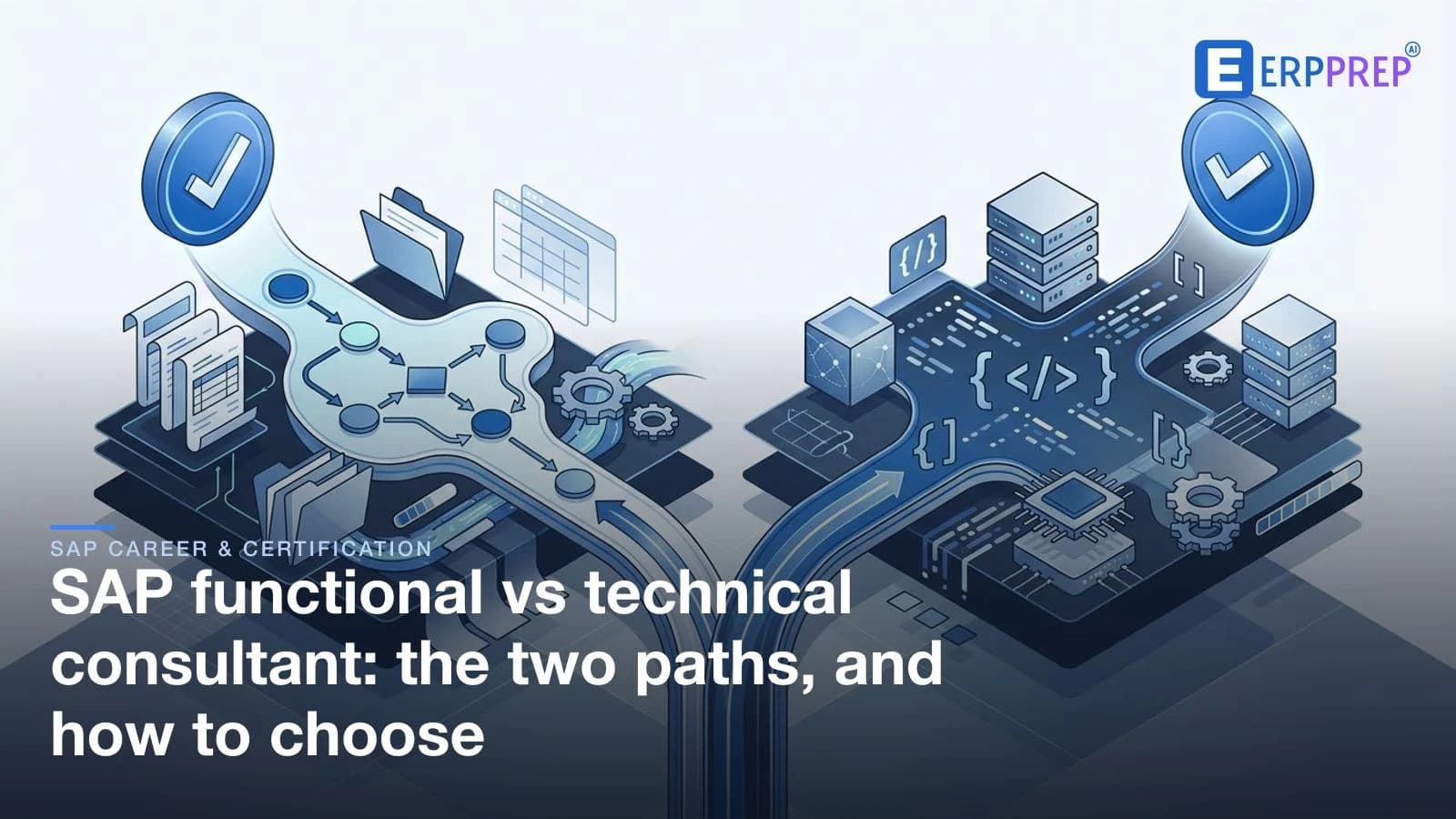
A functional SAP consultant configures the system to fit a business process — finance, HR, procurement — and speaks the language of the department. A technical consultant develops and maintains the platform underneath: ABAP code, BTP services, Fiori apps, integrations. Choose functional if you like business problems and configuration; technical if you like building and code. Many senior people blend both.
Almost everyone weighing an SAP® career hits the same fork early: functional or technical? The two paths lead to different day-to-day work, different skills, and different certifications — and picking the wrong one for your strengths is the most common way people stall. This guide lays out what each consultant actually does, what each needs to learn, and how to choose. If the role itself is still fuzzy, start with what an SAP consultant actually does across a project. For the bigger "is any of this worth it" question, start with whether SAP certification is worth it and how to choose.
Key takeaways
- Functional = business configuration; technical = platform development. That single distinction drives everything else.
- Functional consultants certify in a module (finance, HR, procurement); technical consultants certify in a development or platform area (ABAP, BTP, Fiori).
- Neither pays more by rule — pay tracks scarcity and seniority, not the label. Choose by fit, because fit drives progression.
- Pick the path that overlaps your existing background: business/operations leans functional, software/dev leans technical.
- The senior blend is the techno-functional consultant — a destination you grow into, not a starting point.
Functional vs technical at a glance
Here are the two paths side by side across the dimensions that matter most when you are choosing:
| Dimension | Functional consultant | Technical consultant |
|---|---|---|
| What you do | Configure the system to fit a business process; translate department needs into settings and design. | Develop, extend, integrate, and run the platform; build what standard configuration can't. |
| Core skills | Business-process knowledge, configuration, requirements gathering, stakeholder communication. | Programming, data modelling, integration, debugging, platform and landscape know-how. |
| Example certifications | C_TS4FI (Finance), C_THR81 (HR / Employee Central) | C_ABAPD (ABAP), C_ADBTP (BTP), C_FIORD (Fiori) |
| Day-to-day | Workshops with the business, configuration in the system, testing processes, writing functional specs. | Writing and reviewing code, building extensions and interfaces, troubleshooting, deploying to the platform. |
| Career path | Module consultant → senior/lead → solution or process architect for a line of business. | Developer → senior developer → technical or platform architect / integration lead. |
What a functional consultant actually does
A functional consultant owns the fit between a business process and the system. They sit with the finance, HR, or procurement team, understand how that team works, and then configure the software so it supports the process — chart of accounts and posting rules in finance, organisational and pay structures in HR, purchasing flows in procurement. The work is done through the system's built-in configuration tooling, not by programming.
Two concrete examples map onto the biggest functional tracks. In finance, a consultant preparing for the C_TS4FI exam works across Financial Accounting and Management Accounting on S/4HANA — the general ledger, accounts payable and receivable, asset accounting, and cost and profitability analysis. In human resources, a consultant on the C_THR81 path configures cloud HR — employee data, organisational structures, and the workflows that run a modern HR department. Both roles are about business design and configuration, and both certify against performance-based tasks rather than pure recall.
A useful way to picture the role: the functional consultant is the person who can sit in a room full of accountants or HR managers, understand a problem in their words, and then quietly turn that into a working configuration behind the scenes. A large share of the value is translation — from business intent into system design — and a large share of the day is spent in workshops, testing the configured process end to end, and documenting decisions so the rest of the team can build on them. If finance is your target, the FI consultant career path walks the route in detail.
What a technical consultant actually does
A technical consultant builds and maintains the platform that the functional configuration runs on. When a business need can't be met by standard settings, the technical consultant develops the extension, the interface, or the app that closes the gap — and keeps the landscape running underneath.
The technical path itself branches. A back-end developer on the C_ABAPD path writes ABAP Cloud code — data models, business logic, and services in the modern, cloud-ready development model. A platform specialist on the C_ADBTP path administers SAP Business Technology Platform: provisioning services, managing security and connectivity, and running the environment that extensions live in. A front-end developer on the C_FIORD path builds the user-facing apps and experiences. Different specialisms, one common thread: you are developing and operating the platform, not configuring a business module.
A useful way to picture this role is the mirror image of the functional one: where the functional consultant translates the business need into a design, the technical consultant turns that design into something the system can actually run — an interface that feeds data in, an extension that adds the missing behaviour, a screen that presents it to the user. Much of the day is heads-down building and problem-solving: writing and reviewing code, tracing a defect to its root cause, and getting a change safely through the landscape into production. The ABAP vs BTP developer comparison maps the technical branches against each other.
The skills each path needs
The two roles reward genuinely different aptitudes, which is why fit matters so much. A functional consultant lives on:
- Business-process depth — knowing how finance close, hire-to- retire, or procure-to-pay actually work in a real organisation.
- Configuration fluency — turning a requirement into the right settings without breaking the process elsewhere.
- Communication — running workshops, gathering requirements, and writing specifications the business and developers both trust.
A technical consultant lives on:
- Programming and data modelling — writing clean, maintainable code and structuring data well.
- Integration and debugging — connecting systems and finding the root cause when something breaks.
- Platform and landscape know-how — understanding how the runtime, security, and deployment fit together.
Both sides share one meta-skill: the exams are performance-based, so hands-on ability is what actually gets tested. The skills the performance format tests apply on either path.
Not sure which style of work suits you? A free sample lets you feel the doing-over-recalling exam style before you commit to a path. Try a free sample.
Which path pays more, and which is in demand?
It is tempting to choose by an assumed pay gap, but that is the wrong lens. Neither path pays more by definition. Compensation tracks scarcity, seniority, and whichever specific skill happens to be in short supply in your market at a given time — not the functional-versus-technical label. A deeply experienced functional consultant in a sought-after module can out-earn a junior developer, and an in-demand platform developer can out-earn a mid-level functional consultant. Both directions are true.
Demand works the same way: it shifts by module, by technology wave, and by region. Cloud migrations pull demand toward certain functional modules and toward platform and integration skills at the same time. Rather than chase a snapshot of "what pays most" that will have changed by the time you finish studying, choose the path where you can become genuinely excellent — because seniority and scarce, proven skill are what move pay, and you reach both faster on the path that fits you. If you still want to see how the market values specific certifications, the highest-paying SAP certifications overview treats it honestly.
Can you do both? The techno-functional blend
Yes — and at senior levels many consultants do. The blended role is often called a techno-functional consultant: someone who understands a business module deeply enough to design its configuration and can also read, specify, or write the code that extends it. That person is unusually valuable on a project because they bridge the constant conversation between the business and the developers.
The important nuance is that the blend is a destination, not a starting point. Almost everyone begins clearly on one side — configuring a module or building on the platform — and then, with a few projects behind them, picks up enough of the other side to bridge it. Trying to be both from day one usually means being shallow at both. Go deep on one path first; the bridge comes later. The second-certification stacking guide shows how a well-chosen second certification can be exactly that bridge.
How to choose by your strengths
Work backwards from who you already are. The fastest, most credible path is the one that overlaps your existing experience — a point the career-switcher path into SAP makes concrete. A few honest questions sort most people quickly:
- What energises you — a business problem or a build? If you enjoy untangling how a department works and designing the fix, lean functional. If you enjoy making something run and solving it in code, lean technical.
- What is your background? Finance, HR, operations, or business experience is a running start on the functional side. Software development, computer science, or scripting is a running start on the technical side.
- How do you like to communicate? Functional work is relentlessly people-facing — workshops, requirements, sign-offs. Technical work has more heads-down building. Neither is "better"; they suit different temperaments.
- Where can you practise hands-on soonest? Because both exams are performance-based, the path where you can get real practice fastest is the path you will certify in soonest.
If you are still entirely undecided, the best module for beginners and which certification to get first help you place a concrete first step under whichever path you lean toward.
The certification path for each
Once you have chosen a side, the certification sequence is straightforward because it follows the work. On the functional path you certify in the module you configure — for example C_TS4FI for S/4HANA finance or C_THR81 for cloud HR — then deepen into adjacent modules or move up toward a process/solution architect role for your line of business.
On the technical path you certify in your development or platform specialism — C_ABAPD for ABAP Cloud development, C_ADBTP for platform administration, or C_FIORD for Fiori app development — then broaden across the platform toward a technical or integration architect role. Either way, the associate exams are performance-based, so preparation is the same shape on both paths: practise real tasks, trace whole processes or flows end to end, and rehearse under time pressure. The performance-based exam preparation guide covers that technique, and to see how the two paths sit inside SAP's wider certification landscape, the complete map of certification tracks places every family — functional and technical — on one page.
Frequently asked questions
- What is the difference between a functional and a technical SAP consultant?
- A functional consultant configures the system to match a business process and works closely with the department that owns it — finance, HR, procurement, sales. A technical consultant builds and maintains the platform underneath: custom development, extensions, integrations, and the runtime. Functional work centres on configuration and business logic; technical work centres on code, data, and the platform. In practice they collaborate constantly on the same project.
- Which path pays more, functional or technical?
- Neither path pays more by definition. Pay tracks scarcity, seniority, and the specific skill in demand at a given moment, not the label. A deeply experienced functional consultant in a hot module can out-earn a junior developer and vice versa. Rather than choose by an assumed pay gap, choose the path that matches your strengths — you progress faster, and progression is what actually moves pay.
- Can you be both a functional and a technical SAP consultant?
- Yes, and many senior consultants are. The blended role is often called a techno-functional consultant: someone who understands the business configuration deeply enough to design it and can also read or write the code that extends it. It usually develops with experience rather than being a starting point — most people begin clearly on one side, then pick up enough of the other to bridge the two.
- Do functional SAP consultants need to know how to code?
- Not to do the core job. Functional consultants configure through the system's built-in tooling rather than by programming, and strong functional consultants can have long careers without writing production code. That said, being able to read code, understand what a developer is doing, and specify requirements precisely makes you far more effective on a project team — so a little technical literacy is a genuine advantage.
- What certifications does a functional SAP consultant need?
- A functional consultant typically certifies in the module they configure — for example Financial Accounting and Management Accounting on S/4HANA, or a SuccessFactors HR module such as Employee Central. The associate exams for these areas are performance-based, testing whether you can carry out configuration and process tasks rather than recite theory. Pick the exam that matches the line of business you work in.
- What certifications does a technical SAP consultant need?
- A technical consultant certifies in development or platform areas — ABAP Cloud development, SAP Business Technology Platform administration, or Fiori and UI5 application development, depending on the specialism. These exams test hands-on building and platform skills. Which one you choose depends on whether you lean toward back-end development, platform and integration, or front-end and user experience.
- Is functional or technical easier to get into as a beginner?
- It depends on your background, not on any inherent difficulty. If you come from a business, finance, or operations role, the functional path lets you build on knowledge you already have. If you come from software development or computer science, the technical path plays to existing skills. The easiest entry is the path that overlaps most with what you can already do.
- Are functional and technical roles changing with cloud and AI?
- Both are evolving. Cloud editions push functional work toward standard configuration and fit-to-standard thinking, while technical work moves toward extension frameworks and platform services rather than heavy in-core modification. AI-assisted tooling is changing day-to-day tasks on both sides. The core distinction — business configuration versus platform development — remains, but the specific tools each side uses keep shifting, which is why staying current matters.
ERPPrep is an independent platform and is not affiliated with, endorsed by, or sponsored by SAP SE. SAP and other SAP products are trademarks of SAP SE, referenced here only to describe the certification exams ERPPrep helps you prepare for.
Ready to practise the way the exam tests?
ERPPrep provides original, performance-style scenarios and skill drills built for the 2026 SyBA and SBA formats. Try a free sample and judge the quality yourself.
Practice for these exams
Related guides
SAP salary by module and role: what really drives it
What really drives SAP pay — by module and area, and by role and seniority — plus the five multipliers that move you inside any band. No invented numbers.
What jobs can you get with an SAP certification?
The roles an SAP certification opens, mapped by track — functional consultant, developer, analytics, security, project manager, and architect — with realistic job titles.
Will AI replace SAP consultants? A grounded, balanced answer
AI won't wholesale replace SAP consultants — it automates the repetitive parts of the job and shifts the value toward judgment, design, and advisory work. Here's what changes, what stays human, and what it means for your certification choices.