

Will AI replace SAP consultants? A grounded, balanced answer
AI won't wholesale replace SAP consultants — it automates the repetitive parts of the job and shifts the value toward judgment, design, and advisory work. Here's what changes, what stays human, and what it means for your certification choices.
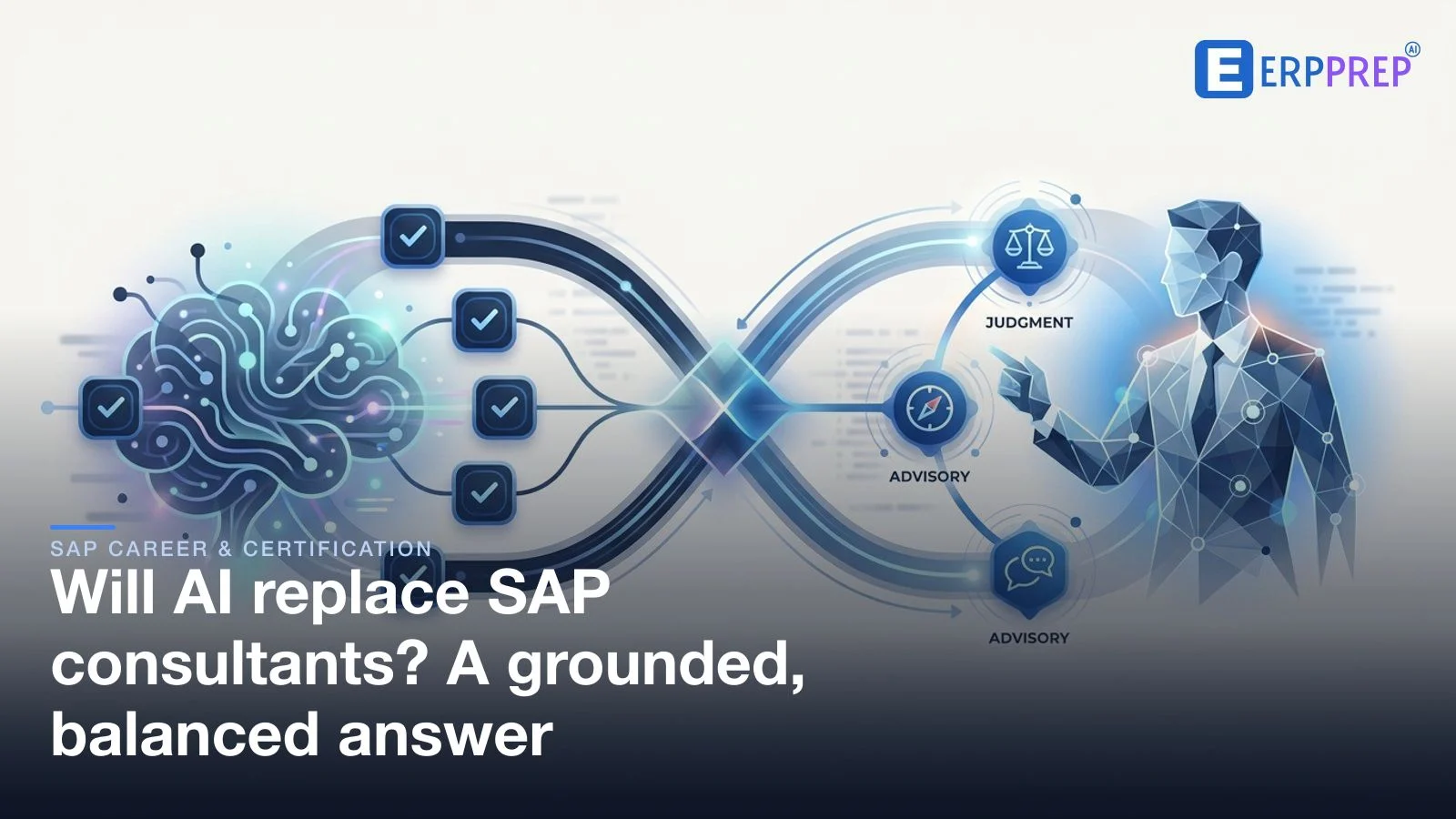
No — the realistic picture is augmentation, not wholesale replacement. Embedded AI assistants and generative AI are automating the repetitive parts of SAP work (boilerplate configuration, first-draft documentation, routine test cases), which shifts a consultant's value toward the judgment-heavy work: requirements, solution design, trade-offs, and change management. The role changes and the durable skills become more valuable, rather than disappearing.
"Will AI replace SAP® consultants?" is the question on every practitioner's mind in 2026, and it deserves a straight, grounded answer rather than either hype or denial. SAP has embedded AI assistants across its products and offers a certification track for building generative-AI solutions on its platform — so the technology is real and already in the room. But the honest read of how consulting work actually gets done points to a shift in the job, not its disappearance. This is the balanced version: what AI genuinely changes, what stays stubbornly human, and what both mean for your SAP certification and career choices.
Key takeaways
- The evidence points to augmentation, not replacement — AI takes over repetitive tasks and raises the value of judgment and advisory work.
- AI is strongest on pattern-based, reviewable tasks(drafting docs, routine tests, standard config) and weakest where business context and accountability are required.
- Certification matters more, not less: someone has to judge whether AI-suggested output is correct — that needs real hands-on fluency.
- The performance-based exam formats (SyBA and SBA) already reward the durable, do-the-work skills AI can't easily own.
- AI-adjacent SAP skills are a growing niche — an associate generative-AI developer certification (C_AIG) already exists to formalize them.
AI's effect on the SAP consultant's work
The clearest way to answer the replacement question is to look at the job as a set of tasks rather than a single monolithic role. Some tasks are highly automatable; others resist automation because they depend on context, judgment, and accountability. Here is how the change lands across the main categories of consulting work:
| Task | How AI is changing it | What stays human |
|---|---|---|
| Repetitive configuration | Assistants can suggest standard settings for well-understood requirements and cut the boilerplate. | Deciding whether a suggested setting is correct for this client's process, landscape, and edge cases. |
| Documentation | Generative AI drafts first-pass specs, config docs, and summaries far faster than writing from scratch. | Verifying accuracy, filling context the draft can't know, and owning what the document commits to. |
| Testing & QA | AI can scaffold routine test cases and flag likely gaps from a specification. | Designing tests for real business risk and judging whether a pass actually means the process works. |
| Process & solution design | AI can surface options and precedents and speed up early exploration. | Choosing the fit-for-purpose design, weighing trade-offs, and being accountable for the recommendation. |
| Stakeholder & change management | AI can help draft communications and organize inputs. | Building trust, reading the room, resolving conflict, and leading people through change. |
The honest answer: augment, not replace
Strip away the headlines and the pattern is consistent: AI is very good at the parts of consulting that are repetitive, well-specified, and reviewable, and much weaker at the parts that require understanding a specific business, making a defensible judgment call, and standing behind it. That is why "augmentation" is the honest framing. A consultant who uses AI well becomes faster at the mechanical work and spends a larger share of the day on the parts clients actually pay a premium for. The job doesn't vanish; its center of gravity moves up the value chain. It is worth being candid about the other side too: roles that are only the repetitive tasks — pure, entry-level, do-exactly-what-the-spec-says work — face the most pressure. The response to that isn't panic; it's to build the judgment layer that makes you the person directing the tool rather than competing with it.
Which tasks AI handles well
Being specific about AI's strengths helps you decide where to lean on it and where to stay firmly in control. Generative AI and embedded assistants tend to do well when a task is pattern-based, has a clear right-ish answer, and gets a human review before it counts:
- Drafting and summarizing. Turning a long specification into a first-draft document, or a meeting into notes, is a natural fit — with a human checking the result.
- Boilerplate and repetition. Standard configuration for well-understood requirements, repetitive data steps, and routine scaffolding are where assistants save the most time.
- First-pass exploration. Surfacing options, precedents, and "have you considered" prompts accelerates early thinking without making the final call.
- Retrieval over recall. Looking up how something is normally done is exactly the kind of memory work assistants offload — which is part of why exams stopped rewarding pure recall.
The common thread is a human in the loop. AI output is a draft to be judged, not a decision to be trusted blindly — and judging it well is itself a skill.
Which judgment-heavy work stays human
The tasks that resist automation are the ones where being right depends on context the model can't fully have and on accountability a tool can't hold. These are the heart of what a good consultant does:
- Understanding the real problem. Clients rarely hand over clean requirements. Drawing out what a business actually needs — and what it hasn't said — is human work.
- Designing for the whole landscape. A change that looks fine in isolation can break something three processes away. Seeing those connections and choosing a fit-for-purpose design is judgment, not pattern matching.
- Owning trade-offs. Most decisions are between imperfect options under real constraints of time, budget, and risk. Someone accountable has to choose — and defend the choice.
- Leading change. Getting people to adopt a new way of working is about trust, communication, and reading a room. That is durably human.
Curious how the exams test the durable skills? A free sample shows the do-the-work, judgment-over-recall style that AI can't shortcut for you. Try a free sample.
How the performance-based exams already reward durable skills
Here is the part that is easy to miss: SAP's move to performance-based certification in 2026 pushes in exactly the direction an AI-augmented world rewards. The two current formats — System-Based Assessment (SyBA), where you complete tasks in a live system, and Scenario-Based Assessment (SBA), where you reason through a connected business scenario — both test whether you can do and evaluate the work, not whether you can recall a fact an assistant could fetch instantly. As AI absorbs the recall-and-draft layer, the skills these exams measure become more distinguishing, not less. If you want the mechanics of that shift, see what SyBA and SBA actually test, and for the durable skill set itself, how the performance-based format rewards applied fluency.
The rise of AI-adjacent SAP skills
The other half of the story is that AI creates new SAP work rather than only subtracting it. Someone has to build, ground, and govern the AI capabilities that land in enterprise systems — and SAP has formalized that as a career path. The associate-level C_AIG (SAP Certified - SAP Generative AI Developer) certification sits in the developer and platform track and recognizes skills in building generative-AI solutions on SAP's platform — prompt engineering, prompt and template management, and orchestrating AI workflows, with grounding in trusted enterprise data. You don't have to become an AI specialist to benefit; even a working understanding of how these capabilities fit your module makes you the person who can bridge functional needs and AI tooling. For where this sits among the broader options, see the BTP, AI & architect certification paths and the wider overview of AI and SAP certification.
How to future-proof your SAP career
"Future-proof" is a strong phrase, but the direction of travel is clear enough to plan around. The consultants best positioned for an AI-augmented market tend to combine three things:
- Deep hands-on fluency in a core module. Depth is what lets you judge AI-suggested output. A shallow generalist is easier to automate than a genuine expert — so stack skills with intent rather than collecting badges.
- The advisory layer. Requirements, design, trade-offs, and change leadership are the durable premium. Deliberately build them, not just your technical config skills.
- Comfort working alongside AI. Learn to use the assistants well and to know their limits. The winners direct the tools; they don't pretend the tools don't exist.
If you're moving in from another field, the same logic applies with more urgency — a switcher's edge is real fluency plus judgment, not just a certificate. The career-switcher path into SAP and hands-on practice in 2026 both lean into building the durable half of the skill set.
What this means for your certification choices
The practical upshot is not "stop certifying" — it's "certify for judgment, and keep it current." Choose a core module where you can build real depth, sit its performance-based exam to prove you can do the work, and treat certification as something you maintain as products evolve rather than a one-time trophy. If your role touches AI, adding an AI-adjacent credential like C_AIG is a defensible way to signal that you can work with the tools, not just around them. And because none of this is about memorizing answers, prepare by practising the way the exams test — doing tasks, tracing processes end to end, and reasoning through scenarios. To place any of this against the market, the SAP consultant pay picture for 2026 and the complete map of certification tracks help you pick where to build depth first.
So — will AI replace SAP consultants? On the evidence of how the work actually gets done, no: it will replace tasks, reshape the role, and reward the consultants who lean into judgment, design, and advisory skill while letting AI take the repetitive load. Certification still matters — arguably more — because someone has to be able to tell whether the machine got it right. Build that person, and the future looks less like a threat and more like leverage. When you're ready to feel how the performance-based format rewards exactly those durable skills, try a free sample.
Frequently asked questions
- Will AI replace SAP consultants?
- Not wholesale. The realistic pattern is augmentation: AI automates repetitive parts of the work — boilerplate configuration, first-draft documentation, routine test scaffolding — while the judgment-heavy work stays human. Requirements gathering, solution design, trade-off decisions, and change management still depend on people who understand a business and can be held accountable for a recommendation. The role shifts rather than disappears.
- Which SAP consulting tasks is AI most likely to automate?
- The most automatable tasks are repetitive and pattern-based: generating first-draft documentation, drafting routine test cases, summarizing long specifications, and suggesting standard configuration for well-understood requirements. AI is strong where the pattern is clear and a human still reviews the output — and weaker where the task needs business context, accountability, or a judgment call between imperfect options.
- What SAP skills stay valuable as AI advances?
- The durable skills are the ones AI struggles to own: understanding a client's actual process and constraints, designing a solution that fits the whole landscape, weighing trade-offs, validating that AI-suggested output is correct in context, and leading stakeholders through change. These are judgment and communication skills layered on top of genuine hands-on fluency — exactly what the performance-based exam formats already reward.
- Do I still need SAP certification if AI can do configuration?
- Yes — arguably more so. If AI drafts configuration, the scarce skill becomes judging whether that draft is correct, safe, and appropriate for the business. That requires the same hands-on understanding certification is meant to verify. The 2026 performance-based formats test whether you can actually do and evaluate the work, not whether you can recall facts an assistant could retrieve for you.
- Is there an SAP certification for AI skills?
- Yes. SAP offers an associate-level certification for generative AI development — C_AIG, SAP Certified - SAP Generative AI Developer — aimed at building AI solutions on SAP's platform using prompt engineering and orchestration. It sits in the developer and platform track and is a natural way to add AI-adjacent skills to an existing SAP profile. Always confirm the current scope and format on the exam's page at learning.sap.com.
- How should career switchers think about AI and SAP?
- Treat AI as a reason to go deeper, not a reason to avoid the field. Entry-level, purely repetitive tasks are the most exposed to automation, so a switcher's edge is building genuine hands-on fluency in a module plus the judgment to evaluate AI-assisted output. Pairing a functional certification with AI-adjacent skills is a defensible way to enter a market where consultants increasingly work alongside AI rather than against it.
- Will AI change how SAP certification exams are taken?
- The exams already moved toward performance-based formats — System-Based (SyBA) and Scenario-Based (SBA) assessment — that test doing over recalling. That direction is well suited to an AI-augmented world: as assistants handle recall and drafting, the exams increasingly reward the judgment and applied skill that remain scarce. Confirm the current format for any specific exam on learning.sap.com.
- What's the single best way to future-proof an SAP career?
- Combine deep hands-on fluency in a module with the advisory skills AI doesn't replace — solution design, trade-off judgment, and change leadership — and stay curious about how AI tools fit your work. Certification in your core area, kept current, plus a working understanding of AI-adjacent skills, is a durable combination that positions you to direct AI rather than be displaced by it.
ERPPrep is an independent platform and is not affiliated with, endorsed by, or sponsored by SAP SE. SAP and other SAP products are trademarks of SAP SE, referenced here only to describe the certification exams ERPPrep helps you prepare for.
Ready to practise the way the exam tests?
ERPPrep provides original, performance-style scenarios and skill drills built for the 2026 SyBA and SBA formats. Try a free sample and judge the quality yourself.
Practice for these exams
Related guides
What jobs can you get with an SAP certification?
The roles an SAP certification opens, mapped by track — functional consultant, developer, analytics, security, project manager, and architect — with realistic job titles.
Is SAP certification worth it in 2026? An honest, data-backed answer
An honest, data-backed look at whether SAP certification is worth it in 2026 — what it does for salary, hiring, and career mobility, and who it suits.
Which SAP AI certification should you take?
SAP's AI credentials split three ways: build generative AI, position Business AI, or run the platform it sits on. A role-by-role way to choose one.