

What jobs can you get with an SAP certification?
The roles an SAP certification opens, mapped by track — functional consultant, developer, analytics, security, project manager, and architect — with realistic job titles.
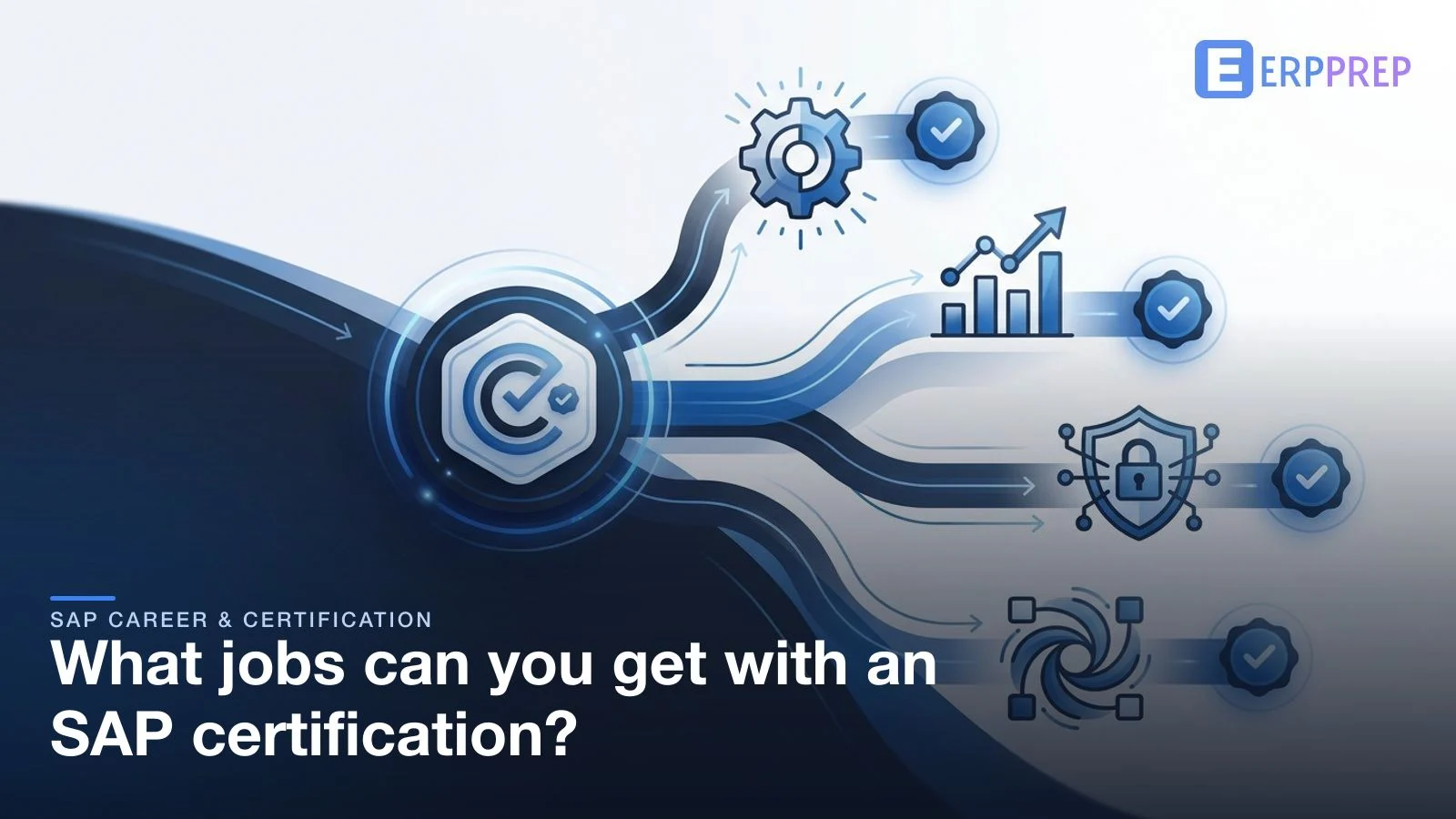
An SAP certification maps to roles across six tracks: functional consultant, technical developer, analytics and data, security and Basis administration, project management, and solution architect. The exact title and seniority depend on the certification family and your hands-on experience — a credential opens the door, but delivery experience and communication are what actually get you hired.
"Get SAP® certified" is common advice, but it skips the question that actually matters: which jobs does a certification open, and which certification points at the role you want? SAP is a large landscape of modules and platforms, and the credential you choose signals a track — functional consulting, development, analytics, security, project delivery, or architecture. This guide maps each track to realistic job titles and seniority, and it is honest about the part certifications don't do on their own. For the bigger picture of whether the effort pays off, see whether SAP certification is worth it and how to choose.
An SAP certification maps to roles across six tracks: functional consultant, technical developer, analytics and data, security and Basis administration, project management, and solution architect. The certification family signals which track you're on, while the exact title and seniority depend on your hands-on experience. A credential opens the door — delivery experience and communication are what actually get you hired.
Key takeaways
- The certification family signals the track. A finance or HR certification points at functional consulting; an ABAP, Fiori, or BTP certification points at development. Choose the family that matches the work you want to do.
- There are six broad tracks, not one job. Functional, technical/developer, analytics/data, security & Basis, project/program, and architect are distinct career paths with distinct titles.
- Seniority comes from experience, not the exam. A certification typically places you at associate or junior level; consultant, senior, lead, and architect titles are earned through delivery.
- A certification opens the door; three things get you hired. Employers hire on the combination of certification, hands-on experience, and soft skills — no credential does it alone.
- Match the track to demand and interest. SAP publishes no role-level hiring or salary data, so choose for genuine interest and real local demand rather than a headline you can't verify.
How SAP certifications map to jobs, at a glance
Before the detail, here is the whole landscape in one table: each track, the certification families that lead into it, and the job titles you'll actually see advertised. Read across to find where a credential you're considering could take you.
| Track | Certification families (examples) | Typical job titles |
|---|---|---|
| Functional consultant | Finance (C_TS4FI), HR / SuccessFactors (C_THR81), procurement, supply chain | Module consultant, functional consultant, S/4HANA consultant, module lead |
| Technical / developer | ABAP, Fiori / UI5, BTP, generative AI on BTP (C_AIG) | ABAP developer, Fiori developer, BTP developer, integration developer |
| Analytics & data | Analytics Cloud, Datasphere, reporting & data modelling | SAP analytics consultant, BI / reporting analyst, data engineer |
| Security & Basis administration | Security & authorizations, system administration (Basis), GRC | SAP security consultant, Basis administrator, GRC consultant |
| Project & program management | SAP Activate project management, delivery methodology | SAP project manager, delivery lead, scrum master, program manager |
| Solution architect | Multiple senior credentials across a solution area | Solution architect, technical architect, enterprise architect |
A useful sanity check on any track is SAP's own catalogue of what it certifies (SAP, learning.sap.com/certifications) — it groups certifications by solution area, which mirrors the way the job market groups roles. The rest of this guide walks each track in turn.
Functional consultant track
This is the largest and most common destination for an SAP certification. A functional consultant configures an SAP module so that it runs a real business process — deciding how finance, HR, procurement, or supply chain should work in the system and setting it up accordingly. The work is business-facing: you gather requirements, map processes, configure, test, and support go-live, usually with limited or no coding. It suits people who enjoy the meeting point of business and technology. For a fuller picture of the day-to-day, see what an SAP consultant actually does.
The track splits by module, and your certification tells recruiters which one you know. A finance certification such as SAP S/4HANA Finance (C_TS4FI) points at roles like FI consultant, finance functional consultant, or S/4HANA finance module lead. An HR certification such as SAP SuccessFactors Employee Central (C_THR81) points at HCM or SuccessFactors consultant roles. Procurement and supply-chain certifications point at the corresponding functional-consultant titles. In every case the pattern holds: the module you certify on is the specialism you get hired into, so choose it to match the work you want — not the exam that looks easiest.
Technical / developer track
If you'd rather build than configure, the developer track is where SAP certifications point. This covers classic ABAP development, Fiori/UI5 front-end work, extension and service development on SAP Business Technology Platform (BTP), and the integration work that connects SAP to everything around it. Titles include ABAP developer, Fiori/UI5 developer, BTP developer, full-stack SAP developer, and integration developer. The skill emphasis is software engineering applied to the SAP ecosystem rather than business-process configuration.
The platform is broadening what "developer" means. Newer credentials sit on BTP and cloud-native development — for example a generative-AI developer certification such as SAP Generative AI Developer (C_AIG) aims at developers building AI-enabled extensions on the platform. That widens the track from pure ABAP into cloud, integration, and AI-adjacent roles. If you're unsure whether to head functional or technical, the trade-offs are laid out in the SAP consultant versus developer certification path. Both are valid careers; the choice is mostly about whether you prefer business problems or building software.
Analytics & data track
A growing set of certifications sits on the analytics and data side of the platform — turning the transactional data SAP captures into reporting, models, and decision support. Certifications here cover tools like SAP Analytics Cloud and SAP Datasphere, plus the reporting and data-modelling skills that ride on top of the core modules. The roles read as SAP analytics consultant, business intelligence or reporting analyst, and data engineer, often bridging between a functional team and the people who need dashboards and insight from the system.
This track suits people who like data structures and turning numbers into answers, and it pairs well with functional knowledge: an analytics specialist who also understands the finance or HR module underneath produces far more useful reporting than one who treats the data as anonymous rows. It's a natural second specialism for a functional consultant, as much as a starting point in its own right.
Security & Basis administration track
Behind every running SAP system are the people who keep it available and secure. The Basis administrator installs, patches, monitors, and tunes the technical landscape; the security consultant designs authorizations and controls who can do what; and the GRC consultant manages governance, risk, and compliance across access. Certifications in system administration, security and authorizations, and governance point at exactly these roles. It is an infrastructure-flavoured track — closer to operations and platform engineering than to business-process consulting.
These roles are less visible than consulting but consistently in demand, because no organisation can run SAP without them and the work carries real responsibility for uptime and control. They suit people who are methodical, comfortable with technical detail, and reassured rather than bored by being the safe pair of hands. Security and Basis skills also travel well, since almost every SAP customer needs them regardless of which modules they run.
Project & program management track
SAP implementations are large projects, and delivering them is a career in its own right. SAP's Activate methodology has its own project management certification, and it points at roles like SAP project manager, delivery lead, scrum master, and — at scale — program manager overseeing a portfolio of workstreams. The emphasis here is on planning, coordination, risk, stakeholders, and delivery cadence rather than hands-on configuration or code.
This track is unusual in that it rewards prior experience heavily: the strongest project managers often come up through functional or technical roles first, so they understand what they are managing. A certification signals fluency in the SAP-specific delivery approach, but management roles lean more than any other track on the soft skills — communication, negotiation, leadership — that no exam measures. If your strength is orchestrating people and moving a complex delivery forward, this is where it fits.
Not sure which track suits how you like to work? The fastest way to feel the difference is to try the practice itself — a functional scenario asks you to decide and configure, and that hands-on experience tells you more than any role description. Try a free sample and see whether the doing-and-deciding style fits you.
Solution architect track: the senior destination
Architect is a destination, not an entry point. Solution architects, technical architects, and enterprise architects design how the pieces fit together — which modules, which platform services, which integrations, and how it all supports the business over time. It is a senior role that assumes years of hands-on delivery across more than one area, and the certifications associated with it tend to be advanced or professional-level credentials rather than the associate exams most people start with.
The honest framing: you don't certify your way into an architect role directly. You build a functional or technical foundation, deliver real projects, broaden across solution areas, and grow the systems-thinking and stakeholder credibility the role demands. Certifications mark milestones along that path and validate breadth, but the title comes from a track record. Treat it as a north star that shapes which experiences you seek, not a box to tick this year.
Certification is one of three things employers hire on
Whichever track you choose, be clear-eyed about what a certification does. It is a genuine asset: it helps you clear automated and recruiter screening filters, it proves you invested real effort in the skill, and it gives you the vocabulary to hold your own in an interview. What it does not do is get you hired on its own. Employers hire on a combination of three things — the certification, demonstrable hands-on experience, and soft skills like communication, problem-solving, and stakeholder management. Miss any one and the other two rarely carry you.
That's why the strongest candidates pair a credential with evidence they can do the work and the ability to explain their reasoning clearly. A certification without any hands-on story reads as theory; hands-on skill without a credential can struggle to get past screening; and both without the soft skills to work with a client team limits how far you go. For a realistic account of what the credential does and doesn't deliver in a job search, see whether an SAP certification actually helps you get hired. Anyone promising a guaranteed job from a certificate alone is overselling.
Seniority: where a certification places you
A common misread is that a certification lands you a senior title. In practice most SAP certifications are associate-level and place a newcomer at associate consultant, junior consultant, or analyst level — the entry rung of a track. Consultant, senior consultant, lead, and architect titles are earned by delivering projects, not by passing more exams. The credential establishes that you know the module or platform; the market decides your level from what you've shipped.
This matters for how you plan. If you already have domain experience — years in finance, HR, or logistics — a certification can help you enter SAP closer to the middle of a track, because your background counts. If you're starting fresh, expect to begin at the associate rung and climb through delivery. Either way, stacking many certifications without the experience to match tends to read as less credible than one or two credentials backed by real project work.
Choosing a track, and where to start
Work backwards from the job. Decide whether you want to configure business processes (functional), build software (technical), turn data into insight (analytics), secure and run the landscape (security & Basis), or deliver projects (project management) — then pick the certification family that track expects and, within it, the specific module or platform that matches your interests and your local market. If you're changing careers into SAP entirely, the practical entry points and how to make your background count are covered in the career-switcher path into SAP.
Once you've chosen, the preparation is what actually builds the skill an employer is hiring for — and SAP's 2026 exams reward doing, not recall, so hands-on practice is the point. Start with a track that genuinely interests you, whether that's finance, HR, or a developer path, and prove to yourself that the work fits before you commit. The best next step is a hands-on look: try a free sample and see which track feels like the job you want, then let your certification and your growing experience carry you into it.
Frequently asked questions
- What jobs can you get with an SAP certification?
- SAP certifications map to six broad tracks. A functional certification (finance, HR, procurement, supply chain) points toward module or functional consultant roles. A developer certification (ABAP, Fiori, BTP) points toward developer and integration roles. There are also analytics and data roles, security and Basis administration roles, project and program roles built on SAP Activate, and — with seniority — solution and enterprise architect roles. The certification family signals which track; your hands-on experience decides the level.
- Can I get an SAP job with only a certification and no experience?
- It is harder than it looks, but not impossible. A certification proves you understand a module or platform, which helps you clear a screening filter and shows commitment — but most SAP roles also expect hands-on delivery experience. Realistic entry points for someone with a certification and no project history are associate consultant, graduate-programme, or support-analyst roles, often at an implementation partner. Pair the credential with a portfolio of practice work and the honesty to say what you have and have not done.
- What is the difference between a functional and a technical SAP job?
- A functional consultant configures an SAP module to match a business process — deciding how finance, HR, or procurement should run and setting the system up to do it, usually with limited or no coding. A technical role builds and extends the software itself: ABAP programs, Fiori apps, BTP services, and integrations. Functional roles suit people who like business process and stakeholder work; technical roles suit people who like building. Some careers blend the two as a techno-functional consultant.
- Which SAP certification leads to the highest-paying jobs?
- SAP does not publish salary data by certification, and pay depends heavily on region, seniority, demand, and the depth of your delivery experience — so treat any single ranking with caution. In general, roles pay for scarcity and responsibility: hard-to-fill specialisms, senior architect positions, and areas of high current demand tend to command more than entry-level generalist roles. Choose a track for genuine interest and market demand rather than a headline figure, because the experience you build is what actually moves your compensation.
- What entry-level SAP jobs can a career switcher target?
- Career switchers most often start as associate or junior functional consultants, application-support analysts, or graduate-programme hires — frequently at an SAP implementation partner, where structured onboarding and mentoring exist. Pick one module that matches your existing domain knowledge (finance experience toward finance, HR experience toward HR) so your background counts for something. A certification plus demonstrable hands-on practice makes you a credible junior candidate even without prior SAP project time.
- Do SAP certifications lead to remote or contract work?
- SAP skills exist in both permanent and contract markets, and much SAP consulting is delivered remotely or hybrid because the system is accessed over the network. Contract and freelance work usually rewards proven delivery experience more than a certification alone, so it tends to open up after you have shipped a few implementations. Early in a career, a permanent role at a partner or customer is the more reliable way to build the track record that later makes contracting viable.
- Which SAP certification track should I choose for my career?
- Start from the work you want to do, not the exam. If you like business process and stakeholder conversations, a functional track (finance, HR, procurement, supply chain) fits. If you like building software, a developer track (ABAP, Fiori, BTP) fits. Analytics, security and Basis, and project management are distinct tracks with their own roles. Match the track to your interests and to where demand is real in your region, then pick the specific certification that role expects.
- Does an SAP certification guarantee a job?
- No. A certification is a strong signal — it clears screening filters, proves you invested in the skill, and gives you vocabulary for interviews — but employers hire on the combination of certification, hands-on experience, and soft skills. No credential can promise an outcome, and anyone claiming a guaranteed job from a certification alone is overselling. Treat the certification as the door-opener and your demonstrable ability to do the work as the thing that actually earns the offer.
ERPPrep is an independent platform and is not affiliated with, endorsed by, or sponsored by SAP SE. SAP and other SAP products are trademarks of SAP SE, referenced here only to describe the certification exams ERPPrep helps you prepare for.
Ready to practise the way the exam tests?
ERPPrep provides original, performance-style scenarios and skill drills built for the 2026 SyBA and SBA formats. Try a free sample and judge the quality yourself.
Practice for these exams
Related guides
Will AI replace SAP consultants? A grounded, balanced answer
AI won't wholesale replace SAP consultants — it automates the repetitive parts of the job and shifts the value toward judgment, design, and advisory work. Here's what changes, what stays human, and what it means for your certification choices.
How to prepare for an SAP consultant interview in 2026
SAP interviews test more than a certificate. This guide maps the four areas every SAP consultant interview probes — module depth, process reasoning, project scenarios (STAR) and soft skills — and shows how to prepare for each, whatever your module.
Is SAP certification worth it in 2026? An honest, data-backed answer
An honest, data-backed look at whether SAP certification is worth it in 2026 — what it does for salary, hiring, and career mobility, and who it suits.