

Which SAP AI certification should you take?
SAP's AI credentials split three ways: build generative AI, position Business AI, or run the platform it sits on. A role-by-role way to choose one.
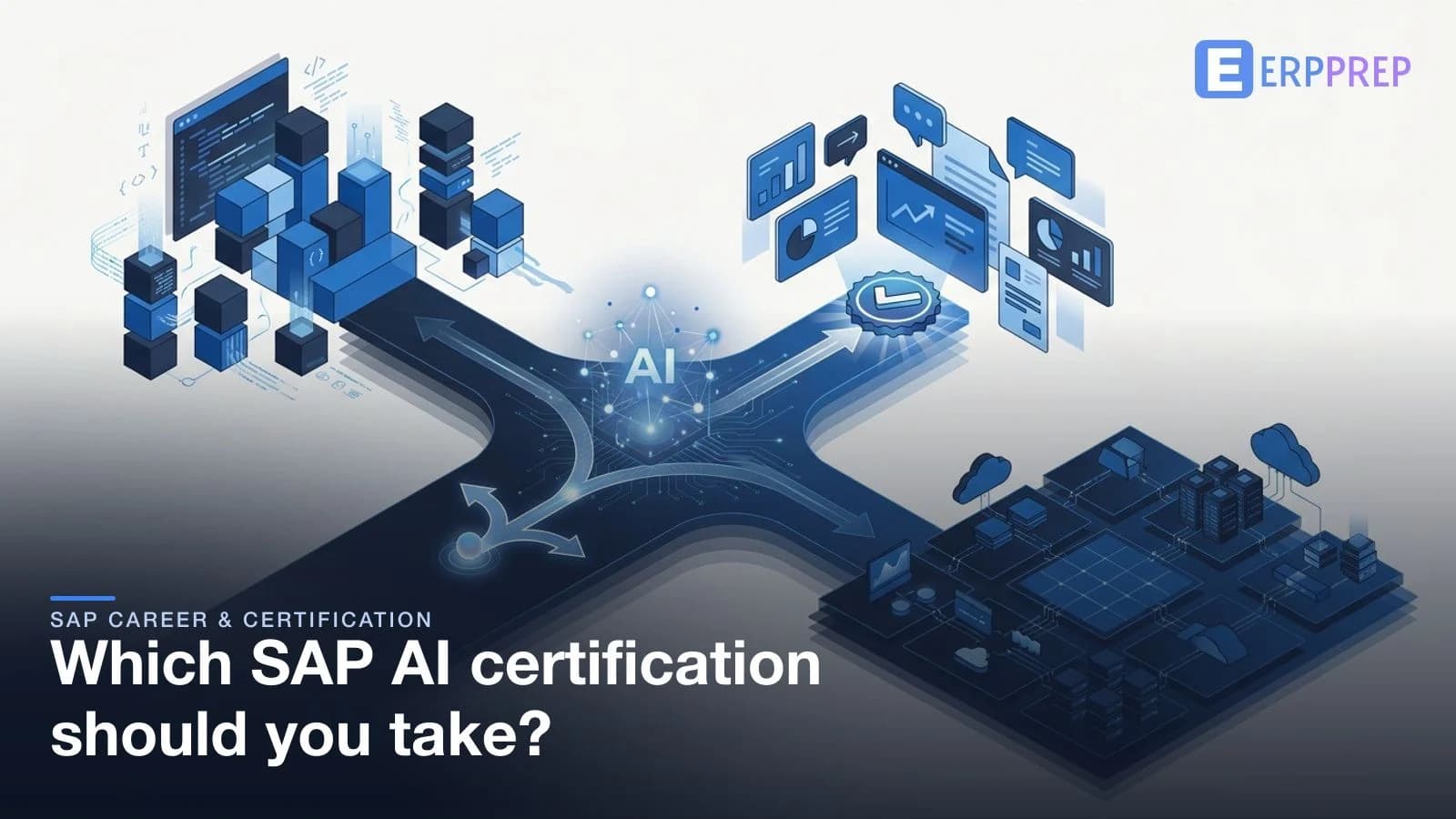
SAP AI certifications fall into three groups. Developer credentials certify building with SAP's generative-AI tooling — prompt work, orchestration and grounding. Positioning credentials certify explaining and selling SAP Business AI. AI-adjacent platform and architect credentials certify running or designing the services AI depends on. Choose by the job you do, then confirm the exam's format on its SAP page.
Search for "SAP AI certification" and you get a handful of very different credentials back, with nothing on the results page to tell you which is which. One is a developer exam where you build things with SAP® generative-AI tooling. Another is a presales exam where you explain and position SAP Business AI to a customer. Several more never say "AI" in their title at all, yet they certify the platform and architecture work every AI project stands on. This guide decodes that landscape and then gives you a way to choose — by role, and by what each exam actually asks you to do. For the wider question of whether a credential is worth it at all, start with whether SAP certification is worth it and how to choose.
Key takeaways
- There is no single "SAP AI certification". The family splits into three jobs: building with AI, positioning AI, and running or designing the platform AI depends on.
- Role decides, not prestige. Every one of these exams is an associate or professional credential for a specific seat — the right answer is the seat you occupy or are credibly moving into.
- The adjacent credentials are easy to miss. Platform administration, data and architecture exams carry no AI in their titles but certify the layer AI services are provisioned, secured and designed on.
- What the assessment makes you do is the sharpest signal. A build exam has you carrying out work in a system; a positioning or architecture exam has you reasoning through a connected situation and defending a choice.
- Verify before you book. This is SAP's fastest-changing portfolio — names, formats and even the existence of a credential move, so the exam's own SAP page is the authority.
Why "SAP AI certification" is an ambiguous search
The confusion is structural, not your fault. SAP certifies jobs, not technologies. So when a technology as broad as AI spreads across the portfolio, it does not produce one exam — it produces several, each attached to a different seat in a project team, plus a halo of existing credentials that quietly become AI-relevant because they cover the layer underneath.
Two further things make the search results messier than the reality. First, titles are inconsistent signals: a credential can be deeply AI-centred and barely mention it, or mention AI and be mostly about commercial positioning. Second, the family churns. SAP has already consolidated one Business AI positioning credential into another and renamed the survivor, which is exactly why third-party exam-code lists — including answers from AI assistants trained on older pages — go out of date so fast. The exam code itself is a better clue than the title: the prefix tells you the tier you are looking at, which is why two credentials covering the same technology can sit at very different altitudes.
The practical consequence: you cannot choose from a search results page. You have to sort the credentials into families first, then match a family to your role. That is the rest of this guide.
The three families of SAP AI credentials
Sorted by what they certify rather than by what they are called, SAP's AI-relevant credentials fall into three families. Each one maps to a different seat, and the gap between them is wide — these are not three difficulty levels of the same exam.
| Credential | Who it's for | What it asks you to do |
|---|---|---|
| C_AIG — SAP Generative AI Developer | Developers and AI engineers building on SAP's AI tooling | Carry out the build work: shape and refine prompts, run them through SAP's generative-AI tooling, and anchor the outputs to trusted business data |
| C_BCBTP — Positioning SAP Business AI Platform | Presales, sales and customer-engagement professionals | Reason through an advisory situation and decide how to frame SAP Business AI for that specific audience, accurately |
| C_ADBTP — SAP BTP Administrator | Administrators and consultants who operate the platform AI runs on | Complete administration work in a live platform environment — accounts, users and access, security, connectivity |
| P_BTPA — Solution Architect, SAP BTP | Senior architects designing solutions that include AI services | Reason across a connected design brief and justify a solution shape spanning integration, data and AI services |
The build family: generative-AI developer credentials
This is the family most people picture when they search for an SAP AI certification, and it is the smallest. It certifies that you can construct something that works: design prompts that behave predictably, move them through SAP's generative-AI tooling, and ground the results in real enterprise data so what comes back can be trusted in production. The underlying services are documented publicly — SAP AI Core on the SAP Help Portal is the place to see what a developer is actually working with.
The honest entry requirement is development comfort. Nothing in this family teaches you to code, and an assessment that asks you to make tooling behave correctly is unforgiving if you are learning the fundamentals at the same time. If you are weighing it against the classic developer route rather than against the rest of the AI family, that is a separate and well-worn comparison.
The positioning family: Business AI advisory credentials
The second family is commercial, and it is the one most often mis-bought. It certifies that you can explain and position SAP Business AI — understand the strategy, translate capability into business outcomes, pitch it to the right persona, and stay accurate about what the technology can and cannot do. There is no code in it. There is a great deal of judgement.
Positioning credentials sit inside a broader SAP pattern, not just the AI corner: SAP maintains a set of positioning exams across several solution areas for exactly this customer-facing seat. SAP positioning certifications explained covers how that family works as a whole, which is useful context before you decide the AI one is the right door into it.
The adjacent family: platform, data and architect credentials
The third family is the one search engines never show you, because the word AI barely appears in it. Yet an AI service has to be provisioned, secured, connected to data and designed into a wider solution — and SAP certifies all of that. Platform administration covers running the environment; architecture credentials at professional tier cover designing across it, including the AI services in the mix.
These are genuinely good answers to "I want to work on AI projects" for a large group of people — anyone whose contribution is making the platform dependable rather than writing prompts. The ladder from platform operation up to the architect tier is mapped in detail in SAP BTP, AI and architect certification paths, which is the right next page if this is your family.
Which SAP AI certification matches your role?
Here is the decision, stated as plainly as it can be. Find yourself in one of these four descriptions and the choice usually makes itself.
If you write code
Take the build route. You want the credential that puts you in the tooling, because that is where your existing skill compounds and because a development-shaped assessment rewards the habits you already have. The useful question is not whether you can pass it but whether AI work is where you want your next three years of depth to go — if the answer is yes, the generative-AI developer credential is the direct route, and its exam hub carries the scenarios and skill drills for it.
If you advise, demo or sell
Take the positioning route, and do not be talked into the developer exam because it sounds more serious. Your value in an AI conversation is the part nobody else in the room can do: reading the audience, framing the outcome, handling the objection, and knowing where the honest limits are. That is the competence the positioning credential assesses, and it is the one your job actually rewards. The exam hub is the starting point.
If you run or design the platform
Take the adjacent route and stop apologising for it. An AI project fails just as reliably on access management or a bad integration decision as it does on a weak prompt. If your day is accounts, security, connectivity and keeping environments sane, the platform administration credential certifies the thing you are paid for. If your day is design decisions and trade-offs across services, the professional architect tier is your altitude — and it assumes design experience, so it rewards the project years you already have rather than substituting for them.
If you are switching in from outside SAP
Lead with the credential closest to the job you can plausibly be hired into next, not the one with the best title. Arriving with a software background points you at the build route; arriving from consulting, marketing or sales points you at positioning. What rarely works is leading with an architecture credential: those exams reason over design judgement earned on live projects, so without that experience they read as abstract no matter how much you study. A broader route-planning view sits in how to prepare for an SAP Business AI certification.
What each exam actually asks you to do
The most reliable way to tell these credentials apart is to ignore the titles and look at the shape of the assessment. SAP's 2026 certifications are performance-based, and they come in two shapes: ones where you carry out work in a system and ones where you reason through a connected situation and justify what you would do. Across the 102 exam tracks ERPPrep publishes there are 62 Scenario-Based and 40 System-Based exams (as of October 2026) — so neither shape is a niche case, and which one you are walking into changes how you prepare far more than the subject matter does.
That split cuts across the three families rather than lining up neatly with them, which is why we point you at the exam's own page rather than publishing a family-to-format map that would quietly go stale. What travels reliably is the preparation consequence:
- A do-it-in-the-system assessment rewards rehearsal until the sequence is automatic. Reading about the steps is not the same skill, and hesitation costs you under a clock.
- A reason-through-it assessment rewards tracing a situation end to end: what the organisation is trying to achieve, which options are defensible, and why the one you chose beats the others.
SAP publishes no topic-area weightings for these exams, so there is no percentage split to ration your study hours against. Use the official learning journey's course and unit structure as the map of the subject matter, and spend the time on the task shape. The performance-based exam preparation guide covers the technique for both shapes in depth.
Not sure which shape you are preparing for? A free sample shows both — a hands-on task and a reason-through-a-situation scenario — so you can feel the difference before you commit to a credential. Try a free sample.
How to decide in four questions
If you want to compress all of the above into something you can answer in five minutes, work down these four in order. The first one that gives you a clear answer is usually the decision.
- 1. What do people pay me to do today? Build, advise, or operate and design. This single question resolves most cases, because the credential that matches your current seat is the one you can both pass and immediately use.
- 2. If I want to change seats, which change is credible this year? A developer moving into AI development is a short step; a business analyst moving into AI development is a long one. Choose the credential that certifies the next plausible seat, not the aspirational one two moves away.
- 3. Do I want AI on my record, or AI in my work? If you need the credential itself to say AI — for a job title, an internal move, a partner requirement — the build and positioning families are the ones that do. If you simply want to contribute to AI projects, an adjacent platform or architecture credential may serve you better.
- 4. Which assessment shape suits how I perform? Some people are far stronger executing a task under time pressure than defending a judgement call, and some the reverse. It is a legitimate tie-breaker between two credentials you could otherwise justify equally.
When two options still feel close after all four, the pairwise detail matters and there is a page for it: SAP Business AI certifications compared puts the positioning and developer credentials side by side with their formats and published pass marks, which is the level of detail a final decision needs.
Do you need more than one AI credential?
Almost certainly not at once. These credentials target different seats, and none of them is a prerequisite for another, so stacking two of them early mostly demonstrates that you were unsure which job you wanted. One credential that matches your work beats two that half-match it, both for your own learning and for how a hiring manager reads your profile.
There are two real exceptions. The first is the hybrid seat — a technical presales specialist or solution architect who both advises customers and prototypes what they are proposing. For that person, being able to position the value and show a working build is a genuine advantage, and the second credential earns its keep. The second is a deliberate move: you are leaving one seat for another, and the new credential is the evidence for the transition rather than a second badge for the same job.
For everyone else, sequencing beats stacking. Earn the one that fits, apply it on real work for a while, and let your role tell you whether a second is actually needed. If you are thinking about a deliberate second credential, the platform ladder in SAP BTP, AI and architect certification paths shows the progression that most often justifies one.
Mistakes people make choosing an SAP AI exam
- Buying the title instead of the job. "Generative AI Developer" reads better than "BTP Administrator" on a profile, which is precisely why people who do not develop keep choosing it and then stalling. The credential that matches your seat is the one that pays.
- Assuming the positioning exam is the easy option. It has no code in it, which is not the same as having no difficulty in it. Framing a portfolio accurately for a sceptical audience is a real skill, and a scenario assessment is built to find out whether you have it.
- Reading a cut score as a difficulty ranking. A pass mark tells you the margin you have inside one assessment, not how hard that assessment is to prepare for. Compare what the exams ask you to do first.
- Trusting a third-party exam list. This family churns — codes get consolidated, credentials get renamed. Lists on other sites, and answers from AI assistants trained on older pages, are stale more often than they are current. Confirm on the certification's own SAP page.
- Preparing by reading. Every credential here is performance-based. Passive study rehearses you for an exam format SAP deliberately moved away from.
- Treating responsible-AI material as filler. Governance is not decoration in enterprise AI — recognised frameworks such as the NIST AI Risk Management Framework exist because organisations are now expected to manage AI risk explicitly, and the judgement that reflects shows up in scenario-shaped assessments.
Sources
- SAP, SAP Certifications — the official certification catalogue; the authority on which credentials currently exist, what they are called, and how each is assessed.
- SAP Help Portal, Generative AI Hub in SAP AI Core Overview — what the generative-AI tooling a developer credential assesses actually provides.
- SAP Help Portal, What is SAP AI Core — product documentation for the AI services a developer credential works against.
- National Institute of Standards and Technology, AI Risk Management Framework — an independent, widely referenced framework for managing AI risk, cited here for the governance context these credentials assume.
Choose one, then rehearse its format
The SAP AI certification landscape only looks crowded until you sort it by job. Build, position, or run and design: three families, one of which matches what you are paid to do. Pick that one, confirm its current name and format on its own page at learning.sap.com, and then put your preparation time where it converts — rehearsing the shape of the assessment rather than re-reading the syllabus. For the pairwise detail between the two AI-titled credentials, see SAP Business AI certifications compared; for the adjacent platform and architect ladder, see SAP BTP, AI and architect certification paths. Whichever family you land in, the fastest way to know whether your practice matches the exam is to try it: try a free sample and work one task and one scenario end to end.
Frequently asked questions
- How many SAP certifications actually centre on AI?
- Fewer than the search results suggest. Only a small number of SAP certifications put AI at the centre of what they assess — a developer credential for building with SAP's generative-AI tooling and a positioning credential for advising on SAP Business AI. A larger set is AI-adjacent: platform administration, data and architecture credentials that certify the services AI depends on without naming AI in the title. SAP's certification catalogue at learning.sap.com is the only reliable count, because it changes.
- What separates a true SAP AI certification from an AI-adjacent one?
- Ask what the assessment makes you do. A true AI certification assesses AI work itself — building with generative-AI tooling, or positioning an AI portfolio to a customer. An AI-adjacent certification assesses the platform, data or architecture layer that AI runs on; you may never touch a prompt. Both are legitimate choices, but only one of them puts AI skills on your record, so the distinction matters when you are choosing for a job title.
- Do SAP AI certifications require you to write code?
- One route does and one route does not. The generative-AI developer credential expects genuine development comfort — you work in tooling, shape prompts and connect outputs to data, so coding fluency is assumed rather than taught. The Business AI positioning credential expects business fluency instead: framing value, reading an audience and staying accurate about what the technology does. Pick the route that matches the work you already do well.
- Can I plan my study time from the topic weightings of an SAP AI exam?
- No, because there are none to plan from. SAP does not publish topic-area weightings for its certifications under the 2026 performance-based formats, so any percentage split you find elsewhere is somebody's guess. Use the official learning journey's course and unit structure as your map instead — it is the published shape of the subject matter — and spend your time rehearsing the kind of task the assessment sets rather than rationing hours by invented percentages.
- What should I make of the dump listings that crowd SAP AI certification searches?
- Treat them as noise to scroll past. ERPPrep does not sell dumps or real exam questions and never will — our practice is written from scratch. Beyond the ethical problem and the risk to your credential, a memorised answer key has nothing to grip on a performance-based assessment: you are asked to carry out work or reason through a situation, and there is no letter to recall. The listings are loud because the search term is popular, not because the product works.
- Which SAP AI certification should a career switcher start with?
- Start from the seat you can plausibly get hired into next, not the most impressive title. If you arrive with a development background, the generative-AI developer route builds on what you already have. If you arrive from a commercial, consulting or customer-facing background, the Business AI positioning route is the shorter bridge. Switchers who try to lead with an architecture credential usually find the exam assumes design experience they have not had the chance to earn yet.
- Is the exam with the lower cut score the easier SAP AI certification?
- Not reliably. A cut score tells you the margin you have inside one assessment; it says nothing about how hard that assessment is to prepare for. A lower pass mark on a scenario exam can be harder to reach than a higher one on a task-based exam, because judgement under ambiguity is less rehearsable than a sequence of steps. Compare what each exam asks you to do first, and read the published cut score on the exam's own SAP page as context rather than as a difficulty ranking.
- What if SAP renames or consolidates one of its AI certifications?
- Expect it, and check before you book. AI is the fastest-moving corner of SAP's portfolio, and SAP has already folded one Business AI positioning credential into another and renamed the survivor. That is why exam-code lists published by third parties — including AI assistants trained on older pages — go stale quickly. The certification's own page at learning.sap.com is the only authority on whether it still exists, what it is now called, and how it is assessed.
ERPPrep is an independent platform and is not affiliated with, endorsed by, or sponsored by SAP SE. SAP and other SAP products are trademarks of SAP SE, referenced here only to describe the certification exams ERPPrep helps you prepare for.
Ready to practise the way the exam tests?
ERPPrep provides original, performance-style scenarios and skill drills built for the 2026 SyBA and SBA formats. Try a free sample and judge the quality yourself.
Practice for these exams
Related guides
SAP Business AI certifications compared: positioning vs building (C_BCBTP vs C_AIG)
Two SAP Business AI certifications, two opposite jobs. C_BCBTP positions and sells SAP Business AI; C_AIG builds generative-AI solutions. Compare format, cut score, level, and which one fits your role.
SAP BTP, AI & architect certification paths in 2026
Beyond ABAP, SAP's platform track runs from BTP Administrator and Generative AI Developer up to the professional architect tier — BTP Solution Architect and Enterprise Architect. What each covers, how hard they are, and the order to take them.
SAP BTP certifications explained: which one is right for you
A map of the SAP BTP certification family — administrator, architect, integration, ABAP and generative-AI developer, LeanIX EA — and how to choose.