

SAP Positioning certifications explained: the credential family for presales, not configuration
SAP's eight Positioning certifications validate presales advisory skill, not hands-on configuration. What the family is, who it's for, how to choose.
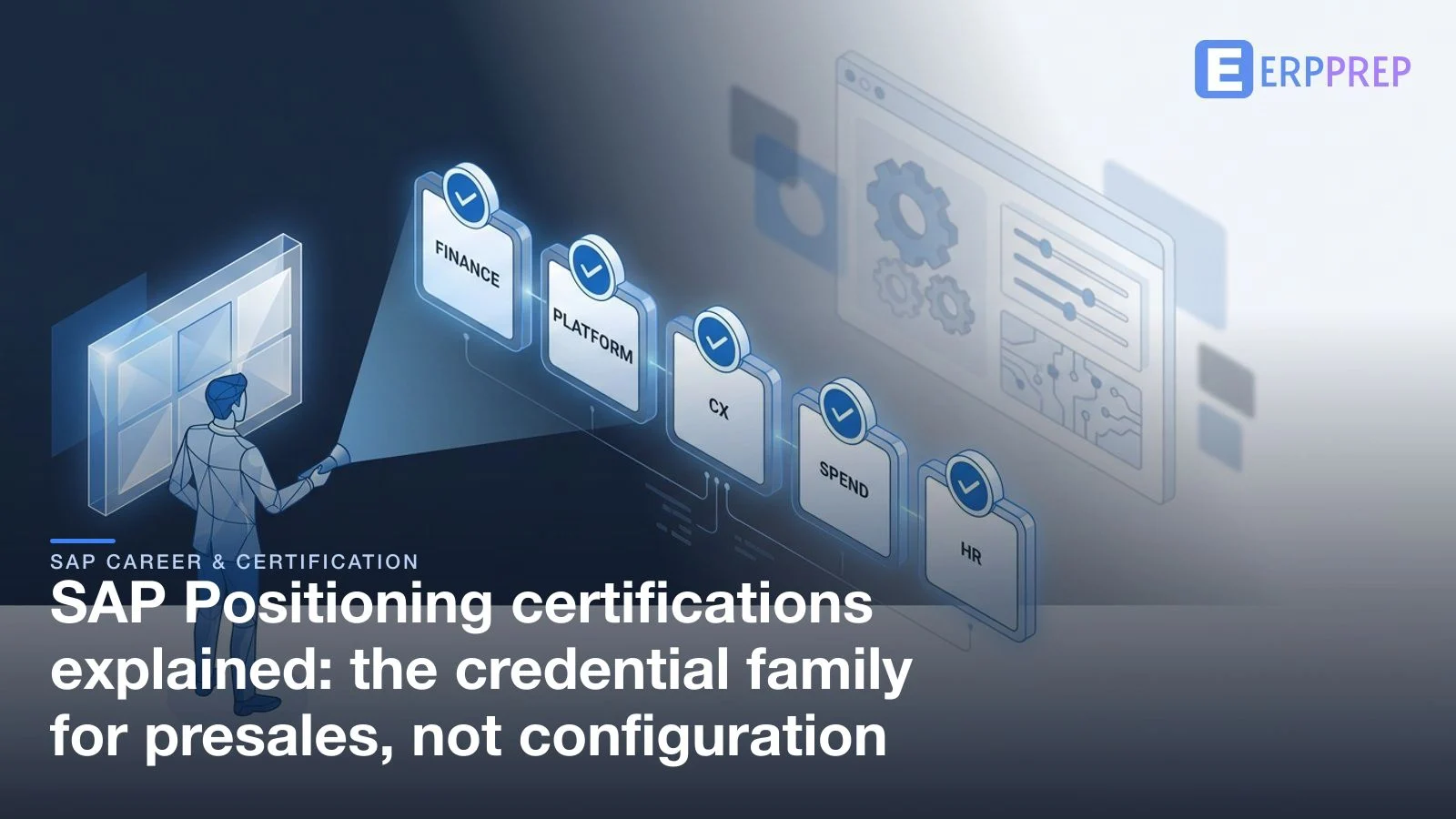
SAP's Positioning certifications validate the ability to explain, advise on, and recommend an SAP solution area to customers — not to configure it. Eight associate credentials, all scenario-based assessments with a 60% cut score, target presales, sales, and partner-enablement roles across finance, supply chain, customer experience, spend, sustainability, transformation management, and platform.
There is a corner of SAP®'s certification catalogue that candidates reliably misread. The exams are titled “Positioning…”, they carry familiar C_ associate codes, and they sit on learning.sap.com next to the implementation credentials — so people assume they are a lighter version of the consultant exams. They are not. They certify a different job entirely. If you are still working out which credential fits your career at all, start with whether SAP certification is worth it and how to choose; this article maps the one family that most often gets picked for the wrong reason.
SAP's Positioning certifications validate the ability to explain, advise on, and recommend an SAP solution area to customers — not to configure it. Eight associate credentials, all scenario-based assessments with a 60% cut score, target presales, sales, and partner-enablement roles across finance, supply chain, customer experience, spend, sustainability, transformation management, and platform.
Key takeaways
- Positioning ≠ implementation. These exams certify customer-facing advisory judgement — what to recommend and why — not hands-on configuration.
- Every exam in the family names the same target roles: presales and sales, widened by the learning journeys to marketing and customer-engagement roles.
- The format is uniform. All eight are scenario-based assessments (SBA) built around a single activity, each with a 60% cut score.
- The family splits three ways: one portfolio-level strategy exam, five line-of-business exams anchored on a buying centre, and two platform/transformation exams.
- Choose by the conversation you have with customers, not by perceived difficulty — the exam rewards fluency you can only build by reasoning about real business problems.
What is an SAP Positioning certification?
A Positioning credential asks a single underlying question: can you put this part of the SAP portfolio in front of a customer and make the case for it? Each exam page frames the outcome in advisory language — understanding a solution area's capabilities, its architectural logic and its strategic value, then matching those to a customer's specific challenges. The credential is a statement about your ability to articulate and recommend, not to deliver.
That is why the supporting content is shaped the way it is. Each certification hangs off a matching learning journey on learning.sap.com whose courses climb a deliberate ladder: a Discovering course that introduces the solution area, a Positioning course that connects it to end-to-end processes and industries, an AI-focused course covering embedded intelligence in that domain, and — on most journeys — a Selling course at the top. Nothing in that ladder is a configuration exercise. It is a narrative-building path for people whose deliverable is a conversation.
Look at the skills each exam says you will earn and the pattern is unmistakable. They read Competitive Positioning, Customer Value Proposition, Financial Analytics, Strategic Procurement, Circular Economy — the vocabulary of advisory and commercial work, not of transaction codes and configuration tables. A Positioning credential is therefore closer in spirit to a sales-enablement qualification than to a functional-consultant one: it proves that you understand a solution area's value story — the problems it solves, the outcomes it drives, and how it slots into the wider portfolio — well enough to lead a customer through it without over-promising.
One structural detail underlines the point. Almost every journey in the family applies the same “AI-First, Suite-First” framing SAP uses across its current portfolio story, and most open by profiling a specific leader — the CFO, COO, CRO or CPO — and that leader's objectives before a single product is named. The learning is deliberately organised around the buyer's agenda, because that is the order a real positioning conversation follows: problem first, portfolio second. The journeys themselves sit at an intermediate level and vary widely in length, from a few focused hours to a substantial multi-hour programme for the broader solution areas, so “advisory” should not be read as “quick.”
The eight Positioning certifications at a glance
Every exam in the family shares a format — a scenario-based assessment with a 60% cut score — so what separates them is the solution area they certify and the conversation they prepare you for. Use this table to place each code before reading the deeper breakdown below.
| Exam | Solution area | Format | Cut score | Best for |
|---|---|---|---|---|
| C_BCSBS | Autonomous-enterprise strategy (whole portfolio) | SBA | 60% | Advisors whose remit spans the full SAP portfolio |
| C_BCFIN | Financial management (CFO agenda) | SBA | 60% | Finance-focused presales and sales |
| C_BCSBN | Supply chain management (COO agenda) | SBA | 60% | Supply-chain and logistics solution advisors |
| C_BCSCX | Customer experience (CRO agenda) | SBA | 60% | CX, commerce and service sales engineers |
| C_BCSPM | Spend management (CPO agenda) | SBA | 60% | Procurement and source-to-pay advisors |
| C_BCSSS | Sustainability solutions | SBA | 60% | Sustainability-portfolio specialists |
| C_BCBTP | Business AI Platform and BTP capabilities | SBA | 60% | Platform, integration and analytics presales |
| C_BCBTM | Business transformation management tooling | SBA | 60% | Transformation and enterprise-architecture advisors |
Positioning versus configuration: the real difference
The clearest way to see the split is side by side. Both tracks are associate credentials; they simply prove opposite halves of an SAP engagement.
| Dimension | Positioning family | Implementation-consultant track |
|---|---|---|
| What it proves | You can articulate value and recommend the right solution. | You can configure, build, and validate the solution in a system. |
| Target roles | Presales, sales, solution advisory, partner enablement. | Functional and technical consultants delivering projects. |
| Assessment style | Scenario-based (SBA) — judgement across a business situation. | Often system-based (SyBA) — task execution and validation. |
| Preparation centre of gravity | Value drivers, buying-centre priorities, portfolio fit. | Hands-on repetition of configuration and process steps. |
It helps to be concrete about what “configuration” means on the other side of that line. A hands-on certification proves you can go into a system and make it do something specific: define an organisational structure, set up a posting rule, wire an integration, build an app. The evidence is executable — the task either produces the right result or it does not. A Positioning credential proves the opposite kind of competence: that when a customer describes a problem, you can identify which part of the portfolio answers it, explain why in business terms, and stand behind the recommendation. Nobody logs into a system to demonstrate that; you demonstrate it in a conversation, and the exam recreates that conversation on paper.
The two credentials also serve different buyers of your time. A hiring manager staffing a delivery project wants the configuration proof, because the risk they are managing is whether the build will work. A partner or vendor building a go-to-market team wants the positioning proof, because the risk they are managing is whether their people can represent a solution area credibly in front of a prospect. That is why the family names presales, sales and partner-enablement as its audience rather than project consultants — it is answering a commercial question, not a technical one.
One practical consequence: the Positioning exams are far more accessible to someone without a sandbox system, because they never ask you to operate one. The trade-off is that they demand something a system cannot give you — commercial judgement under competing pressures. That makes them unusually portable across the portfolio, too: the reasoning skill you build for one solution area transfers to the next, even though the product content does not.
Not sure whether the judgement style suits you? A scenario-style task tells you more in ten minutes than any syllabus comparison. Try a free sample.
Who are these credentials actually for?
Every exam in this family names presales and sales as its roles, and the underlying journeys extend that to marketing and customer-engagement roles. Read practically, that covers four kinds of people:
- Solution advisors and sales engineers who demo, scope, and answer “can SAP do this?” for a living.
- Partner-enablement teams that need a defensible, portable signal that their people can represent a solution area credibly.
- Account and customer-engagement roles that must connect a customer's stated priority to the right part of the portfolio without over-promising.
- Delivery consultants moving upstream — a very common mid- career move, and one where the credential formalises knowledge you have been picking up informally on projects. If you are weighing that direction, the functional versus technical consultant comparison is a useful companion read.
Notice who is not the primary audience: someone who will spend their week inside configuration screens. That is not a value judgement — it is simply a different proof for a different job. If your day is delivery, a hands-on credential describes your work more faithfully, and a Positioning exam is a complement rather than a substitute. The family earns its keep for people whose influence on a deal comes from clarity of explanation: being trusted, in the room, to say what SAP can and cannot do for a specific business problem, and to make that case survive scrutiny from a buyer who has options.
There is also a signalling angle worth naming. Because these credentials are relatively new and tied explicitly to SAP's current portfolio story, holding one is a compact way to show you are current — that you can talk about the autonomous-enterprise model, embedded AI and the suite-first direction, not just the products as they stood a few years ago. For partner teams whose competitive edge is being visibly up to date, that recency is part of the point.
How do the eight Positioning certifications differ?
The family divides cleanly into three groups. Use the group to narrow the shelf, then the exam hub to pick the book.
Before the differences, note the shared spine, because it is what makes the family coherent. Each line-of-business credential is built the same way: it opens on a leader's objectives and challenges, moves to how the relevant solutions create value for that leader, then spends real time on the seams — how the solution area combines with SAP Business Data Cloud, with embedded SAP Business AI, with sustainability capability, and with the transformation tooling. That recurring “combine with” theme is deliberate: modern SAP deals rarely sit inside one product, and the exam reflects that a positioning conversation is really about how the pieces reinforce each other.
1. Portfolio-level strategy. C_BCSBS is the widest of the eight: it covers SAP's autonomous-enterprise operating model — its architectural principles, the domains that make up the model, how assistants and agents differ in the way people work with them, and the pillars of the AI platform beneath it. Its journey is the only one in the family that names a prerequisite journey, an introductory tour of SAP. This is the right start if your conversations span the whole portfolio rather than one line of business.
2. Line-of-business positioning — five credentials, each built around one buying centre and that leader's agenda:
- C_BCFIN — finance, framed around the CFO. It covers end-to-end finance processes, value drivers, and how the finance portfolio connects to SAP's cloud-transformation programmes and to embedded AI. The heaviest journey of the line-of-business group.
- C_BCSBN — supply chain, framed around the COO, from design and planning through to delivery and operations, with business-network and sustainability angles alongside.
- C_BCSCX — customer experience, framed around the CRO, spanning commerce, sales and service solutions plus the customer-data and marketing tools that sit with them.
- C_BCSPM — spend management, framed around the CPO, covering the source-to-pay estate: SAP Ariba, SAP Fieldglass and Concur solutions, and the strategic-procurement value story around them.
- C_BCSSS — sustainability, anchored on SAP Sustainability Control Tower and skills such as circular-economy and carbon-footprint reasoning. Its journey is the longest in the family, so budget accordingly.
3. Platform and transformation. C_BCBTP is the technology-side credential — the AI platform and the core platform capabilities behind it, positioned for integration, extension, and analytics conversations rather than for building anything yourself. It is described on its page as an entry-level qualification and, unusually for this family, publishes English as its exam language. C_BCBTM is its change-management sibling, covering the transformation-management tooling — process management, enterprise architecture, and digital adoption — used to plan and land a transformation. If that toolset is your patch, the Signavio versus LeanIX comparison goes a level deeper on the products themselves.
Which Positioning certification fits your role?
The cleanest selection rule is to match the exam to the customer conversation you are already closest to. A few common mappings:
- Finance-facing presales or a consultant moving toward CFO conversations → C_BCFIN. It is the most substantial of the line-of-business journeys and leans into value drivers, end-to-end finance processes, and the RISE and GROW with SAP transformation paths.
- Supply-chain, logistics or operations advisory → C_BCSBN, which frames everything around the COO and walks the design-to-operate flow of the supply chain.
- CX, commerce, marketing or service sales → C_BCSCX, spanning the commerce, sales, service, customer-data and marketing solutions that report up to a CRO.
- Procurement and source-to-pay → C_BCSPM, covering the SAP Ariba, SAP Fieldglass and Concur estate and the CPO's strategic-procurement agenda.
- Sustainability and ESG positioning → C_BCSSS, anchored on SAP Sustainability Control Tower and reasoning skills such as circular economy and carbon-footprint reduction; expect the deepest journey of the family.
- Platform, integration or analytics presales → C_BCBTP, an entry-level qualification on the SAP Business AI Platform and the SAP Business Technology Platform capabilities beneath it — and the one exam in the family that publishes English as its language.
- Transformation, process and enterprise-architecture advisory → C_BCBTM, the change-management sibling built around the SAP Signavio, SAP LeanIX and WalkMe tooling.
- A portfolio-wide remit, or no single line of business → C_BCSBS, the strategy-level entry point; its journey is the only one that names a prerequisite, an introductory tour of SAP, so it doubles as a sensible orientation before a line-of-business exam.
If two of these describe you, sequence rather than agonise: take the one closest to your live pipeline first, because you will be able to rehearse it against real conversations, then add the adjacent credential once the first is banked. The shared structure means the second exam is always easier to prepare for than the first.
How should you prepare for a Positioning exam?
Because these are scenario assessments, the preparation trap is treating them as a vocabulary test. Learning a product list will not carry you through a question that asks which recommendation holds up when a customer's budget, timeline, and existing landscape pull in different directions. Three things actually move the needle:
- Learn the buying centre, not just the products. Each line-of-business journey opens with that leader's objectives and challenges for a reason — the exam reasons from the customer's problem inwards.
- Rehearse trade-offs out loud. Practise defending a recommendation and naming what you are giving up. That is the exact muscle an SBA scores; our guide to practising for a scenario-based assessment breaks the technique down.
- Know the portfolio's seams. Almost every journey in this family spends time on how its solution area combines with data, AI, and sustainability capability — because that is where real customer questions live.
For the format itself, the mechanics are shared with every other scenario exam SAP runs, so how to prepare for the performance-based format transfers here unchanged. And a note on shortcuts: ERPPrep does not provide exam dumps, and against a judgement-based assessment they are worse than useless — there is no key to memorise for a recommendation you have to justify.
A sensible study path mirrors the way each learning journey is built. Start with the Discovering layer to fix the persona and the problem space — you should be able to state, from memory, what keeps that leader awake and which outcomes they are measured on. Move to the Positioning layer to connect those problems to specific solutions and to the end-to-end processes they touch. Then drill the integration stories, because the single most common shape of a real objection — “we already have something for that” — is answered by knowing how the solution area combines with data, AI and the rest of the suite rather than by reciting a feature list. Where a Selling course sits at the top of a journey, treat it as the rehearsal of turning that understanding into a recommendation under commercial pressure.
Finally, calibrate. Because there is a single 60% cut score and a scenario format, the useful question in practice is not “do I recognise this term?” but “would my recommendation survive a follow-up question?” Working through scenario-style prompts and then articulating the reasoning out loud — the trade-off you accepted, the option you rejected and why — is the closest rehearsal there is to what the assessment actually measures, and it exposes the soft spots a reading-only revision plan hides.
Do Positioning credentials replace a hands-on certification?
No — they sit beside one. The two tracks answer different questions from a hiring manager, and the strongest profiles usually pair them: a delivery credential that proves you can build it, and a Positioning credential that proves you can explain why it is worth building. For a consultant moving toward advisory work, the Positioning exam is the cheaper half of that pair to add, because it needs no system time.
If you are choosing your very first SAP credential, work through which SAP certification to get first before committing, and use the complete map of SAP certification tracks to see where this family sits against the rest. Then pick the exam hub that matches the conversation you already have with customers — that is the credential that will read as true on your CV.
Whichever code you land on, the deciding factor is the same: can you reason your way to a defensible recommendation under pressure? Before you commit weeks to a journey, it is worth feeling what that judgement format asks of you — try a free ERPPrep sample and see how positioning-style reasoning feels in practice.
Frequently asked questions
- What is an SAP Positioning certification?
- It is an associate credential that verifies you can articulate what an SAP solution area does, why it matters to a customer, and which capability answers which business problem. The emphasis is advisory rather than technical: you are certified on explaining and recommending a portfolio, not on configuring or building it. Each exam maps to a matching learning journey whose skills read like a commercial toolkit — competitive positioning, customer value proposition, and domain skills such as financial analytics or strategic procurement — rather than a list of configuration tasks. In short, it proves you can lead a customer conversation about the solution.
- How is a Positioning certification different from an implementation-consultant certification?
- Different job, different proof. An implementation credential validates hands-on delivery — configuring, building, and validating in a system, where the task either produces the right result or it does not. A Positioning credential validates customer-facing judgement: mapping a business challenge to the right solution and defending that recommendation in a scenario. Both are associate-level, but they certify opposite halves of an SAP engagement, and they answer different buyers — a delivery manager wants the build proof, a partner building a go-to-market team wants the positioning proof. The strongest profiles often carry one of each.
- Who are the SAP Positioning certifications for?
- SAP names presales and sales as the target roles on every exam in the family, and the underlying learning journeys widen that to marketing and customer-engagement roles too. In practice they suit solution advisors, sales engineers, partner-enablement teams, and delivery consultants moving upstream into advisory work. The common thread is that your influence on a deal comes from clarity of explanation rather than from time spent in configuration screens. If your week is mostly delivery, a hands-on credential describes your work more faithfully and a Positioning exam is a complement, not a replacement.
- What exam format do the Positioning certifications use?
- All eight use SAP's scenario-based assessment (SBA) format, built around a single activity, each with a 60% cut score published on its exam page. SBA is a judgement format: you reason across a connected business situation and choose the most defensible recommendation, rather than executing configuration steps in a system. That uniformity is useful — once you have prepared for the format on one solution area, the mechanics carry over to the next, and only the product content changes. It also means recognition alone is not enough; you have to be able to justify a recommendation.
- Which SAP Positioning certification should I take first?
- Start with the solution area you already sell or support, because the exam rewards a fluency you can only build by reasoning about real customer conversations. So finance-facing advisors gravitate to C_BCFIN, supply-chain to C_BCSBN, customer experience to C_BCSCX, spend to C_BCSPM, and sustainability to C_BCSSS. If your role spans the whole portfolio rather than one line of business, the autonomous-enterprise credential (C_BCSBS) is the natural strategy-level entry point — and, usefully, its journey names an introductory tour of SAP as a prerequisite, so it doubles as orientation before a line-of-business exam.
- Are Positioning certifications easier than technical SAP exams?
- They are different, not lighter. You are not asked to configure anything, but you are asked to make defensible recommendations under competing pressures — budget, timeline, an existing landscape all pulling against each other — which is hard to fake if you have never sat in front of a customer. The factual recall is smaller than a technical exam's; the judgement demand is real, and the scenario format is specifically designed to expose reasoning you have not actually done. Treating one as a quick win because it needs no system time is the classic way to underestimate it.
- Do Positioning certifications need hands-on system access?
- Generally no, and that is a genuine practical advantage. The assessments target advisory reasoning rather than system execution, so preparation centres on the solution story, the value drivers, and the buying centre's priorities rather than on a sandbox. That makes the family far more accessible to people who cannot easily get system time — partners, sales engineers, and career-changers among them. Hands-on exposure still helps you sound credible in front of a customer, and it deepens your answers, but it is not the gate it is for an implementation exam.
- Do the Positioning certifications cover SAP Business AI?
- Yes — embedded intelligence runs through the whole family. Most journeys include a dedicated course on SAP Business AI for that solution area, and the platform-level exam, C_BCBTP, is built around the SAP Business AI Platform and its pillars directly. The portfolio-level exam, C_BCSBS, goes further into the autonomous-enterprise operating model, including how Joule agents and assistants differ. Because SAP frames its current story as AI-first, being able to position embedded AI credibly is not an optional extra in these exams; it is part of the core value conversation each one prepares you for.
- Which Positioning certification has the most study content?
- SAP does not publish exam length, question counts, or validity for this family, so any claim about exam difficulty by size would be guesswork. What the learning journeys do show is relative depth: the sustainability journey (C_BCSSS) is the longest in the family, and the finance journey (C_BCFIN) is the heaviest of the line-of-business set, while supply chain (C_BCSBN) and transformation management (C_BCBTM) are more compact. Use those as a rough guide to preparation time, not to exam difficulty — the cut score is a uniform 60% across all eight.
- Does ERPPrep provide real SAP exam questions or dumps?
- No. ERPPrep does not provide exam dumps or actual exam content, and neither would help you here — a scenario assessment asks for a judgement you have to make yourself, not an answer you can memorise from a leaked key. Our practice is original material modelled on the published format, built to rehearse the reasoning the exam rewards: mapping a customer problem to the right solution and defending the recommendation. Against a judgement-based assessment that is the only preparation that transfers, which is exactly why the shortcut everyone searches for does not exist.
ERPPrep is an independent platform and is not affiliated with, endorsed by, or sponsored by SAP SE. SAP and other SAP products are trademarks of SAP SE, referenced here only to describe the certification exams ERPPrep helps you prepare for.
Ready to practise the way the exam tests?
ERPPrep provides original, performance-style scenarios and skill drills built for the 2026 SyBA and SBA formats. Try a free sample and judge the quality yourself.
Practice for these exams
Related guides
SAP BTP certifications explained: which one is right for you
A map of the SAP BTP certification family — administrator, architect, integration, ABAP and generative-AI developer, LeanIX EA — and how to choose.
SAP SuccessFactors Compensation vs Variable Pay certification: C_THR86 vs C_THR87
Two SAP SuccessFactors reward-management associate certifications. C_THR86 (Compensation — base pay, merit and salary planning) vs C_THR87 (Variable Pay — bonus and incentive programs): what each covers, the shared format and cut score, and which to sit first.
SAP Signavio vs SAP LeanIX certification: C_SIGPM vs C_LIXEA
Two SAP transformation-tooling certifications, two lenses on business change. C_SIGPM (process management with SAP Signavio) vs C_LIXEA (enterprise architecture with SAP LeanIX) — scope, format, cut score, and which fits your career.