

SAP Signavio vs SAP LeanIX certification: C_SIGPM vs C_LIXEA
Two SAP transformation-tooling certifications, two lenses on business change. C_SIGPM (process management with SAP Signavio) vs C_LIXEA (enterprise architecture with SAP LeanIX) — scope, format, cut score, and which fits your career.
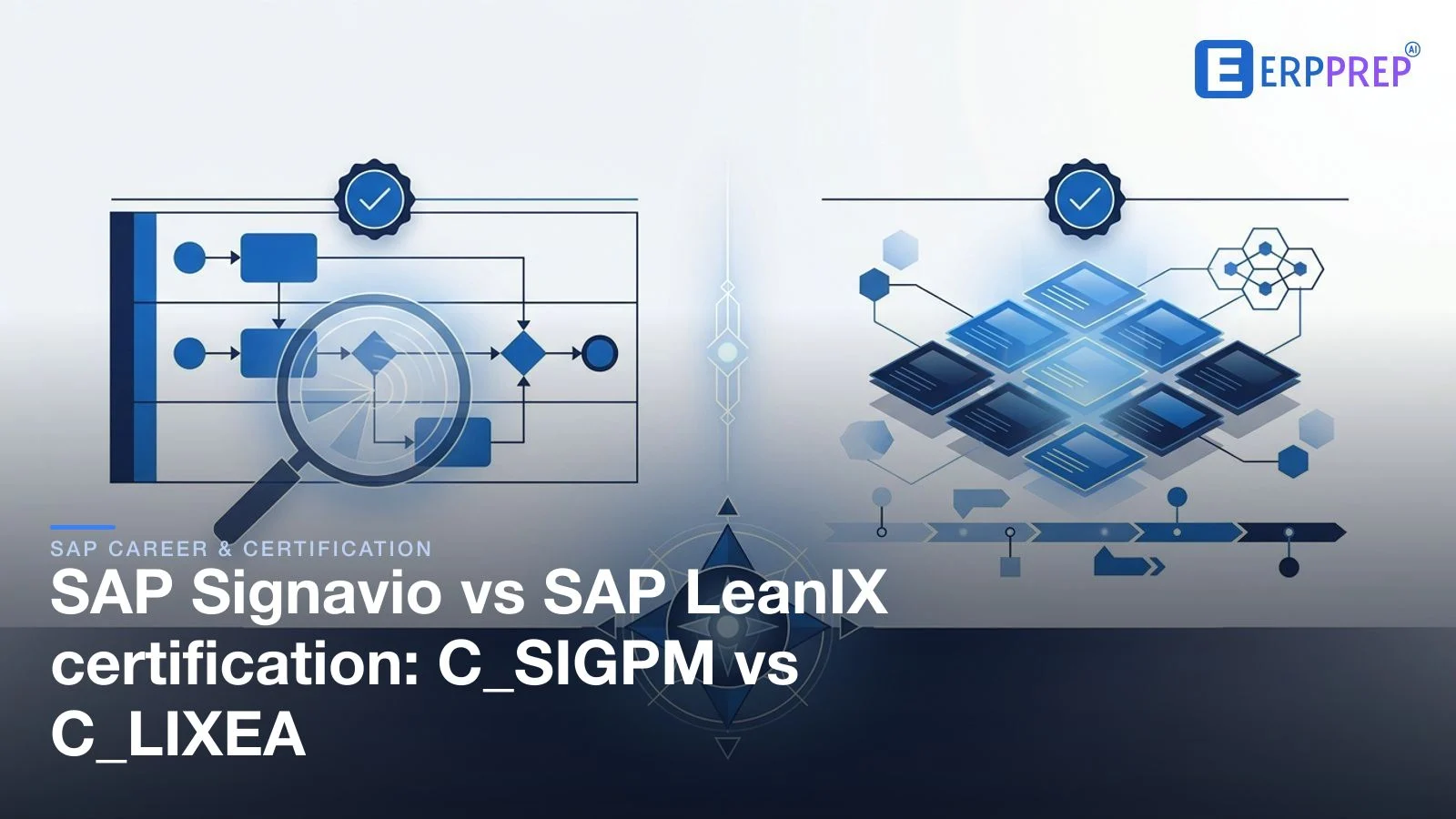
C_SIGPM (Process Management Consultant — SAP Signavio) certifies designing, mining, and improving business processes. C_LIXEA (Enterprise Architecture Consultant — SAP LeanIX) certifies mapping the application and technology landscape, the EA repository, and transformation roadmaps. Both are associate Scenario-Based Assessments. Choose by the lens you own: how work flows (process) or how the IT estate is structured (architecture).
SAP® has built out a family of tools for business transformation, and two of them now carry their own associate certifications that look adjacent but point at genuinely different jobs. C_SIGPM certifies process management with SAP Signavio — designing, mining, and improving how business processes actually run — while C_LIXEA certifies enterprise architecture with SAP LeanIX — mapping the application and technology landscape and planning transformation roadmaps. This guide compares what each certifies, the shared performance-based format, and how to choose. For the wider question of which credential fits your direction, see whether SAP certification is worth it and how to choose.
Key takeaways
- C_SIGPM is the process lens — it certifies modelling, process intelligence (mining), and continuous improvement with SAP Signavio, the "how does work flow, and where does it break?" question.
- C_LIXEA is the architecture lens — it certifies cataloguing applications and technology, maintaining the EA repository, and planning roadmaps with SAP LeanIX, the "what do we run, and where is it heading?" question.
- Both are associate-level Scenario-Based Assessments (SBA) described as a single activity, so the format is shared — but the cut scores differ (C_SIGPM 55%, C_LIXEA 50% at the time of writing).
- They map to different transformation sub-roles: a process analyst / improvement consultant versus an enterprise architect / landscape planner.
- Both tools are SAP-owned and complementary — process insight tells you what to change; architecture mapping tells you what the change touches.
C_SIGPM vs C_LIXEA at a glance
Both certifications sit on official SAP learning journeys (SAP, learning.sap.com) and share a performance-based format — but they aim at different audiences. Here they are side by side:
| C_SIGPM — Process Management (SAP Signavio) | C_LIXEA — Enterprise Architecture (SAP LeanIX) | |
|---|---|---|
| What it covers | Process modelling, process intelligence / mining, process improvement and transformation, governance and collaboration on processes | Application and technology landscape, the EA repository (fact sheets), business capabilities, roadmaps, and portfolio rationalization |
| Best for | Process analysts and improvement / transformation consultants | Enterprise architects and IT-landscape / roadmap planners |
| Format | Scenario-Based Assessment (SBA), single activity | Scenario-Based Assessment (SBA), single activity |
| Cut score | 55% (confirm on learning.sap.com) | 50% (confirm on learning.sap.com) |
| Level | Associate (entry qualification) | Associate (entry qualification) |
What C_SIGPM (process management with SAP Signavio) covers
The Signavio certification is about understanding and improving how a business actually operates. Rather than cataloguing systems, you learn to make processes visible, measure where they leak time and effort, and drive the changes that make them run better — with the customer experience kept at the heart of the design. Its learning journey frames this as managing and designing business processes end to end.
In practice, the module spans the Signavio toolset from foundations through to improvement:
- Process fundamentals and BPM — the core elements of a process, why clarity matters as an organization grows, and how variation and inefficiency translate into business impact.
- Process modelling — building clear models with the editor, gateways and events that control flow, sub-processes, responsibilities, and standards-based notation for readable diagrams.
- Collaboration and governance — sharing processes through the collaboration hub, running approval workflows, and keeping a governed, single view everyone can work from.
- Process intelligence and improvement — using insight and mining-style analysis to find bottlenecks and variants, then steering transformation toward a better target state.
- Decision and journey modelling — capturing business decisions with decision notation and modelling the outside-in customer journey that a process is meant to serve.
The through-line is that a process consultant is an optimizer of flow: someone who can see a whole process, prove where it underperforms, and design a version that works better for the business and its customers. That judgement — read the process, find the waste, defend the redesign — is exactly what a Scenario-Based Assessment is designed to probe.
What C_LIXEA (enterprise architecture with SAP LeanIX) covers
Enterprise architecture with LeanIX is about understanding and steering the technology estate. Where Signavio reads the flow of work, LeanIX maps the structure underneath it — which applications exist, what technology they run on, which business capabilities they support, and where the whole landscape should head next. The learning journey frames this as using the tool for successful enterprise architecture, built on two practical use cases.
The module moves from the repository foundations through to landscape decisions:
- The EA repository and meta model — how LeanIX structures information, the meta model behind it, and how the pieces connect into one inventory.
- Fact sheets and modelling — the fact-sheet types that describe applications, IT components, technology categories, platforms, and initiatives, plus the modelling guidelines that keep them consistent.
- Getting data in and keeping it clean — populating the inventory, meta-model configuration, and data-quality assurance so the architecture reflects reality.
- Reports, diagrams, and collaboration — LeanIX reports, data-flow and free-draw diagrams, and the adoption and collaboration settings that get an organization actually using the repository.
- Landscape use cases — application portfolio assessment and application rationalization, the decisions about what to keep, invest in, or retire, plus out-of-the-box integrations.
An enterprise architect, then, owns the map that transformation decisions are made from: errors here surface as blind spots in a roadmap, so the exam rewards candidates who can keep a landscape accurate and reason about portfolio trade-offs rather than just describe a screen. If Signavio rewards seeing how work flows, LeanIX rewards seeing how the estate is structured and where it should evolve.
The very different transformation sub-roles
The clearest way to choose is to look at who actually does each job. On a transformation programme they collaborate, but they are not the same seat.
A process management specialist tends to be the analyst or improvement consultant — the person a process owner turns to when a workflow is slow, inconsistent, or ripe for automation. The work is flow-and-evidence shaped: model the current state, measure where it breaks, and design a better target. If you like getting close to how a business really runs and making it measurably better, this is the lens — and it pairs naturally with continuous-improvement and operations careers.
An enterprise architecture specialist works one level up, on the technology estate itself. The work is inventory-and-strategy shaped: keep the landscape accurate, understand what supports which capability, and advise on what to consolidate, invest in, or retire. It suits someone who likes structure, portfolio thinking, and long-range roadmaps, and it sits closer to IT strategy and governance than to day-to-day operations.
There is a career-shape difference too. Process skills travel well into operational-excellence and business-analysis roles wherever an organization wants its work to run better. Architecture skills travel into IT-strategy and portfolio-governance roles wherever an organization needs to steer a complex estate. Neither is "better" — they are different bets on whether you want to optimize how work flows or shape how the technology evolves. If your interest runs toward the broader architecture ladder, the SAP architect certification path shows where a tool credential like C_LIXEA sits alongside the wider solution- and enterprise-architect track.
Can you hold both C_SIGPM and C_LIXEA?
Yes, and on a large transformation programme the pairing is powerful, because the two lenses answer different halves of the same question. Process insight from Signavio tells you what to change — which workflows are slow, inconsistent, or costly. Architecture mapping from LeanIX tells you what the change touches — which applications and technology components sit behind that workflow and how a redesign ripples through the estate. A programme that has both can move from "this process is broken" to "here is the landscape impact of fixing it" without a hand-off gap.
That said, most people specialise. Holding both makes sense when your role genuinely spans process design and landscape planning — a transformation lead or a broad business-transformation consultant. Otherwise, go deep on one lens first and add the second only when real project exposure pulls you toward it. Depth in the lens you actually use beats a shallow badge in the one you do not.
Not sure how a Scenario-Based Assessment feels? A free sample shows the reason-through-a-scenario style before you commit to a tool. Try a free sample.
Format and cut score: both SBA, but different thresholds
Both C_SIGPM and C_LIXEA use the Scenario-Based Assessment (SBA) format — SAP's performance-based style, described on each page as a single activity, where you work through a connected situation and choose the best judgement rather than recalling isolated facts. C_LIXEA is offered in English; C_SIGPM does not list a language on its card, so confirm availability on the page.
Where they diverge is the pass mark. At the time of writing C_SIGPM publishes a 55% cut score and C_LIXEA a 50% cut score, so the threshold is exam-specific rather than a shared number — always verify the current value on each exam's page before you book. Either way, the winning preparation is the same: practise applied reasoning about the tool's way of working. If you want the technique for this exam family, the guide to the performance-based exam format covers how SBAs are built and how to work them under time pressure.
Which one should you choose?
Work backwards from the lens you hold or want, not from the cut score — the pass marks differ but neither exam is the "easy" option, because both test applied judgement. Three rules of thumb:
- Choose C_SIGPM if your world is process. You model, analyse, or improve how work flows, and you want to prove and drive process transformation. Signavio is the lens for optimizing operations and customer journeys.
- Choose C_LIXEA if your world is architecture. You own or contribute to the application landscape, IT roadmap, or architecture governance. LeanIX is the lens for mapping the estate and steering where it evolves.
- Consider both — in sequence — for a transformation-lead role. On a full programme the two complement each other, since clean process insight and an accurate landscape map are two halves of a confident change. Lead with the lens you already touch daily, then add the second once you have real project exposure.
Weighing these tool credentials against the broader architecture track? The solution architect vs enterprise architect comparison maps the higher-level architect roles, while each exam hub below carries the scenarios, skill drills, and exam facts for that specific certification.
Prepare for whichever you pick
Once you have chosen, the approach is the same because the format is shared. Practise doing the work in a realistic setting rather than only reading — model and analyse a process for C_SIGPM, or build out fact sheets, reports, and a rationalization use case for C_LIXEA. Trace whole scenarios end to end, and rehearse under time pressure so your accuracy holds when it counts. Start from the exam hub for your tool, try a free sample to feel the Scenario-Based style, and build from there.
Frequently asked questions
- What is the difference between C_SIGPM and C_LIXEA?
- C_SIGPM certifies process management with SAP Signavio — modelling, mining, and improving how business processes actually run. C_LIXEA certifies enterprise architecture with SAP LeanIX — cataloguing applications and technology, maintaining the EA repository, and planning transformation roadmaps. One is a process lens on transformation; the other is an architecture lens. They complement rather than compete.
- What exam format does C_SIGPM use?
- C_SIGPM is a Scenario-Based Assessment (SBA), described on its page as a single activity — SAP's performance-based style where you reason through a connected business situation rather than answering isolated multiple-choice trivia. Always confirm the current format and activity count on the exam page at learning.sap.com before you book.
- What exam format does C_LIXEA use?
- C_LIXEA is also a Scenario-Based Assessment (SBA), described on its page as a single activity, and is offered in English. Like C_SIGPM it is performance-based, so preparation means practising applied judgement about the SAP LeanIX way of working rather than memorizing definitions. Confirm the live details on learning.sap.com.
- What is the cut score for C_SIGPM and C_LIXEA?
- At the time of writing, C_SIGPM publishes a 55% cut score and C_LIXEA publishes a 50% cut score on their respective pages. The two thresholds differ, so treat them as exam-specific rather than a shared number, and always check the current cut score on each exam's page before booking.
- Should I take the process-management or the enterprise-architecture certification first?
- Lead with the lens closest to your current work. If you model, analyse, or improve business processes day to day, start with C_SIGPM. If you own or contribute to the application landscape, IT roadmap, or architecture governance, start with C_LIXEA. Neither is a prerequisite for the other, so there is no fixed order — sequence them by relevance.
- Is a process-management or an enterprise-architecture career better?
- Neither is objectively better; they are different bets. Process management (C_SIGPM) sits close to operations, continuous improvement, and process transformation. Enterprise architecture (C_LIXEA) sits close to IT strategy, portfolio decisions, and long-range roadmaps. Choose by whether you want to optimize how work flows or shape how the technology estate evolves.
- Do I need both the SAP Signavio and SAP LeanIX certifications?
- Not usually — most people specialise in one lens. But the two pair well on a large transformation programme, because process insight (Signavio) tells you what to change and architecture mapping (LeanIX) tells you what the change touches. Hold both only if your role genuinely spans process design and landscape planning; otherwise go deep on one first.
- Are SAP Signavio and SAP LeanIX part of SAP?
- Yes. Both are SAP-owned solutions: SAP Signavio for business process transformation and SAP LeanIX for enterprise architecture management. Their certifications sit within SAP's official learning catalogue on learning.sap.com, alongside the wider S/4HANA and cloud portfolio.
- Do C_SIGPM and C_LIXEA have prerequisites?
- Both are positioned as associate-level entry qualifications rather than exams gated behind another certification. Each has an official learning journey to work through first, and hands-on familiarity with the respective tool matters far more than any formal prerequisite. Confirm the current requirements on each exam's page at learning.sap.com.
ERPPrep is an independent platform and is not affiliated with, endorsed by, or sponsored by SAP SE. SAP and other SAP products are trademarks of SAP SE, referenced here only to describe the certification exams ERPPrep helps you prepare for.
Ready to practise the way the exam tests?
ERPPrep provides original, performance-style scenarios and skill drills built for the 2026 SyBA and SBA formats. Try a free sample and judge the quality yourself.
Practice for these exams
Related guides
SAP Signavio certifications explained
The four certifications around SAP Signavio compared: C_SIGDA, C_SIGPM, C_SIGBT and the rescoped C_SIGVT — what each covers, who it suits, where to start.
SAP transformation and change certifications compared: RISE, Activate, OCM and Signavio
Compare SAP's transformation and change credentials — C_RISME, E_ACTAI, C_OCM, C_SIGBT and C_SIGVT — mapped across the delivery lifecycle and how each complements a module certification.
SAP BTP certifications explained: which one is right for you
A map of the SAP BTP certification family — administrator, architect, integration, ABAP and generative-AI developer, LeanIX EA — and how to choose.