

SAP Solution Architect vs Enterprise Architect: P_BTPA and P_SAPEA compared
P_BTPA certifies solution architecture on SAP BTP; P_SAPEA certifies enterprise-wide architecture with SAP's Enterprise Architecture Framework. Both are professional-tier, scenario-based exams — here's the scope difference and which to target.
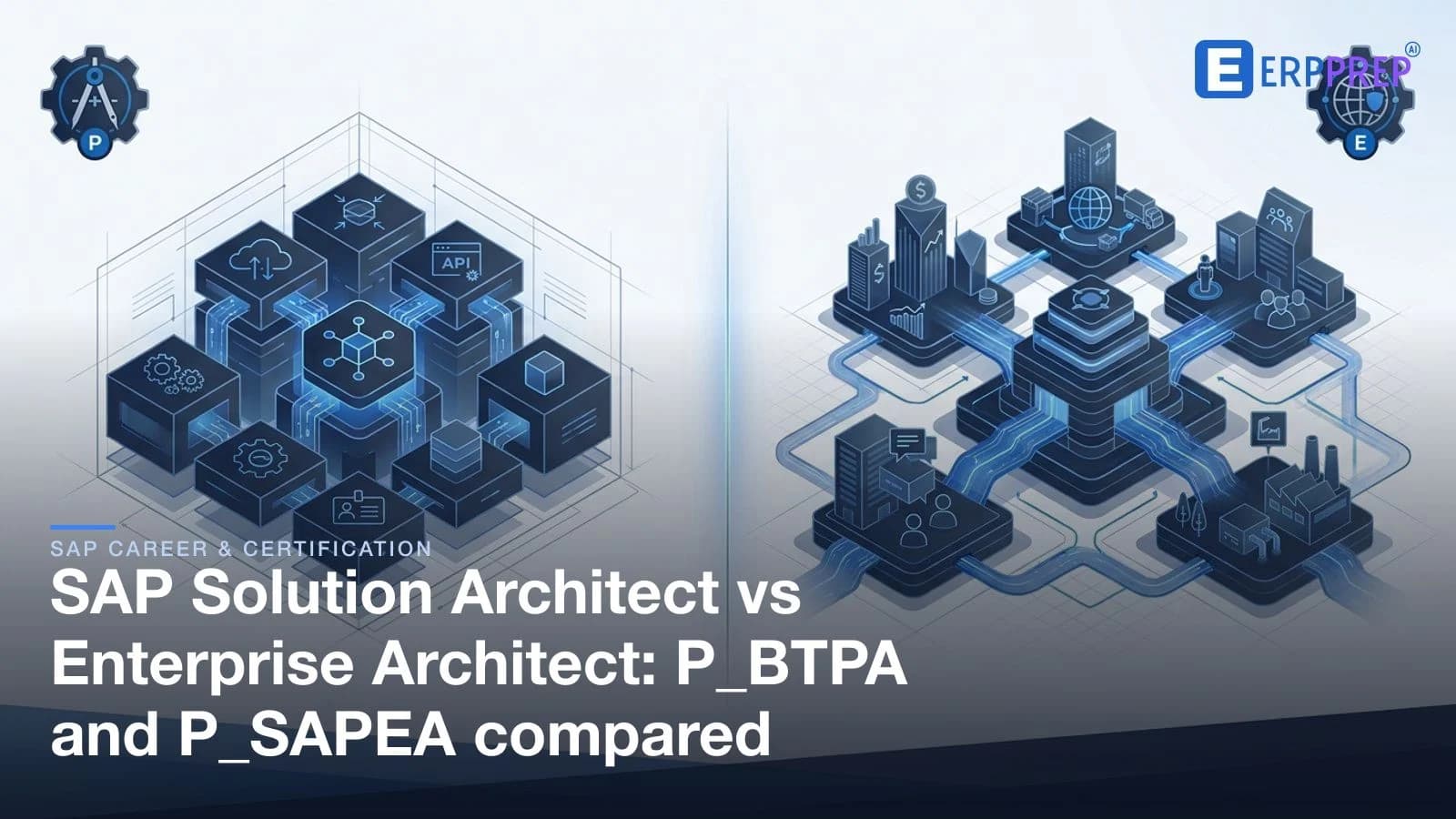
P_BTPA (SAP Certified Solution Architect – SAP BTP) certifies designing solutions on the SAP Business Technology Platform across services such as Integration Suite, AI Core, and Business Data Cloud. P_SAPEA (SAP Certified Enterprise Architect) certifies enterprise-scope architecture using the SAP Enterprise Architecture Framework. Both are professional-tier, Scenario-Based Assessments with a 60% cut score; the difference is platform scope versus enterprise scope.
SAP® runs two professional-tier architect certifications, and they are easy to confuse because both carry the word "architect" and both sit above the associate tier. They are not interchangeable. P_BTPA certifies a solution architect on SAP Business Technology Platform; P_SAPEA certifies an enterprise architect working across the whole landscape. This is the scope difference, the shared format, and how to decide which one reflects the work you actually do. For where these sit in the wider ladder, see how SAP certifications map to your career.
Key takeaways
- P_BTPA is platform-scoped. It certifies designing solutions on SAP Business Technology Platform by combining its services into a working architecture.
- P_SAPEA is enterprise-scoped. It certifies architecture across the whole enterprise, applying the SAP Enterprise Architecture Framework as its method.
- Both are professional-tier (P_ prefix), so both assume real design experience rather than only study.
- Both use the same exam machinery: Scenario-Based Assessment (SBA) with a 60% cut score.
- Choose by scope, not prestige — the right exam is the one that matches where your architecture decisions are made.
P_BTPA vs P_SAPEA at a glance
The two certifications differ mostly on one axis — the scope of the architecture you own. Everything else (tier, format, cut score) is shared. Here they are side by side, with facts confirmed against each exam's page (SAP, learning.sap.com):
| P_BTPA — Solution Architect (BTP) | P_SAPEA — Enterprise Architect | |
|---|---|---|
| Scope | The SAP Business Technology Platform — designing across its services | The whole enterprise landscape — architecture end to end |
| What it covers | Combining BTP services such as Integration Suite, AI Core, and Business Data Cloud into a solution design | Enterprise-wide architecture using the SAP Enterprise Architecture Framework as the method |
| Best for | Architects designing and integrating solutions on the platform | Architects shaping architecture across business and technology at enterprise scale |
| Format | Scenario-Based Assessment (SBA) | Scenario-Based Assessment (SBA) |
| Cut score | 60% | 60% |
| Tier | Professional (P_) | Professional (P_) |
What a solution architect on SAP BTP does
A solution architect on the SAP Business Technology Platform designs how a business problem gets solved on the platform. That means choosing which BTP services to use and, more importantly, how they fit together — integration, data, and intelligent capabilities composed into one coherent design rather than a pile of disconnected components. In practice the raw material is services such as Integration Suite for connecting systems, AI Core for machine-learning and generative-AI workloads, and Business Data Cloud for unifying data — and the architect's job is the reasoning that turns those pieces into a solution that meets the requirement.
P_BTPA is the certification for exactly this work. It is platform-scoped: the decisions it tests live inside BTP, not across the entire enterprise. If you want the broader map of how the platform, its AI capabilities, and the architect tier connect, the BTP, AI & architect certification paths guide places P_BTPA in context.
What an enterprise architect does
An enterprise architect works one level up. Instead of designing a solution on a single platform, they shape architecture across the whole enterprise— how business capabilities, applications, data, and technology align, and how today's landscape moves toward a target state. The work is inherently broader: it spans multiple solutions and lines of business, and it is as much about structure and governance as it is about any one technology.
P_SAPEA certifies this enterprise-scope role, and its distinguishing feature is method. The exam is built around the SAP Enterprise Architecture Framework — a structured way to describe and reason about an enterprise's architecture across business and technology. Where P_BTPA rewards fluency in a set of platform services, P_SAPEA rewards disciplined, framework-driven thinking about a landscape you rarely hold in your head all at once.
The scope difference: platform vs enterprise
Strip away the shared format and the two certifications reduce to a single contrast — platform scope versus enterprise scope. It is the most important thing to get right before you invest, so it is worth stating plainly:
- P_BTPA — the platform view. You are deep inside SAP Business Technology Platform, composing its services into a solution. The boundary of the problem is the platform.
- P_SAPEA — the enterprise view. You are above any single platform, aligning architecture across the whole organisation with a formal framework. The boundary of the problem is the enterprise.
Neither is "more advanced" than the other — they are different jobs at the same professional tier. A brilliant BTP solution architect is not automatically an enterprise architect, and vice versa; the two demand different breadth and different kinds of judgement.
Want to feel the scenario-based style first? Both architect exams reason through a connected scenario rather than isolated questions — a free sample shows that doing-over-recalling format before you commit. Try a free sample.
Who each is for, and what they assume
Both certifications share a prefix that matters: P_, the professional tier. That single letter is a signal about who these exams are for. Unlike associate (C_) certifications, which verify fundamental, implementation-level skills and are positioned as entry points, the professional architect exams assume real design experience. They are not a way to break into architecture; they verify architecture judgement you have already built by making decisions on real work.
- P_BTPA fits the architect who already designs on the SAP Business Technology Platform — someone who has integrated systems, wired up data flows, and combined services into solutions, and now wants that skill certified.
- P_SAPEA fits the architect who already operates at enterprise scale — someone comfortable reasoning about an entire landscape and applying a framework to it, not just one platform's services.
If you are earlier in the journey, the professional tier is a destination rather than a starting line. The certification levels explained guide walks through how the associate and professional tiers relate, so you can see the ground these architect exams sit on top of.
Format and cut score: what the exams share
On the mechanics, P_BTPA and P_SAPEA are twins. Both are Scenario-Based Assessments (SBA) — the performance-based format where you work through a connected scenario and make decisions in context, rather than answering disconnected multiple-choice items. That format is a natural fit for architecture, which is fundamentally about trade-offs: an SBA can present a situation and ask what you would decide, which is closer to the real job than recall ever is.
Both also share a 60% cut score (SAP, learning.sap.com). Because the exams are scenario-based, clearing that line is less about how much you have memorised and more about whether your decisions across the scenario hold up. Two architects with the same factual knowledge can land on different sides of 60% purely on the quality of their judgement. Exam details do change, so confirm the current format and cut score on each exam's page before you book, and read how the professional tier fits your path if you are weighing the effort.
The progression to each certification
Neither architect exam is where most people start, and the routes to them look different because the scopes are different.
The path to P_BTPA tends to run through the platform. You build depth on SAP Business Technology Platform — integration, data, and intelligent services — often after associate-level work in development or platform administration, and the certification recognises when that depth has matured into genuine solution design. It is a technical-breadth progression: from using services to composing them.
The path to P_SAPEA tends to run through the enterprise. You accumulate experience across multiple solutions and lines of business until you can reason about the whole landscape, and you learn to apply a formal framework to that reasoning. It is a scope-breadth progression: from owning one area to aligning many. Both are multi-year journeys, which is exactly why the professional tier assumes experience rather than teaching it.
Which one should you target?
Work backwards from the architecture decisions you already make. The question is not which certification sounds more senior — at the same professional tier, that framing is a trap — but which scope your work actually occupies.
- Choose P_BTPA if your decisions live on the SAP Business Technology Platform: you design how services combine into solutions, and the platform is the boundary of your problem.
- Choose P_SAPEA if your decisions span the enterprise: you align architecture across the organisation and think in frameworks, and no single platform contains the problem.
- Choose the one you can evidence. Both exams reward experience you already have. The certification that matches your real work is both the more honest signal and the more passable exam.
It is entirely reasonable to hold both over a career, but they answer to different jobs, and doing one first does not automatically prepare you for the other — the platform-to-enterprise jump is a genuine change of scope, not just a harder version of the same exam.
How to prepare for a professional architect exam
Because both are scenario-based, the preparation approach rhymes even though the content differs. Practise making decisions, not memorising facts: work through realistic situations and defend your choices, since that is what an SBA measures. For P_BTPA, keep your fluency across BTP services current and deliberately practise composing them; for P_SAPEA, internalise the SAP Enterprise Architecture Framework until applying it feels automatic. In both cases, rehearse under time pressure so your judgement holds when the scenario gets long.
A free ERPPrep sample lets you experience the scenario-based style before you decide which architect track to commit to. Try a free sample. To go wider first, the BTP, AI & architect certification paths guide maps how the platform and architect exams connect, and the certification levels explained guide shows how the associate and professional tiers stack — the ground both P_BTPA and P_SAPEA sit on.
Frequently asked questions
- What is the difference between a SAP solution architect and enterprise architect certification?
- P_BTPA (SAP Certified Solution Architect – SAP BTP) validates designing solutions on the SAP Business Technology Platform, combining services such as Integration Suite, AI Core, and Business Data Cloud into a working design. P_SAPEA (SAP Certified Enterprise Architect) validates enterprise-wide architecture using the SAP Enterprise Architecture Framework. The first is scoped to the platform; the second spans the whole enterprise landscape.
- Is P_BTPA or P_SAPEA harder?
- Both are professional-tier Scenario-Based Assessments with the same 60% cut score, so neither is 'easier' on paper. The real difficulty is the breadth of judgement each demands: P_BTPA rewards deep, current fluency across BTP services, while P_SAPEA rewards structured, framework-driven reasoning about an entire enterprise landscape. Which feels harder depends on where your day-to-day experience sits.
- Do I need experience before taking a professional architect exam?
- Yes. Both P_BTPA and P_SAPEA sit at SAP's professional tier, which assumes real design experience rather than only study. These are not entry-level qualifications — they verify that you can make architecture decisions you have already made in practice, so hands-on design work in the relevant scope is effectively a prerequisite.
- What does the SAP Enterprise Architecture Framework have to do with P_SAPEA?
- P_SAPEA is built around the SAP Enterprise Architecture Framework — the structured method for describing an enterprise's architecture across business and technology. The exam expects you to apply that framework to reason about an enterprise-scope landscape, which is what separates it from a platform-scoped solution exam like P_BTPA.
- What format are P_BTPA and P_SAPEA?
- Both are Scenario-Based Assessments (SBA), the performance-based format where you reason through a connected scenario rather than answer isolated multiple-choice questions. This suits architecture work, which is inherently about trade-offs and decisions across a scenario. Confirm the current format and question count on each exam's page at learning.sap.com before you book.
- What is the cut score for P_BTPA and P_SAPEA?
- Both exams have a 60% cut score. Because they are scenario-based and professional-tier, hitting that mark depends less on recall and more on making defensible design decisions across the scenario. Always verify the current cut score on the exam's page at learning.sap.com, since SAP updates exam details over time.
- Which architect certification should I target first?
- Target the one that matches the scope you actually work in. If you design and combine services on the SAP Business Technology Platform, P_BTPA reflects your work; if you shape architecture across an entire enterprise landscape using a formal framework, P_SAPEA is the better fit. Many people reach these after years at the associate tier rather than starting here.
- Are P_BTPA and P_SAPEA associate or professional certifications?
- Both are professional-tier certifications — their P_ code prefix signals the professional level, above the associate (C_) tier. That tier positioning is why both assume genuine design experience and test architecture judgement rather than fundamental, implementation-level configuration skills.
ERPPrep is an independent platform and is not affiliated with, endorsed by, or sponsored by SAP SE. SAP and other SAP products are trademarks of SAP SE, referenced here only to describe the certification exams ERPPrep helps you prepare for.
Ready to practise the way the exam tests?
ERPPrep provides original, performance-style scenarios and skill drills built for the 2026 SyBA and SBA formats. Try a free sample and judge the quality yourself.
Practice for these exams
Related guides
SAP BTP certifications explained: which one is right for you
A map of the SAP BTP certification family — administrator, architect, integration, ABAP and generative-AI developer, LeanIX EA — and how to choose.
How to prepare for an SAP professional architect certification
A practical study guide for the professional-tier SAP architecture exams (P_SAPEA and P_BTPA) — why they assume delivery experience, and how to rehearse for the scenario-based format.
Which SAP AI certification should you take?
SAP's AI credentials split three ways: build generative AI, position Business AI, or run the platform it sits on. A role-by-role way to choose one.