

SAP BTP, AI & architect certification paths in 2026
Beyond ABAP, SAP's platform track runs from BTP Administrator and Generative AI Developer up to the professional architect tier — BTP Solution Architect and Enterprise Architect. What each covers, how hard they are, and the order to take them.
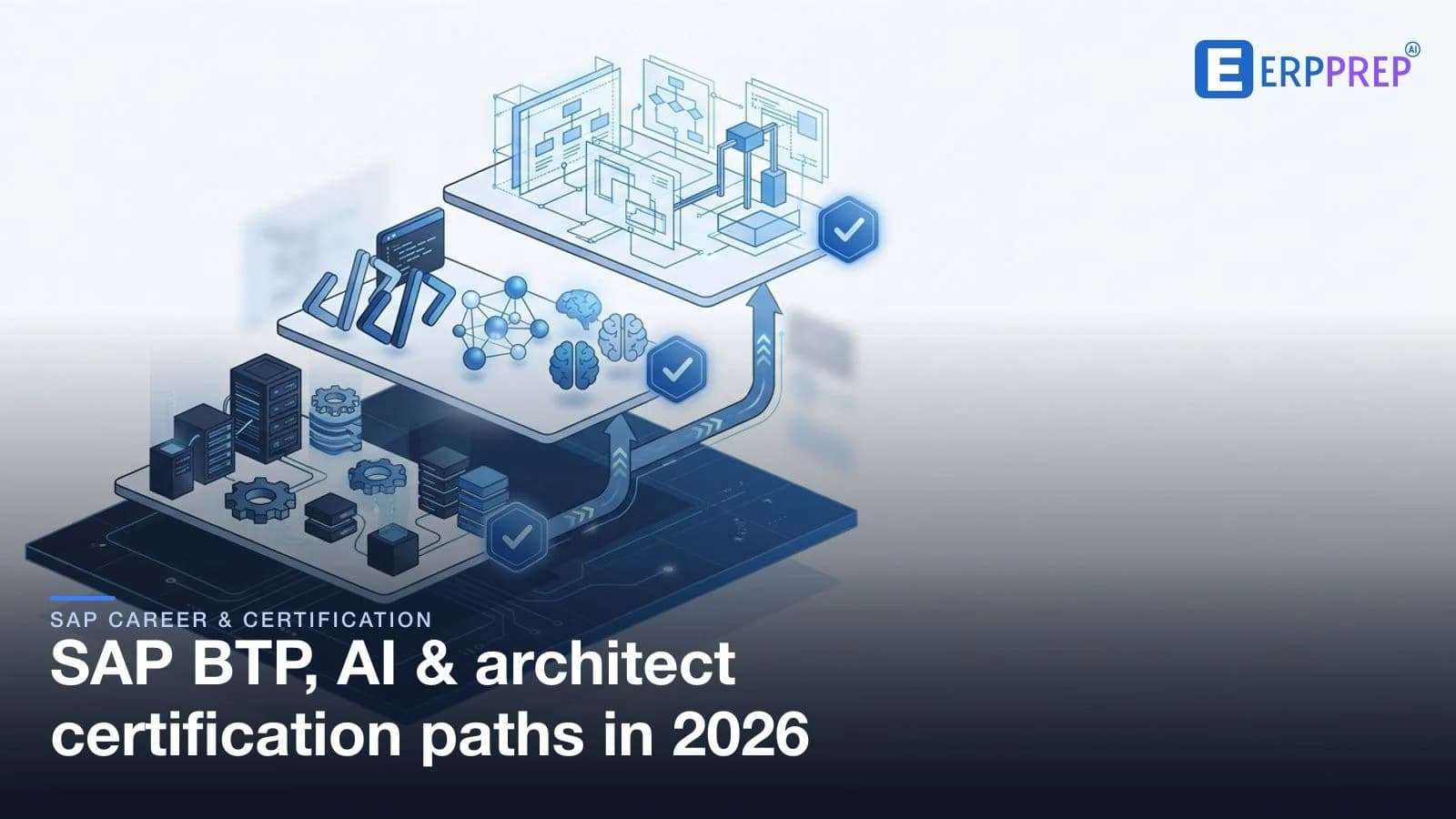
SAP's platform track has four rungs beyond ABAP development. BTP Administrator (C_ADBTP) operates the platform — cloud services, security, and identity management — as a System-Based Assessment with an unusual 100% cut score. Generative AI Developer (C_AIG) builds AI applications on the platform, also System-Based, at a 76% cut score. The professional architect tier designs across it: BTP Solution Architect (P_BTPA) at platform scope and Enterprise Architect (P_SAPEA) at enterprise scope, both Scenario-Based at a 60% cut score. The C_ codes are associate; the P_ codes assume real design experience. Choose by whether you operate, build, or architect.
SAP® developer certification doesn't stop at ABAP. Above it sits a platform track with four distinct jobs — operate the platform, build AI on it, then architect across it — and each has its own certification, format, and difficulty profile. This guide maps all four rungs so you can see how they stack, who each is for, and the order that actually makes sense. For the classic developer starting point, see ABAP Cloud vs BTP Administrator; for where this whole track sits among the others, every SAP certification track in 2026. And for the "is any of this worth it" question, see whether SAP certification is worth it and how to choose.
Key takeaways
- The platform track is four jobs, not one ladder — operate (C_ADBTP), build AI (C_AIG), architect the platform (P_BTPA), architect the enterprise (P_SAPEA).
- The code prefix is the tier: C_ = associate (implementation-level), P_ = professional (senior architect, assumes real design experience).
- All four are performance-based — the associate exams are System-Based (SyBA), the professional exams are Scenario-Based (SBA); none is legacy multiple-choice.
- Cut scores differ sharply: BTP Administrator publishes a 100% cut score (zero margin), Generative AI Developer 76%, and both architect exams 60%.
- The natural path is operate or build first, architect later — the professional exams reward hands-on platform context you can't fake.
The platform certifications at a glance
Each exam sits on an official SAP learning journey (SAP, learning.sap.com) and targets a distinct job on the platform. Here they are side by side:
| Exam | What it covers | Tier | Format & cut score |
|---|---|---|---|
| C_ADBTP — BTP Administrator | Operating the platform: cloud services, cloud security, identity & access management | Associate (C_) | System-based (SyBA) · 100% |
| C_AIG — Generative AI Developer | Building generative-AI apps: cloud app development + generative-AI practice | Associate (C_) | System-based (SyBA) · 76% |
| P_BTPA — Solution Architect, SAP BTP | Designing BTP solutions across Integration Suite, AI Core, Business Data Cloud | Professional (P_) | Scenario-based (SBA) · 60% |
| P_SAPEA — Enterprise Architect | Enterprise-scope architecture using the SAP Enterprise Architecture Framework | Professional (P_) | Scenario-based (SBA) · 60% |
What each certification covers in detail
- Operate — C_ADBTP, SAP BTP Administrator. This is the platform-operations rung. It centres on cloud services, cloud security, and identity and access management — the day-to-day of running SAP Business Technology Platform. In practice that spans account and landscape setup, managing users and authorizations, platform connectivity, and keeping the environment healthy and governed. It is a System-Based Assessment, so the emphasis is on completing real administration tasks in a live environment rather than reciting concepts.
- Build — C_AIG, SAP Generative AI Developer. One rung up in purpose (not seniority), this certifies building generative-AI applications on the platform. Its skill areas are cloud application development and the day-to-day practice of working with generative AI — designing and managing prompts, wiring AI into enterprise workflows, and grounding outputs against trusted business data so results stay reliable. It is also a System-Based Assessment: you demonstrate the work, not just describe it.
- Architect the platform — P_BTPA, Solution Architect – SAP BTP. This is the first professional rung. It targets designing end-to-end solutions on the platform, spanning services such as Integration Suite, AI Core, and Business Data Cloud, and translating business requirements into a coherent solution blueprint. Expect integration strategy, application design, cost estimation, and solution governance to sit at the centre. As a Scenario-Based Assessment, it tests judgment across a connected situation rather than isolated tasks.
- Architect the enterprise — P_SAPEA, SAP Enterprise Architect. The broadest rung. It certifies working at enterprise scope using the SAP Enterprise Architecture Framework — building a holistic architecture model aligned to business strategy and shaping how IT supports the organization's goals. Where P_BTPA designs on the platform, P_SAPEA designs across the whole estate: business, application, data, and technology architecture and the roadmap that connects them. It is also a Scenario-Based Assessment.
Prerequisites & who each is for
The associate and professional tiers imply very different starting points, and reading the code prefix correctly saves a lot of wasted effort.
The associate rungs (C_ADBTP, C_AIG) verify fundamental, implementation-level skills for one part of the platform, and they're the right entry point for most people. C_ADBTP fits administrators and consultants who operate SAP environments — the people responsible for accounts, security, identity, and connectivity. C_AIG fits developers building on the platform, specifically those working with generative AI. Neither assumes you're already an architect; they assume you can do the hands-on work, which is exactly what a System-Based Assessment checks.
The professional rungs (P_BTPA, P_SAPEA) are a different animal. They target senior architect roles, and while there isn't a formal exam-prerequisite chain, both assume real design experience — the kind you accumulate leading solution work, not the kind you can read your way into. P_BTPA suits solution architects who already design on the platform and want to validate that breadth across integration, application, data, and AI services. P_SAPEA suits enterprise architects operating above any single platform, aligning IT strategy to business goals across the estate. If you have never owned an architecture decision on a live project, these exams will feel abstract — because they reward judgment, not recall. Always confirm the current prerequisites on each exam's page at learning.sap.com, since SAP updates them over time.
How hard are they? Cut scores & difficulty
Difficulty here is exam-specific, and the published cut score is the clearest single signal — but it's not the only one. Here are the four side by side (SAP, learning.sap.com):
| Exam | Cut score | Format |
|---|---|---|
| C_ADBTP — BTP Administrator | 100% | System-based (SyBA) |
| C_AIG — Generative AI Developer | 76% | System-based (SyBA) |
| P_BTPA — Solution Architect | 60% | Scenario-based (SBA) |
| P_SAPEA — Enterprise Architect | 60% | Scenario-based (SBA) |
The number that jumps out is C_ADBTP's 100% cut score. That is genuinely unusual — most SAP associate exams pass somewhere between the mid-50s and low-80s percent — and it means the assessment leaves zero margin for error: you're expected to complete the administration activity correctly and completely. It doesn't make BTP Administrator the "hardest" exam in some absolute sense, but it does change how you prepare. Because it's a System-Based Assessment, the right response is to rehearse the actual administration tasks in a live environment until they're automatic — a single fumbled step is the difference between passing and not. By contrast, the architect exams pass at 60%, which sounds gentler, but they're Scenario-Based: the challenge isn't completing a checklist, it's making the right judgment call across a connected, ambiguous situation where several options look defensible. Learning to prepare for the performance-based format matters most exactly where the bar is highest.
See how a performance-based task is scored. A free sample shows the doing-in-a-system style these platform exams use — before you commit to a rung. Try a free sample.
Career progression: how they stack
For most people the sequence is operate or build first, architect later — and the reason is structural, not arbitrary. The professional architect exams assume design experience, and the fastest way to earn that experience is to have run or built on the platform yourself.
A common path starts by earning hands-on platform context: taking BTP Administrator if you operate the platform, or Generative AI Developer if you build applications on it. Either one grounds you in how the platform actually behaves — its services, security model, and integration points — which is the raw material the architect exams reason over. As your role shifts from building or operating toward designing, the professional tier becomes the next step: Solution Architect when your scope is the platform, and Enterprise Architect when your scope widens to the whole estate. The two architect exams aren't a strict sequence either — P_BTPA is platform-scoped and P_SAPEA is enterprise-scoped, so which comes "next" depends on where your responsibility lands, not on a fixed ladder.
It's also worth seeing this track next to the ABAP developer path rather than in isolation. An ABAP Cloud developer writes clean-core extensions; a BTP Administrator runs the platform those extensions deploy to; a Generative AI Developer builds AI apps on it; and the architects design across all of it. Careers move between these over time, which is why the ABAP Cloud vs BTP Administrator comparison is the natural companion to this guide.
Common mistakes to avoid
- Treating the four rungs as one ladder. Operating, building AI, and architecting are different jobs, not seniority steps you climb in order. Pick the rung that matches the work you do, not the one that sounds most senior.
- Reading past the 100% cut score. C_ADBTP leaves no margin. Preparing for it like a typical 70%-pass exam — where a few slips are survivable — is the fastest way to fail it. Rehearse the tasks until they're automatic.
- Attempting an architect exam without design experience. The professional exams reward judgment earned on real projects. Studying the framework without having made architecture trade-offs yourself leaves you guessing on exactly the questions that discriminate.
- Confusing platform scope with enterprise scope. P_BTPA designs on the platform; P_SAPEA designs across the enterprise. Choosing the wrong one wastes preparation on material aimed at a different altitude of decision-making.
- Preparing by reading alone. Every rung here is performance-based. Passive study prepares you for an exam these certifications deliberately no longer resemble.
How to prepare
Whichever rung you choose, the preparation principle is consistent because the formats are shared within the track. For the associate System-Based exams (C_ADBTP, C_AIG), practise doing the tasks in a realistic environment until the sequence is second nature — this matters doubly for BTP Administrator, where the 100% bar punishes any incomplete step. For the professional Scenario-Based exams (P_BTPA, P_SAPEA), rehearse reasoning through connected situations: trace a business goal to an architecture decision, weigh competing options, and justify the trade-off, because that judgment is what's actually scored. Across all four, work under time pressure so accuracy holds when it counts. The performance-based exam preparation guide covers the technique in depth, and every exam above links down to its hub — where the scenarios, skill drills, and exam facts for that specific certification live.
Frequently asked questions
- What is the SAP BTP Administrator certification?
- C_ADBTP (SAP BTP Administrator) is an associate certification for operating SAP Business Technology Platform — cloud services, cloud security, and identity and access management. It's a System-Based Assessment, so you complete administration tasks in a live environment rather than answering pure multiple-choice questions. Its cut score is unusual: candidates are expected to complete the assessment fully, so there is effectively no margin for error.
- Is there an SAP AI certification?
- Yes — C_AIG (SAP Generative AI Developer) certifies building generative-AI applications on SAP's platform, covering cloud application development and the day-to-day practice of working with generative AI. It's an associate-level, System-Based Assessment with a 76% cut score at the time of writing. It sits one rung up from platform operation: you build AI apps on the platform an administrator runs.
- What's the difference between P_BTPA and P_SAPEA?
- Both are professional-tier architect certifications, but at different scopes. P_BTPA (Solution Architect – SAP BTP) designs solutions on the Business Technology Platform, spanning services such as Integration Suite, AI Core, and Business Data Cloud. P_SAPEA (SAP Enterprise Architect) works at enterprise scope using the SAP Enterprise Architecture Framework. One architects on the platform; the other architects across the whole enterprise. Both are Scenario-Based Assessments with a 60% cut score.
- Do I need to be a developer first to take the architect exams?
- Not as a formal rule, but the professional architect certifications assume real design experience. Most people reach them after working as a developer or administrator — for example ABAP Cloud or BTP Administrator — and then move up as their role shifts from building to designing. The architect exams reward judgment you accumulate on real projects, not study alone. Confirm current prerequisites on each exam's page at learning.sap.com.
- Why does C_ADBTP have a 100% cut score?
- The BTP Administrator exam is published with a 100% cut score, which is unusual — most SAP associate exams pass somewhere between the mid-50s and low-80s percent. In practice it means the assessment leaves no margin: you are expected to complete the administration activity correctly and fully. The takeaway is preparation strategy, not panic — because it's a System-Based Assessment, you should rehearse the actual administration tasks in a live environment until they're second nature, rather than relying on reading.
- Which comes first — BTP Administrator or Generative AI Developer?
- There's no fixed order; they target different jobs. BTP Administrator (C_ADBTP) suits people who operate the platform — accounts, security, identity, connectivity. Generative AI Developer (C_AIG) suits people who build applications, specifically AI apps, on top of it. Pick the one that matches what you actually do day to day. Many people who intend to architect later take one of these first to earn the hands-on platform context the professional exams assume.
- Are the BTP and AI exams multiple-choice?
- The underlying SAP assessments are performance-based, not legacy multiple-choice: C_ADBTP and C_AIG are System-Based Assessments where you work in a live environment, and P_BTPA and P_SAPEA are Scenario-Based Assessments where you reason through a connected business situation. Preparation content like ERPPrep's uses a question-and-answer format to rehearse the same competencies, but it's practice — it doesn't reproduce the live exam.
- How does this platform track relate to ABAP certification?
- ABAP development is the classic developer starting point; this platform track sits above and alongside it. An ABAP Cloud developer writes clean-core extensions, while a BTP Administrator runs the platform those extensions deploy to, a Generative AI Developer builds AI apps on it, and the architects design across it. Many careers move from ABAP or platform operation into architecture over time. See the ABAP Cloud vs BTP Administrator comparison for the developer starting point.
ERPPrep is an independent platform and is not affiliated with, endorsed by, or sponsored by SAP SE. SAP and other SAP products are trademarks of SAP SE, referenced here only to describe the certification exams ERPPrep helps you prepare for.
Ready to practise the way the exam tests?
ERPPrep provides original, performance-style scenarios and skill drills built for the 2026 SyBA and SBA formats. Try a free sample and judge the quality yourself.
Practice for these exams
Related guides
Which SAP AI certification should you take?
SAP's AI credentials split three ways: build generative AI, position Business AI, or run the platform it sits on. A role-by-role way to choose one.
SAP BTP certifications explained: which one is right for you
A map of the SAP BTP certification family — administrator, architect, integration, ABAP and generative-AI developer, LeanIX EA — and how to choose.
SAP CAP vs ABAP back-end developer certification: C_CPE vs C_ABAPD
Two SAP back-end developer certifications, two runtimes. C_CPE (CAP — SAP's cloud application framework in Node.js/Java) vs C_ABAPD (ABAP Cloud, using RAP). What each covers, the format, the cut score, and which to choose.