

SAP Business AI certifications compared: positioning vs building (C_BCBTP vs C_AIG)
Two SAP Business AI certifications, two opposite jobs. C_BCBTP positions and sells SAP Business AI; C_AIG builds generative-AI solutions. Compare format, cut score, level, and which one fits your role.
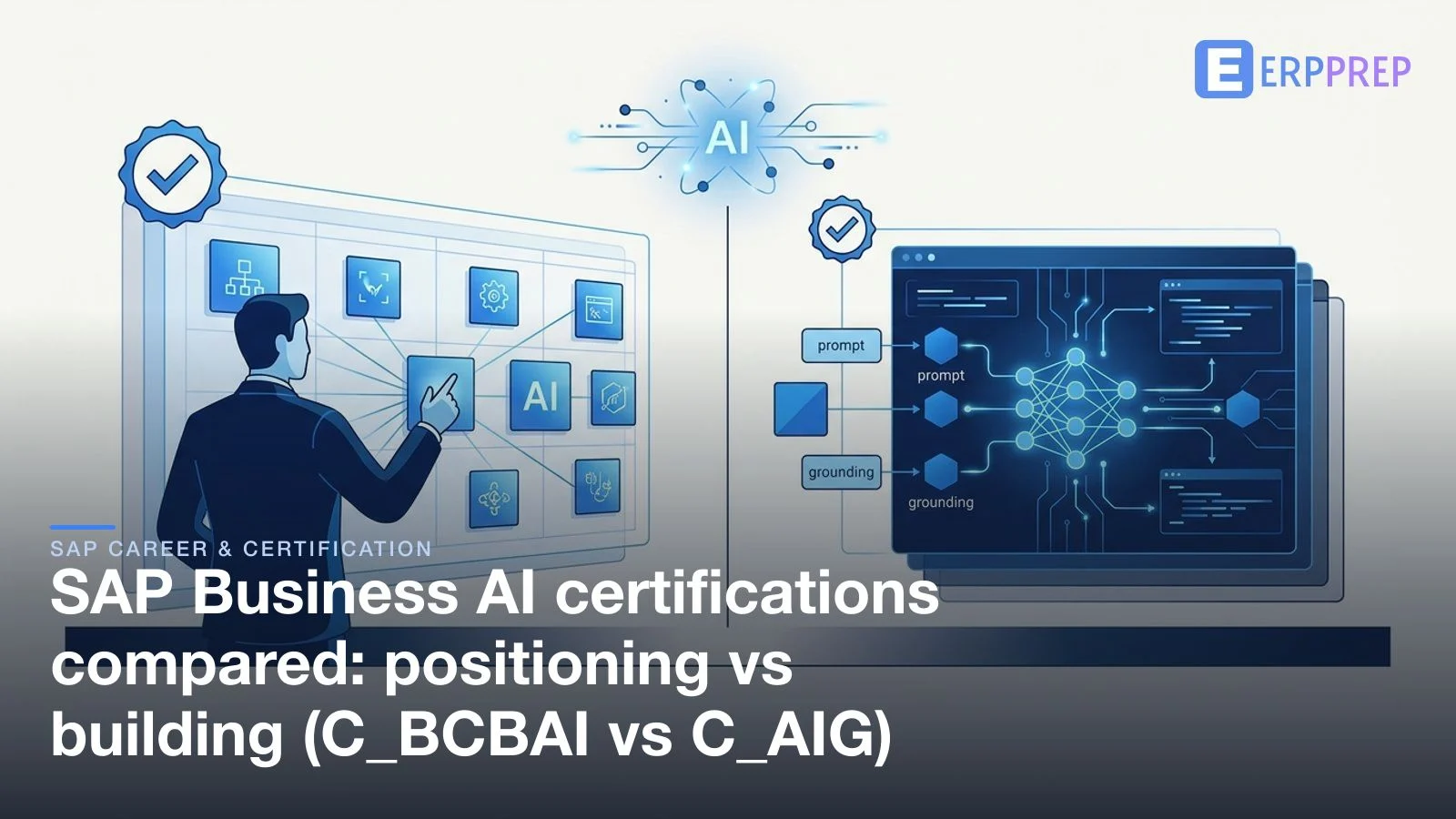
C_BCBTP (Positioning SAP Business AI Platform) is a presales and sales credential — you learn to advise on and position SAP Business AI, Joule, and responsible AI. C_AIG (SAP Generative AI Developer) is a hands-on developer credential — prompt engineering, the generative AI hub, and grounding. Both are associate-level, but C_BCBTP is a Scenario-Based Assessment at 60% and C_AIG a System-Based Assessment at 76%. Choose by whether you sell AI or build it.
SAP® Business AI is one technology story, but SAP certifies two very different jobs around it. C_BCBTP — Positioning SAP Business AI Platform across the Business Suite — is a presales and sales credential about positioning the technology: explaining its value, tailoring the message, and advising customers. C_AIG — SAP Generative AI Developer — is a developer credential about building with it: prompt engineering, the generative AI hub, and grounding. This is not a head-to-head between rivals; it is a fork in the road between selling AI and building it. For the wider question of which credential fits your direction, see whether SAP certification is worth it and how to choose.
Key takeaways
- C_BCBTP is the positioning track — it certifies advising on and positioning SAP Business AI for presales and sales roles, not writing code.
- C_AIG is the building track — it certifies hands-on generative-AI development with prompt engineering, the generative AI hub, and grounding.
- Both are associate-level, but they use different formats and pass marks: C_BCBTP is a Scenario-Based Assessment (SBA) at a 60% cut score, while C_AIG is a System-Based Assessment (SyBA) at a 76% cut score.
- They map to different roles: a customer-facing presales/sales professional versus an AI developer or engineer.
- This is a positioning-versus-building choice, not a better-or-worse one — pick the one that mirrors the work you actually do.
C_BCBTP vs C_AIG at a glance
Both certifications sit on official SAP Business AI learning journeys (SAP, learning.sap.com) and share the same underlying product family — but they aim at opposite ends of the work. Here they are side by side:
| C_BCBTP — Positioning SAP Business AI | C_AIG — Generative AI Developer | |
|---|---|---|
| Core angle | Positioning, advising, selling | Building, developing, integrating |
| What it covers | SAP Business AI strategy, value propositions, competitive positioning, Joule, and responsible AI | Prompt engineering, the generative AI hub, prompt templates, orchestration, and grounding |
| Best for | Presales and sales professionals | Developers and AI engineers |
| Format | Scenario-Based Assessment (SBA) | System-Based Assessment (SyBA) |
| Cut score | 60% | 76% |
| Level | Associate | Associate |
Verify every one of these facts on the two exam pages before you book — SAP updates format details, cut scores, and languages over time, and the definitive figures always live on each certification's own page at learning.sap.com.
What C_BCBTP (Positioning SAP Business AI) covers
C_BCBTP is a business credential, not a technical one. Its whole purpose is to make you fluent at explaining and positioning SAP Business AI to a customer — understanding the strategy, the principles behind it, and the business opportunities it opens, then turning that into a compelling story. The skills it targets sit in the commercial space: building a customer value proposition, competitive positioning, and a working grasp of artificial intelligence as a business capability rather than a coding discipline.
The associated learning journey is aimed squarely at customer-facing roles — think presales, sales, and customer-engagement work — and the topics reflect that:
- The SAP Business AI value story — framing the business challenges AI addresses and articulating the portfolio in terms a buyer cares about.
- Positioning to different personas — tailoring the message to specific customer roles and their priorities rather than reciting one generic pitch.
- Joule and agentic AI — explaining what Joule and its agents do across the SAP ecosystem, including SAP Business Suite, and how they automate work and support decisions.
- Deployment context — describing how SAP Business AI supports both ready-to-use and custom scenarios across different environments, so you can speak to how a customer would actually adopt it.
- Responsible AI — conveying SAP's approach to AI ethics and its guiding principles, which is increasingly part of any serious enterprise conversation.
The through-line is persuasion grounded in accuracy: a C_BCBTP-certified professional can walk into a room, read who is across the table, and position SAP Business AI so the value lands — without over-claiming. That judgement, weighing what to emphasise for a given audience and how to frame trade-offs honestly, is exactly what a Scenario-Based Assessment is designed to probe.
What C_AIG (SAP Generative AI Developer) covers
C_AIG is the hands-on counterpart. Where C_BCBTP positions the value, C_AIG builds the thing. The certification recognises that you can solve business problems with SAP's generative AI hub — applying prompt-engineering techniques and working with prompt development, template management, and workflow orchestration in the tooling. Its skills are developer skills: cloud application development, artificial intelligence, and the day-to-day practice of generative AI.
The learning journey behind it is a genuine engineering curriculum, and it goes deep:
- Large language model fundamentals — how LLMs work, their strengths and limits, and how to apply them responsibly inside SAP environments.
- Prompt engineering — developing and refining prompts, using system, user, and assistant roles, and hardening prompts against misuse.
- The generative AI hub — navigating its interfaces, managing models, and using the orchestration service to run AI workflows for enterprise use.
- Prompt registry and templates — managing prompts for consistency and scale, and integrating LLMs into workflows with the SAP Cloud SDK for AI.
- Grounding — connecting model outputs to trusted enterprise data with document grounding and vector techniques so answers are context-aware and reliable.
A C_AIG-certified developer, then, owns the construction: designing prompts that behave, wiring the SDK, and grounding outputs in real data so the solution is trustworthy in production. The exam's System-Based Assessment format matches that reality — it leans on doing the work in a system rather than describing it, which is one reason its cut score sits higher.
The very different roles behind each exam
The cleanest way to choose is to look at who actually holds each job. They almost never sit in the same seat.
A C_BCBTP professional is customer-facing. They run discovery conversations, shape value propositions, deliver the positioning in a demo or a workshop, and help a customer see where SAP Business AI fits their business. The work is communication-and-judgement shaped: understand the audience, frame the value, handle the objection, stay honest about what the technology does. If you enjoy translating capability into business outcomes and moving a decision forward, this is your lane — and it pairs naturally with a presales or sales career.
A C_AIG professional is a builder. They design and test prompts, integrate the generative AI hub through the cloud SDK, and ground outputs against enterprise data so the result holds up. The work is code-and-systems shaped: precise, testable, and unforgiving when a prompt drifts or a grounding source is wrong. It suits someone who likes constructing a working solution and being the person who can actually ship it.
There is a career-shape difference too. Positioning skills compound toward advisory, presales-leadership, and go-to-market roles — the instinct for reading a room and framing value travels well beyond any single product. Building skills compound toward deeper engineering: AI-solution architecture, platform work, and the kind of hands-on credibility that only comes from having shipped. Neither is "better" — they are different bets on how you want your expertise to grow. If you are weighing the developer path specifically, the SAP generative AI vs ABAP developer certification comparison places C_AIG alongside the classic ABAP route.
Not sure how these performance-based formats feel? A free sample shows the reason-through-a-situation style before you commit to a path. Try a free sample.
Format and cut score: SBA at 60% vs SyBA at 76%
This is where the two exams diverge most, and it is worth understanding before you book. C_BCBTP uses the Scenario-Based Assessment (SBA) format — SAP's roleplay-style approach where you work through a realistic business or advisory situation and pick the best positioning or recommendation. That fits a credential about judgement and communication. C_AIG uses the System-Based Assessment (SyBA) format, where tasks resemble real system work — here, doing prompt, hub, and grounding work rather than talking about it. That fits a credential about building.
The pass marks differ as well: C_BCBTP publishes a 60% cut score while C_AIG publishes a 76% cut score at the time of writing. The higher bar on the developer exam is consistent with its hands-on nature — there is less room for a partly-right answer when the task is to make a system behave correctly. Either way, the winning preparation is the same in spirit: rehearse the actual style of the exam. For the technique that applies across this family, the guide to the performance-based exam format covers how SBAs and SyBAs are built and how to work them under time pressure. Always confirm the current format and cut score on each exam's page at learning.sap.com, since these can change.
Can you hold both?
Yes — but ask whether you should. Because C_BCBTP and C_AIG target genuinely different roles, most people are best served by the one that matches their day job, and there is no dependency between them: neither is a prerequisite for the other. Holding both is a breadth play, and it makes most sense for a narrow band of hybrid roles — a solution architect or a technical presales specialist who both advises customers and prototypes what they are proposing. For that person, being able to position the value and demonstrate a working build is a real edge.
For everyone else, sequencing beats stacking. Lead with the credential that reflects the work you already do, earn it, apply it, and only add the second if your role genuinely shifts across the positioning/building line. A developer who moves into a presales-engineering role, or a presales professional who takes on more hands-on prototyping, is exactly the case where the second exam starts to pay off.
Which one should you choose?
Work backwards from the role you hold or want, not from the cut score. Three rules of thumb:
- Choose C_BCBTP if you position and sell. You run customer conversations, build value propositions, deliver demos, or own the go-to-market narrative for AI. This is the presales and sales credential, and its SBA format rewards judgement and framing.
- Choose C_AIG if you build. You write code, design prompts, integrate services, and ship AI solutions. This is the developer credential, and its SyBA format and higher cut score reflect genuine hands-on depth.
- Consider both — in sequence — only for a hybrid role. If you truly straddle advising and building, add the second once you have real exposure to the other side. Otherwise, one well-matched credential beats two half-relevant ones.
Still mapping the broader AI and developer landscape? Each exam hub below carries the scenarios, skill drills, and exam facts for that specific certification, and the guide to choosing an SAP certification places these two among the wider set of options.
Prepare for whichever you pick
Once you have chosen, prepare for the format that exam actually uses. For C_BCBTP, rehearse reasoning through advisory and positioning scenarios — who the customer is, what they value, and how you frame SAP Business AI honestly and persuasively. For C_AIG, do the work in a realistic setting: design and refine prompts, use the generative AI hub and the cloud SDK, and practise grounding until it is second nature. Either way, trace whole situations end to end and rehearse under time pressure so your accuracy holds when it counts. Start from the exam hub for your path, try a free sample to feel the performance-based style, and build from there.
Frequently asked questions
- What is the difference between C_BCBTP and C_AIG?
- C_BCBTP (Positioning SAP Business AI Platform) is a business-facing credential for presales and sales roles — you learn to explain, position, and advise on SAP Business AI, Joule, and its responsible-AI foundations. C_AIG (SAP Generative AI Developer) is a technical developer credential — you build solutions with prompt engineering, the generative AI hub, and grounding. One sells the value; the other constructs the solution.
- What exam format does C_BCBTP use?
- C_BCBTP is a Scenario-Based Assessment (SBA), the roleplay-style performance format where you reason through a business or advisory situation and choose the best positioning or recommendation rather than recalling isolated facts. The exam page lists it as a single-activity assessment. Always confirm the current format on the exam's page at learning.sap.com before you book.
- What exam format does C_AIG use?
- C_AIG is a System-Based Assessment (SyBA), the hands-on format where tasks resemble real system work — here, working with prompts, the generative AI hub, and grounding to solve a business problem. The exam page lists it as a single-activity assessment. Confirm the live format and any updates on the exam's page at learning.sap.com before booking.
- What is the cut score and level for each exam?
- Both are associate-level certifications. C_BCBTP publishes a 60% cut score; C_AIG publishes a higher 76% cut score at the time of writing. The higher pass mark on C_AIG reflects its technical, build-focused nature. Cut scores can change, so verify the current figure on each exam's page at learning.sap.com.
- Which SAP AI certification is for positioning versus building?
- Choose C_BCBTP if your job is positioning — presales, sales, or advisory work where you frame SAP Business AI's value, tailor the message to different customer roles, and speak to Joule and responsible AI. Choose C_AIG if your job is building — developer work using prompt engineering, the generative AI hub, prompt templates, and grounding to ship AI solutions.
- Do I need both C_BCBTP and C_AIG?
- Rarely at once. They target different roles, so most people hold the one that matches their day job. A solution or presolution architect who both advises customers and prototypes could reasonably add the second over time, but neither is a prerequisite for the other, and holding both is a breadth play rather than a requirement.
- Which SAP AI certification fits my career?
- Work backwards from your role. If you engage customers, run demos, or build value propositions, C_BCBTP aligns with presales and sales. If you write code, integrate services, and design prompts, C_AIG aligns with a developer or AI-engineering path. The certification should mirror the work you already do or want to move into.
- Is one of these SAP AI certifications more technical?
- Yes. C_AIG is the technical credential — it covers hands-on generative-AI development with the generative AI hub, prompt engineering, the SAP Cloud SDK for AI, and grounding techniques. C_BCBTP is business-facing: it covers positioning, competitive messaging, and the strategy and ethics of SAP Business AI rather than writing or deploying code.
- Are there prerequisites for C_BCBTP or C_AIG?
- Neither exam is gated behind a formal prerequisite certification; both are associate entry points into SAP Business AI. In practice C_AIG expects real development comfort — LLM concepts, prompt engineering, and cloud SDK work — while C_BCBTP expects business fluency in framing and positioning technology. Confirm any current requirements on each exam's page at learning.sap.com.
ERPPrep is an independent platform and is not affiliated with, endorsed by, or sponsored by SAP SE. SAP and other SAP products are trademarks of SAP SE, referenced here only to describe the certification exams ERPPrep helps you prepare for.
Ready to practise the way the exam tests?
ERPPrep provides original, performance-style scenarios and skill drills built for the 2026 SyBA and SBA formats. Try a free sample and judge the quality yourself.
Practice for these exams
Related guides
Which SAP AI certification should you take?
SAP's AI credentials split three ways: build generative AI, position Business AI, or run the platform it sits on. A role-by-role way to choose one.
How to prepare for an SAP Business AI certification
A practical study guide for SAP's two Business AI certifications — C_BCBTP (positioning) and C_AIG (generative-AI developer) — which demand very different preparation.
Are SAP's acquired-product certifications real SAP certifications?
Signavio, LeanIX, Concur, WalkMe and SmartRecruiters all carry SAP credentials. Whether they count as real SAP certifications — and when to take one.