

What SyBA and SBA actually test (skills, not recall)
What SAP's SyBA and SBA exams actually test in 2026: procedural fluency in a live system vs business judgement in scenarios — and how to prepare for each.
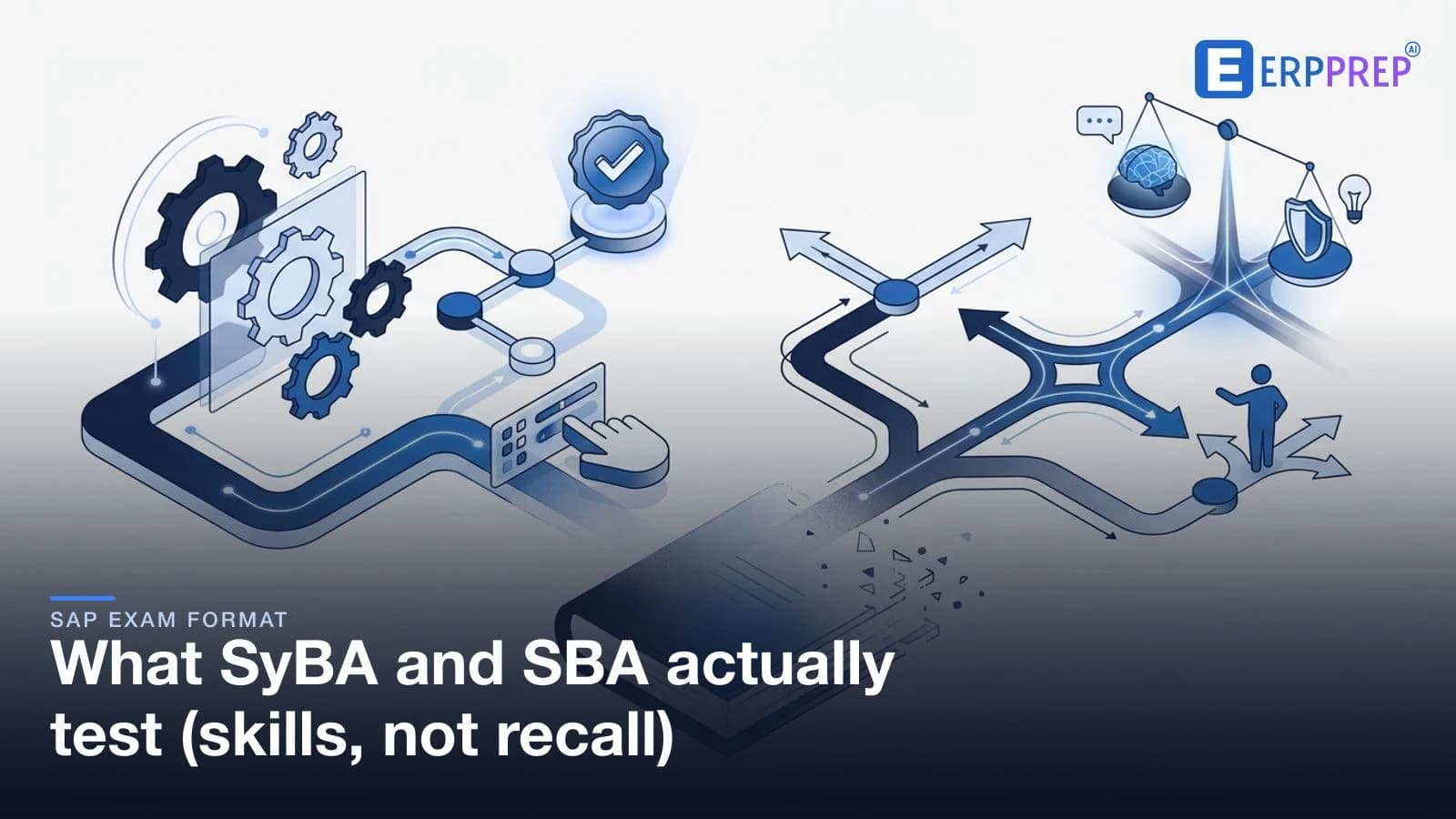
SyBA stands for System-Based Assessment and SBA for Scenario-Based Assessment — SAP's two 2026 performance-based exam formats. SyBA tests whether you can execute a task in a live system and prove it worked; SBA tests whether you can reason through a connected business case and choose the defensible action. Both measure applied capability, not memorised facts.
The most useful question to ask about SAP®'s 2026 certifications is not "what's on the exam?" but "what is the exam measuring?" The answer reshapes how you should study. The two performance-based formats — System-Based Assessment (SyBA) and Scenario-Based Assessment (SBA) — are built to test applied capability, the things a competent practitioner can actually do, rather than facts a candidate can merely recognise. Get that distinction wrong and you can revise for weeks in the wrong mode. For the full prep approach this implies, see how to pass SAP's 2026 performance-based exams.
Key takeaways
- SyBA measures procedural fluency — performing a task in a live system and identifying the evidence that confirms it worked.
- SBA measures judgement — reasoning through a connected scenario and choosing the action that stays defensible in context.
- Neither rewards memorisation the way the old format did. Recognition of a fact is no longer enough to score.
- The format dictates the rehearsal — timed task reproduction for SyBA, whole-scenario reasoning and justification for SBA.
- Check your specific exam's format first. When a certification blends both styles, train both muscles.
SyBA vs SBA at a glance
Before the deep dives, here is the whole comparison in one place. The two formats share a philosophy — reward doing, not recognising — but the ability each one probes, and therefore the way you prepare, diverge sharply.
| Aspect | System-Based (SyBA) | Scenario-Based (SBA) |
|---|---|---|
| What you do | Complete a task in a live system — configure, sequence, or correct a setting — then identify the evidence it worked. | Read a connected business case, weigh competing pressures, and choose the action a competent advisor would defend. |
| What it measures | Procedural fluency: can you perform and validate the task correctly? | Judgement: can you apply knowledge in context and pick the defensible option? |
| Typical tracks | S/4HANA functional and administration exams — Finance, procurement, sales, HANA administration, Fiori administration. | Cloud HR (SuccessFactors) modules, application development, and the senior architect exams. |
| How to prepare | Repeated, timed task reproduction in a realistic environment until execution is automatic. | Whole-scenario reasoning: make a decision, justify it, and reject the plausible alternatives. |
What does SyBA measure?
System-Based Assessment measures procedural fluency. You're placed in a system context and asked to make something true — configure an organisational unit, sequence a set of steps, correct a broken setting — and then to identify the validation evidence that confirms it worked. That second half is where many candidates lose marks: recognising the report, balance, document, or status that proves the outcome is half of what a SyBA item is really testing. It is not enough to know that a setting exists; the exam wants to see that you know where it lives, what order things run in, and how you confirm the result once you have made the change.
Think about how that differs from the old world. A multiple-choice item could reward you for recognising a correct statement among four; you could arrive at the right letter without ever having performed the action. A SyBA item removes that shortcut. The task is the question, and your fluency in carrying it out — smoothly, in the right sequence, with the confirmation step included — is the answer. Someone who has done the configuration a hundred times moves through it almost without thinking; someone who has only read about it hesitates at exactly the steps where hands-on people have muscle memory.
What does SBA measure?
Scenario-Based Assessment measures judgement. You reason across a connected business narrative — with competing pressures like cost, risk, governance, and timeline — and choose the course of action a competent advisor would defend. The difficulty is deliberate: several options look reasonable, and the wrong ones are plausible mistakes, not obvious errors. SBA is therefore testing whether you can apply knowledge in context and distinguish the correct decision from the merely possible one.
What makes this a genuinely different skill is that the scenario is connected: an earlier fact constrains a later choice, and the "best" answer in isolation may be indefensible once the whole situation is in view. That rewards a specific habit — holding the entire case in your head, tracing consequences forward, and asking not just "is this correct?" but "is this correct given everything else in play?" For the tactics that make connected scenarios manageable under time pressure, see the SBA connected-scenario strategy.
Why SAP moved from recall to doing
The shift to performance-based formats is not cosmetic; it addresses a long-standing complaint about knowledge exams — that they can be passed by pattern-matching against memorised material without any assurance the holder can do the job. A certificate is only as valuable as the confidence an employer can place in it. When recognition of a fact is enough to pass, the certificate certifies recognition, not competence. By making the candidate execute a task or decide a case, the 2026 formats tie the credential far more tightly to on-the-job capability.
There is a second motive: durability. Rote answer keys age badly and leak; a scenario that demands reasoning, or a task that demands execution, is much harder to reduce to a memorisable list. That makes the credential more resistant to the kind of shortcut prep that undermines trust in an exam. The knock-on effect is that a performance-based certificate tends to age more gracefully alongside the product: because it certified capability rather than a snapshot of trivia, it stays a fairer signal for longer even as screens and menus evolve underneath. If you want the wider view of how and why the exam experience changed, the 2026 format-change explainer traces the transition end to end.
Skills vs recall: what each really rewards
It helps to name the abilities precisely, because "skills" is a slippery word. Recall is the ability to retrieve a stored fact. Recognition — the workhorse of multiple-choice — is the ability to pick a correct statement out of a set. Neither is what the 2026 formats primarily reward. SyBA rewards production: generating a correct outcome yourself and proving it. SBA rewards discrimination under context: choosing the defensible option when several are superficially credible.
The practical consequence is that the study methods which feel productive — re-reading notes, highlighting, watching walkthroughs — build recognition, which is exactly the ability the new formats discount. They are not useless; they lay groundwork. But they create a dangerous illusion of readiness, because the fluent recognition they produce does not transfer to production or to contextual judgement. The test of whether you are actually ready is uncomfortable but reliable: can you perform the task with the notes closed, and can you defend a scenario decision without seeing the answer key first? If the honest answer is no, more reading will not fix it — more doing will. This is one of the most common reasons well-prepared-feeling candidates stumble, explored further in why people fail SAP performance-based exams. The skills that actually pass a functional certification break the same point down ability by ability.
Not sure how a performance-based item feels? A free sample shows the doing-over-recalling style — a task to perform and validate, or a scenario to reason through — before you commit prep time. Try a free sample.
How to tell which format you'll sit
Because the two formats reward different practice, working out which one your exam uses is one of the highest-leverage moves you can make early. Each certification's own page describes its format, so check the specific exam you are targeting rather than assuming from its neighbours. As a rough orientation while you confirm the detail:
- Lean System-Based (SyBA): S/4HANA functional exams (Finance, sourcing & procurement, sales) and administration exams (HANA administration, Fiori administration) — anywhere the job is mostly configuring and validating in a system.
- Lean Scenario-Based (SBA): cloud HR (SuccessFactors) modules, application development, and the senior architect exams — anywhere the job is mostly weighing options and defending a decision.
- Blended: some certifications mix both styles, so the safest reading of an ambiguous exam page is "prepare for both."
If you are still choosing which track to enter — and therefore which format you are likely to meet — the complete map of SAP certification tracks places every family and its typical format side by side.
How to prepare for each format
Once you know what an exam measures, the preparation almost designs itself, because you are training the exact ability that earns marks rather than a proxy for it.
For a System-Based (SyBA) exam, practise active reproduction: perform each task from memory in a realistic environment, then locate the evidence that proves it worked. Repeat until the sequence is automatic and the validation step is reflex, not an afterthought. Add a clock, because fluency that only appears when you are relaxed will desert you under exam pressure — a discipline explored in managing time in a performance-based exam.
For a Scenario-Based (SBA) exam, practise whole-scenario reasoning: work through a connected case, make a decision, then force yourself to justify it out loud and articulate why each alternative is worse in context. The goal is to rehearse the discrimination the exam rewards — not to memorise cases, but to build the habit of tracing consequences across a whole situation before committing. And because many of these formats let you consult materials, knowing what that does and does not buy you matters; see what open-book really means for SAP exams.
What this means for your study plan
Step back and the implication is simple but demanding: if the exam measures what you can do, then doing is the syllabus. That reframes how you spend every hour. Passive re-reading is demoted to a first pass that builds vocabulary; the bulk of your time goes to active reproduction and scenario reasoning, in the proportion your specific format demands. On a Finance exam such as SAP S/4HANA Finance (C_TS4FI), that means practising the configuration-and-close tasks and the judgement calls the domain actually involves, with the exam-specific breakdown living on that programmatic page rather than in a general article like this one.
The common thread across both formats — and across every track — is that recognition is no longer enough. A study plan built on that single truth, weighted toward production for SyBA and toward contextual judgement for SBA, is the one that matches how these exams actually score. For the end-to-end technique, return to how to pass SAP's 2026 performance-based exams, and for choosing legitimate practice that trains the right ability, see how to prepare for an SAP certification. The fastest way to feel the difference for yourself is still to do a task rather than read about one — try a free sample and notice how different the two feel.
Frequently asked questions
- What does SyBA test?
- System-Based Assessment tests procedural fluency. Placed in a live system context, you have to configure, sequence, or fix the right thing, and then identify the validation evidence that proves it worked. It measures the ability to perform a task correctly and confirm the outcome — not recall of where a setting happens to live. Knowing that a setting exists earns little; executing and validating it earns the mark.
- What does SBA test?
- Scenario-Based Assessment tests judgement. Given a connected business case with competing pressures such as cost, risk, and timeline, you choose the action that stays defensible across the whole situation. It measures decision-making in context — separating the correct option from several that only look plausible — rather than recall of isolated facts. The wrong answers are realistic mistakes, not obvious errors.
- Do the new formats test memorisation at all?
- Far less than the older multiple-choice exams did. Recall can help you orient yourself, but it earns few marks on its own. SyBA wants the task executed and validated; SBA wants the decision made and justified. Both are deliberately built so that a memorised answer cannot substitute for the ability to apply knowledge in a working context, which is the whole point of the 2026 redesign.
- If both formats test 'skills', why distinguish them?
- Because the skills differ, and so should your practice. SyBA rewards repeated, hands-on task reproduction until execution is automatic and you can spot the evidence that confirms it. SBA rewards reasoning through whole scenarios, weighing trade-offs, and justifying a chosen decision. Knowing which format your exam leans on tells you where to spend your prep hours instead of splitting them evenly by guess.
- How do I tell which format my exam uses?
- Each certification's page describes its format, so check the exam you are targeting rather than assuming. As a rough guide, S/4HANA functional and administration exams lean System-Based, while cloud HR modules, application development, and the senior architect exams lean Scenario-Based. Some exams blend both. When in doubt, prepare for both muscles — task reproduction and scenario reasoning — because neither wastes effort.
- Can I pass a performance-based exam by only reading study guides?
- It is far harder than it was under multiple-choice, because reading builds recognition and these formats reward production. A guide can teach you the concept, but SyBA asks you to perform and validate the task, and SBA asks you to decide and defend it. Reading is a useful first pass, but without hands-on reproduction and scenario practice you leave most of the exam untrained.
- Are SyBA and SBA harder than the old multiple-choice exams?
- They are harder to fake and easier to pass with genuine experience. If you actually do the work day to day, performance-based formats reward you, because the exam mirrors the job. If you rely on memorised answer keys, they are unforgiving, because recognition no longer scores. The difficulty shifts from breadth of trivia toward depth of applied capability in the module you work in.
- Does knowing the format change my study plan?
- Yes, materially. A System-Based exam pushes you toward repeated, timed task reproduction in a realistic environment until each procedure is automatic. A Scenario-Based exam pushes you toward reasoning through connected cases and rehearsing why one option beats the alternatives. Same domain content, different rehearsal — so identifying the format early is one of the highest-leverage moves in your preparation.
ERPPrep is an independent platform and is not affiliated with, endorsed by, or sponsored by SAP SE. SAP and other SAP products are trademarks of SAP SE, referenced here only to describe the certification exams ERPPrep helps you prepare for.
Ready to practise the way the exam tests?
ERPPrep provides original, performance-style scenarios and skill drills built for the 2026 SyBA and SBA formats. Try a free sample and judge the quality yourself.
Practice for these exams
Related guides
Do SAP practice tests match the real SAP exam?
No legitimate practice copies the live SAP exam question-for-question — here's what a realistic, format-faithful practice-to-exam relationship actually looks like.
What is the SAP certification exam? A 2026 guide
What the SAP certification exam is in 2026: certification levels, the performance-based SyBA and SBA formats, and how exams are scored and delivered.
SAP exam formats by certification: which exams are SyBA vs SBA in 2026
A reference map grouping popular SAP certifications by their 2026 performance-based format — System-Based (SyBA) or Scenario-Based (SBA) — so you can find yours and prepare for it.