

The best SAP module to start with as a beginner (2026)
Which SAP module is best for a beginner? It depends on your background. How Finance, HR, development and logistics compare as entry points, and how to choose.
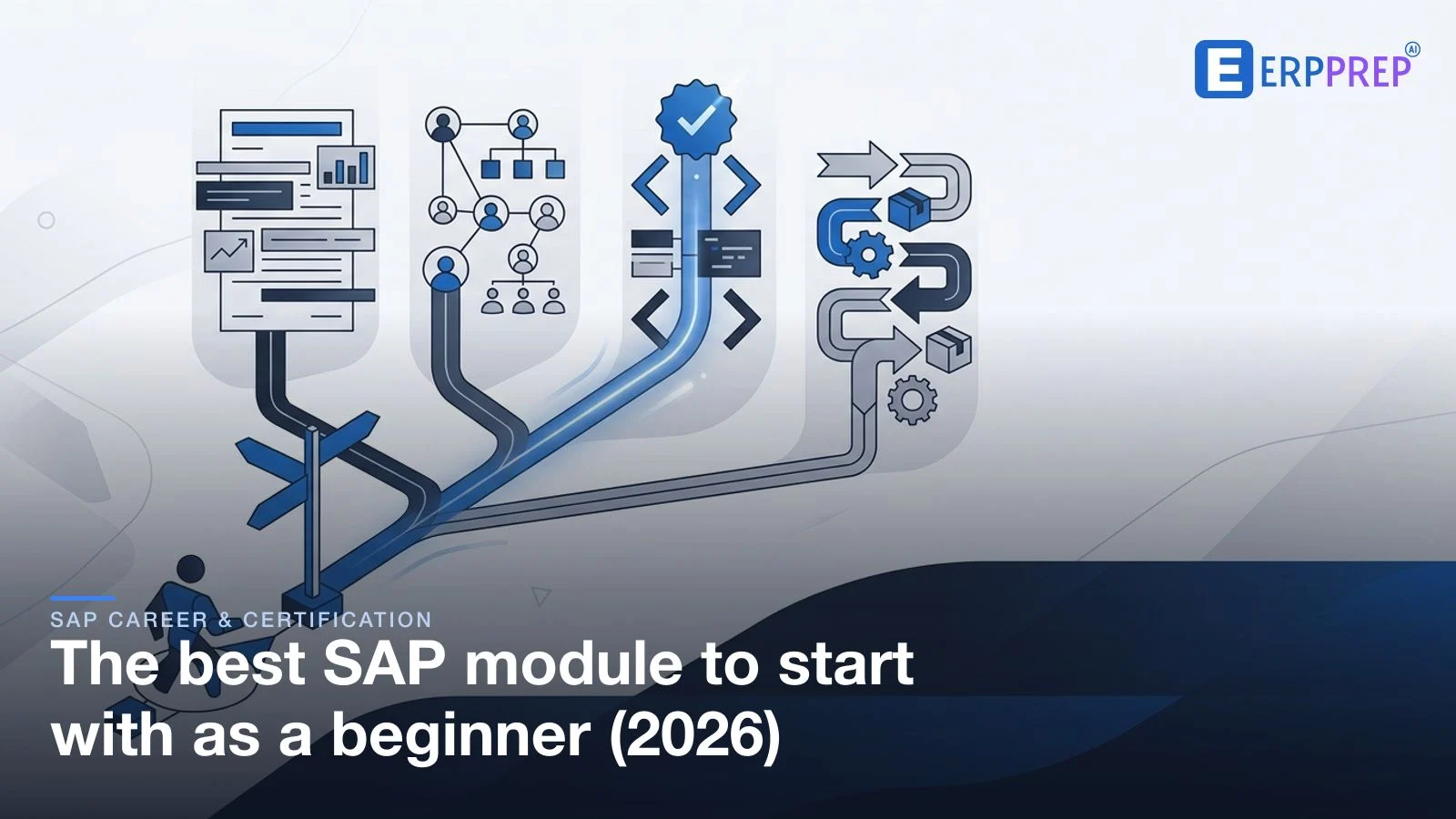
There's no universally best first SAP module — the right one is closest to what you already know. Finance suits accounting backgrounds, SuccessFactors suits HR professionals, ABAP Cloud suits programmers, and logistics modules such as Sourcing & Procurement suit supply-chain people. Under the 2026 performance-based formats, hands-on familiarity is a real advantage, so pick the track nearest your experience and certify there.
"What's the best SAP® module to start with?" is the most common beginner question in the ecosystem — and the honest answer disappoints people who want a single name. There isn't one best module. There is a best module for you, and it is almost always the one closest to the work you already understand. Your background is what makes the learning curve manageable, what makes your certification credible to employers, and — under the 2026 performance-based exam formats — what gives you an edge on exam day. This guide compares the main entry points and shows you how to place yourself on the map. If you're still picturing the job at the end of it, see what an SAP consultant actually does. For the deeper "is certification even the right move" question, see whether SAP certification is worth it and how to choose.
Key takeaways
- There is no single best beginner module — the right one is whichever sits closest to your existing background and daily work.
- The four main entry points map to four backgrounds: Finance (business/accounting), SuccessFactors/HR (HR), ABAP Cloud (programming), and logistics (supply chain/operations).
- "Easiest" is the wrong lens. A module you have real context for feels far easier than an unfamiliar one, whatever its reputation — and there's no reliable difficulty ranking that holds for everyone.
- The 2026 performance-based formats (SyBA and SBA) reward hands-on fluency, so real-world familiarity with a module is a genuine advantage on exam day.
- Start with one module, go deep, then grow. Depth in one certified area is more employable than shallow exposure to several.
Which module fits your background: at a glance
Before the detail, the whole decision on one line: find the row that describes where you're coming from, and read across to the module and lead exam that fit it. Each exam code links down to its hub, where the scenarios, skill drills, and exam facts for that certification live.
| Your background | Best-fit module / track | Lead exam | Why it fits |
|---|---|---|---|
| Accounting, finance, or general business | Finance — S/4HANA Financial Accounting | C_TS4FI | Its concepts map onto business and accounting knowledge you already have; demand is broad across industries. |
| Human resources / people operations | SuccessFactors — Employee Central (HR) | C_THR81 | Cloud HR is modular, and Employee Central is the data foundation the other HR modules build on — familiar ground for HR people. |
| Programming / software development | Development — ABAP Cloud | C_ABAPD | The developer entry point into the ecosystem; your coding skills transfer directly. |
| Supply chain, procurement, or operations | Logistics — Sourcing & Procurement | C_TS452 | A representative logistics module close to real procurement and operations work you already do. |
These four aren't the only SAP modules — the platform spans analytics, security, Fiori, and more — but they are the four most common on-ramps for beginners, because they map onto the four backgrounds people most often arrive with. If none of them fits, the full landscape is laid out in every SAP certification track in 2026.
The main entry modules in detail
Here is what each of the four entry points actually is, who it fits, and the background that gives you a head start in it. Read the one that matches you first — but skim the others, because knowing what the neighbours cover helps you place your own choice.
- Finance — S/4HANA Financial Accounting. C_TS4FI certifies Financial Accounting on S/4HANA: the general ledger, accounts payable and receivable, asset accounting, and the closing processes that finance teams run every period. It suits anyone from an accounting, finance, or broad business background, because the underlying concepts — debits and credits, reconciliation, reporting — are ones you already reason with. Demand is broad and durable across industries, which is why Finance is the most common default when someone's background is general rather than specialised.
- HR — SuccessFactors Employee Central. C_THR81 certifies Employee Central, the core HR data foundation in SuccessFactors' cloud HR suite. Cloud HR is modular — recruiting, performance, learning, time, and pay each have their own certification — and Employee Central is the base the others sit on, holding the organisational and employee data they all reference. If you've worked in HR or people operations, this is the most natural first step: the workflows model the employee lifecycle you already manage, so you're learning the system, not the domain.
- Development — ABAP Cloud. C_ABAPD is the developer entry point into the SAP ecosystem, covering ABAP Cloud — the modern, cloud-ready way to build and extend applications on the platform. If you can already program in any language, your core skills (data modelling, logic, debugging, working with an API) transfer directly, and you're mainly learning SAP's conventions and tooling. This is the clearest choice for people arriving from a software-development background rather than a functional business one.
- Logistics — Sourcing & Procurement. C_TS452 certifies Sourcing & Procurement, a representative logistics module covering the purchase-to-pay flow: purchase requisitions and orders, source determination, goods receipt, and invoice verification. It fits people from supply chain, procurement, or operations, because it mirrors real purchasing work. Logistics is a family of related modules — sales, production planning, warehouse management, and more — and Sourcing & Procurement is a common on-ramp; the whole family is compared in the logistics & supply-chain comparison.
Why background beats "easiest module"
Beginners almost always start by asking which SAP module is easiest, hoping to shave time off the learning curve. It's an understandable instinct and the wrong lens. The difficulty of a module isn't a fixed property you can look up and rank — it's relative to what you already know. A module you have context for will feel dramatically easier than an unfamiliar one, no matter what its reputation says, because most of the effort in learning SAP is learning the domain, not the screens. Someone who has spent years in HR isn't really learning what an employee record or a performance cycle is when they pick up SuccessFactors — they're just learning how SAP represents concepts they already own.
Flip that around and the trap is obvious. Choosing a module purely because it's described somewhere as "easy" means starting with no domain context, so you carry the full weight of learning both the business area and the system at once. A supposedly harder module that overlaps your background will nearly always be the faster route to a certification you can actually stand behind. And there's a second payoff: employers read a certification alongside your history. A logistics certification on top of a procurement CV tells a coherent story; the same certification with no related background reads as a bare exam pass. Background doesn't just make the studying easier — it makes the credential mean more.
This is also why there's no honest universal difficulty ranking of SAP modules to give you. The variable that dominates isn't the module — it's the match between the module and you. Get that match right and the "easy versus hard" question mostly dissolves.
How the 2026 performance-based format changes the choice
There's a second reason background wins, and it's specific to how SAP tests in 2026. Most associate exams are now performance-based rather than pure multiple-choice, in one of two formats:
- System-Based Assessment (SyBA) — you complete tasks directly in a live system, so the exam checks whether you can actually do the configuration, not just recognise it in a list of options.
- Scenario-Based Assessment (SBA) — you reason through a connected business scenario, making decisions in context rather than answering isolated questions.
Both formats reward the same thing: hands-on fluency. That changes the beginner calculus. When exams were mostly recall, you could partly brute-force an unfamiliar module by memorising enough. When the exam asks you to do the task or navigate a realistic scenario, prior familiarity with the domain stops being a nice-to-have and becomes a structural advantage. The person who already thinks in procurement steps or HR processes recognises what the scenario is really asking; the person cramming an unfamiliar module has to decode the domain and the task at the same time, under time pressure. Choosing the module closest to your background means the performance-based format works with your experience instead of against it — which is exactly why the format shift reinforces, rather than weakens, the background-first rule.
Not sure how a performance-based module feels? A free sample lets you experience the doing-over-recalling style in a track before you commit any time or money. Try a free sample.
One module first, then grow
Once you've matched a module to your background, resist the urge to collect several at once. Start with a single module and its certification, and go deep. Depth in one area is more employable than shallow exposure to many, and it gives you a real project footing — the thing that turns a certificate into a job. It also fits the performance-based formats, which reward genuine skill in a module far more than a broad but thin acquaintance with several.
Growing later is straightforward and natural. Once you're certified and working, adjacent modules become obvious next steps — a Finance professional adding controlling, a procurement specialist adding inventory or sales, a developer widening into the broader platform. By then you'll understand SAP well enough to choose the second module deliberately rather than guessing, and each move is easier because the first one gave you real context. The full set of destinations is mapped in every SAP certification track in 2026 when you're ready to plan the next one.
Common mistakes beginners make
- Chasing the "easiest" module instead of the closest one. As above, difficulty is relative to your background. Picking a module because someone called it easy — while ignoring the one that overlaps your experience — usually makes the whole journey longer, not shorter.
- Defaulting to Finance without a business background. Finance is popular for good reasons, but its popularity isn't a reason for you to start there. If your real overlap is HR, programming, or operations, that track is the faster and more credible first step; Finance can come later.
- Starting several modules at once. Spreading effort across multiple modules produces shallow knowledge in all of them and a certification in none. Finish one before you begin the next.
- Studying only by reading. Under SyBA and SBA, reading about a module is not the same as being able to work in it. Beginners who never practise realistic tasks are surprised by the performance-based format — build hands-on practice in from the start.
- Treating the first module as permanent. Your starting module shapes your early roles, not your whole career. Choosing by background just gets you certified and working sooner, which is the best position from which to broaden later.
How to prepare
Once you've chosen the module closest to your background, the preparation approach is remarkably consistent — because the exam formats are shared across modules. Practise doing tasks in a realistic environment rather than only reading about them; trace whole business processes end to end so you understand how steps connect, not just what each one is; and rehearse under time pressure so your accuracy holds when it counts. Your background gives you a head start on the domain; deliberate, hands-on practice closes the gap to the system. The performance-based exam preparation guide covers that technique in depth, and it transfers across whichever module you picked — learn it once, and it carries from your first certification to every adjacent one you add later. Each module in this guide links to its exam hub above, where the scenarios, skill drills, and exam facts for that specific certification live. You can also see how the whole ecosystem is organised on learning.sap.com before you commit.
Frequently asked questions
- What is the best SAP module for a beginner?
- There isn't one universal answer — the best first module is the one closest to your existing background. Accountants and business generalists often start with Finance (S/4HANA Financial Accounting, C_TS4FI); HR professionals with SuccessFactors Employee Central; programmers with ABAP Cloud; supply-chain people with a logistics module such as Sourcing & Procurement. Choosing by your background makes the learning curve manageable and the certification more credible to employers, because you can back it with context they recognise.
- Is SAP Finance good for beginners?
- Finance (the S/4HANA Financial Accounting certification, C_TS4FI) is a popular starting point because demand is broad and durable across industries, and the concepts map onto general business and accounting knowledge that many beginners already have. It's a strong first module if you have any finance or business background. If you don't, a module aligned to your own experience will usually be an easier on-ramp than forcing yourself into Finance just because it's well known.
- Which SAP module is easiest to learn?
- "Easiest" is less useful than "closest to what you already know." A module you have real-world context for — HR if you've worked in HR, procurement if you've worked in supply chain — will feel far easier than an unfamiliar one, regardless of the module's inherent complexity. There's no reliable ranking of SAP modules by difficulty that holds for everyone, so match the module to your background rather than chasing a reputedly easy exam.
- Should a beginner learn one module or several?
- Start with one. Depth in a single module and its certification is more employable than shallow exposure to several, and the 2026 performance-based exams reward genuine hands-on skill rather than broad familiarity. Once you're certified and working in one module, adding an adjacent one later is a natural progression — and by then you'll understand the platform well enough to choose the second module deliberately.
- I have no SAP experience at all — where do I start?
- Start from your non-SAP background rather than from SAP itself. Whatever domain you already understand — finance, HR, operations, or writing code — has a matching SAP module, and that overlap is your fastest route in. If your background is genuinely general, Finance is a common default because its concepts are widely transferable, but a role you've actually done will always beat a module you picked only because it sounded beginner-friendly.
- Does the module I pick first lock in my SAP career?
- No. Your first module shapes your early roles, but SAP professionals routinely broaden into adjacent areas as they gain experience — a Finance consultant picking up controlling or a procurement specialist adding inventory. The first module is a starting point, not a life sentence. Choosing the one closest to your background simply gets you certified and working sooner, which is the position from which every later move is easier.
- How do the 2026 performance-based exams change which module I should choose?
- They raise the value of hands-on familiarity. Under the System-Based (SyBA) and Scenario-Based (SBA) formats, you complete tasks or work through a connected scenario rather than answering pure multiple-choice, so real experience in a module counts more than ever. That reinforces the background-first rule: the module where you can practise realistic tasks with existing context is the one where the performance-based format works for you instead of against you.
- Can I still choose Finance if I'm not from an accounting background?
- Yes — plenty of people do, because Finance demand is broad and the concepts are learnable. Just go in knowing you'll be building the domain context from scratch, which takes longer than starting from a module you already know. If you have a stronger overlap elsewhere — say an HR or supply-chain background — that track is usually the faster, more credible first step, and Finance can come later once you're established.
ERPPrep is an independent platform and is not affiliated with, endorsed by, or sponsored by SAP SE. SAP and other SAP products are trademarks of SAP SE, referenced here only to describe the certification exams ERPPrep helps you prepare for.
Ready to practise the way the exam tests?
ERPPrep provides original, performance-style scenarios and skill drills built for the 2026 SyBA and SBA formats. Try a free sample and judge the quality yourself.
Practice for these exams
Related guides
Which SAP certification should you get first?
How to choose your first SAP certification: pick by your existing domain, role demand, and a path you can credibly grow into. A decision guide.
SAP modules explained — and how to choose yours
A plain-English map of the SAP module landscape — functional, HR, technical, analytics and cross-cutting — plus a practical framework for choosing yours.
How to become an SAP consultant
The honest, step-by-step pathway into SAP consulting: pick a track and module, build hands-on skill, certify, prove experience, and land the first role.