

SAP S/4HANA logistics & supply-chain certifications compared
SAP's S/4HANA operations certifications each map to one line of business: procurement, sales, production planning, warehouse, transportation, project systems. A side-by-side comparison of what each covers, its format, its cut score, and which one to choose.
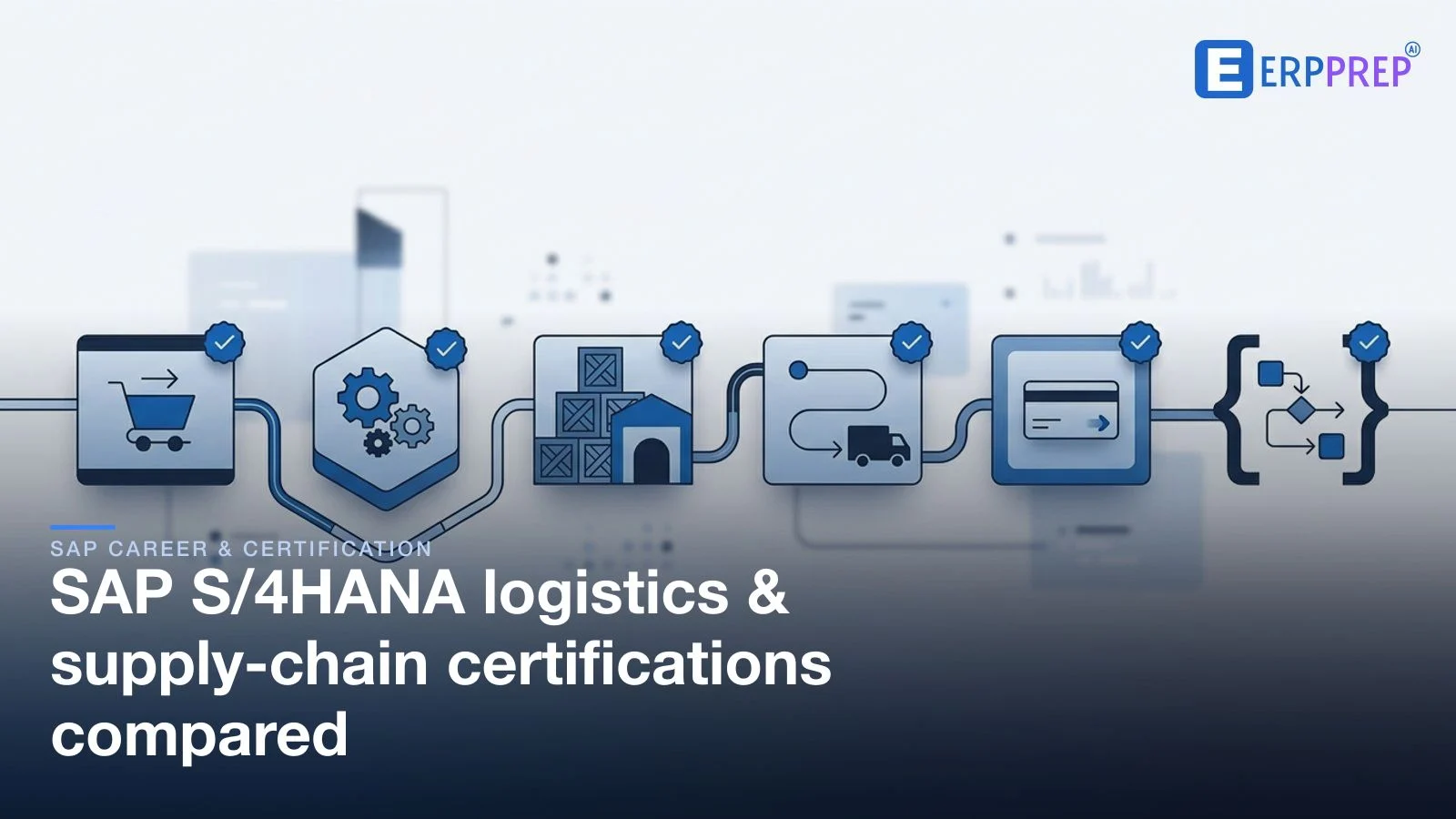
SAP's S/4HANA operations certifications each cover one line of business, tracing the flow of goods through a company: buy (C_TS452, Sourcing & Procurement), make (C_TS422, Production Planning & Manufacturing), store (C_S4EWM, Extended Warehouse Management), move (C_S4TM, Transportation Management), sell (C_TS462, Sales) and deliver by project (C_TS412, Project Systems). Five are System-Based Assessments (SyBA); Transportation is the one Scenario-Based Assessment (SBA). Cut scores run from 55% (Project Systems) to 82% (Sales). Choose by the process you configure day to day.
"Which SAP® supply-chain certification do I need?" is the wrong question, because it assumes there is one. SAP splits S/4HANA operations into a separate certification per line of business, so the real decision is about which process you configure — and once you know that, the exam is almost chosen for you. This guide compares the six side by side: what each covers, how the formats and cut scores differ, who each is for, and how they stack into a career. For where this whole track sits among SAP's other families, see every SAP certification track in 2026, and for the higher-level "is it worth it" question, see whether SAP certification is worth it and how to choose.
Key takeaways
- SAP splits S/4HANA operations into six certifications, one per line of business — there is no single supply-chain exam, so pick by the process you own.
- Read them as the flow of goods: buy, make, store, move, sell, and deliver by project. Each stage is a distinct exam.
- Five are System-Based Assessments (SyBA) — hands-on configuration in a live system. Only Transportation Management is Scenario-Based (SBA).
- Cut scores vary widely, from 55% (Project Systems) to 82% (Sales), so difficulty is exam-specific rather than uniform across the family.
- Because the SyBA technique is shared, adding an adjacent line of business later is mostly domain knowledge, not a new exam skill.
The six logistics certifications at a glance
Each exam validates implementation-level skills for one S/4HANA line of business, sitting on its own official learning journey (SAP, learning.sap.com). Here they are side by side before we go deeper on each:
| Exam | Line of business | Best for | Format & cut score |
|---|---|---|---|
| C_TS452 | Sourcing & Procurement (buy) | Procurement and purchasing consultants | SyBA · 76% |
| C_TS422 | Production Planning & Manufacturing (make) | Manufacturing and planning consultants | SyBA · 64% |
| C_S4EWM | Extended Warehouse Management (store) | Warehouse and logistics specialists | SyBA · 65% |
| C_S4TM | Transportation Management (move) | Freight, carrier and logistics teams | SBA · 60% |
| C_TS462 | Sales (sell) | Order-to-cash consultants | SyBA · 82% |
| C_TS412 | Project Systems (deliver by project) | Project-driven delivery consultants | SyBA · 55% |
What each certification covers in detail
The cleanest way to hold these six in your head is to follow a physical unit of stock through a business — you buy it, you make it, you store it, you move it, you sell it, and sometimes you deliver a whole thing as a project. Each stage maps to one certification:
- Buy — C_TS452, Sourcing and Procurement. The procure-to-pay side of the house. Its learning journey walks through core procurement processes end to end: purchase requisitions and orders, source determination and supplier selection, goods receipts and inventory management, and logistics invoice verification as the closing step. It also touches consumption-based planning and the cross-functional customizing that ties purchasing, valuation and account determination together. If your day is spent configuring purchasing, this is your exam.
- Make — C_TS422, Production Planning and Manufacturing. The shop floor and everything that schedules it. It spans demand management and planning strategies (make-to-order versus make-to-stock), material requirements planning including MRP Live and predictive MRP, capacity evaluation and leveling, and the lifecycle of production and process orders through discrete and process shop-floor control. Advanced planning with detailed scheduling (PP/DS) sits at the top end. Configuration depth here is real, which is worth knowing before you book.
- Store — C_S4EWM, Extended Warehouse Management. Everything that happens once goods are inside four walls. The journey covers structuring the warehouse and its master data, inbound goods receipt and putaway strategies, outbound picking and goods issue, storage control, and operational optimization such as wave management, resource management and radio-frequency processing. It is the most operationally dense of the six in terms of physical movement logic.
- Move — C_S4TM, Transportation Management. Getting freight from origin to destination and paying for it correctly. It covers building a transportation network of locations, zones and lanes, creating freight units and planning them interactively or with an optimizer, executing and monitoring freight orders, and calculating and settling transportation charges. Strategic freight procurement and warehouse integration round it out. Uniquely in this family, it is assessed as a connected scenario rather than isolated tasks.
- Sell — C_TS462, Sales. The order-to-cash side. Its journey is broad: enterprise structure and customer master data, sales document and item-category configuration, availability checking and backorder handling, delivery processing including integration with embedded warehouse management, billing in its many variants, and the condition-technique-based pricing engine. It carries the highest cut score in the family, so the margin for error is slim.
- Deliver by project — C_TS412, Project Systems. For businesses whose "product" is a project rather than a repeat-run good. It covers work breakdown structures and networks, cost planning, budgeting and revenue planning, scheduling and capacity planning, and period-end steps like results analysis and settlement — plus its integration into finance, controlling, procurement, manufacturing and sales. It is the connective tissue certification of the six.
Prerequisites & who each is for
None of these six publishes a formal prerequisite, but all are positioned as associate-level qualifications for consultants working in a mentored role on a project team — the assumption is that you can already operate in the system and are learning to configure it, not that you are starting from zero. The learning journeys all sit at an intermediate experience level, and they vary a lot in length: Warehouse is the leanest at around 30-plus hours, Transportation around 35, while Sales, Sourcing & Procurement, Manufacturing and Project Systems each run to roughly 75 to over 90 hours of recommended study.
Practically, that means the right certification is usually the one closest to the role you already hold or want next:
- Functional consultants should certify in their live module first — a procurement consultant in Sourcing & Procurement, an order-to-cash consultant in Sales, and so on. The exam rewards the work you already do.
- Career switchers are often best served by the lines of business with the broadest demand — procurement, sales and warehousing appear on the most implementations — paired with genuine hands-on practice, since the formats reward doing over reading.
- Sponsored learners heading into a specific implementation should match the certification to the scope of that project: a warehouse rollout points to Extended Warehouse Management, a logistics network to Transportation.
How hard are they? Cut scores & difficulty
Difficulty across this family is exam-specific, not uniform, and the published cut score is the clearest single signal of how much margin you have. Here is the full spread, from the toughest bar to the most forgiving (SAP, learning.sap.com):
| Exam | Line of business | Cut score | Format |
|---|---|---|---|
| C_TS462 — Sales | Sell | 82% | SyBA |
| C_TS452 — Sourcing & Procurement | Buy | 76% | SyBA |
| C_S4EWM — Warehouse | Store | 65% | SyBA |
| C_TS422 — Production Planning | Make | 64% | SyBA |
| C_S4TM — Transportation | Move | 60% | SBA |
| C_TS412 — Project Systems | Deliver by project | 55% | SyBA |
A higher cut score leaves less room for error — at 82%, Sales tolerates far fewer slips than Project Systems at 55%. But the cut score is only half the story. Because these are performance-based exams, hands-on fluency in the line of business is the real determinant of difficulty. Someone who configures pricing and billing every day will find the 82% bar manageable, while someone cramming warehouse theory without ever having driven a putaway strategy may struggle even against a gentler cut score. Treat the number as a margin gauge, not a difficulty ranking.
See how a system-based task actually plays out. A free sample shows the doing-in-a-system style these logistics exams use, before you commit to a line of business. Try a free sample.
Career progression: how they stack
These six are not a ladder to climb in order — they are adjacent skills you add as your remit widens. The common pattern is to certify in your core line of business, then reach for the neighbours it touches. A procurement consultant often adds inventory-heavy Warehouse knowledge next, because goods receipt and putaway sit right where purchasing hands off. A sales consultant frequently pairs with delivery and warehouse integration, since order-to-cash flows straight into shipping. Manufacturing and Project Systems overlap wherever engineer-to-order work runs a shop floor inside a project structure.
The strategic move is usually depth before breadth: one line of business you can genuinely configure and defend is worth more on an implementation than a scattered handful. Once that first certification is solid, adding a second is mostly about learning new domain content, because — for five of the six — the exam technique already transfers. If you are still weighing which line of business to lead with, our guide to the best SAP module for beginners and which SAP certification to get first both help you place this track in a wider plan.
Common mistakes to avoid
- Chasing one "supply-chain" certification. There isn't one. Trying to prepare for all of logistics at once dilutes your study; pick the single line of business your role actually owns.
- Reading the cut score as a difficulty ranking. A 55% cut score is not an easy exam and an 82% cut score is not an impossible one — the number sets your margin for error, while your hands-on experience sets the real difficulty.
- Studying theory without touching a system. All six are performance-based. Configuration you have only read about rarely survives contact with a task under time pressure; practise the doing, not just the definitions.
- Assuming every exam is the same format. Five are System-Based, but Transportation Management is Scenario-Based — a different style of thinking. Prepare for the format the specific exam actually uses.
- Booking without re-checking the exam page. Formats, cut scores and journey contents are revised periodically. Confirm the current details on the exam's page before you schedule.
How to prepare
Once you have matched a certification to the process you own, the preparation approach is remarkably consistent across five of these six exams, because they share the System-Based format. Practise completing configuration and master-data tasks in a realistic environment rather than only reading about them; trace whole processes end to end — a purchase requisition through to invoice verification, a sales order through to billing — so the dependencies become second nature; and rehearse under time pressure so your accuracy holds when the clock is running. For Transportation Management, shift your practice toward working through a connected scenario and choosing the right planning and settlement path, since the Scenario-Based format rewards judgement over isolated configuration.
Because the technique transfers within the family, learning to prepare for the performance-based format pays off across every line of business you later add. Each certification above links down to its exam hub, where the scenarios, skill drills and exam facts for that specific line of business live — the fastest way to feel the format before you sit the real thing.
Frequently asked questions
- Which SAP S/4HANA logistics certification should I take?
- Choose by the process you configure day to day. If you own purchasing, take C_TS452 (Sourcing and Procurement); order-to-cash consultants take C_TS462 (Sales); manufacturing consultants take C_TS422 (Production Planning and Manufacturing); warehouse specialists take C_S4EWM (Extended Warehouse Management); freight and logistics teams take C_S4TM (Transportation Management); and project-driven delivery takes C_TS412 (Project Systems). The certification maps one-to-one to a line of business, so your role usually decides it for you.
- Is there one SAP supply-chain certification, or several?
- There are several. Rather than one broad supply-chain exam, SAP splits S/4HANA operations into separate certifications by line of business. That means the certification you need depends on whether your work sits in procurement, sales, manufacturing, warehousing, transportation or projects. Most consultants certify in their core process first and add an adjacent one later once they need it.
- What format are these logistics exams?
- Five of the six are System-Based Assessments (SyBA), where you complete configuration tasks in a live system — that covers Sourcing & Procurement, Sales, Production Planning, Warehouse and Project Systems. Transportation Management (C_S4TM) is a Scenario-Based Assessment (SBA), where you reason through a connected business situation. Confirm the current format on each exam's page at learning.sap.com before you book, since formats can change.
- Which of these logistics certifications is the hardest to pass?
- Cut scores are a rough proxy, and they vary more than most people expect. Sales (C_TS462) has the highest published cut score at 82%, followed by Sourcing & Procurement (C_TS452) at 76%. Warehouse (C_S4EWM) sits at 65%, Production Planning (C_TS422) at 64%, Transportation (C_S4TM) at 60% and Project Systems (C_TS412) lowest at 55%. A higher cut score leaves less room for error, but real difficulty also depends on your hands-on experience with that line of business.
- Do I need prior SAP experience for these certifications?
- Each of these certifications is positioned as an associate-level qualification aimed at consultants who work on a project team in a mentored role, so they assume you can operate in the system rather than build one from nothing. The learning journeys sit at an intermediate experience level and run from roughly 30 to over 90 hours of recommended study, so some functional background in the relevant line of business helps a great deal even though a formal prerequisite is not published.
- Can I move from one logistics certification to another easily?
- Yes, and it is a common path. Five of the six share the SyBA format, so once you have learned to work through configuration tasks under exam conditions, that technique carries across. What changes between exams is the domain content — moving from procurement to warehousing means learning warehouse structures and putaway logic, not a new exam style. Transportation is the exception, since its Scenario-Based format tests advisory judgement rather than hands-on configuration.
- Is Sourcing & Procurement (C_TS452) the same as an SAP MM certification?
- In practice it is the S/4HANA successor to what many people still call the materials management certification. C_TS452 covers procurement processes, purchasing, source determination, inventory management, and logistics invoice verification on S/4HANA. If your background is in classic MM, this is the certification that maps most directly to your experience, updated for the S/4HANA data model and Fiori-based ways of working.
- Why is Transportation Management the only Scenario-Based exam in this family?
- Transportation Management (C_S4TM) leans on end-to-end planning judgement — building a transportation network, planning freight interactively or with an optimizer, then settling charges — which suits a scenario you reason through more than isolated configuration tasks. The other five lines of business are validated through direct system work, so they use the System-Based format. Always confirm the current format on the exam page, since SAP periodically revises which format an exam uses.
ERPPrep is an independent platform and is not affiliated with, endorsed by, or sponsored by SAP SE. SAP and other SAP products are trademarks of SAP SE, referenced here only to describe the certification exams ERPPrep helps you prepare for.
Ready to practise the way the exam tests?
ERPPrep provides original, performance-style scenarios and skill drills built for the 2026 SyBA and SBA formats. Try a free sample and judge the quality yourself.
Practice for these exams
Related guides
SAP security & system-administration certifications: which one?
SAP security and administration roles split across three certifications: C_SEC (security), C_DBADM (SAP HANA database) and C_STC (Cloud ALM). Full coverage map, formats, cut scores, prerequisites, and how to choose between them.
Every SAP certification track in 2026: the complete map
SAP's 2026 associate certifications map to seven tracks — Finance, logistics, HR, developer/BTP, analytics, Fiori, security — with their formats and cut scores.
How to prepare for an SAP supply-chain certification
A practical, format-faithful study plan for the SAP supply-chain certifications — IBP, EWM, TM and Production Planning — built for the 2026 performance-based exams.