

SAP security & system-administration certifications: which one?
SAP security and administration roles split across three certifications: C_SEC (security), C_DBADM (SAP HANA database) and C_STC (Cloud ALM). Full coverage map, formats, cut scores, prerequisites, and how to choose between them.
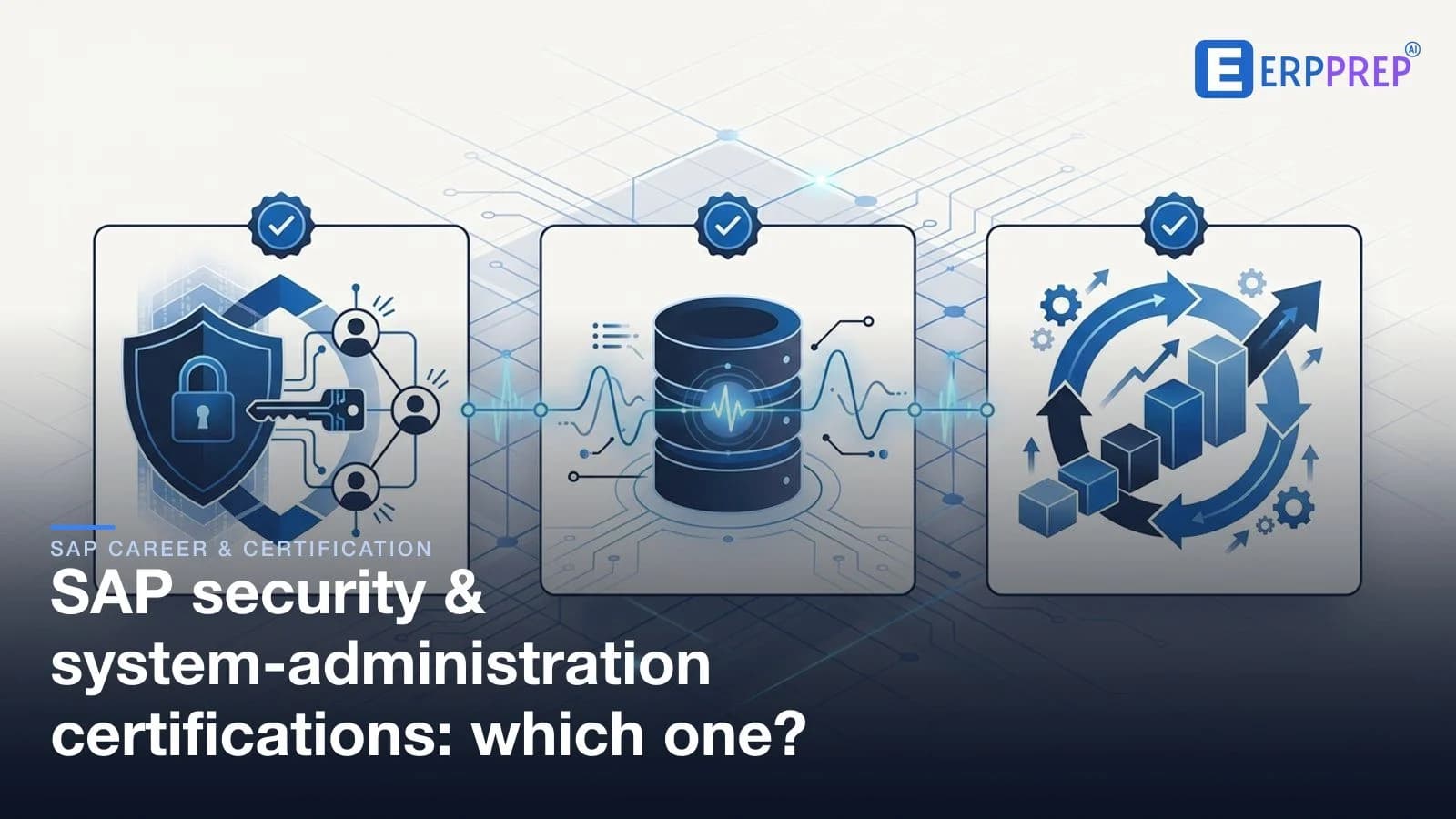
For SAP security and system-administration roles, three certifications cover three different jobs. Security Administrator (C_SEC) secures access — authorizations, user provisioning, roles, and security controls across S/4HANA's Public and Private Editions, tested as a System-Based Assessment (SyBA). Database Administrator – SAP HANA (C_DBADM) runs the database — configuration, monitoring, and recovery, also a SyBA with a 73% cut score. Solution Transformation Consultant with SAP Cloud ALM (C_STC) drives landscape transformation and lifecycle management, tested as a Scenario-Based Assessment (SBA) with a 50% cut score. Choose by whether you secure access, administer the database, or lead transformation.
"SAP® security certification" sounds like a single exam, but the administration space is really three different jobs — securing access, running the database, and driving solution transformation. Each has its own certification, its own exam format, and its own audience, and picking the wrong one wastes months. This guide maps all three so you choose the credential that matches your actual remit. If you're still weighing whether certification is worth it and how the tracks fit together, start with whether SAP certification is worth it and how to choose, then come back here to place the security and admin exams.
Key takeaways
- The old "SAP security" or "Basis" label now splits into three role-based certifications — pick by job, not by title.
- C_SEC secures access (authorizations, provisioning, roles), C_DBADM runs the HANA database, and C_STC leads transformation and lifecycle with SAP Cloud ALM.
- Two of the three (C_SEC and C_DBADM) are hands-on System-Based Assessments; C_STC is a Scenario-Based Assessment.
- Published cut scores are 73% (C_DBADM) and 50% (C_STC); the C_SEC cut score is not published on its exam page — confirm before you book.
- The fastest, most credible route is the certification closest to the work you already do — not the one with the easiest-looking cut score.
The three certifications at a glance
Each certification sits on its own learning journey (SAP, learning.sap.com) and targets a distinct role. Here they are side by side before we go into the detail:
| Exam | What it covers | Best for | Format & cut score |
|---|---|---|---|
| C_SEC — Security Administrator | System configuration, security controls, user provisioning, roles, and security strategies across S/4HANA Public & Private Edition | Security administrators, access & authorization owners | SyBA; cut score not published |
| C_DBADM — Database Administrator, SAP HANA | System administration, monitoring, and recovery of the SAP HANA database (Cloud & on-premises) | Database administrators, platform operations | SyBA; 73% |
| C_STC — Solution Transformation Consultant, SAP Cloud ALM | Product lifecycle management, solution architecture, deployment, and testing across a transformation with SAP Cloud ALM | Transformation consultants, lifecycle leads | SBA; 50% |
What each certification covers in detail
The one-line summaries hide how different these three roles really are. Here is what each exam actually asks you to be able to do:
- C_SEC — Security Administrator (secure access). This is the closest thing to a modern "SAP security" credential. It verifies a working understanding of SAP authorization and security concepts and the ability to put them into practice as part of a project or security team. The ground it covers includes system configuration, security controls, user provisioning, user accounts and roles, single sign-on and secure authentication, and broader security strategies — spanning both the Public and Private Editions of S/4HANA. In practice that means designing and maintaining business roles, running authorization traces to troubleshoot access, and managing identity and access with cloud identity services. See the C_SEC exam hub for the scenarios and drills.
- C_DBADM — Database Administrator, SAP HANA (run the database). This certification validates the essential database-administration skills for SAP HANA across HANA Cloud and on-premises. It concentrates on the operational lifecycle of the database itself: deploying and upgrading, configuring and tuning performance, monitoring and troubleshooting, and implementing backup and recovery. The skills it names are system administration, system monitoring, and system recovery — the three things that keep a production database available. Start at the C_DBADM exam hub.
- C_STC — Solution Transformation Consultant with SAP Cloud ALM (drive transformation). This is the outlier of the three: rather than securing or operating a system, it validates the application lifecycle-management skills to lead a project team through a solution transformation using SAP Cloud ALM. It covers product lifecycle management, solution architecture, software deployment, and software testing methodologies — the judgement to guide a team from planning through deployment and into run. It is a consulting-and-methodology credential more than a hands-on administration one. See the C_STC exam hub.
Prerequisites & who each is for
None of the three publishes a hard prerequisite, but each clearly assumes a background — and that background is the real filter for which one you should sit. A useful frame first: "Basis" is the traditional umbrella term for SAP system administration — the platform, database, and security layer beneath the business applications. There is no single modern "Basis" exam; instead the work has been split across role-based certifications, and these three cover most of that ground. So if you are searching for a Basis path, you are really choosing among these roles:
- C_SEC is for the access owner. If you already administer users, design roles, or troubleshoot "why can't this person see this app," C_SEC formalises what you do. It is pitched at an intermediate level and assumes you work within a project or security team rather than starting from zero. A background in identity, authorizations, or security operations is the natural on-ramp.
- C_DBADM is for the database operator. If your day involves keeping a database available — patching, monitoring, tuning, restoring — C_DBADM is your credential. It suits people with hands-on database or platform-operations experience; comfort with HANA administration tooling and the mechanics of backup and recovery matters far more than exam theory here.
- C_STC is for the transformation consultant. This one assumes a consulting or project-delivery background. If you sit across planning, deployment, and testing on transformation projects and use SAP Cloud ALM as your lifecycle backbone, C_STC fits. Someone whose experience is purely operational administration will find its emphasis on architecture and methodology less familiar than a delivery lead would.
In short: the same person rarely wants all three at once, because they map to genuinely different careers. Match the certification to the role you hold or the one you're moving into, and the choice becomes obvious.
How hard are they? Cut scores & difficulty
Difficulty here is exam-specific, not track-specific, and the published cut score is the clearest single signal — but it is not the whole story. Here is how the three compare:
| Exam | Format | Cut score |
|---|---|---|
| C_DBADM — HANA DBA | SyBA | 73% |
| C_STC — Cloud ALM transformation | SBA | 50% |
| C_SEC — Security Administrator | SyBA | Not published |
A note on reading these numbers. A higher cut score, like C_DBADM's 73%, leaves less margin for error and signals an exam that expects precise operational knowledge. A lower one, like C_STC's 50%, does not automatically mean an easier exam — a scenario-based assessment can be demanding in ways a percentage doesn't capture, because it rewards judgement over recall. And for C_SEC, the cut score was simply not published on the exam page at the time of writing (SAP, learning.sap.com), so treat any specific figure you see elsewhere with caution and confirm the current terms before you book. Because two of the three are hands-on System-Based Assessments, the biggest determinant of difficulty isn't the number at all — it's whether you can actually perform the tasks in a live system.
Not sure how a system-based admin task is scored? A free sample shows the doing-in-a-system style these exams use, before you commit to one. Try a free sample.
Career progression: how they stack
Because the three map to different roles, they don't form a single ladder you climb rung by rung — they form a small map you move across as your remit widens. A few common paths:
- The security specialist. Many people anchor on C_SEC and stay there, deepening into authorization design, access governance, and identity across the landscape. It's a durable specialisation on its own — security work rarely runs dry.
- The platform administrator who broadens. Someone who starts on the database with C_DBADM often picks up security next, because keeping a system available and keeping it secure are adjacent responsibilities that frequently land on the same team. C_DBADM also appears in the analytics & data track, because HANA underpins so many data workloads — so a DBA can pivot toward data engineering just as naturally as toward security.
- The consultant who moves up. C_STC tends to sit later in a career, once you're leading rather than executing. It rewards people who have already delivered on projects and now guide the transformation itself — planning, deployment, testing, and lifecycle — with SAP Cloud ALM as the backbone.
The practical takeaway: hold the one that matches your job now, and let the next one follow the direction your responsibilities actually grow — toward security, toward data, or toward transformation leadership.
Common mistakes to avoid
- Treating "SAP security" as one exam. The single biggest error is assuming there's one credential. Securing access (C_SEC), running the database (C_DBADM), and leading transformation (C_STC) are three different jobs — sitting the wrong one certifies a skill you may not use.
- Chasing the lowest cut score. C_STC's 50% looks inviting next to C_DBADM's 73%, but a scenario-based exam you aren't prepared for is harder than a hands-on exam you practise for. Pick by role fit, not by the percentage.
- Studying theory for a hands-on exam. C_SEC and C_DBADM are System-Based Assessments — you perform tasks in a live system. Reading documentation without practising the actual configuration, monitoring, and recovery work leaves the most important gap unclosed.
- Assuming a fixed C_SEC cut score. Because the C_SEC cut score wasn't published on the exam page, any exact figure you find second-hand is unverified. Always confirm the current format and terms on the exam's own page before you book.
- Believing "Basis certification" still means one thing. The old umbrella term has fragmented. Searching for a single Basis exam leads people in circles; the real question is which of these role-based certifications matches the part of the platform you own.
How to prepare
Once you've chosen, the preparation approach is consistent across the two System-Based exams and adapts for the Scenario-Based one — and in both cases the shortcut is to rehearse in the format the exam actually uses. For C_SEC and C_DBADM, practise doing the work: create and maintain roles, run authorization traces, monitor a database, and walk through a backup-and-recovery cycle until the steps are muscle memory rather than notes. For C_STC, rehearse judgement: work through connected transformation scenarios and defend the trade-offs across planning, deployment, and testing the way an SBA asks you to. In every case, trace whole processes end to end rather than memorising isolated facts, and rehearse under time pressure so accuracy holds when it counts. The performance-based exam preparation guide covers that technique in depth, and each exam hub above — C_SEC, C_DBADM, and C_STC — links to the scenarios, skill drills, and exam facts for that specific certification, so you can prepare in the exact style your chosen exam uses.
Frequently asked questions
- What is the SAP Security Administrator certification (C_SEC)?
- C_SEC (Security Administrator) verifies the core skills to secure an SAP system — system configuration, security controls, user provisioning, user accounts and roles, and security strategies — spanning both the Public and Private Editions of SAP S/4HANA. It's a System-Based Assessment (SyBA), so you carry out administration tasks in a live environment rather than only answering theory. It sits at an intermediate level and assumes you already work as part of a project or security team.
- Is SAP Basis the same as these certifications?
- "Basis" is the traditional umbrella term for SAP system administration — the platform, database, and security layer beneath the applications. Today that work is split across role-based certifications rather than one Basis exam: C_SEC covers security and authorizations, C_DBADM covers HANA database administration, and adjacent platform-admin exams cover the rest. If you're looking for a modern "Basis" path, these are the certifications that carve up the ground the old term used to describe.
- What does the Database Administrator – SAP HANA certification (C_DBADM) cover?
- C_DBADM verifies the database-administration skills for SAP HANA — deploying and upgrading the database, configuring and tuning performance, monitoring and troubleshooting, and running backup and recovery, across HANA Cloud and on-premises. It's a System-Based Assessment (SyBA) with a 73% cut score at the time of writing. Because HANA underpins so many analytics and data workloads, this exam also appears in the analytics and data track, not only in system administration.
- What does the Cloud ALM certification (C_STC) cover?
- C_STC (Solution Transformation Consultant with SAP Cloud ALM) covers leading a solution-transformation journey with SAP Cloud ALM — product lifecycle management, solution architecture, software deployment, and testing methodologies across the software lifecycle. It's a Scenario-Based Assessment (SBA) with a 50% cut score at the time of writing, and it leans toward transformation and lifecycle judgement rather than pure system security or database operations.
- Which security or admin certification should I start with?
- Start with the job you own today. If you manage who can do what — authorizations, roles, provisioning — C_SEC (Security Administrator) is the core credential. If you keep the HANA database healthy, C_DBADM (HANA DBA) is the match. If you lead landscape transformations and lifecycle work with SAP Cloud ALM, C_STC fits. The three test genuinely different competencies, so the fastest, most credible route is the one closest to your current responsibility rather than the one with the lowest cut score.
- Do I need to hold all three certifications?
- No. They map to three distinct roles — securing access, running the database, and driving transformation — and most people only need the one that matches their remit. That said, administrators whose scope widens often add a second over time: a security administrator who inherits database duties, or a consultant who moves from lifecycle work into access design. Because two of the three share the hands-on System-Based format, the preparation habits carry over even when the subject matter doesn't.
- Are these exams multiple-choice, and how are they scored?
- Not in the old sense. C_SEC and C_DBADM are System-Based Assessments (SyBA), where you perform administration tasks in a live system, and C_STC is a Scenario-Based Assessment (SBA), where you reason through a connected transformation scenario. Published cut scores are 73% for C_DBADM and 50% for C_STC; the C_SEC cut score was not published on its exam page at the time of writing (SAP, learning.sap.com), so confirm it before you book. Practise in the format each exam uses rather than only reading notes.
- Does ERPPrep provide real exam questions or dumps for these exams?
- No. ERPPrep does not provide real exam questions, exam dumps, or copies of live SAP exam content — using those would breach SAP's terms and wouldn't teach you the hands-on skills these performance-based exams actually test. What ERPPrep offers is original practice scenarios and skill drills that mirror the SyBA and SBA style, so you rehearse doing the work the way the exam asks you to.
ERPPrep is an independent platform and is not affiliated with, endorsed by, or sponsored by SAP SE. SAP and other SAP products are trademarks of SAP SE, referenced here only to describe the certification exams ERPPrep helps you prepare for.
Ready to practise the way the exam tests?
ERPPrep provides original, performance-style scenarios and skill drills built for the 2026 SyBA and SBA formats. Try a free sample and judge the quality yourself.
Practice for these exams
Related guides
SAP S/4HANA logistics & supply-chain certifications compared
SAP's S/4HANA operations certifications each map to one line of business: procurement, sales, production planning, warehouse, transportation, project systems. A side-by-side comparison of what each covers, its format, its cut score, and which one to choose.
SAP modules explained — and how to choose yours
A plain-English map of the SAP module landscape — functional, HR, technical, analytics and cross-cutting — plus a practical framework for choosing yours.
SAP S/4HANA vs SuccessFactors: which certification career should you choose?
Core ERP / S/4HANA or cloud HR / SuccessFactors? Two very different SAP career worlds compared — the roles, the job markets, and how to choose — using C_TS4FI (Financial Accounting) and C_THR81 (Employee Central) as examples.