

SAP analytics & data certifications: BW/4HANA vs SAC vs HANA DBA
SAP's data track splits three ways — Data Engineer on BW/4HANA, Data Analyst on SAP Analytics Cloud, and Database Administrator on SAP HANA. What each certifies, how hard they are, and which fits your role.
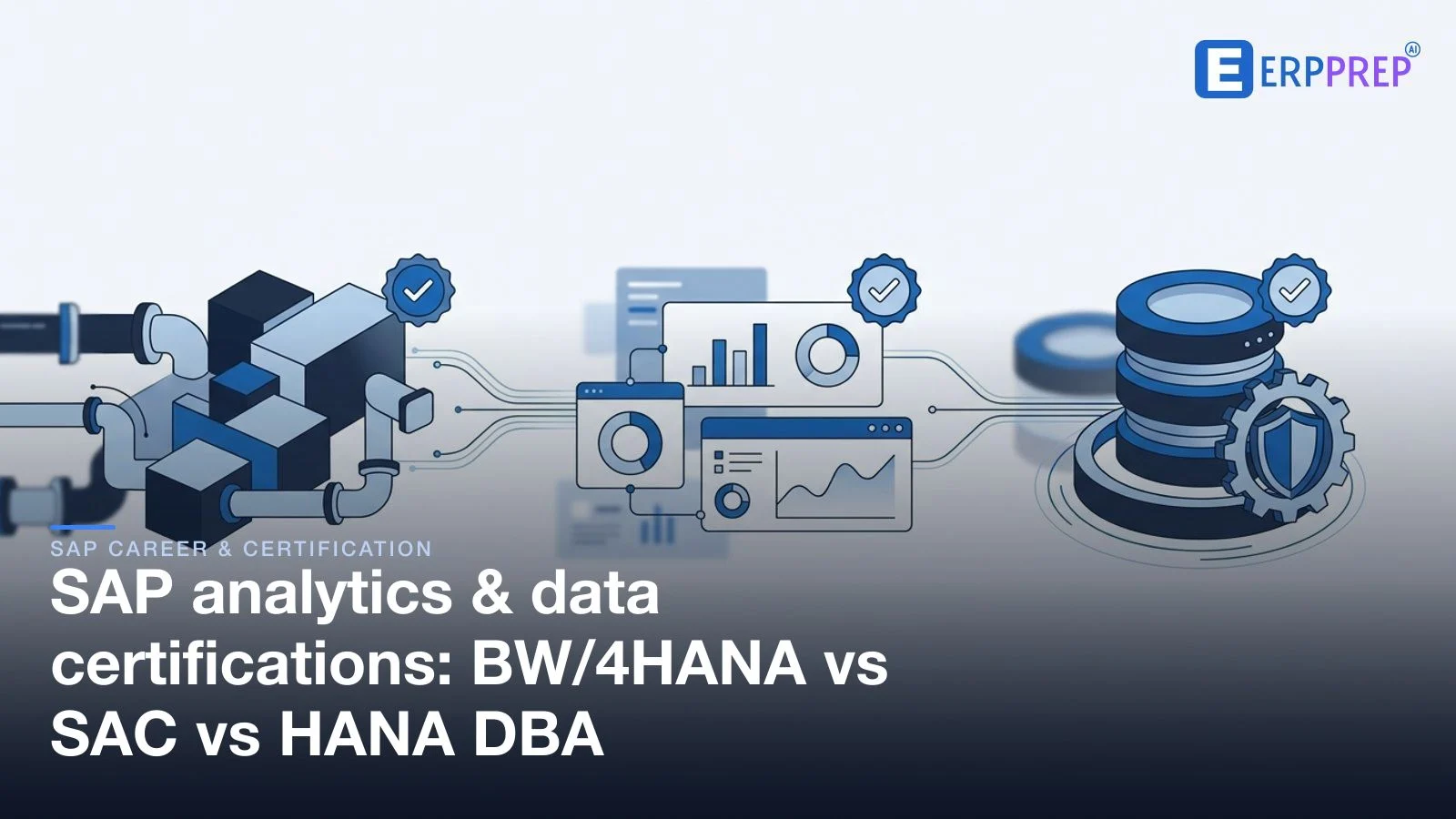
SAP's data certifications map to three distinct layers of the same stack. Data Engineer on SAP BW/4HANA (C_BW4H) covers data acquisition, modeling, and management — the engineering layer that builds the warehouse. Data Analyst on SAP Analytics Cloud (C_SAC) covers data visualization, modeling, and business planning — the analysis layer that turns data into decisions. Database Administrator on SAP HANA (C_DBADM) covers system administration, monitoring, and recovery — the database itself. All three are associate-level; C_BW4H and C_DBADM are System-Based (SyBA), C_SAC is Scenario-Based (SBA). Choose by whether you engineer data, analyze it, or administer the platform it lives on.
"Which SAP® data certification should I get?" is really a question about where in the data stack you work. SAP splits the field into three distinct roles — engineer the data, analyze it, or administer the database it lives on — and there is a separate associate certification for each. They are frequently lumped together as "the analytics certifications," but they certify very different jobs, and picking the wrong one wastes weeks of preparation on skills you will not use. This guide compares all three side by side: what each covers, who each is for, how hard they are, and how they stack into a career. For the wider landscape of every SAP track, see every SAP certification track in 2026, and for the broader "is it worth it and how do I choose" question, whether SAP certification is worth it and how to choose your path.
Key takeaways
- The three data certifications sit at different layers of the same stack — engineering (BW/4HANA), analysis (SAP Analytics Cloud), and the database (SAP HANA) — so they rarely overlap in day-to-day work.
- C_BW4H (Data Engineer) and C_DBADM (HANA DBA) are performance-based System-Based Assessments (SyBA); C_SAC (Data Analyst) is a Scenario-Based Assessment (SBA).
- Cut scores differ: 73% for C_DBADM, 69% for C_BW4H, and 60% for C_SAC (SAP, learning.sap.com) — the two hands-on system exams sit higher.
- All three are associate-level and positioned as entry-level qualifications — but entry-level still assumes real hands-on fluency, not memorization.
- Pick the certification that matches the layer you own today; add an adjacent one later, since engineer-plus-analyst and engineer-plus-DBA are natural pairings.
The three data certifications at a glance
Each exam sits on its own SAP learning journey (SAP, learning.sap.com) and verifies core skills for one role. Here they are side by side:
| Exam | Role / layer | Best for | Format & cut score |
|---|---|---|---|
| C_BW4H | Data Engineer — the engineering layer (builds the warehouse) | People who acquire, model, and manage data foundations | System-Based (SyBA), 69% |
| C_SAC | Data Analyst — the analysis layer (turns data into decisions) | People who build dashboards, reports, and business plans | Scenario-Based (SBA), 60% |
| C_DBADM | Database Administrator — the database layer (runs SAP HANA) | People who deploy, monitor, and recover the database | System-Based (SyBA), 73% |
Read the table top to bottom and you are reading the stack top to bottom: the engineer prepares the data, the analyst presents it, and the administrator keeps the platform underneath both of them alive. The rest of this guide unpacks what that means in practice.
What each certification covers in detail
- Engineer the data — C_BW4H, Data Engineer on SAP BW/4HANA. This is the foundation-building role. The certification verifies core Data Engineer skills on SAP BW/4HANA — a data warehouse solution that itself runs on SAP HANA. Its learning journey centres on three things: acquiring data (extracting from source systems, provisioning, and loading both master and transactional data), modeling it (InfoObjects, DataStore objects, CompositeProviders, and layered warehouse architecture), and managing it (queries, data-lifecycle housekeeping, and analysis authorizations that control who sees which data). In short, it is about assembling a trustworthy, well-governed data layer that everything downstream depends on.
- Analyze the data — C_SAC, Data Analyst on SAP Analytics Cloud. This is the decision-making role. The certification verifies fundamental Data Analyst knowledge on SAP Analytics Cloud, and its four earned skills are data visualization, business planning, data modeling, and data analysis. In practice that means designing and presenting stories (the dashboards and reports that communicate what the data says), formatting and filtering and calculating within them, modeling data for reporting, and doing business planning — from manual data entry through more advanced planning features. Its learning journey spans navigating the tool, building compelling stories, and performing both manual and advanced planning. Where the engineer prepares the data, the analyst turns it into something a business can act on.
- Administer the database — C_DBADM, Database Administrator on SAP HANA. This is the keep-it-running role, and it sits underneath the other two rather than beside them. The certification validates essential administration skills for SAP HANA, covering both cloud and on-premise editions: deploying and upgrading the database, configuring and optimizing performance, monitoring and troubleshooting, and running the backup-and-recovery process. Its three earned skills are system administration, system monitoring, and system recovery, and its learning journey walks through installing and upgrading, starting and stopping, configuring, monitoring, and recovering the database — plus migrating an existing SAP HANA system to the cloud edition. It is the platform layer that the warehouse and the analytics tools both rely on.
The clean mental model: C_DBADM keeps the database alive, C_BW4H fills it with well-modeled data, and C_SAC turns that data into decisions. Three roles, three layers, one platform.
Prerequisites & who each is for
None of the three publishes a hard prerequisite certification — all are associate-level and described as entry-level qualifications for their roles. What differs is the background each rewards:
- C_BW4H suits data engineers and BI consultants who work with warehouses, ETL/data pipelines, and modeling. If you spend your time getting data into a well-structured, governed home and shaping it for reporting, this is your exam. A working grasp of SAP HANA concepts helps, because BW/4HANA runs on HANA, but you do not need the full DBA skill set.
- C_SAC suits analysts, report builders, and planners — people closer to the business than to the plumbing. If you build dashboards, tell stories with data, and run planning and forecasting cycles, the Data Analyst certification maps to your day job. It leans less on infrastructure knowledge and more on judgment about how to present and plan with data.
- C_DBADM suits system administrators and Basis-style operators who own uptime, performance, and recoverability. If your success is measured in availability, monitoring dashboards, and backups that actually restore, this is the fit. It also belongs to the wider security and administration track, so it pairs naturally with security-and-authorization work.
A useful test: ask whether your job is measured by data quality and structure (engineer), insight and decisions (analyst), or uptime and recoverability (administrator). The answer usually points at exactly one of the three.
How hard are they? Cut scores & difficulty
Difficulty is exam-specific, not track-specific, and the published cut score is the clearest single signal — the percentage you must reach to pass. Here is how the three compare (SAP, learning.sap.com):
| Exam | Cut score | Format |
|---|---|---|
| C_DBADM — HANA DBA | 73% | SyBA |
| C_BW4H — BW/4HANA Data Engineer | 69% | SyBA |
| C_SAC — SAP Analytics Cloud Data Analyst | 60% | SBA |
The two System-Based exams sit higher — 73% and 69% — which fits their hands-on nature: a system task is either done correctly or it is not, so there is less room for partial credit and the bar is set accordingly. The Scenario-Based analytics exam sits at 60%, reflecting a format that rewards reasoned judgment across a connected scenario rather than exact system execution. But the cut score is only half the story. Because all three are performance-based, hands-on fluency in the actual role is the real determinant. Someone who administers SAP HANA every week will find a 73%-cut exam manageable, while someone who only read about backups may struggle even where the bar is lower — the exams are built to reward doing over recalling.
Want to feel a performance-based data task before you commit? A free sample shows the doing-over-recalling style these exams use — the fastest way to tell whether you are ready to practise hands-on. Try a free sample.
Career progression: how they stack
These three certifications are not a ladder you climb in order — they are three doors into the same building. But they combine in predictable, valuable ways once you have your first one:
- Engineer → Analyst. The most common pairing. A Data Engineer who adds the Data Analyst certification can both prepare the data foundation in BW/4HANA and present it in SAP Analytics Cloud — owning the whole path from raw source data to a finished dashboard or plan. This is the profile many small data teams prize, because one person covers two layers.
- Engineer → Administrator. An engineer who adds HANA DBA skills understands not just the models but the database they run on — an advantage when tuning performance or diagnosing why a load is slow. This pairing leans toward deeper platform expertise rather than business-facing reporting.
- Administrator → wider platform track. Because C_DBADM also belongs to the security and administration family, it is a natural stepping stone into system security, authorizations, and landscape administration — see the adjacent security & system administration certifications.
The rule of thumb: go deep before you go wide. One certification backed by genuine hands-on skill is worth more than three collected quickly, and the second certification lands far more credibly once the first reflects real working experience.
Common mistakes to avoid
- Treating all three as "the analytics exam." They are three different jobs. Studying BW/4HANA modeling when your role is building dashboards means preparing for the wrong exam entirely — start from the role, not the buzzword.
- Assuming HANA DBA is an analytics certification. C_DBADM is administration, not analysis. It covers running the database, and it sits underneath the analytics stack. If you want to visualize and plan with data, C_SAC is your target, not C_DBADM.
- Chasing the lowest cut score. C_SAC's 60% looks like the easy option on paper, but a lower bar on the wrong exam is still the wrong exam — and a Scenario-Based format rewards judgment you either have or do not. Pick for fit first, difficulty second.
- Preparing by reading alone. All three are performance-based. Reading a study guide without practising tasks in a realistic environment leaves the exact skill these exams test untouched — plan hands-on practice from day one.
- Collecting certifications instead of skills. Holding all three without depth in any is less compelling to an employer than one certification plus demonstrable project work. Lead with the layer you actually own.
How to prepare, whatever the layer
Once you have chosen your certification, the preparation approach is remarkably consistent across all three because the exam formats are shared. Practise doing tasks in a realistic environment rather than only reading — for a System-Based exam like C_BW4H or C_DBADM that means actually modeling data or administering a system, and for a Scenario-Based exam like C_SAC it means reasoning through connected business situations end to end. Trace whole processes rather than memorizing isolated steps: follow data from source into the warehouse, from the warehouse into a story, or a database from install through backup and recovery. And rehearse under time pressure so your accuracy holds when it counts. The performance-based exam preparation guide covers the technique in depth, and each hub above — C_BW4H, C_SAC, and C_DBADM — has the scenarios, skill drills, and exam facts for that specific certification. Lead with the layer you own today, get genuinely fluent in it, and let the adjacent certifications follow.
Frequently asked questions
- Which SAP data certification should I take?
- Choose by the layer of the stack you work at. If you acquire, model, and manage data in a warehouse, take C_BW4H (Data Engineer, SAP BW/4HANA). If you build dashboards, reports, and business plans on top of that data, take C_SAC (Data Analyst, SAP Analytics Cloud). If you install, monitor, and recover the database that everything runs on, take C_DBADM (Database Administrator, SAP HANA). They sit at different layers of the same data platform, so the one to pick is the layer you own day to day.
- What's the difference between BW/4HANA and SAP Analytics Cloud certifications?
- They certify different jobs. C_BW4H (Data Engineer) is about acquiring, modeling, and managing data in the BW/4HANA warehouse — the engineering layer that prepares data for use. C_SAC (Data Analyst) is about visualizing that data, modeling for reporting, and building business plans in SAP Analytics Cloud — the analysis and planning layer. Engineers assemble the data foundation; analysts turn it into decisions. Many teams need both, but they are separate roles with separate skill sets.
- Is HANA DBA an analytics certification?
- Not exactly — C_DBADM (Database Administrator, SAP HANA) is an administration certification. It covers running the SAP HANA database: deploying and upgrading it, configuring and tuning performance, monitoring and troubleshooting, and handling backup and recovery. It sits underneath the analytics stack rather than in it, but it is often grouped with the data track because SAP HANA is the in-memory database many analytics and warehouse workloads run on. It also belongs to the broader security and administration track.
- What format are these exams?
- C_BW4H and C_DBADM are System-Based Assessments (SyBA) — you complete tasks in a live system. C_SAC is a Scenario-Based Assessment (SBA), where you reason through a connected business scenario. Cut scores at the time of writing are 69% for BW/4HANA, 73% for HANA DBA, and 60% for SAP Analytics Cloud (SAP, learning.sap.com). Always confirm the current format and cut score on each exam's page, because SAP updates them over time.
- Which is the hardest of the three data certifications?
- By published cut score, C_DBADM (HANA DBA) sits highest at 73%, followed by C_BW4H at 69% and C_SAC at 60%. A higher cut score means less margin for error, but the bigger factor is hands-on fluency: the two System-Based exams reward people who actually configure and operate the system daily, while the Scenario-Based analytics exam rewards judgment about visualizing and planning with data. The hardest one for you is usually the layer furthest from your day job.
- Do I need to know SAP HANA to take the BW/4HANA exam?
- A working understanding helps. SAP BW/4HANA is a data warehouse that runs on SAP HANA, and the Data Engineer role touches HANA concepts — for example, generating HANA calculation views from BW/4HANA objects and understanding how HANA powers the warehouse. You do not need the full Database Administrator skill set to sit C_BW4H, but the two certifications are complementary, and engineers who understand the database underneath often model more efficiently.
- Can I hold more than one of these certifications?
- Yes, and many data professionals do. A common combination is Data Engineer plus Data Analyst — you can both prepare the data foundation in BW/4HANA and present it in SAP Analytics Cloud. Another is Data Engineer plus Database Administrator, which pairs modeling with running the platform. There is no fixed order, but leading with the certification that matches your current role is the fastest, most credible path; add the adjacent layer once the first is solid.
- Are these certifications aimed at beginners or experienced professionals?
- All three are associate-level and positioned as entry-level qualifications for their roles — they verify core, implementation-level skills rather than senior architecture competence. That said, entry-level does not mean easy: because the exams are performance-based, they assume you can actually do the work in the system or reason through a real scenario. They suit people who already work with SAP data or are moving into a data role and can practise hands-on rather than only reading.
ERPPrep is an independent platform and is not affiliated with, endorsed by, or sponsored by SAP SE. SAP and other SAP products are trademarks of SAP SE, referenced here only to describe the certification exams ERPPrep helps you prepare for.
Ready to practise the way the exam tests?
ERPPrep provides original, performance-style scenarios and skill drills built for the 2026 SyBA and SBA formats. Try a free sample and judge the quality yourself.
Practice for these exams
Related guides
Every SAP certification track in 2026: the complete map
SAP's 2026 associate certifications map to seven tracks — Finance, logistics, HR, developer/BTP, analytics, Fiori, security — with their formats and cut scores.
SAP data-engineering certifications compared: modelling, warehousing, platform & low-code
Compare SAP's data credentials by layer: C_HAMOD (HANA modelling), E_BW4HE (BW/4HANA delta), C_BDCDA (data architect) — plus where SAP Build's C_LCNC really fits.
SAP BTP certifications explained: which one is right for you
A map of the SAP BTP certification family — administrator, architect, integration, ABAP and generative-AI developer, LeanIX EA — and how to choose.