

How to become an SAP consultant
The honest, step-by-step pathway into SAP consulting: pick a track and module, build hands-on skill, certify, prove experience, and land the first role.
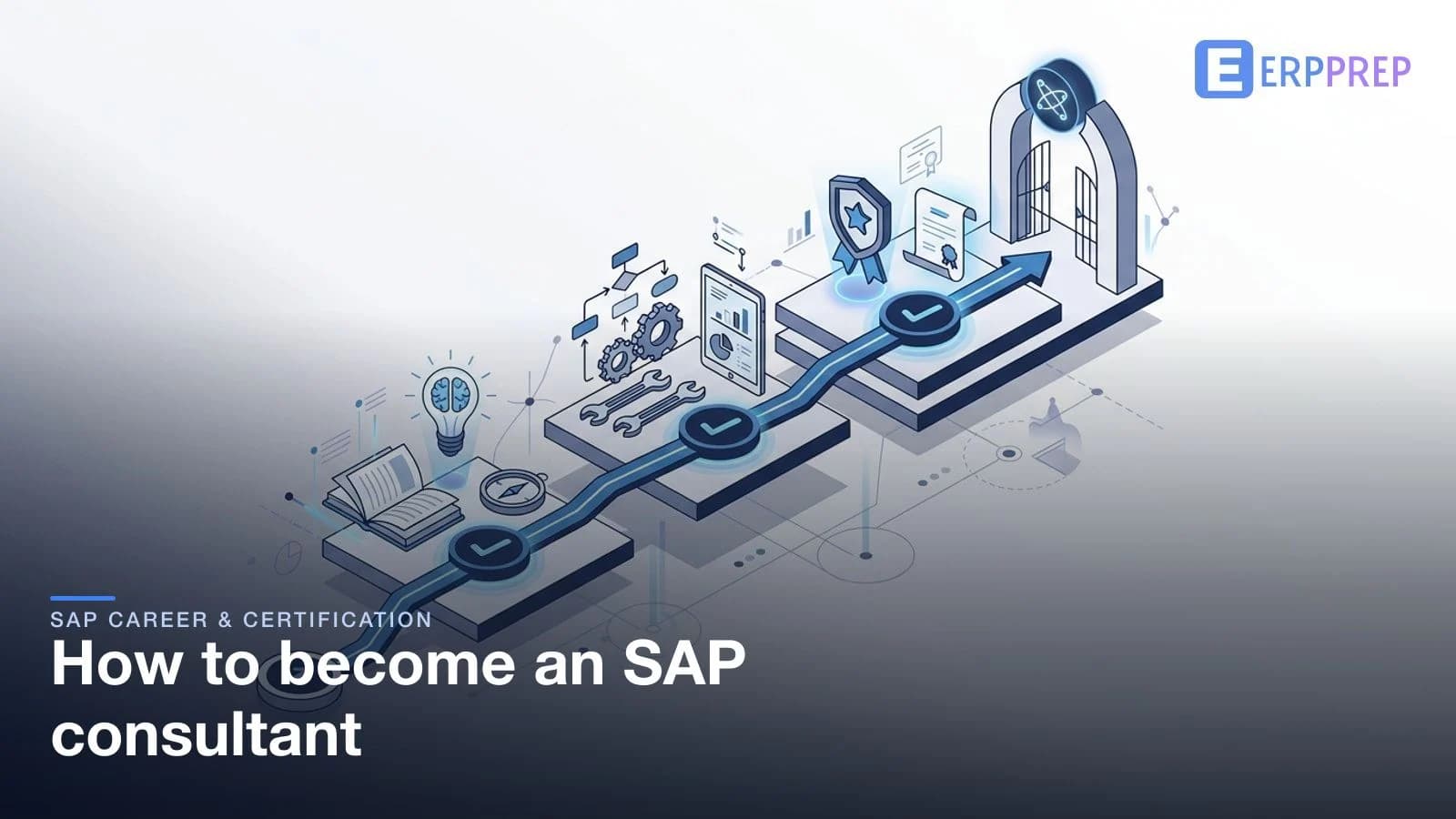
To become an SAP consultant, choose a functional or technical track and one module, learn the business processes behind it, practise the configuration and decision tasks hands-on, certify on a role-based credential, then build demonstrable experience through projects, sandbox work or a graduate programme before targeting an associate role. Certification proves capability; it does not by itself guarantee a job.
Becoming an SAP® consultant is less mysterious than it looks from the outside, but it is also not a single decision — it is a sequence, and most people who stall have skipped a step rather than failed one. This guide lays out the whole pathway honestly: how to choose a track and a module, how to build the business and system knowledge that makes you useful, where a certification genuinely helps, how to close the experience gap, and how the first role turns into a career. For the wider question of whether the move pays off, see whether SAP certification is worth it.
Pick a functional or technical track and one module, learn the business process underneath it, then practise the configuration and decision tasks hands-on. Certify on the role-based credential for that module, build demonstrable experience through sandbox work, internal projects or a graduate programme, and target associate roles. Certification proves capability — it does not by itself guarantee a job.
Key takeaways
- Depth beats breadth at the start. One module you can actually configure is worth more to an employer than passing familiarity with four.
- Process knowledge is half the job. Configuration only makes sense on top of the business process it serves, which is why domain experience transfers so well.
- The 2026 formats reward hands-on capability. SAP's performance-based exams ask you to perform tasks and reason through scenarios, so the preparation that passes them is the preparation that makes you employable.
- The experience gap is solvable, but only deliberately. Sandbox builds, internal projects, internships and partner graduate programmes all count — waiting for someone to hand you experience does not.
- Be honest with yourself about timelines. There is no standard number of months, and the first role usually takes longer to land than the credential takes to earn.
First, be clear what the job actually is
An SAP consultant sits between a business problem and a system that can solve it. On a typical week that means gathering requirements, deciding how a process should run, configuring the system to match, testing it against real cases, and explaining the result to people who will live with it. It is a blend of domain expertise, system fluency and communication — and the balance shifts by track and by seniority.
That matters for the pathway, because it tells you what to build. You are not training to memorise menu paths; you are training to make defensible decisions inside a business process and then carry them out in the system. Everything below is arranged around that outcome. If the day-to-day shape of the role is still fuzzy, start with what an SAP consultant actually does and come back — choosing a track is much easier once the work is concrete.
The pathway at a glance
Here is the whole route in one table: the seven stages, what you actually do at each, and the signal that tells you to move on. The stages overlap in practice — most people are building experience while they prepare to certify — but the order of dependency is real, and skipping forward is where the wasted months come from.
| Stage | What you actually do | Signal you're ready to move on |
|---|---|---|
| 1. Choose track and module | Decide functional or technical; narrow to one module that matches what you already know | You can say, in one sentence, which role you are training for and why |
| 2. Learn the process | Understand the business process end to end, independently of any screen | You can explain why the process works that way, not just what it does |
| 3. Get hands-on | Perform the configuration steps and run the process through the system | You can complete a realistic task unaided, without a step-by-step guide |
| 4. Certify | Prepare for and pass the associate credential for your module | The credential is earned and verifiable on your profile |
| 5. Build experience | Sandbox builds, internal projects, internships, graduate or partner programmes | You have at least one piece of work you can walk someone through in detail |
| 6. Position and apply | Rewrite the CV around delivered processes; target associate and mentored roles | You are getting technical conversations, not just automated rejections |
| 7. Grow | Deepen one module, then widen into integration and client-facing work | Colleagues bring you their questions about your area |
Step 1 — Decide functional or technical, then pick one module
The first fork is the biggest. Functional consultants own the business process: they translate requirements into configuration, decide how the process should run, and test that it does. Technical consultants build and extend: development, integration, data, platform administration. Neither is the junior version of the other, and both lead to senior roles — so choose on how you prefer to solve problems, not on which sounds more prestigious.
Then narrow to a single module. This is the step people most often refuse to take, and it costs them months, because partial knowledge of four areas reads as no knowledge of any. Pick the module closest to work you already understand: finance or controlling experience points at the S/4HANA finance track, HR experience at SuccessFactors, planning and warehouse experience at supply chain, delivery and project experience at implementation methodology. Your background is not something to set aside — it is the half of consulting that is hardest to teach. That logic is worked through in depth in the career switcher's path into SAP.
Step 2 — Build the business-process foundation
Before you touch a single configuration screen, learn the process the module serves. If you are heading for finance, that means the month-end close, the document flow behind a posting, and how a chart of accounts supports reporting. For HR, it is the employee lifecycle and the data model that holds it together. For supply chain, it is how demand, supply and fulfilment actually hand off to each other.
The reason is practical, not academic. Configuration decisions are choices between defensible options, and you cannot choose defensibly without knowing what the business is trying to achieve. Consultants who skip this stage can follow instructions but freeze the moment a client asks "what would you recommend?" — which is, unfortunately, most of the job. If you already work in the process, you are further ahead here than you think; your task is to make the knowledge explicit enough to explain to someone else.
Step 3 — Get hands-on with the system
This is the stage that separates candidates, and it is also where the 2026 exam formats and real employability point in exactly the same direction. SAP's current certifications are performance-based: a System-Based Assessment (SyBA) has you carry out configuration tasks, and a Scenario-Based Assessment (SBA) has you reason through a connected business situation and decide what to do. Neither rewards recognising a remembered answer. See what SyBA and SBA actually test for the mechanics.
That convergence is good news for anyone building a career: the practice that prepares you for the exam is the practice that makes you useful on a project. Work through the configuration steps yourself, run a process from start to finish, break something and fix it, and get used to making the call rather than reading someone else's. Access is the usual obstacle — trial and developer-tier environments, employer or partner sandboxes, training systems bundled with courses, and format-faithful practice that puts you in the position of performing the task all work. What matters is that you are doing and deciding, not watching.
Not sure what hands-on practice is supposed to feel like? The fastest way to find out is to try a task-shaped exercise rather than read about one. Try a free sample and see whether you can already make the decisions the role asks for.
Step 4 — Certify on a role-based credential
Once you can perform the tasks, the certification is how you make that visible to people who have never seen you work. SAP's credentials are role-based and module-specific, and the associate level is the normal entry point — you can browse the current catalogue on SAP's certification site. Typical first credentials look like SAP S/4HANA Finance (C_TS4FI) for a finance route, SAP SuccessFactors Employee Central (C_THR81) for an HR route, or SAP Activate project management (C_ACT) for a delivery and methodology route.
Two honest notes before you book anything. First, a credential earned by building real capability carries weight; one chased as a shortcut does not, and material advertising leaked or actual exam questions is both a risk to your credential and useless against a format where you have to perform the task rather than pick a letter. Second, SAP does not publish topic-area weightings for exams under the 2026 formats, so treat any confident claim about exactly how much of the exam covers a given area as guesswork. Prepare across the published scope. For the preparation itself, see how to prepare for SAP certification.
Step 5 — Build demonstrable experience
Here is the honest part of the pathway that most guides skip: a credential answers "can you do this?" but employers also ask "have you done this?" — and that gap has to be closed deliberately. The good news is that "experience" is broader than "years on a client project". What counts is work you can walk someone through in specific detail.
- Sandbox builds you can narrate. Configure a small but complete slice of a process end to end, and be able to explain every decision you made and the alternatives you rejected.
- Projects inside your current employer. If your company runs SAP software, volunteering for testing, data cleansing, a rollout or a support rota is the single fastest legitimate route in — you are already trusted and already know the business.
- Internships and graduate programmes. Implementation partners and consultancies hire deliberately at entry level and train on the job; these exist precisely for people with capability and no project history.
- Adjacent roles. Support desk, key user, super user, business analyst and testing positions all put you next to a live system, and all convert into consulting far more often than people expect.
None of these require permission from anyone. If you are starting with no project history at all, the sequencing and the specific moves are covered in how to get into SAP with no experience.
Step 6 — Position yourself and land the first role
Positioning is where good candidates undersell themselves. A CV that lists tools reads like everyone else's; a CV that names processes you have delivered, decisions you have made and outcomes you understand reads like a consultant. Lead with the process, then the system, then the credential — and make the credential verifiable rather than merely claimed, because a digital badge someone can check does more work than a line of text.
Then target roles that are designed for your stage: associate consultant, graduate scheme, junior functional analyst, mentored delivery roles at implementation partners. Aiming straight at senior postings with no project history is the hardest possible version of the search. In interviews, expect practical questions — how would you approach this requirement, what would you check first, why that option and not the other one. This is exactly why the hands-on stage matters so much: fluency at performing the task is what lets you answer those questions without rehearsing a script.
Step 7 — Grow from associate to senior
The first role is a beginning, not a destination. Early on, depth pays: keep working one module until you are the person colleagues bring their awkward questions to. That reputation, inside one team, is what generates the opportunities that look like luck from outside.
After that, growth comes from widening in two directions at once. Technically, you learn the integration points — where your module hands off to the neighbouring ones, and what breaks when it does. Professionally, you move closer to the client: leading requirements workshops, shaping designs, managing expectations, and eventually owning a workstream. Senior consultants are rarely the fastest configurers in the room; they are the ones whose judgement holds up under pressure and whose explanations land with non-technical stakeholders. The non-technical half of that is not soft or optional, and it is worth building on purpose — see the skills that make a great SAP consultant.
How long does it really take?
Every version of this question has the same honest answer: it depends, far too much for a single number to be useful. Someone already working in finance who moves into the finance track is doing a different job from someone starting with no business background at all, and available study hours vary by an order of magnitude between people. Any guide quoting a confident number of months is inventing it.
What you can do is measure the right things. Can you explain the process without notes? Can you complete a realistic configuration task unaided? Can you defend a design decision against a plausible alternative? Those are progress markers that actually predict readiness, and they move at your pace rather than a generic calendar's. The one pattern worth planning around: landing the first role usually takes longer than earning the credential, so start building experience and applying in parallel rather than treating them as sequential phases.
Where people get stuck — and how to unstick
The pathway is not hard to understand, but there are four places people reliably stall. Each has a specific fix, and recognising which one you are in is usually most of the solution.
- Collecting credentials instead of building depth. Adding a second and third certification before you can confidently configure the first module feels like progress and reads to employers as indecision. Fix: finish the depth — one module you can genuinely work in — before you widen.
- Studying passively. Watching courses and re-reading notes produces recognition, which is exactly what a performance-based exam and a practical interview do not reward. Fix: convert every study session into something you perform or decide, even if the environment is small.
- Waiting to be given experience. The belief that you cannot build anything until an employer hands you a project keeps people parked indefinitely. Fix: build the smallest complete thing you can narrate, and volunteer for the adjacent work that already exists around you.
- Applying at the wrong level. Sending a first-role profile at senior postings generates silence that feels like rejection of your skill when it is really a mismatch of stage. Fix: target associate, graduate and mentored roles explicitly, where your profile is the one being looked for.
Notice that none of these fixes require more money or better luck — they require a change in what you spend your effort on. That is the encouraging thing about this pathway: the levers that matter most are the ones you control.
What certification will and won't do
Since the credential is the step people most overweight, it is worth being precise. A certification will get your application read, prove you can perform the assessed tasks, give a structured syllabus to your learning, and — under the performance-based formats — say something meaningful about applied capability rather than memory. Where an employer is funding your development, it is also a clean, verifiable milestone.
It will not substitute for business-process understanding, manufacture project experience, or guarantee an offer. Nobody outside a hiring team can promise you a job, and anyone who does is selling. The right mental model is that the credential is the part of your case you fully control: you cannot control the market, the vacancy list or the timing, but you can arrive able to do the work and able to prove it. That is also why preparing properly is worth more than passing narrowly — the capability is what you keep.
Your next step
The pathway compresses to this: choose a track and one module, learn the process, get genuinely hands-on, certify on a role-based credential, build experience you can narrate, position yourself around delivered work, and then grow by going deep before you go wide. None of the steps are optional, but all of them are ordinary — this is a route many people have walked, not a talent you either have or lack.
If you are at the start, the most useful thing you can do today is find out what the hands-on stage feels like, because everything downstream depends on it. Take one task-shaped exercise, and notice where your reasoning holds and where it runs out — that gap is your study plan. Try a free sample and start with the doing.
Frequently asked questions
- Do I need a degree to become an SAP consultant?
- Usually not a specific one. Consulting firms and in-house teams care most about whether you understand the business process, can configure the system, and can be trusted in front of stakeholders. A degree in accounting, business, supply chain or computer science makes the story tidier, but plenty of consultants arrive from operational roles, support desks or entirely unrelated fields and prove capability another way.
- Do I need an IT background to become an SAP consultant?
- Not for the functional side. Functional consultants configure business processes and spend more time on requirements, design decisions and testing than on code. A finance, HR or logistics background is genuinely valuable there. A technical track — development, integration, platform administration — does expect programming and architecture fluency, which is why choosing your track early matters so much.
- How long does it take to become an SAP consultant?
- It depends so heavily on your starting knowledge and weekly study time that any single number would be misleading. What is consistent is the shape: learning the process is faster if you already work in it, hands-on configuration skill takes deliberate repetition, and landing the first role usually takes longer than earning the credential. Measure progress by what you can perform unaided, not by elapsed weeks.
- Is an SAP certification enough to get hired?
- No, and anyone promising otherwise is overselling. A certification proves you can perform the tasks it assesses, which is real evidence — especially under the 2026 performance-based formats. But hiring managers also look for business-process understanding, communication, and some form of applied experience. Treat the credential as the part of your case you can control, not the whole case.
- Which SAP module should I start with?
- The one closest to work you already understand. Finance or controlling experience points toward the S/4HANA finance track, HR experience toward SuccessFactors, warehouse or planning experience toward supply chain, development experience toward the ABAP and extension tracks. Where two feel equally close, let hiring demand in your region break the tie — and then commit to one rather than sampling three.
- Should I start functional or technical?
- Start with whichever matches how you prefer to solve problems. Functional work suits people who enjoy business process, requirements and configuration decisions; technical work suits people who enjoy building, debugging and integrating. Neither is a junior version of the other, and both lead to senior roles. Switching later is possible but costs time, so choose deliberately rather than defaulting.
- How do I get hands-on practice without access to a company system?
- This is the most common blocker, and it has answers. Trial and developer-tier environments, employer or partner sandboxes, training systems supplied with courses, and format-faithful practice that makes you perform the tasks and decisions all build the same muscle. What matters is that you are doing and deciding, not watching — passive study does not produce the fluency the exam or an interview probes.
- Are exam dumps a shortcut into SAP consulting?
- No. Material advertising real or actual exam questions puts your credential at risk, and against performance-based formats it does not even work, because there is no answer key to a task you have to carry out. It also leaves you unable to answer the first practical question in an interview. Build the underlying skill instead — it is the only thing that survives both the exam and the job.
ERPPrep is an independent platform and is not affiliated with, endorsed by, or sponsored by SAP SE. SAP and other SAP products are trademarks of SAP SE, referenced here only to describe the certification exams ERPPrep helps you prepare for.
Ready to practise the way the exam tests?
ERPPrep provides original, performance-style scenarios and skill drills built for the 2026 SyBA and SBA formats. Try a free sample and judge the quality yourself.
Practice for these exams
Related guides
The career switcher's path into SAP consulting
Moving into SAP consulting from another field, done right: pick a module matching your background, build hands-on skills, and prove them with a certification.
How to get your first SAP job after certification
A tactical playbook for turning a passed SAP certification into a first job offer: hands-on practice, realistic entry roles, a portfolio, and networking.
What is an SAP ERP certification?
There is no single SAP ERP certification. It means a role-based S/4HANA certification — SAP's current ERP — by area and cloud. Here's how to map the term.