

The skills that make a great SAP consultant (beyond the certification)
A certification proves you can do the configuration. What makes a great SAP consultant is everything around it — business acumen, stakeholder communication, diagnosis, adaptability, and clean handover. Here's what those skills are and how to build them.
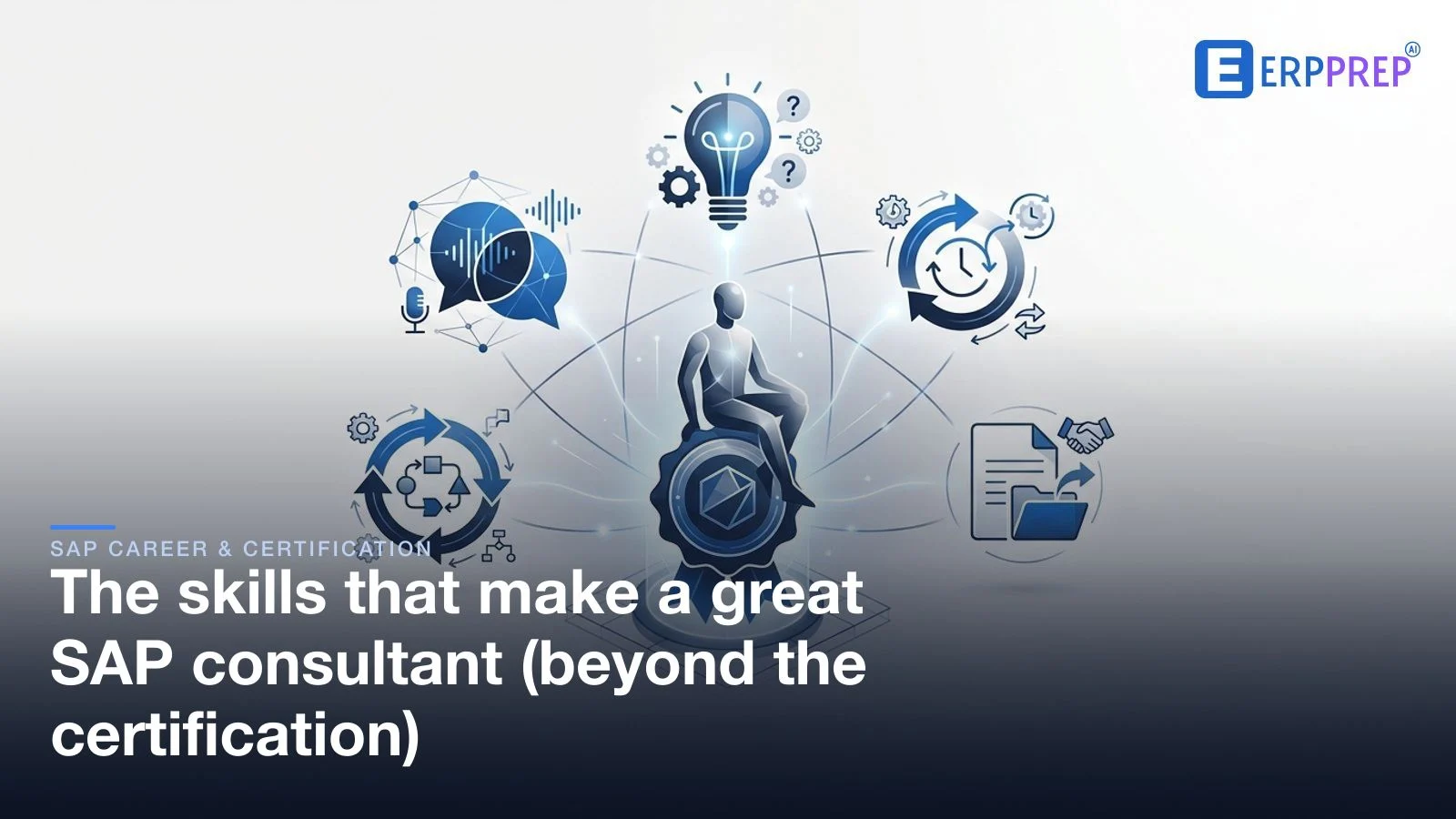
A great SAP consultant needs far more than a passed exam. Certification proves module competence, but on the job the differentiators are business-process understanding, clear stakeholder communication, structured problem-solving, adaptability, disciplined documentation and handover, and continuous learning. The credential is the entry ticket; these durable human and business skills decide whether teams keep asking for you.
Passing an SAP® certification proves you can do the work of a module — the configuration, the process reasoning, the tasks under time pressure. That matters, and it is a real signal to employers. But anyone who has spent time on a live project knows the credential is the start of the story, not the end of it. The consultants clients ask for by name are rarely the ones with the most certificates; they are the ones who understand the business, communicate clearly, and stay calm when a plan slips. This guide is about those durable skills — the ones beyond the exam. For the skills the exam itself tests, see the wider view of whether certification is worth it and how it fits a career.
Key takeaways
- A certification is necessary but not sufficient: it proves module competence, but on-the-job success rests on skills an exam cannot fully measure.
- Business-process understanding is the highest-leverage skill — it makes every technical skill more valuable and transfers across every module and edition.
- The human skills — communication, adaptability, clean handover — are what turn a competent configurer into a trusted advisor.
- The 2026 performance-based formats already reward some of these (process reasoning, diagnosis), but the social and open-ended parts you build only on real work.
- You develop the rest deliberately: pair every task with its business reason, keep a diagnosis log, seek feedback, and treat learning as continuous.
The skills beyond the exam
Here are the six skills that most consistently separate a competent consultant from a genuinely great one — what each is, why it matters once you are on a project, and a concrete way to build it. None of them appears on a certificate, yet together they decide the shape of a career.
| Skill | Why it matters on the job | How to build it |
|---|---|---|
| Business-process understanding | You are configuring a business, not a system. Knowing why a finance close, a procurement approval, or a warehouse move exists lets you design solutions that fit reality, not just the settings screen. | For every area you support, trace a document end to end and ask users what breaks their day. Learn the process before the transaction. |
| Stakeholder communication | Projects live or die on shared understanding. Translating between business language and system behaviour — in a workshop, an email, or a status update — prevents the misalignment that sinks go-lives. | Practise explaining one trade-off to a non-technical person in plain words. Run more workshops; ask for feedback on clarity afterwards. |
| Problem-solving & diagnosis | When something breaks in production, the client wants a calm, methodical fix. Knowing what to check first — and why — is worth more than knowing every setting by heart. | Keep a running log of issues you diagnosed and the steps you took, so troubleshooting becomes a repeatable method rather than luck. |
| Adaptability to change | Requirements shift, scope moves, and products evolve. The consultant who stays useful is the one who adjusts without losing the thread or the client's confidence. | Deliberately take on unfamiliar tasks. Treat each new release or edition as a chance to relearn rather than a threat to what you know. |
| Documentation & handover | Work that only lives in your head is a liability. Clean configuration notes, decision records, and handover packs are what let a team — and the client — carry on without you. | Write the document you would want to inherit. Record the why behind a decision, not only the what. |
| Continuous learning | SAP products change continuously. A skill set frozen at your last exam dates fast; staying current is what keeps you in demand across a long career. | Block regular time to explore new features and adjacent modules. Treat learning as part of the job, not an occasional event. |
Why certification is necessary but not sufficient
It is tempting to treat a certificate as the goal. It is not — it is a gate. A certification does something valuable and specific: it gives a hiring manager or project lead a credible, standardised signal that you can perform the core work of a module without hand-holding. That signal opens doors, shortlists you for roles, and gives a client early confidence. None of that is trivial, and skipping it makes almost every path harder.
But a signal of competence is not the same as competence in context. The exam is a bounded, individual task with a known correct answer. Real consulting is open-ended and social: the requirements are ambiguous, two stakeholders want opposite things, and the "right" configuration depends on a business context no exam could encode. The credential proves you can do the work; the surrounding skills decide whether you do it well when the answer is not written down anywhere. That is why the best framing is necessary but not sufficient — get the certification, then keep going.
The technical foundation the certification gives you
Before moving past the exam, it is worth being clear about what it genuinely gives you, because the foundation matters. A well-earned certification builds real configuration fluency, a mental model of how a module's objects fit together, and the habit of reasoning through a process rather than memorising screens. Those are not throwaway skills — they are the base every consulting skill sits on. You cannot advise a client on a process you cannot actually operate.
The distinction this guide draws is between that foundation and everything built on top of it. The exam-facing skills — configuration fluency, process reasoning, diagnostic thinking, and accuracy under time pressure — are covered in depth in the skills you actually need to pass an SAP functional certification. This article picks up where that one ends: once you can do the work, what makes you someone a team keeps asking back?
The human skills that separate good from great
Two consultants can hold the same certification and configure the same setting identically, and still be worlds apart in value. The difference is almost always human. A great consultant walks into a room of anxious stakeholders and leaves it with alignment. They explain a trade-off so a finance director and a warehouse lead both understand what they are choosing. When a requirement changes late, they adapt without drama and without quietly resenting it. When they finish, they hand over work so cleanly that the next person barely needs them.
These are not soft in the sense of optional — they are the load-bearing skills of the job. A large part of what a consultant does is understand what people actually need (as opposed to what they first asked for), and to do that you have to listen, ask good questions, and read a room. If you want a fuller picture of the role these skills sit inside, see what an SAP consultant actually does across a project, and for how a specific track's career develops, the finance consultant career path.
Business acumen: seeing past the transaction
Business acumen is the skill that quietly powers all the others, and it is the one that most cleanly divides consultants who plateau from those who keep rising. A configurer sees a setting; a consultant with business acumen sees the process the setting serves, the risk it manages, and the people whose day it changes. When a finance close runs a certain way, they ask what that sequence is protecting. When a procurement approval exists, they ask what decision it is really governing. They configure the system in service of the business outcome, not the other way round.
You build this by learning the process before the transaction. Read the client's own process documentation. Sit with the users whose work the system touches and ask what frustrates them. Trace a single document from the moment it is created to the moment it appears in a report, and notice every hand-off along the way. Over enough repetitions you stop thinking in screens and start thinking in outcomes — and that is when clients start treating you as an advisor rather than a pair of hands.
Want to feel the difference between recall and doing? A free sample shows the process-reasoning style the modern format rewards — the same instinct great consulting runs on. Try a free sample.
How the performance-based exams already reward some of these
Here is an encouraging point: the shift to performance-based certification means the exam and the job have moved closer together than they used to be. The 2026 formats — System-Based Assessment (SyBA), where you complete tasks in a live system, and Scenario-Based Assessment (SBA), where you reason through a connected business scenario — reward exactly the process fluency and diagnostic thinking that on-the-job work demands. A candidate who can trace a scenario end to end and figure out what to check when something is off is practising a real consulting instinct, not just passing a test.
So the modern exam is no longer a pure memory game divorced from practice — preparing well for it genuinely builds transferable skill. If you want the detail of what these formats measure and how they differ from the old multiple-choice style, the performance-based exam preparation guide covers it. What an exam still cannot reach, though, is the social and open-ended half of the job: a live client conversation, a requirement that changes mid-project, a tense go-live weekend, a handover to a team you may never meet. Those you can only build on real work — which is the next section.
How to develop the skills the exam cannot teach
The good news is that these skills are learnable and mostly free to practise — they just require deliberate effort rather than another course. A few habits move the needle faster than anything else:
- Pair every task with its reason. Whenever you configure something, write one sentence on the business problem it solves. This alone rebuilds a technician into a consultant over a few months.
- Keep a diagnosis log. Every time you troubleshoot an issue, record the symptom, what you checked, and what it turned out to be. Patterns emerge, and your problem-solving becomes a method you can trust under pressure.
- Explain things to non-experts. After any workshop or call, ask yourself whether the least technical person in the room actually followed you. Clarity is a muscle; it grows with reps and feedback.
- Volunteer for the unfamiliar. Adaptability only develops when you leave the module you already know. Take the odd task in an adjacent area and treat the discomfort as the point.
- Write handovers you would want to inherit. Document the why behind decisions, not just the settings. It forces clarity of thought and makes you the person teams trust with important work.
None of these needs permission or budget. They are simply the difference between accumulating years and accumulating skill — and they are how consultants who started at the same place end up in very different places a decade later.
A growth plan: from certified to genuinely great
If you want a simple arc to follow, think of it in three overlapping stages. First, earn the foundation. Get certified in the module closest to the work you do, and make sure the configuration fluency behind the credential is real, not crammed — that base makes everything after it possible. Second, add the business layer. On every engagement, deliberately learn the process and the people, not only the system; this is where business acumen and communication compound. Third, become the person others rely on. Document cleanly, hand over generously, mentor where you can, and keep learning as the products evolve — that reputation is what a durable SAP career is actually built on.
Certification remains the sensible first move; it is the credible signal that gets you into the rooms where the rest is learned. But treat it as a launch pad, not a destination. The consultants who last are the ones who keep adding the skills no exam prints on a certificate — and who never stop.
Where to go next. Ground your foundation with the skills that pass the exam, understand the full role in what an SAP consultant does, prepare for the conversations in common SAP interview questions, and see how the field is changing in whether AI will replace SAP consultants. Or step back to the career pillar for the whole picture.
Frequently asked questions
- Is a certification enough to be a good SAP consultant?
- No. A certification is necessary but not sufficient. It proves you can perform the configuration and reasoning a module requires, which is a real and useful signal, but day-to-day consulting success also depends on understanding the client's business process, communicating clearly with stakeholders, diagnosing problems methodically, adapting when requirements change, and handing work over cleanly. The credential opens the door; the surrounding skills decide whether you thrive once inside.
- What soft skills does an SAP consultant need most?
- The highest-leverage ones are stakeholder communication (translating between business language and system behaviour), structured problem-solving, and adaptability. A consultant who can run a workshop, explain a trade-off in plain terms, and stay calm when a go-live slips is worth more than one who only knows the configuration. These skills transfer across every module, so they compound over a whole career rather than one exam.
- How do I build business acumen as an SAP consultant?
- Learn the process before the transaction. For any area you support, understand why the business runs it that way — what the finance close is protecting, why a procurement approval exists, what a warehouse move is really tracking. Read the client's own process documentation, ask users what breaks their day, and trace a document from creation to reporting. Over time you stop configuring settings and start solving business problems.
- Do the performance-based SAP exams test these on-the-job skills?
- Partly. The 2026 performance-based formats — System-Based Assessment (SyBA) and Scenario-Based Assessment (SBA) — reward end-to-end process reasoning and doing tasks in context rather than pure recall, so they already lean toward diagnostic thinking and process fluency. What an exam cannot test is a live client conversation, a shifting requirement, or a messy handover. Those you build on real work, deliberately.
- How is being a good SAP consultant different from passing the exam?
- Passing the exam is a bounded, individual task with a known answer. Consulting is open-ended and social: requirements are ambiguous, stakeholders disagree, and the 'right' answer depends on the client's context. Exam skill is the foundation; consulting skill is applying that foundation under uncertainty, with people, against a deadline. Both matter, but they are learned in different places.
- What is the fastest way to become a better SAP consultant?
- Pair every technical task with the business reason behind it, then practise explaining that reason to a non-technical person. Keep a running log of problems you diagnosed and how, so your troubleshooting becomes a repeatable method rather than luck. Ask for feedback after every workshop or handover. Deliberate reflection on real work compounds faster than passively accumulating more certifications.
- Do senior SAP consultants still need to keep learning?
- Yes — arguably more. SAP's products evolve continuously, and the move to cloud editions and performance-based certification reflects a wider shift toward staying current rather than certifying once. Senior consultants who stop learning become dated fast; the ones who stay in demand treat continuous learning as part of the job, not an occasional event.
- Which single skill matters most for a long SAP career?
- If forced to pick one, business-process understanding. Configuration skill can be looked up and tooling changes, but a consultant who genuinely understands why a business runs a process the way it does can adapt to any module, any edition, and any new feature. It is the skill that makes every other skill more valuable, which is why it sits at the top of the table in this guide.
ERPPrep is an independent platform and is not affiliated with, endorsed by, or sponsored by SAP SE. SAP and other SAP products are trademarks of SAP SE, referenced here only to describe the certification exams ERPPrep helps you prepare for.
Ready to practise the way the exam tests?
ERPPrep provides original, performance-style scenarios and skill drills built for the 2026 SyBA and SBA formats. Try a free sample and judge the quality yourself.
Practice for these exams
Related guides
How to get your first SAP job after certification
A tactical playbook for turning a passed SAP certification into a first job offer: hands-on practice, realistic entry roles, a portfolio, and networking.
Can you work in SAP without a degree?
Yes — you can work in SAP without a degree. What matters most is demonstrable skill, certification, and hands-on ability — here is how to prove it.
What does an SAP consultant actually do? The real day-to-day role
SAP consultant meaning in plain terms: what the role does phase by phase, from workshops to go-live, and how functional and technical roles differ.