

What is an SAP ERP certification?
There is no single SAP ERP certification. It means a role-based S/4HANA certification — SAP's current ERP — by area and cloud. Here's how to map the term.
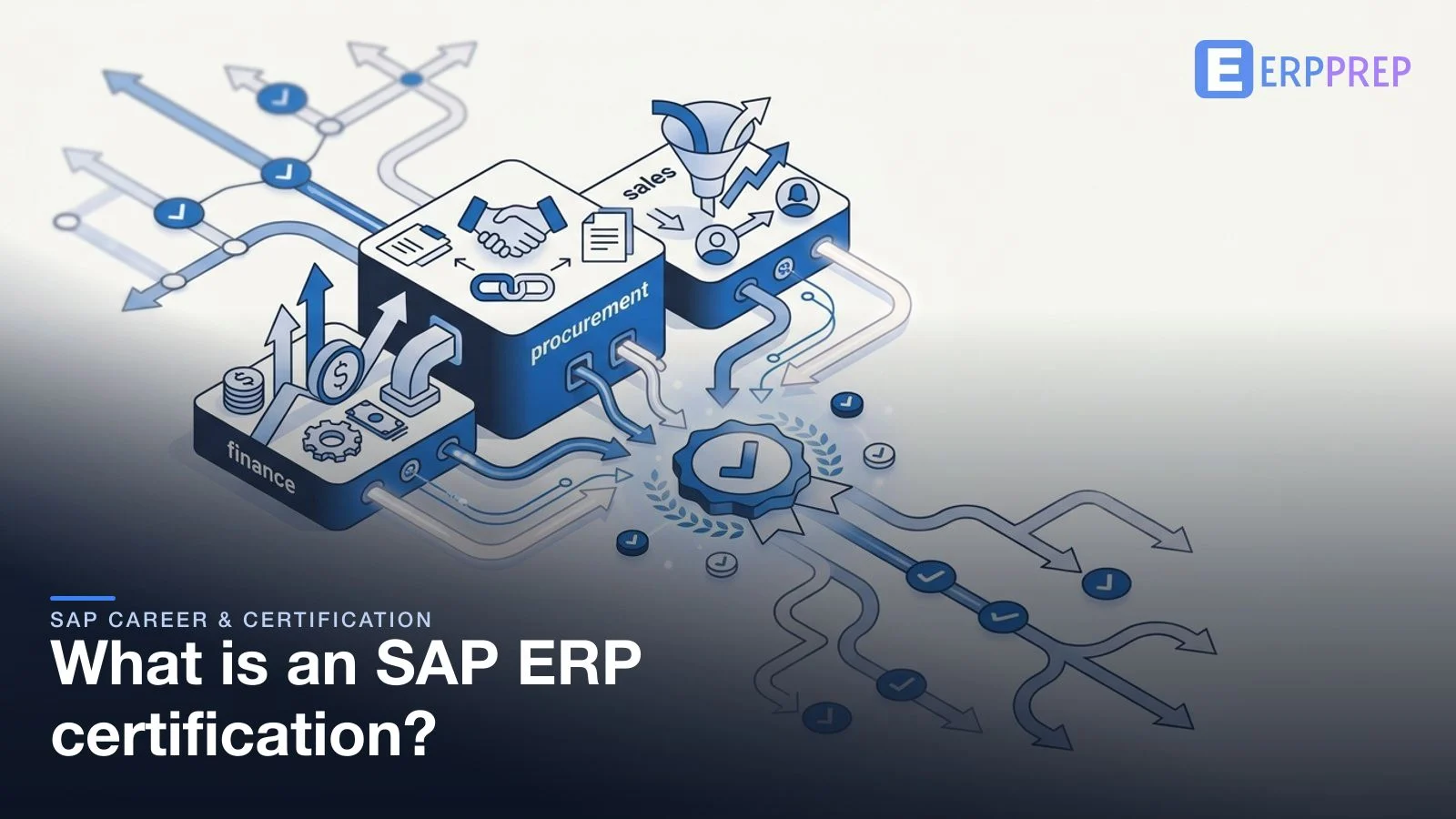
An SAP ERP certification is an informal name for SAP's role-based S/4HANA certifications — S/4HANA being SAP's current ERP and the successor to the older ECC suite. Rather than one exam, SAP certifies by functional area (finance, sourcing and procurement, sales and more) and by deployment, at associate and professional levels. Start with the associate certification for the area you work in.
Search for an "ERP certification" and you quickly hit a wall of jargon: SAP®, S/4HANA, ECC, modules, associate versus professional, public versus private cloud. If you just want to know what to actually get, this guide untangles it. There is no single "SAP ERP certification" — the phrase is shorthand for a family of role-based S/4HANA credentials, and the useful question is which one fits you. For the bigger picture of whether the effort pays off and how to choose across every SAP track, see whether SAP certification is worth it and how to choose.
"SAP ERP certification" is an informal name for SAP's role-based S/4HANA certifications — S/4HANA being SAP's current ERP and the successor to the older ECC suite. Rather than one exam, SAP certifies by functional area (finance, sourcing and procurement, sales and more) and by deployment, at associate and professional levels. Start with the associate certification for the area you work in.
Key takeaways
- "SAP ERP certification" is an umbrella term, not an exam. No single credential carries that name; it points at a whole family of role-based S/4HANA certifications.
- SAP's ERP is now S/4HANA. It is the successor to the classic ECC suite, and current certifications are built around it and its 2026 exam formats.
- You certify by functional area. Finance, sourcing and procurement, sales, and others each have their own certification — you pick the one that matches your role.
- Levels and clouds narrow it further. Associate or professional level, and public-cloud or private-cloud edition, each split the catalog again. Beginners start at associate.
- The exams are performance-based. SAP's 2026 formats (SyBA and SBA) test doing tasks and reasoning through scenarios, so how you prepare matters as much as which exam you choose.
Why "ERP certification" is a confusing search
ERP stands for enterprise resource planning — the software a business runs its core operations on: finance, procurement, sales, manufacturing, HR, and the rest. Several vendors sell ERP systems, and SAP is one of the largest. So "ERP certification" is genuinely ambiguous: it could mean a certification from any ERP vendor, and even narrowed to SAP it still does not point at one exam. People type the phrase because they know they want to validate ERP skills; the catalog they land in is organised very differently from how the search term reads.
The mismatch is worth naming, because it trips up almost every beginner. You arrive expecting a single "SAP ERP" badge to study for, and instead you find dozens of role-based certifications with codes like C_TS4FI and C_S4CFI. That is not a maze to get lost in — it is a map, once you understand the two things it is organised by: the product (S/4HANA today) and the role (the functional area you work in). Get those two straight and the right certification becomes obvious.
SAP's ERP today is S/4HANA
For years SAP's flagship ERP was the suite most people just called "SAP ERP" — technically SAP ERP Central Component, or ECC. That is the generation many long-serving consultants trained on. SAP's current ERP is S/4HANA, a re-architected successor built on SAP's in-memory database. SAP has publicly set an end-of-maintenance timeline for the classic suite, and that has been steadily pushing organisations to migrate to S/4HANA. In practical terms, S/4HANA is where new implementation work — and new hiring — is concentrated.
For anyone choosing a certification now, the takeaway is simple: aim at a current S/4HANA credential rather than an older ECC one. A legacy certification may still describe real accounting or logistics knowledge, but it rehearses a platform the market is leaving behind. Certifying on S/4HANA keeps your credential aligned with the systems companies are actually rolling out. If you want the deeper distinction between SAP and rival ERP platforms as a career bet, see SAP versus other ERP careers.
There is no single "SAP ERP certification" — it is role-based
Here is the core idea that makes the whole catalog click into place: SAP certifies by role and functional area, not by the system as a whole. You do not certify on "all of S/4HANA" — you certify on the part of it you work with. A finance consultant certifies on S/4HANA finance; a procurement consultant certifies on S/4HANA sourcing and procurement; a sales consultant certifies on S/4HANA sales. Each is a separate exam with its own content, because each maps to a distinct job.
This is the opposite of a single generalist badge, and it is a good thing. It means the certification you earn is specific enough to signal exactly what you can do, which is far more useful to an employer than a vague claim to know "SAP". It also means you do not have to learn the entire system to get certified — you go deep in your area. The trade is that you have to know which area to pick, which is where matching the certification to a real role comes in.
What "ERP certification" maps to today
To make the translation concrete, here is how the vague search term lines up against SAP's real, current catalog. Read down the left for what you might mean, and across for what that actually is and a place to start.
| If you mean… | In SAP's catalog that is… | A starting point |
|---|---|---|
| "A general SAP ERP certification" | A role-based S/4HANA certification in one functional area, at associate level | Pick the area you work in |
| "An SAP finance / accounting certification" | An S/4HANA Financial Accounting certification (public or private cloud) | C_S4CFI or C_TS4FI |
| "An SAP procurement / purchasing certification" | An S/4HANA Sourcing and Procurement certification | C_TS452 |
| "An SAP sales certification" | An S/4HANA Sales certification | The sales area exam hub |
| "An entry-level ERP certification" | An associate-level S/4HANA certification | Start at associate, one area |
| "An expert / advanced ERP certification" | A professional-level certification, after real project experience | Earn an associate one first |
Notice the pattern: every row resolves to the same two choices — an area and a level (plus, for cloud editions, a deployment). Once you have made those two or three picks, you are looking at a single, specific exam rather than a fog of options. The rest of this guide walks through each of those choices so you can make them deliberately.
Associate and professional: the levels
SAP certifications come in levels, and for ERP roles the two that matter most are associate and professional. An associate certification validates foundational, implementation-level skill in a module — it is the usual entry point and the level nearly every beginner should target. A professional certification sits above it and expects deeper, demonstrated project experience; it is something you grow into after you have delivered real work, not a starting line.
Getting the level right matters as much as getting the area right. Reaching straight for a professional exam without the hands-on background behind it tends to end in a hard exam and a thin result; starting at associate builds the base the professional level later assumes. The three finance and procurement exams this guide points to — SAP S/4HANA Finance (C_TS4FI), its public-cloud counterpart (C_S4CFI), and S/4HANA Sourcing and Procurement (C_TS452) — are all associate-level, which is exactly why they suit someone establishing a credential. For the full ladder and how the levels relate, see SAP certification levels explained.
Public cloud and private cloud editions
There is one more split to understand, because it directly changes which exam you sit: S/4HANA comes in more than one deployment, and SAP certifies them separately. The same functional area — finance, say — appears as one certification for the public cloud edition and another for the private cloud edition. That is why finance shows up twice in the table: C_S4CFI targets the public cloud edition of S/4HANA Financial Accounting, while C_TS4FI targets the private cloud edition of the same area.
The editions differ mainly in how much they can be configured and extended: public cloud favours standardised, SAP-managed processes, while private cloud allows more tailoring. Neither is "better" in the abstract — the right one is the edition your projects, or your target employer, actually run. So decide the deployment first, then pick the matching area certification, rather than the other way around. If you are weighing the two, the dedicated comparison in SAP S/4HANA public vs private cloud certifications lays out how the choice affects your path.
Not sure an SAP certification is your kind of exam? The fastest way to find out is to feel the format for yourself — the 2026 exams are hands-on, not multiple-choice recall. Try a free sample and see whether performance-based practice suits how you like to learn.
The 2026 format: what these exams actually test
One thing that surprises newcomers is that a modern SAP certification exam is not a long multiple-choice quiz. SAP moved to performance-based formats in 2026, and understanding them shapes how you should prepare. There are two: the System-Based Assessment (SyBA), where you carry out real configuration tasks in a live system, and the Scenario-Based Assessment (SBA), where you reason through a connected business scenario and make decisions in context. Both reward doing over memorising.
The finance and procurement associate exams above are System-Based, so preparing means practising the configuration itself, not just reading about it. It is also worth setting expectations honestly: SAP does not publish topic-area weightings or pass rates for these exams, so anyone quoting you an exact breakdown or a guaranteed pass figure is inventing it. Treat the format as the real syllabus — practise the tasks and scenarios the exam asks you to perform. You can confirm the current formats, areas, and levels for any exam directly on SAP's own listing at SAP's certification catalog. For the technique behind sitting a hands-on exam well, the performance-based exam preparation guide goes into depth.
A note on dumps and "real exam questions"
When you research any SAP certification, you will run into sites advertising "real" or "actual" exam questions and dumps. Avoid them. They put your credential at risk, and — just as importantly — they do not even work against a performance-based exam, because there is no fixed answer key to a task you have to actually perform. A memorised list of letters buys you nothing when the exam asks you to configure a system or reason through a scenario. ERPPrep does not provide dumps or leaked questions and never will; the only thing that survives the 2026 format is the underlying skill, so that is what legitimate practice builds.
The tell is easy to spot once you know it: a resource that leans on "real questions" or a "guaranteed pass" is selling a shortcut that the exam format has closed off, while a legitimate one talks about mirroring the format and building skill. Keeping that distinction in mind is part of choosing well, and it applies to every SAP ERP certification, not just the finance and procurement ones here.
Who should pursue which — and where to start
With the pieces on the table — product (S/4HANA), area, level, and deployment — choosing becomes a matter of matching them to your situation:
- Career switchers with no SAP background. Start with an associate certification in a broadly useful area. Finance is a common choice because almost every organisation runs it, which pairs the credential with a large pool of live projects — an S/4HANA Finance certification such as C_TS4FI or C_S4CFI is a solid first target.
- Working consultants specialising. Certify in the area you already deliver. If your projects are procurement-heavy, an S/4HANA Sourcing and Procurement (C_TS452) certification signals exactly what you do; if they are finance-heavy, one of the finance exams does the same.
- Sponsored candidates whose employer is paying. Match the certification to the edition and area your organisation actually runs — public or private cloud, and the module your team implements — so the credential maps directly to the work in front of you.
If you are still torn between areas, do not agonise over collecting the "best" badge — pick the one closest to real work you can practise and talk about. The decision framework in which SAP certification to get first walks through the trade-offs if finance and procurement are not obviously where you sit.
Putting it together
So "What is an SAP ERP certification?" has a clear answer once the jargon clears: it is a role-based S/4HANA certification — SAP's current ERP, the successor to ECC — chosen by functional area, level, and cloud edition rather than as one all-in-one exam. To turn the vague search into a concrete plan, make three decisions: the area that matches your role (finance, sourcing and procurement, sales, or another), the level (associate to start), and the deployment your projects use. Those choices resolve the whole catalog to a single, specific exam.
From there, the honest next step is to see whether the hands-on 2026 format suits you before you commit to a study path — the exams reward doing, so a few minutes of performance-based practice tells you more than any amount of marketing copy. Start with an associate certification in your area, from SAP S/4HANA Finance (C_TS4FI) to Sourcing and Procurement (C_TS452), and the path stops feeling like a maze. Try a free sample to feel how a performance-based SAP exam actually works, then choose your certification with your eyes open.
Frequently asked questions
- What is an SAP ERP certification?
- It is an informal way of describing SAP's role-based certifications for S/4HANA, which is SAP's current ERP. There is no single exam called "SAP ERP certification". Instead SAP certifies you in a specific functional area — finance, sourcing and procurement, sales, and others — and at a level (associate or professional). When someone says they want an SAP ERP certification, they almost always mean one of these S/4HANA role-based credentials that matches the work they do.
- Is there a single SAP ERP certification exam?
- No. SAP does not offer one all-in-one ERP exam. Its certifications are organised by role and functional area on top of S/4HANA, so you certify in the module you actually work with rather than the whole system at once. That is why the search term "ERP certification" maps to a family of exams — for example an S/4HANA Finance certification or an S/4HANA Sourcing and Procurement certification — not to a single credential you can point to.
- What is the difference between an SAP ECC and an S/4HANA certification?
- ECC (the classic SAP ERP suite) is the previous generation; S/4HANA is the current one, and SAP has published an end-of-maintenance timeline that is moving the market toward it. Current SAP certifications are built around S/4HANA and its 2026 performance-based exam formats, not the older suite. If you are certifying today, you want a current S/4HANA credential, because that is what employers implementing new systems are hiring for.
- Which SAP S/4HANA certification should a beginner start with?
- Start with the associate-level certification in the functional area closest to your work or your target role. Finance is a common entry point because nearly every organisation runs it, so an S/4HANA Finance certification pairs with a lot of live projects. Sourcing and procurement or sales are strong alternatives if that is where your experience sits. The key is to match the certification to a real role rather than picking one at random.
- Are SAP ERP certifications public cloud or private cloud?
- Both — SAP publishes separate S/4HANA certifications for its public cloud and private cloud editions, and the same functional area (finance, for instance) can appear in each. The two deployments differ in how much they can be configured and extended, so the certification you choose should follow the edition your projects use. If you are unsure which applies to you, decide the edition first, then pick the matching area certification.
- What levels do SAP S/4HANA certifications come in?
- Chiefly associate and professional. Associate certifications validate implementation-level, foundational skill in a module and are the usual entry point; professional certifications sit above them and expect deeper, hands-on project experience. Most people begin at associate in one area and only add a professional credential once they have delivered real work. Choosing the right level matters as much as choosing the right area — an associate certification is where almost everyone should start.
- What format are SAP S/4HANA certification exams in 2026?
- They are performance-based rather than pure multiple-choice recall. SAP's 2026 formats are the System-Based Assessment (SyBA), where you carry out configuration tasks in a live system, and the Scenario-Based Assessment (SBA), where you reason through a connected business scenario. Both reward doing over memorising. SAP does not publish topic-area weightings or pass rates for these exams, so prepare by practising the tasks the format asks you to perform.
ERPPrep is an independent platform and is not affiliated with, endorsed by, or sponsored by SAP SE. SAP and other SAP products are trademarks of SAP SE, referenced here only to describe the certification exams ERPPrep helps you prepare for.
Ready to practise the way the exam tests?
ERPPrep provides original, performance-style scenarios and skill drills built for the 2026 SyBA and SBA formats. Try a free sample and judge the quality yourself.
Practice for these exams
Related guides
SAP S/4HANA vs SuccessFactors: which certification career should you choose?
Core ERP / S/4HANA or cloud HR / SuccessFactors? Two very different SAP career worlds compared — the roles, the job markets, and how to choose — using C_TS4FI (Financial Accounting) and C_THR81 (Employee Central) as examples.
The most in-demand SAP certifications in 2026
Which SAP certification areas have the strongest hiring demand in 2026 — S/4HANA finance, SuccessFactors HR, development and BTP, analytics, supply chain, and architecture — and how to choose the one that fits you.
The highest-paying SAP certifications in 2026 (and why they pay)
Which SAP certifications pay most in 2026 — and why: S/4HANA core, BTP and the architect tier, analytics, security. With an area-by-area comparison table.