

The most in-demand SAP certifications in 2026
Which SAP certification areas have the strongest hiring demand in 2026 — S/4HANA finance, SuccessFactors HR, development and BTP, analytics, supply chain, and architecture — and how to choose the one that fits you.
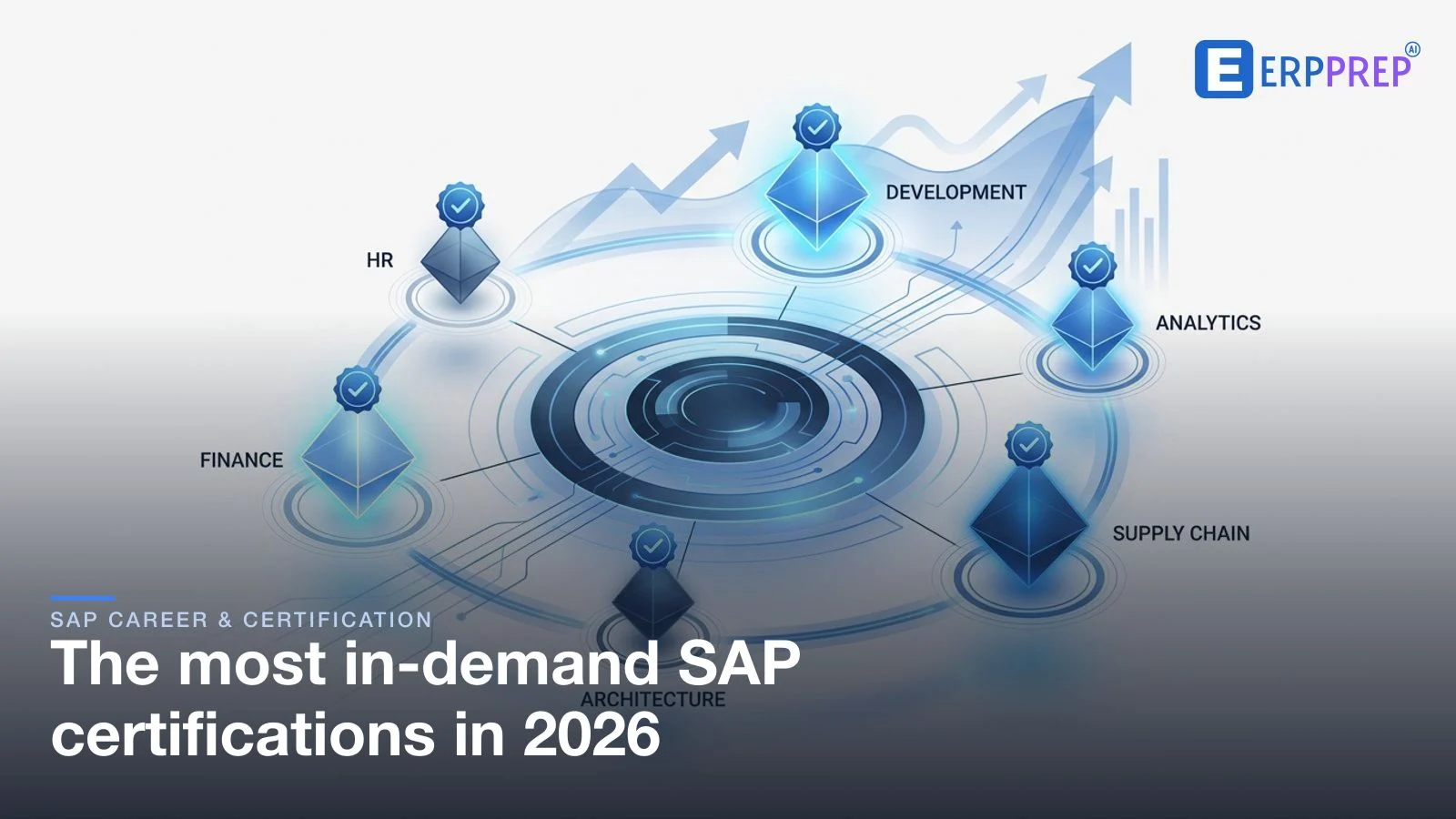
In 2026 the most in-demand SAP certification areas track the S/4HANA migration wave and the move to cloud. S/4HANA finance (C_TS4FI), SuccessFactors HR (C_THR81/C_THR82), development and BTP (C_ABAPD, C_FIORD, C_ADBTP), analytics (C_SAC), and supply chain (C_S4EWM) all carry strong demand. The best one is the area that matches your background and the projects near you.
"Which SAP® certification is most in demand?" is one of the most-searched questions in the whole ecosystem — and the honest answer is that demand isn't concentrated in one exam. It clusters in a handful of areas that are being pulled forward by the same forces: the migration off older ERP releases onto SAP S/4HANA, the steady move to cloud, and the clean-core principle that is reshaping how systems get extended. This guide surveys the areas that carry the strongest 2026 hiring demand, routes each to its exam hub, and then helps you weigh demand against your own fit. If you want the shape of the job those areas lead to, see what an SAP consultant actually does. For the broader "is certification worth it and how do I choose" framing, start with whether SAP certification is worth it and how to choose.
Key takeaways
- There is no single "most in-demand" exam — demand clusters in areas riding the same S/4HANA and cloud shift.
- S/4HANA finance (C_TS4FI) is one of the most consistently sought areas, because finance migrates early.
- SuccessFactors HR (C_THR81) stays in demand on the strength of SAP's large cloud-HR footprint.
- Development and BTP — C_ABAPD, C_FIORD, and C_ADBTP — rose with clean-core extension work.
- Analytics (C_SAC) and supply chain (C_S4EWM) round out the high-demand functional areas.
- High demand is not a salary guarantee — choose the area where market interest overlaps your background and reachable projects.
Why demand clusters where it does in 2026
The single biggest driver of SAP hiring right now is the move to SAP S/4HANA. Organizations that ran older ERP releases for years are migrating, and every migration needs people who can configure, test, and run the new system. That is a broad, multi-year wave rather than a one-off, which is why so many of the in-demand areas below are S/4HANA-based. Layered on top of it are two reinforcing trends: the shift to cloud delivery, and the clean-core approach, where you extend the system through supported channels instead of modifying the standard so upgrades stay safe.
The practical upshot for a career decision is that "in demand" is less about one hot exam and more about being on the right side of these shifts. A certification that proves you can work the S/4HANA, cloud, and clean-core way carries a signal that outlasts any single project. These patterns are qualitative and widely reported across the industry rather than a precise number you should quote — treat them as direction, not data points. The sections that follow walk the areas where that direction is strongest.
S/4HANA finance: the migration's front line
When an organization moves to S/4HANA, finance is almost always among the first modules to go live, because record-to-report has to work from the moment the system is switched on. That timing is a large part of why financial-accounting skills sit at the front of demand. The C_TS4FI certification covers Financial Accounting on SAP S/4HANA — system configuration, the R2R flow, and the core accounting skills a finance consultant applies on a project.
C_TS4FI is a consultant-track, associate-level certification, and in 2026 it uses SAP's System-Based Assessment (SyBA) format, where you complete a task in a live environment rather than answering multiple-choice questions about it. That format matters for demand: it means the certification signals hands-on capability, which is exactly what a migration project needs. If you come from an accounting or finance background, this is often the most natural high-demand entry point — the domain knowledge you already have transfers directly. Confirm the current scope on the exam's page at learning.sap.com before you commit.
SuccessFactors HR: the cloud people-suite
Human-resources technology is a second area of durable demand, and for SAP that means SuccessFactors — its cloud HR suite. Because so many organizations run it, consultants who can implement its modules stay consistently sought after. Two certifications anchor the area: C_THR81, covering Employee Central Core and Position Management (the foundational people-data layer), and C_THR82, covering Performance and Goals. Both are described as entry-level consultant qualifications intended for partner consultants implementing the solution.
What makes the HR area attractive for a career change is that it leans on process and domain knowledge more than deep coding. If you come from an HR or people-operations background, the concepts — core employee data, workflows, position management, performance cycles — are already familiar, and the certification adds the SAP-specific implementation skill on top. One practical note: SuccessFactors exams move to SAP's new performance-based formats too, and individual exams periodically go under maintenance as they are updated, so always check the live status and format on learning.sap.com rather than assuming last year's details still hold.
Want to feel how a performance-based SAP exam works before you pick an area? A free sample shows the doing-over-recalling style that finance, HR, and developer exams now share. Try a free sample.
Development and BTP: clean-core raised the bar
The move to clean-core did something interesting to developer demand: it didn't just ask for more developers, it asked for developers who build the upgrade-safe way. That reshaped three related paths. The C_ABAPD certification covers back-end ABAP Cloud development, including the ABAP RESTful Application Programming Model — the modern, clean-core way to write business logic. The C_FIORD certification covers Fiori application development, the front-end layer users actually touch. And C_ADBTP covers SAP Business Technology Platform administration — the platform where extensions and integrations live.
These paths reward hands-on skill, and their exam formats reflect it: ABAP Cloud and BTP Administrator use the System-Based (SyBA) format, while Fiori Application Developer uses the Scenario-Based (SBA) format. BTP Administrator is notable for a demanding cut score, a signal that the platform work rewards precise, practised command rather than partial familiarity. For someone switching into SAP who already programs, the developer area is one of the strongest fits — your existing skills transfer, and clean-core is where the new work is. For a role-first walk through these paths, see the developer-career certification guide.
Analytics: turning SAP data into decisions
As more of the business runs in S/4HANA and the cloud, the value of the data it produces rises with it — and so does demand for people who can turn that data into planning and reporting. The C_SAC certification targets the SAP Analytics Cloud Data Analyst profile: data visualization, modeling, analysis, and business planning. It's a Scenario-Based (SBA) certification aimed at people who join a project team as the analytics specialist.
Alongside it sits a more engineering-flavoured path for data specialists — the BW/4HANA Data Engineer certification (C_BW4H), which is System-Based and focuses on data acquisition and modeling in a data-warehouse context. The two suit different temperaments: C_SAC leans toward the analyst who communicates insight, while the data-engineer path leans toward building the pipelines underneath. If you come from a business-intelligence or reporting background, analytics is a high-demand area where your existing instincts carry over quickly.
Supply chain and logistics: execution that can't slip
Supply-chain and logistics modules are another area of steady demand, partly because they are operationally critical — a warehouse or a transportation flow can't afford downtime, so migrations here are handled carefully and staffed well. The C_S4EWM certification covers Extended Warehouse Management on S/4HANA — inbound and outbound logistics, warehouse operations, and the configuration behind them. It's a consultant-track, System-Based certification relevant to both cloud and on-premise S/4HANA.
Its companion on the movement side is Transportation Management (C_S4TM), a Scenario-Based certification covering transportation planning and freight handling. Together they map to the two halves of physical logistics — storing goods and moving them — and both benefit from the same S/4HANA wave pulling finance and the rest forward. For candidates with a logistics, operations, or warehousing background, this area converts real-world experience into an SAP credential with unusually little translation loss.
Architecture: the professional tier demand grows into
Not every in-demand certification is an entry point. As landscapes get more complex — multiple clouds, extensions on BTP, integrations across modules — demand rises for people who can see the whole picture. The P_SAPEA Enterprise Architect certification sits at the professional (P_) tier and targets exactly that: building a holistic architecture model aligned with business strategy and making sure the IT landscape supports it. It's Scenario-Based, and it assumes real experience rather than serving as a first badge.
The reason it belongs in a demand survey is that it's where several of the associate paths above eventually lead. A finance consultant, a developer, or a BTP administrator can each grow toward architecture as they take on design responsibility. So if you're early in your SAP career, don't target P_SAPEA first — but do note that the high-demand associate areas are also on-ramps to a high-demand senior role later.
How to read demand versus fit
Here is the part most "most in-demand" lists skip: demand only helps you if you can reach the work. An area can be genuinely hot and still be the wrong choice for you if your background doesn't overlap it and the projects near you don't use it. The strongest certification decision sits at the intersection of three things — market demand, your existing skills, and the projects you can realistically get onto. A finance professional will usually get more career lift from C_TS4FI than from chasing a developer path, even if both areas are in demand, because the finance path compounds with what they already know.
It's also worth being clear-eyed about pay. High demand tends to improve opportunity — more openings, more projects — but it does not guarantee a specific salary. Compensation depends on your experience, region, industry, and the value you deliver, and any single quoted figure you see online should be treated as a rough, unverified signal rather than a promise. Use demand to decide where to invest your preparation, and let real delivery experience drive what you eventually earn.
Preparing for whichever area you choose
One thing unites every high-demand area above: in 2026 these exams are performance-based, not multiple-choice trivia. Finance, warehouse, and developer exams use the System-Based (SyBA) format where you do tasks in a live system; analytics, transportation, Fiori, and architecture use the Scenario-Based (SBA) format where you reason through a connected case. Either way, the skill that passes them is the same: understand whole flows, work in a realistic environment, and hold accuracy under time pressure. Learn to prepare for the performance-based format once and the technique carries across areas even as the domain changes.
So the sequence is simple. Pick the area where demand overlaps your background — finance (C_TS4FI), HR (C_THR81), development (C_ABAPD or C_FIORD), analytics (C_SAC), or supply chain (C_S4EWM). Confirm the current format and cut score on each exam's page at learning.sap.com. Then practise the format itself — the fastest way to know whether you're ready is to try it. Try a free sample and see the doing-over-recalling style for yourself.
Frequently asked questions
- What is the most in-demand SAP certification in 2026?
- There isn't a single winner — demand is strongest across a handful of areas that ride the S/4HANA migration and cloud shift. S/4HANA finance (C_TS4FI), SuccessFactors HR (C_THR81/C_THR82), clean-core development (C_ABAPD), analytics (C_SAC), and supply chain (C_S4EWM) all carry broad hiring interest. The most in-demand certification for you is the one in the area your background and local projects point toward.
- Is S/4HANA finance certification in demand?
- Yes. As organizations move off older ERP releases onto SAP S/4HANA, finance is one of the first modules to migrate, because record-to-report has to work from day one. The C_TS4FI certification covers Financial Accounting on S/4HANA and is widely reported as one of the more consistently sought-after credentials. Confirm the current exam scope and format on its page at learning.sap.com before you plan.
- Is a SuccessFactors certification worth it in 2026?
- SuccessFactors is SAP's cloud HR suite and has a large installed footprint, so consultants who can implement it stay in demand. Certifications such as C_THR81 (Employee Central Core and Position Management) and C_THR82 (Performance and Goals) target that work. They're recommended as entry-level consultant qualifications, so they suit people building an HR-technology career rather than deep technical developers.
- Are SAP developer certifications in demand?
- Yes — the shift to clean-core, extension-based S/4HANA raised demand for developers who build the right way. ABAP Cloud (C_ABAPD) is the classic back-end path, Fiori Application Developer (C_FIORD) covers front-end work, and BTP Administrator (C_ADBTP) covers the platform. Because these are performance-based exams, employers value the hands-on fluency they signal, not just the badge.
- Does an in-demand certification mean higher pay?
- Not automatically. High demand for a skill area tends to improve opportunity, but compensation depends on your experience, region, industry, and the value you deliver on projects — a certification is a signal, not a salary guarantee. Treat 'in demand' as a hint about where roles are opening, then let real delivery experience drive your earnings. Avoid trusting any single quoted figure as a promise.
- Which SAP certification is best for a career change?
- For most career changers, a consultant-track functional area is the friendlier entry: S/4HANA finance (C_TS4FI) if you come from an accounting or finance background, or SuccessFactors HR (C_THR81) if you come from HR. These lean on domain knowledge you may already have. Deep developer paths like C_ABAPD reward existing coding skills, so they suit switchers who already program.
- What is a good entry point into SAP certification?
- Start where your current skills overlap an SAP area. Finance professionals often begin with C_TS4FI, HR professionals with C_THR81, programmers with C_ABAPD, and data people with C_SAC. Most of these are associate-level, entry-oriented certifications meant to let you contribute to a project team in a mentored role — an honest description of where a first certification actually places you.
- How do I choose between in-demand SAP certifications?
- Weigh demand against fit. Pick the area where market interest overlaps your background and the projects you can realistically reach — a certification you can apply beats a 'hotter' one you can't. Check each exam's current format and cut score on learning.sap.com, then practise the performance-based style so you're ready for how these exams are actually assessed in 2026.
ERPPrep is an independent platform and is not affiliated with, endorsed by, or sponsored by SAP SE. SAP and other SAP products are trademarks of SAP SE, referenced here only to describe the certification exams ERPPrep helps you prepare for.
Ready to practise the way the exam tests?
ERPPrep provides original, performance-style scenarios and skill drills built for the 2026 SyBA and SBA formats. Try a free sample and judge the quality yourself.
Practice for these exams
Related guides
SAP S/4HANA vs SuccessFactors: which certification career should you choose?
Core ERP / S/4HANA or cloud HR / SuccessFactors? Two very different SAP career worlds compared — the roles, the job markets, and how to choose — using C_TS4FI (Financial Accounting) and C_THR81 (Employee Central) as examples.
SAP modules explained — and how to choose yours
A plain-English map of the SAP module landscape — functional, HR, technical, analytics and cross-cutting — plus a practical framework for choosing yours.
What is an SAP ERP certification?
There is no single SAP ERP certification. It means a role-based S/4HANA certification — SAP's current ERP — by area and cloud. Here's how to map the term.