

SAP BTP administrator vs HANA DBA certification: C_ADBTP vs C_DBADM
Two SAP administrator certifications, two very different technical careers. C_ADBTP (SAP BTP administration) vs C_DBADM (SAP HANA database administration) — what each covers, the format, the cut score, and which to choose.
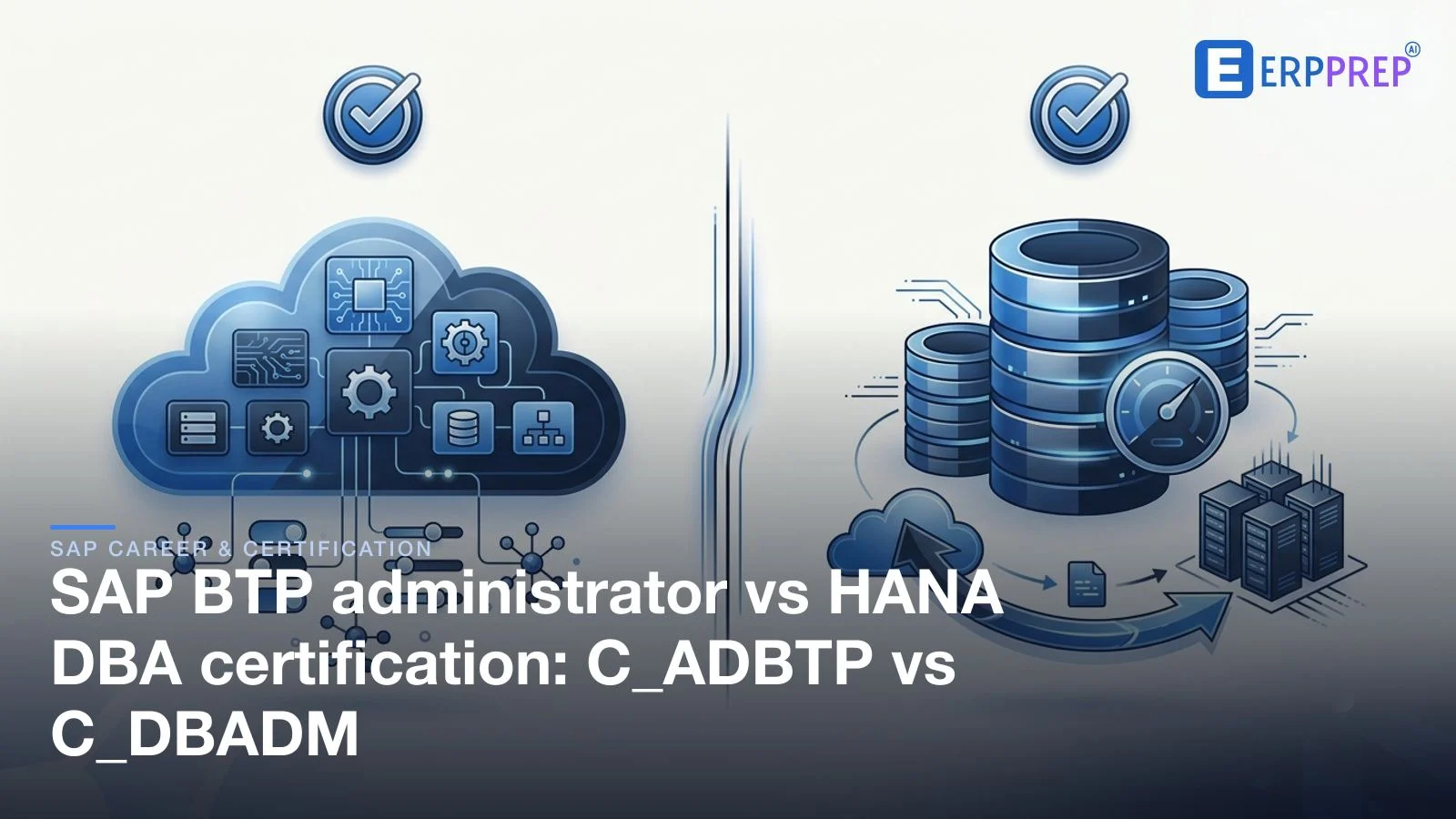
C_ADBTP certifies SAP BTP administration — cloud account structure, identity and access management, runtime environments, connectivity, DevOps, and infrastructure-as-code. C_DBADM certifies SAP HANA database administration — install and upgrade, configuration, monitoring, and backup and recovery across HANA Cloud and on-premises. Both are associate System-Based Assessments. Choose by the layer you run: the cloud platform, or the database engine underneath it.
SAP® certifies its administrators by the layer they operate, and two associate credentials sit close on the catalogue but point at genuinely different technical careers. C_ADBTP covers SAP BTP administration — running the cloud platform itself — while C_DBADM covers SAP HANA database administration — running the database engine underneath it. This guide compares what each certifies, the format they share, where their pass marks diverge, and how to choose. For the wider question of which SAP path fits your career, see whether SAP certification is worth it and how to choose.
Key takeaways
- C_ADBTP is the cloud-platform track — it certifies administering SAP BTP: accounts, identity and access, runtime environments, connectivity, DevOps, and automation.
- C_DBADM is the database track — it certifies administering SAP HANA: installation, configuration, monitoring, and backup and recovery across cloud and on-premises.
- Both are associate-level and use the same System-Based Assessment (SyBA) performance-based format, so you perform real activities rather than recall facts.
- Their pass marks differ: C_ADBTP publishes a 100% cut score and C_DBADM a 73% cut score at the time of writing — a meaningful difference in how much margin for error each allows.
- They map to different technical roles: a cloud-platform / operations administrator versus a database administrator.
C_ADBTP vs C_DBADM at a glance
Both certifications sit on official SAP learning journeys (SAP, learning.sap.com) and share the performance-based assessment style — but they run different layers of the stack. Here they are side by side:
| C_ADBTP — BTP administration | C_DBADM — HANA DBA | |
|---|---|---|
| What it covers | Cloud account structure, identity and access management, runtime environments, connectivity, DevOps, observability, cost, and infrastructure-as-code | Install and upgrade, configuration, monitoring, backup and recovery, security, and migration across HANA Cloud and on-premises |
| Best for | Cloud-platform / cloud-operations administrators | Database administrators (DBAs) |
| Format | System-Based Assessment (SyBA) | System-Based Assessment (SyBA) |
| Cut score | 100% | 73% |
| Cloud vs on-premises | Cloud platform | Both cloud and on-premises |
What C_ADBTP (SAP BTP administration) covers
The BTP administrator certification is about operating a cloud platform. Rather than tuning a single system, you set up and run the environment that other teams build and deploy on. The earned skills sit in the cloud-operations space — cloud services and strategy, cloud security, identity and access management, and cloud computing architecture — all centred on SAP Business Technology Platform.
In practice, the module spans the platform from account setup through to automation:
- Account structure and governance — working with the platform cockpit, the account and subaccount model, service subscriptions, and the governance model that keeps them in order.
- Runtime environments — provisioning and managing the environments applications run in, including Cloud Foundry, Kyma, and the ABAP environment.
- Identity and access management — users, identity providers, authorization models, and access across the different runtimes, plus the cloud identity services that sit behind them.
- Connectivity — destinations and the Cloud Connector that links cloud applications to on-premises systems, including its installation, configuration, and high-availability setup.
- DevOps and observability — continuous integration and delivery, transport handling, and the monitoring strategy that keeps running applications visible.
- Cost and infrastructure-as-code — commercial models and consumption tracking, and automating platform resources with command-line tooling and Terraform.
The through-line is breadth. A BTP administrator is a platform-operations generalist who has to hold several disciplines at once — access, networking, automation, cost — and keep them coherent so the teams building on the platform are not blocked. Two threads recur and are worth calling out. The first is access and isolation: much of the work is deciding who can reach which subaccount, environment, and service, and getting that wrong is a security problem, not a cosmetic one. The second is automation over clicking: the modern expectation is that platform resources are provisioned as code, so fluency with the command line and infrastructure-as-code is part of the job, not an extra. That combination — broad surface, automated delivery — is exactly what a System-Based Assessment is designed to probe.
What C_DBADM (SAP HANA database administration) covers
The HANA DBA certification is a classic, deep administration discipline aimed at one thing done well: keeping a database available, performant, and recoverable. Where BTP administration is broad, database administration is deep. Its earned skills reflect that focus — system administration, system monitoring, and system recovery — applied to SAP HANA in both its cloud and on-premises forms.
The module moves through the full lifecycle of a database system:
- Architecture and deployment — understanding the in-memory architecture, sizing and preparing an installation, and deploying or provisioning a database in HANA Cloud or on-premises.
- Administration tooling — operating the cockpit, database explorer, cloud central, and the command-line client to carry out day-to-day work.
- Configuration and operation — starting and stopping the database, changing configuration parameters, managing tenants, and handling routine operational tasks.
- Monitoring and troubleshooting — watching memory, services, persistence, alerts, and SQL workload, and acting on what the monitoring surfaces.
- Backup and recovery — data and log backups, scheduling, and performing a database recovery — the core reason a DBA exists.
- Security and migration — users, roles, privileges, encryption and auditing, plus migrating an existing on-premises HANA database to HANA Cloud.
A HANA DBA, then, owns a system that has to stay up and stay recoverable: if a backup is misconfigured or a recovery is untested, the cost of being wrong is severe and immediate. What makes the module demanding is not breadth but consequence. Backup and recovery, in particular, is where the exam leans hardest, because it is the skill a business ultimately depends on. The database credential also deliberately spans two worlds — the managed HANA Cloud service and on-premises HANA — and even covers moving between them, so a candidate is expected to reason about administration in a managed cloud service and on self-run infrastructure. If BTP administration rewards holding a wide surface together, HANA administration rewards getting a narrower, higher-stakes set of operations exactly right.
The very different technical roles
The clearest way to choose is to look at who actually does each job. They rarely sit in the same seat on a project.
A BTP administrator is a cloud-platform operations person — the one who owns accounts and subaccounts, sets up identity and access, provisions runtime environments, wires connectivity to on-premises systems, and increasingly writes the automation that does all of that repeatably. The work is broad and integration-shaped: understand how the pieces of a cloud platform fit, and keep them secure and available for the teams building on top. If you enjoy operating the environment everyone else deploys into, this is the role — and it pairs naturally with a broader cloud-operations career.
A HANA DBA is a database specialist. The work is depth-and-reliability shaped: install and patch cleanly, configure for performance, watch the system continuously, and above all guarantee that the data can be recovered when something goes wrong. It suits someone who likes precise, high-stakes operational work where the correct procedure is defensible and the cost of a mistake is concrete. It sits closer to the infrastructure and data-reliability side of an implementation than to platform enablement.
There is a career-shape difference too. BTP administration skills travel across the whole cloud-operations space — the instincts for identity, environment provisioning, and infrastructure-as-code are useful anywhere a modern platform is run, so a BTP administrator can drift toward a wider cloud-platform or site-reliability role over time. HANA DBA skills are deeper but more specialised: they make you the person a project cannot deliver without when a HANA database is in scope, and that scarcity has its own durable value, though the expertise is more tightly bound to the database and its neighbours. Neither is "better" — they are simply different bets on whether you want your expertise to compound in breadth or in depth.
For a full picture of how these administrator roles sit alongside the rest of the SAP field, the SAP certification roadmap lays out the main technical tracks and how they connect.
Prerequisites and the cut-score difference
Neither exam is gated behind a formal prerequisite certification — both are positioned as associate entry points into their discipline. What matters more is the practical grounding underneath them. For C_ADBTP that means genuine comfort with cloud concepts, identity, connectivity, and command-line and infrastructure tooling; the learning journey assumes an intermediate, hands-on starting point. For C_DBADM it means comfort with database operations, the underlying Linux platform, and the HANA administration tools. If you are new to a discipline entirely, expect to build that base first rather than reading your way to a pass.
The one hard difference to plan around is the pass mark. At the time of writing, C_ADBTP publishes a 100% cut score and C_DBADM a 73% cut score. A 100% threshold is unforgiving: every scored activity has to be correct, so the BTP exam leaves no room to lose a point and recover elsewhere. The HANA exam's lower threshold gives some margin, which does not make it easy — it is a deep module — but it does change how you prepare. For a 100% target you rehearse until every activity is automatic; for a 73% target you make sure the high-value, high-frequency operations are rock solid and accept that a missed edge will not sink you. Confirm both cut scores on each exam's page at learning.sap.com before you book, because SAP can adjust them.
Not sure how a System-Based Assessment feels? A free sample shows the perform-the-activity style before you commit to a track. Try a free sample.
Format: both System-Based Assessments
This is where the two exams converge. Both C_ADBTP and C_DBADM use the System-Based Assessment (SyBA) format — SAP's performance-based style for hands-on administrator credentials, where you carry out realistic activities in a system rather than recalling isolated facts. That shared format means the winning preparation looks the same on both sides: practise doing the work, not just reading about it.
Because the mechanics are shared, the difficulty comes from the shape of each module rather than the exam style. BTP administration asks you to be competent across a wide surface — accounts, access, environments, connectivity, automation — while HANA administration asks you to be precise on a deeper, higher-stakes set of operations, above all backup and recovery. If you want the technique for this exam family, the guide to the performance-based exam format covers how SyBA activities are built and how to work them under time pressure.
Which one should you choose?
Work backwards from the role you hold or want, not from the exam that looks lighter — the two run different layers, so there is no real shortcut. Three rules of thumb:
- Choose C_ADBTP if your world is the cloud platform. You own accounts and access, provision environments, connect systems, or write the automation that provisions them. BTP administration is also the more transferable of the two if you see yourself moving toward cloud operations generally — but plan for its 100% cut score.
- Choose C_DBADM if your world is the database. You install, tune, monitor, and above all back up and recover data stores. HANA administration is the deeper, higher-stakes specialism, and it bridges cloud and on-premises rather than committing to one.
- Consider both — in sequence — for a fuller stack. SAP HANA often runs as a managed database on SAP BTP, so a platform administrator who also understands the database beneath it is genuinely more capable. Lead with the layer you already operate, then add the second once you have real project exposure to the other.
Still weighing these against the wider SAP technical field? The exam hub for each certification below carries the scenarios, skill drills, and exam facts for that specific credential, so you can see the real shape of the work before you commit.
Prepare for whichever you pick
Once you have chosen, the approach is the same because the format is shared. Practise doing the work in a realistic setting rather than only reading — provision accounts, access, and environments for C_ADBTP, or install, monitor, and run backup-and-recovery drills for C_DBADM. Trace whole activities end to end, rehearse under time pressure so your accuracy holds when it counts, and — for the BTP exam especially — rehearse until every step is automatic, because a 100% cut score leaves no margin. Start from the exam hub for your track, try a free sample to feel the System-Based style, and build from there.
Frequently asked questions
- What is the difference between C_ADBTP and C_DBADM?
- C_ADBTP certifies SAP BTP administration — running the cloud platform itself: account and subaccount structure, identity and access management, runtime environments such as Cloud Foundry and Kyma, connectivity through the Cloud Connector, DevOps, observability, cost management, and infrastructure-as-code with Terraform. C_DBADM certifies SAP HANA database administration — running the database engine: installation and upgrade, configuration, monitoring, and backup and recovery across HANA Cloud and on-premises. One administers the platform, the other administers the data store beneath it.
- What exam format does C_ADBTP use?
- C_ADBTP is a System-Based Assessment (SyBA), the performance-based format SAP uses for hands-on administrator credentials. You carry out realistic system activities rather than answering isolated multiple-choice trivia. Confirm the current activity count and any updates on the exam's page at learning.sap.com before you book.
- What exam format does C_DBADM use?
- C_DBADM is also a System-Based Assessment (SyBA). Like the BTP administrator exam, it asks you to perform practical database-administration work in a system rather than recall definitions. Always check the current format details on the exam's page at learning.sap.com, since SAP refreshes these certifications over time.
- What is the cut score for C_ADBTP and C_DBADM?
- At the time of writing the two publish different pass marks: C_ADBTP lists a 100% cut score, while C_DBADM lists a 73% cut score. A 100% threshold means every scored activity has to be right, so there is no margin for error on the BTP exam. Always verify the current cut score on each exam's page before booking, because SAP can adjust it.
- Should I take the cloud platform admin or the database admin certification first?
- Take the one closest to the job you already do. If you operate cloud accounts, identity, and environments, start with C_ADBTP. If you install, tune, monitor, and back up databases, start with C_DBADM. If you are new to both, the HANA DBA path is a more contained, classic administration discipline, whereas BTP administration spans a broader cloud-platform surface — so many people find the database exam a tighter first target.
- Is one a cloud-only admin role and the other on-premises?
- Not cleanly. C_ADBTP is cloud-platform administration by nature — SAP BTP is a cloud offering. C_DBADM spans both worlds: it reaches across HANA Cloud as well as on-premises HANA deployments, including migrating an on-premises database up to the cloud. So the database credential deliberately bridges cloud and on-premises administration, while the BTP credential sits firmly in the cloud-platform layer.
- Do I need prerequisites for C_ADBTP or C_DBADM?
- Neither exam is gated behind a formal prerequisite certification; both are associate-level entry points into their discipline. What matters is hands-on grounding. For C_ADBTP that means comfort with cloud concepts, identity, and command-line and infrastructure tooling. For C_DBADM it means comfort with database operations, Linux, and administration tools. Build that practical base before you sit either exam.
- Which certification fits a cloud-platform career versus a database career?
- C_ADBTP fits a cloud-platform or cloud-operations career — someone who owns accounts, access, environments, and the automation that provisions them. C_DBADM fits a database-administration career — someone who owns availability, performance, and recoverability of the data store. They are different specialisms: platform breadth versus database depth. Pick the one that matches where you want your expertise to compound.
- Can I hold both C_ADBTP and C_DBADM?
- Yes, and the pairing is coherent because SAP HANA frequently runs as a managed database on SAP BTP, so a platform administrator who also understands the database beneath it is genuinely more capable. Most people lead with the credential closest to their current role, then add the second once they have real project exposure to the other layer.
ERPPrep is an independent platform and is not affiliated with, endorsed by, or sponsored by SAP SE. SAP and other SAP products are trademarks of SAP SE, referenced here only to describe the certification exams ERPPrep helps you prepare for.
Ready to practise the way the exam tests?
ERPPrep provides original, performance-style scenarios and skill drills built for the 2026 SyBA and SBA formats. Try a free sample and judge the quality yourself.
Practice for these exams
Related guides
SAP BTP certifications explained: which one is right for you
A map of the SAP BTP certification family — administrator, architect, integration, ABAP and generative-AI developer, LeanIX EA — and how to choose.
SAP CAP vs ABAP back-end developer certification: C_CPE vs C_ABAPD
Two SAP back-end developer certifications, two runtimes. C_CPE (CAP — SAP's cloud application framework in Node.js/Java) vs C_ABAPD (ABAP Cloud, using RAP). What each covers, the format, the cut score, and which to choose.
SAP developer certifications: ABAP Cloud vs BTP Administrator
Two technical SAP certifications, two different roles: C_ABAPD certifies an ABAP Cloud backend developer, C_ADBTP a SAP BTP administrator. Formats, cut scores, prerequisites, difficulty, and how to choose the one that matches your technical career.