

SAP EWM vs TM certification: which S/4HANA logistics exam to choose
SAP EWM (C_S4EWM) certifies work inside the warehouse; SAP TM (C_S4TM) certifies moving goods across a transport network. The roles, formats, cut scores, and how to choose between them.
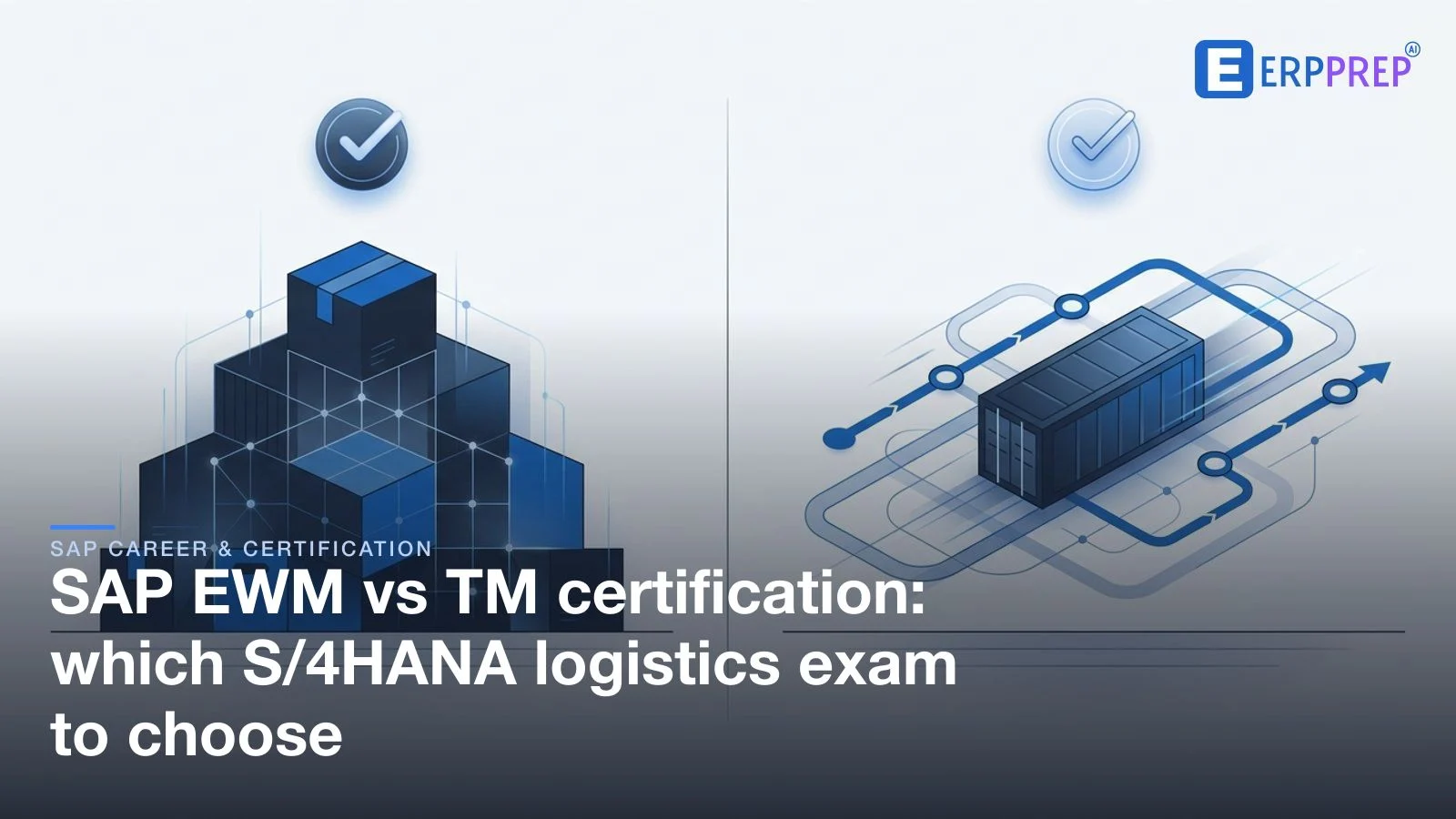
Choose C_S4EWM (Extended Warehouse Management) if your work is inside the warehouse — structures, inbound and outbound processing, waves and resources — tested as a System-Based Assessment with a 65% cut score. Choose C_S4TM (Transportation Management) if you plan freight, execute shipments, and settle charges across a transport network — tested as a Scenario-Based Assessment with a 60% cut score. Both are associate-level.
Two of the most in-demand SAP® S/4HANA logistics certifications sit right next to each other in the supply chain — and it is easy to confuse them. C_S4EWM (Extended Warehouse Management) is about the work that happens inside the warehouse. C_S4TM (Transportation Management) is about moving goods between locations. They meet at the dock door and rarely overlap beyond it. This guide compares what each covers, who each suits, how the two exam formats differ, and how to choose. For the wider question of whether certifying pays off at all, see whether SAP certification is worth it and how to choose.
Key takeaways
- EWM is warehouse-inside; TM is between-location. EWM ends at the dock door where TM begins — they are consecutive stages of the same outbound flow.
- Different formats. C_S4EWM is a System-Based Assessment (SyBA); C_S4TM is a Scenario-Based Assessment (SBA).
- Different cut scores. EWM requires 65%; TM requires 60% (SAP, learning.sap.com). Both are associate-level.
- Pick by role, not by difficulty. Warehouse-heavy work points to EWM; distribution- and carrier-heavy work points to TM.
- They pair well. Holding both covers the goods flow end to end, from put-away and picking through freight planning and charge settlement.
EWM vs TM at a glance
Both certifications sit in SAP's S/4HANA logistics family and appear on their respective learning journeys (SAP, learning.sap.com). Here they are side by side:
| C_S4EWM — Extended Warehouse Management | C_S4TM — Transportation Management | |
|---|---|---|
| What it covers | Warehouse structures, inbound and outbound processing, wave and resource management | Freight planning, execution, and charge settlement across a transport network |
| Best for | Warehouse and fulfilment consultants, EWM implementation teams | Transportation and logistics-network consultants, freight and distribution teams |
| Format | System-Based Assessment (SyBA) | Scenario-Based Assessment (SBA) |
| Cut score | 65% | 60% |
| Difficulty character | Hands-on configuration fluency inside the warehouse | Reasoning through a connected transportation scenario |
The exam hubs — C_S4EWM and C_S4TM — carry the current blueprint detail, scenarios, and skill drills for each. This article compares them; those pages go deep on one exam each.
What EWM covers: work inside the warehouse
Extended Warehouse Management is about everything that happens within the four walls. The C_S4EWM blueprint centres on three pillars:
- Warehouse structures. How the physical and logical warehouse is modelled — storage types, sections, bins, activity areas, and the master data that makes the layout usable by the system.
- Inbound and outbound processing. The core goods flow: receiving and putting away arriving stock, then picking, packing, staging, and shipping goods on their way out. This is the spine of warehouse operations.
- Wave and resource management. Organising work into waves and directing resources — labour and equipment — so the warehouse keeps pace with demand without bottlenecks.
If a task involves a bin, a pick, a pack, or a put-away, it belongs to EWM. The credential proves you can configure and run the warehouse itself, and it stops precisely where the goods leave the building.
What TM covers: moving goods between locations
Transportation Management picks up where the warehouse ends. Once goods are ready to leave, someone has to decide how they travel and what that costs. The C_S4TM blueprint centres on the transport network:
- Freight planning. Turning transportation demand into an efficient plan — building freight units, consolidating loads, and choosing routes and carriers across the network.
- Execution. Carrying out the plan: tendering freight to carriers, tracking movements, and managing the shipment from origin to destination.
- Charge settlement. Calculating, agreeing, and settling transportation charges — the financial close-out of every movement across the network.
If a task involves a route, a carrier, a freight order, or a transportation charge, it belongs to TM. The credential proves you can plan, run, and settle movement between locations — never the internal warehouse work that feeds it.
How the roles differ in practice
The cleanest way to separate the two is by the boundary of the building. A shipment is prepared and dispatched inside an EWM-run warehouse; it is then planned and carried across a TM-run network. That hand-off — the dock door — is where the two roles touch and where their responsibilities cleanly divide.
In day-to-day terms, an EWM consultant thinks about layout, storage strategy, picking efficiency, and the flow of stock across bins and activity areas. A TM consultant thinks about lanes, carriers, consolidation, and the cost of every movement. Both are core supply chain roles, but one optimises what happens at rest in a facility and the other optimises what happens in transit between facilities. For a full side-by-side of the logistics family they both belong to, see the S/4HANA logistics & supply-chain comparison.
Prerequisites and who each suits
Neither certification requires the other, and both are associate-level — positioned to verify fundamental, implementation-level skills in one solution area rather than assuming senior architecture experience. There is no forced order: choose by the work you do.
- EWM suits warehouse and fulfilment consultants, WMS or distribution-centre specialists moving to S/4HANA, and anyone on an EWM implementation who owns receiving, storage, picking, or shipping.
- TM suits transportation and logistics-network consultants, distribution and freight professionals, and anyone who owns carrier relationships, routing, or transportation cost across a network.
For career switchers, the honest signal is which world you can already talk about credibly — bins and picks, or lanes and carriers. Lead with that. If you are still choosing your first SAP area entirely, start from which SAP certification to get first and then place EWM or TM within it.
Want to feel a performance-based logistics exam before you commit? A free sample shows the doing-over-recalling style of both formats. Try a free sample.
Format difference: SyBA vs SBA, and the cut scores
This is the difference that changes how you should prepare. C_S4EWM is a System-Based Assessment (SyBA): you complete configuration and processing tasks in a live system, and the cut score is 65%. C_S4TM is a Scenario-Based Assessment (SBA): you reason through a connected business scenario — planning, executing, and settling movement — and the cut score is 60% (SAP, learning.sap.com).
| Exam | Format | Cut score | What it rewards |
|---|---|---|---|
| C_S4EWM — EWM | System-Based (SyBA) | 65% | Configuration fluency in a live warehouse |
| C_S4TM — TM | Scenario-Based (SBA) | 60% | Reasoning across a connected transport scenario |
The higher cut score on EWM leaves slightly less margin for error, but the number is not the whole story. A SyBA rewards muscle memory in the system: if you configure warehouses hands-on, 65% is very reachable. An SBA rewards joined-up thinking: TM asks you to carry context from planning through settlement without losing the thread. Because the format shapes the study method, learning to prepare for the performance-based format matters as much as the domain content itself.
Which one should you choose?
Work backwards from your role, and the choice usually makes itself:
- Choose EWM (C_S4EWM) if your days involve the inside of a warehouse — receiving, put-away, picking, packing, shipping — or if you are implementing a warehouse on S/4HANA. You want the System-Based format and a 65% target.
- Choose TM (C_S4TM) if your days involve moving goods between locations — planning freight, tendering to carriers, tracking shipments, settling charges. You want the Scenario-Based format and a 60% target.
- Still unsure? Ask which vocabulary is already yours. If you naturally reach for bins, waves, and activity areas, that is EWM. If you reach for lanes, freight units, and carrier charges, that is TM.
Whichever you pick, go deep before you go wide: one logistics certification with real hands-on skill behind it is worth far more than two half-prepared attempts.
Do EWM and TM pair together?
Yes — and unusually well, because they cover consecutive stages of the same journey. Goods are prepared and dispatched inside an EWM warehouse, then planned and carried across a TM network. Holding both credentials describes the outbound flow end to end, from put-away to charge settlement, which is a genuinely broad and marketable logistics profile.
The usual sequence is to certify first in the area you work in every day, build credible hands-on experience, then add the adjacent certification to widen your reach. If you already run warehouses, TM is the natural second step; if you already run transportation, EWM completes the picture upstream. For how to sequence a second SAP credential deliberately, see building a second-certification stack.
Where to go next
EWM and TM are neighbours in the supply chain that certify different work in different formats: EWM proves you can run the warehouse (System-Based, 65%), TM proves you can move goods across the network (Scenario-Based, 60%). Pick by the work you do, prepare for the format you will face, and treat the second credential as an option once the first is genuinely earned. Start at the C_S4EWM or C_S4TM exam hub for the scenarios, skill drills, and exam facts, compare the whole family in the logistics & supply-chain guide, and try a free sample to feel the performance-based style before you book.
Frequently asked questions
- What is the difference between SAP EWM and SAP TM certification?
- C_S4EWM (Extended Warehouse Management) certifies work inside the warehouse — warehouse structures, inbound and outbound processing, and wave and resource management. C_S4TM (Transportation Management) certifies moving goods between locations — freight planning, execution, and charge settlement across a transport network. EWM stops at the dock door; TM starts there. Both are associate-level SAP S/4HANA certifications.
- Is SAP EWM or SAP TM harder?
- Neither is universally harder — they test different work in different formats. C_S4EWM is a System-Based Assessment (SyBA) with a 65% cut score, so it rewards hands-on configuration fluency inside the warehouse. C_S4TM is a Scenario-Based Assessment (SBA) with a 60% cut score, so it rewards reasoning through a connected transportation scenario. The exam that matches the work you actually do will always feel more manageable.
- What format is the SAP EWM certification exam?
- The C_S4EWM exam is a System-Based Assessment (SyBA): you complete configuration and processing tasks in a live system rather than answering pure multiple-choice questions. The cut score is 65%. Always confirm the current format and requirements on the exam page at learning.sap.com before you book.
- What format is the SAP TM certification exam?
- The C_S4TM exam is a Scenario-Based Assessment (SBA): you reason through a connected business scenario — planning freight, executing shipments, and settling charges — rather than answering isolated questions. The cut score is 60%. Confirm the current details on the exam page at learning.sap.com.
- Do I need SAP EWM before SAP TM, or vice versa?
- No — neither certification is a prerequisite for the other. They certify adjacent but distinct roles: EWM is warehouse-inside work and TM is between-location transport work. Choose the one that matches your role today. Many supply-chain professionals pair them over time because a shipment leaving an EWM-run warehouse is exactly what a TM-run network then moves.
- Which SAP certification is better for a supply chain career, EWM or TM?
- Both are strong S/4HANA logistics credentials; the better one is the one closest to your work. If you run or implement warehouses — receiving, put-away, picking, packing, shipping — EWM (C_S4EWM) is the fit. If you plan and settle freight across carriers and lanes, TM (C_S4TM) is the fit. Warehouse-heavy roles lean EWM; distribution- and carrier-heavy roles lean TM.
- Can I hold both SAP EWM and SAP TM certifications?
- Yes, and they complement each other well because they cover consecutive stages of the outbound flow — goods are prepared and shipped inside an EWM warehouse, then planned and carried across a TM transport network. A common path is to certify first in the area you work in daily, build genuine hands-on skill, then add the adjacent certification to broaden your logistics profile.
- Are SAP EWM and SAP TM associate or professional certifications?
- Both C_S4EWM and C_S4TM are associate-level certifications (C_ codes), which verify fundamental, implementation-level skills in one solution area. They sit within SAP's S/4HANA logistics family alongside exams for sourcing and procurement, sales, and production planning. Confirm current validity and requirements for each on learning.sap.com.
ERPPrep is an independent platform and is not affiliated with, endorsed by, or sponsored by SAP SE. SAP and other SAP products are trademarks of SAP SE, referenced here only to describe the certification exams ERPPrep helps you prepare for.
Ready to practise the way the exam tests?
ERPPrep provides original, performance-style scenarios and skill drills built for the 2026 SyBA and SBA formats. Try a free sample and judge the quality yourself.
Practice for these exams
Related guides
SAP BTP certifications explained: which one is right for you
A map of the SAP BTP certification family — administrator, architect, integration, ABAP and generative-AI developer, LeanIX EA — and how to choose.
SAP S/4HANA Sourcing & Procurement vs SAP Ariba certification
C_TS452 certifies procure-to-pay inside core S/4HANA, while C_ACDET certifies configuring the SAP Ariba strategic-sourcing cloud. Which fits an operational buyer versus a strategic-sourcing specialist — coverage, format, cut scores, and how to choose.
SAP MM vs SD certification: C_TS452 vs C_TS462 (which to choose)
SAP MM vs SD in 2026: C_TS452 Sourcing & Procurement (the modern MM, procure-to-pay) vs C_TS462 Sales (the modern SD, order-to-cash). Coverage, formats, cut scores, and how to choose.