

SAP HCM Payroll vs SuccessFactors certification: on-prem HR or cloud HR?
C_HCMP (SAP HCM Payroll for S/4HANA) certifies the on-premise/managed payroll engine; C_THR81 (SuccessFactors Employee Central) certifies the cloud HR data foundation. Which HR-tech certification fits your role, your employer, and a future-proof career.
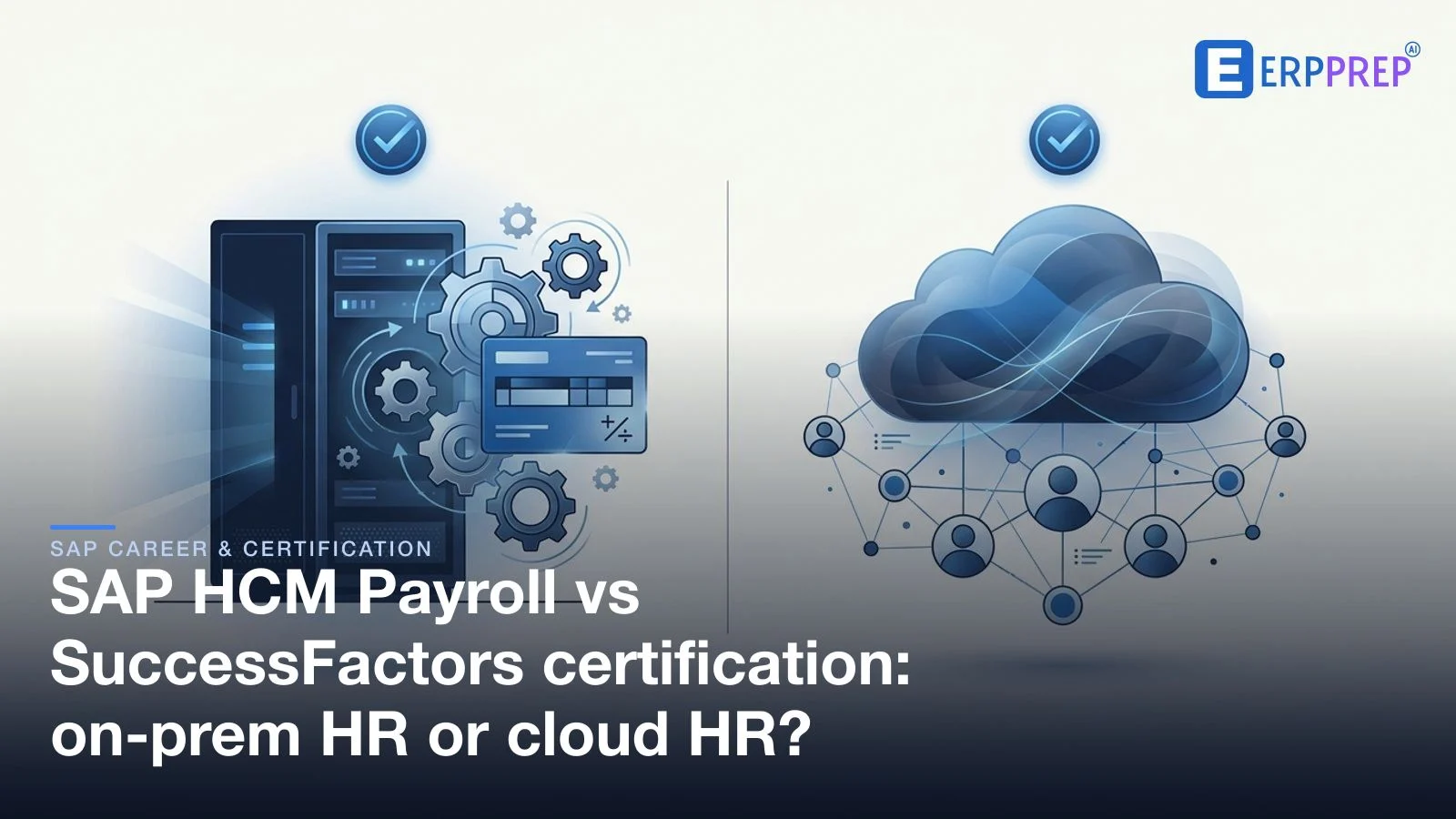
C_HCMP (SAP HCM Payroll for SAP S/4HANA) certifies the on-premise or managed payroll engine — wage types, calculation rules, and the payroll run. C_THR81 (SuccessFactors Employee Central Core & Position Management) certifies the cloud HR data foundation — foundation objects, workflows, and position management. Choose HCM Payroll if you run or support payroll on S/4HANA; choose Employee Central if you implement cloud HR.
Two SAP® certifications sit either side of the biggest divide in HR technology: C_HCMP certifies the on-premise (or managed) payroll engine on S/4HANA, while C_THR81 certifies the cloud HR data foundation in SuccessFactors Employee Central. They sound adjacent, but they point at different systems, different day jobs, and different employers. This guide compares them so you pick the one that fits your role — and for the wider "is an HR certification worth it" question, start with whether SAP certification is worth it and how to choose.
Key takeaways
- Different systems. C_HCMP lives inside an S/4HANA Enterprise Management system (on-premise / managed); C_THR81 lives in the SuccessFactors cloud.
- Different depth. HCM Payroll is deep engine mechanics — wage types, calculation rules, factoring, retroactive accounting. Employee Central is the cloud HR foundation — people, positions, and process configuration.
- Format differs. C_HCMP is a Scenario-Based Assessment (SBA) with a 60% cut score; C_THR81 is a System-Based Assessment (SyBA) at 59% — so the two reward genuinely different preparation.
- Both are associate (C_) certifications — entry-level, implementation-focused, for consultants working under guidance rather than senior architects.
- They complement, not compete. Hybrid HR landscapes feed cloud Employee Central data into a payroll engine, so the strongest careers understand both sides of the seam.
C_HCMP vs C_THR81 at a glance
Both certifications sit on official learning paths (SAP, learning.sap.com). Here they are side by side:
| C_HCMP — HCM Payroll | C_THR81 — SuccessFactors Employee Central | |
|---|---|---|
| What it covers | Payroll master data, wage types, personnel calculation rules, the payroll run, postings to Finance | Foundation objects, succession data model, workflows, permissions, position management |
| Deployment | On-premise / managed — runs inside S/4HANA Enterprise Management | Cloud — the SuccessFactors HR system of record |
| Best for | Payroll consultants and support running pay on S/4HANA | Cloud HR consultants implementing employee data and org structure |
| Format | Scenario-Based Assessment (SBA) | System-Based Assessment (SyBA) |
| Cut score | 60% | 59% |
| Level | Associate (C_) | Associate (C_) |
The on-premise HCM Payroll world (C_HCMP)
SAP HCM Payroll for S/4HANA is the deep, mechanical end of HR. The C_HCMP certification verifies that you have the core knowledge to work as a payroll consultant on an S/4HANA Enterprise Management system, working on real projects with support from a senior colleague. It is positioned as an entry-level qualification into the HCM Payroll consultant profile — and, per learning.sap.com, it is assessed as a Scenario-Based Assessment with a 60% cut score.
What you actually learn is the payroll engine itself. The associated learning path moves from HR master data and personnel administration into the payroll process: running payroll against a control record, simulating a run, and handling the messy realities — retroactive accounting when past periods change, payroll for employees who have already left, and troubleshooting errors in both the run and the underlying configuration. Then it goes deeper into configuration: personnel calculation rules, valuing and deriving wage types, valuing absences, selecting time-based wage types, factoring for partial periods, cumulations, and average processing. It closes the loop by posting results to Financial Accounting and generating bank transfers.
In short, C_HCMP is for the person who owns how pay is calculated, corrected, and posted. It rewards system fluency — knowing why a wage type behaves the way it does and how a rule change ripples through a run — far more than memorised definitions. If you support payroll operations or configure a payroll engine, this is your certification. It sits in the broader HR family mapped in the best SAP certification for an HR career.
The cloud SuccessFactors world (C_THR81)
SuccessFactors Employee Central is the opposite pole: a cloud HR system of record. The C_THR81 certification — Employee Central Core and Position Management — verifies fundamental skill in configuring that foundation, and it is aimed squarely at consultants implementing the solution for organisations. Like C_HCMP it is an associate credential pitched at consultants who still lean on more experienced colleagues, but the work is configuration in the cloud rather than engine mechanics on S/4HANA.
The learning path is built around the cloud toolset. It starts with the SuccessFactors platform itself — provisioning, the Admin Center, role-based permissions, and the Metadata Framework (MDF) with business rules — then moves into Employee Central Core: importing data models and picklists, configuring foundation objects and their associations, modelling person and employment data through the succession data model, and configuring transactions such as self-service, workflows, alerts, and event reasons. Position Management adds a second layer: the position object and its settings, maintaining and mass-editing positions, managing the employee lifecycle against positions, and using business rules to automate position data — plus integration points to Recruiting and Succession.
So C_THR81 certifies the person who stands up and configures the cloud HR foundation everything else plugs into. Because Employee Central is where the core employee and org data lives, it is often the first SuccessFactors certification a cloud HR consultant targets; the wider module map is in the full SuccessFactors certification map.
Why organisations are shifting to cloud HR
The demand behind Employee Central is part of a broad, industry-wide move of HR systems of record to the cloud. The pull is familiar from every enterprise software category: faster release cadence and new features without upgrade projects, a configuration-first model instead of deep custom code, self-service for managers and employees, and a single cloud record that reporting and downstream HR processes can trust. For a global employer, one cloud foundation that holds people, positions, and org structure — and pushes changes out continuously — is operationally attractive.
But "shifting to the cloud" rarely means ripping out payroll on day one. Payroll is heavily regulated, deeply country-specific, and unforgiving when it is wrong, so many organisations keep a proven payroll engine — on-premise or managed — and integrate it with the cloud system of record. That is precisely why the S/4HANA HCM path itself introduces SuccessFactors and the integration between the two worlds. The realistic end state for a large enterprise is hybrid, not either/or, which shapes how you should read these two certifications.
Which certification for which employer
Work backwards from where the hiring demand sits, because the two certifications map to visibly different employers and programmes:
- C_HCMP fits payroll-owning organisations and support teams. Enterprises running or managing payroll on S/4HANA, payroll bureaus, and the support functions that keep pay runs correct and compliant. The value is deep, durable engine skill in a function that cannot fail.
- C_THR81 fits cloud HR transformation programmes and partners. Consultancies and SAP partners implementing SuccessFactors, and organisations standing up or extending Employee Central as their HR foundation. The value is configuration skill on the platform the rest of cloud HR builds on.
- Hybrid landscapes value both. An employer running Employee Central as the cloud record and a payroll engine behind it needs people who understand the seam. Either certification gets you in the door; understanding both makes you the person who owns the integration.
If you are weighing the whole HR track rather than just these two exams, the HR career comparison places them against the rest of the SuccessFactors modules.
The format difference: two SBAs, two different states
Both certifications reflect SAP's 2026 move toward performance-based, scenario-driven assessment rather than pure multiple-choice — but they were in different states at the time of writing, and that matters for planning.
C_HCMP is settled: a Scenario-Based Assessment (SBA) with a published 60% cut score, per learning.sap.com. In an SBA you reason through a connected business situation, so preparation is about applying payroll knowledge to a scenario — tracing how a configuration or master data decision plays out through a run — not reciting facts.
C_THR81 landed somewhere different. The format change its card was flagged for is complete, and the exam is now a System-Based Assessment (SyBA) with a 59% cut score. So these two HR credentials sit on opposite sides of SAP's performance-based split: C_HCMP asks you to reason through a payroll narrative, while C_THR81 asks you to carry out Employee Central configuration in a system and show it worked. Plan your practice for the format you are actually sitting — and check the exam page before you commit a study plan, since SAP revises these as products evolve. The underlying discipline of preparing for a performance-based exam transfers either way, which is the subject of the performance-based exam preparation guide.
Never sat a scenario-style SAP exam? A free sample shows the reason-through-a-scenario style — the format both of these HR certifications lean on — before you pick one. Try a free sample.
How to future-proof an HR-tech career
The instinct to pick "the cloud one because cloud is the future" is understandable but too blunt. A more durable strategy treats these certifications as two ends of a spectrum you can traverse:
- Start where you already have gravity. If you run payroll today, C_HCMP converts real experience into a credential fastest and keeps you valuable in a function that will not disappear. If you are implementing cloud HR, C_THR81 is the foundation everything else in SuccessFactors sits on.
- Learn the seam next. The scarce, well-paid profile is not "payroll only" or "cloud only" — it is the person who understands how cloud HR data flows into a payroll engine and back. Adding the opposite certification later builds exactly that.
- Lead with the format skill. Because both exams are scenario-driven, the ability to reason through a connected business situation transfers between them and across the wider SAP catalogue — invest in it once.
In other words, the future-proof move is not choosing on-premise or cloud forever; it is choosing your first credential by your current role, then deliberately building toward the hybrid picture employers actually run.
Bottom line: pick by your role, then bridge
C_HCMP and C_THR81 are not really rivals — they are the on-premise/managed and cloud halves of SAP HR. Pick HCM Payroll if you own how pay is calculated and posted on S/4HANA; pick Employee Central if you configure the cloud HR foundation. Then, because real HR landscapes are hybrid, plan to learn enough of the other side to own the integration. Whichever you choose, the preparation approach is the same: practise reasoning through scenarios rather than memorising, because that is what the performance-based format tests. Line them up against the rest of the family in the SuccessFactors certification map and the best SAP certification for an HR career, and when you are ready to feel the format, try a free sample.
Frequently asked questions
- What is the difference between C_HCMP and C_THR81?
- C_HCMP certifies SAP HCM Payroll for SAP S/4HANA — the on-premise or managed payroll engine, covering master data, wage types, personnel calculation rules, the payroll run, and postings to Financial Accounting. C_THR81 certifies SuccessFactors Employee Central Core and Position Management — the cloud HR data foundation, covering foundation objects, the succession data model, workflows, permissions, and positions. One is deep payroll mechanics on S/4HANA; the other is cloud HR configuration.
- Is SAP HCM Payroll on-premise or cloud?
- SAP HCM Payroll for S/4HANA (the C_HCMP certification) is the on-premise / managed side of SAP HR — it runs inside an S/4HANA Enterprise Management system rather than in a public cloud suite. SuccessFactors Employee Central (C_THR81) is the cloud HR foundation. Many organisations run a hybrid: Employee Central as the cloud system of record for HR data, integrated back to an on-premise or managed payroll engine.
- Which SAP HR certification should I get first?
- Match the certification to the work in front of you. If you run, support, or configure payroll on an S/4HANA system, C_HCMP is the direct fit. If you implement cloud HR — hiring, employee data, org structure, and workflows in the cloud — C_THR81 (Employee Central) is the foundation the rest of the SuccessFactors suite builds on. Employers hiring for cloud HR transformation programmes tend to ask for Employee Central skills first.
- What format are the C_HCMP and C_THR81 exams?
- They use different formats. C_HCMP is a Scenario-Based Assessment (SBA) — a connected business scenario you reason through — with a 60% cut score at the associate level, per learning.sap.com. C_THR81 has completed its format change and is a System-Based Assessment (SyBA), where you carry out configuration tasks in a live system, with a 59% cut score. Confirm both on the exam pages before you book, as SAP revises these on a schedule.
- Do I need to know SuccessFactors to work in SAP HCM Payroll?
- Not to run payroll itself, but the two increasingly meet. The S/4HANA HCM learning path itself introduces SuccessFactors and the integration between the two, because many organisations feed cloud HR data from Employee Central into a managed payroll engine. Understanding where the system of record ends and the payroll engine begins makes you far more useful on a hybrid HR landscape than knowing either half alone.
- Is cloud HR replacing on-premise SAP payroll?
- Organisations are broadly shifting HR systems of record to the cloud, which is why Employee Central skills are in demand. But payroll is heavily regulated, country-specific, and risk-sensitive, so many enterprises keep a proven payroll engine — on-premise or managed — and integrate it with cloud HR rather than replacing it wholesale. That is exactly why deep payroll skill (C_HCMP) retains value alongside cloud HR skill (C_THR81).
- Are C_HCMP and C_THR81 associate-level certifications?
- Yes. Both carry the C_ prefix, marking them as associate certifications that verify fundamental, implementation-level skill for their solution area, positioned as entry-level qualifications for consultants working under the guidance of an experienced colleague. Neither is a senior architect (P_) credential — they establish core competence in payroll and in cloud HR configuration respectively.
- Can I use one certification to move toward the other?
- Yes, and it is a common path. HCM Payroll teaches you HR master data, org structure, and the mechanics of how pay is calculated and posted; Employee Central teaches you how a cloud system of record models the same people, positions, and events. Because the underlying HR domain is shared, either certification is a credible stepping-stone toward a hybrid HR-tech profile — the kind employers running cloud transformations value most.
ERPPrep is an independent platform and is not affiliated with, endorsed by, or sponsored by SAP SE. SAP and other SAP products are trademarks of SAP SE, referenced here only to describe the certification exams ERPPrep helps you prepare for.
Ready to practise the way the exam tests?
ERPPrep provides original, performance-style scenarios and skill drills built for the 2026 SyBA and SBA formats. Try a free sample and judge the quality yourself.
Practice for these exams
Related guides
SAP S/4HANA vs SuccessFactors: which certification career should you choose?
Core ERP / S/4HANA or cloud HR / SuccessFactors? Two very different SAP career worlds compared — the roles, the job markets, and how to choose — using C_TS4FI (Financial Accounting) and C_THR81 (Employee Central) as examples.
SAP SuccessFactors Succession vs Career Development certification: C_THR85 vs C_THR95
Two adjacent talent-growth modules in the same SuccessFactors product family. C_THR85 (Succession Management) vs C_THR95 (Career Development Planning and Mentoring) — what each covers, the format, the cut score, and which to sit first.
SAP SuccessFactors Compensation vs Variable Pay certification: C_THR86 vs C_THR87
Two SAP SuccessFactors reward-management associate certifications. C_THR86 (Compensation — base pay, merit and salary planning) vs C_THR87 (Variable Pay — bonus and incentive programs): what each covers, the shared format and cut score, and which to sit first.