

SAP SuccessFactors Succession vs Career Development certification: C_THR85 vs C_THR95
Two adjacent talent-growth modules in the same SuccessFactors product family. C_THR85 (Succession Management) vs C_THR95 (Career Development Planning and Mentoring) — what each covers, the format, the cut score, and which to sit first.
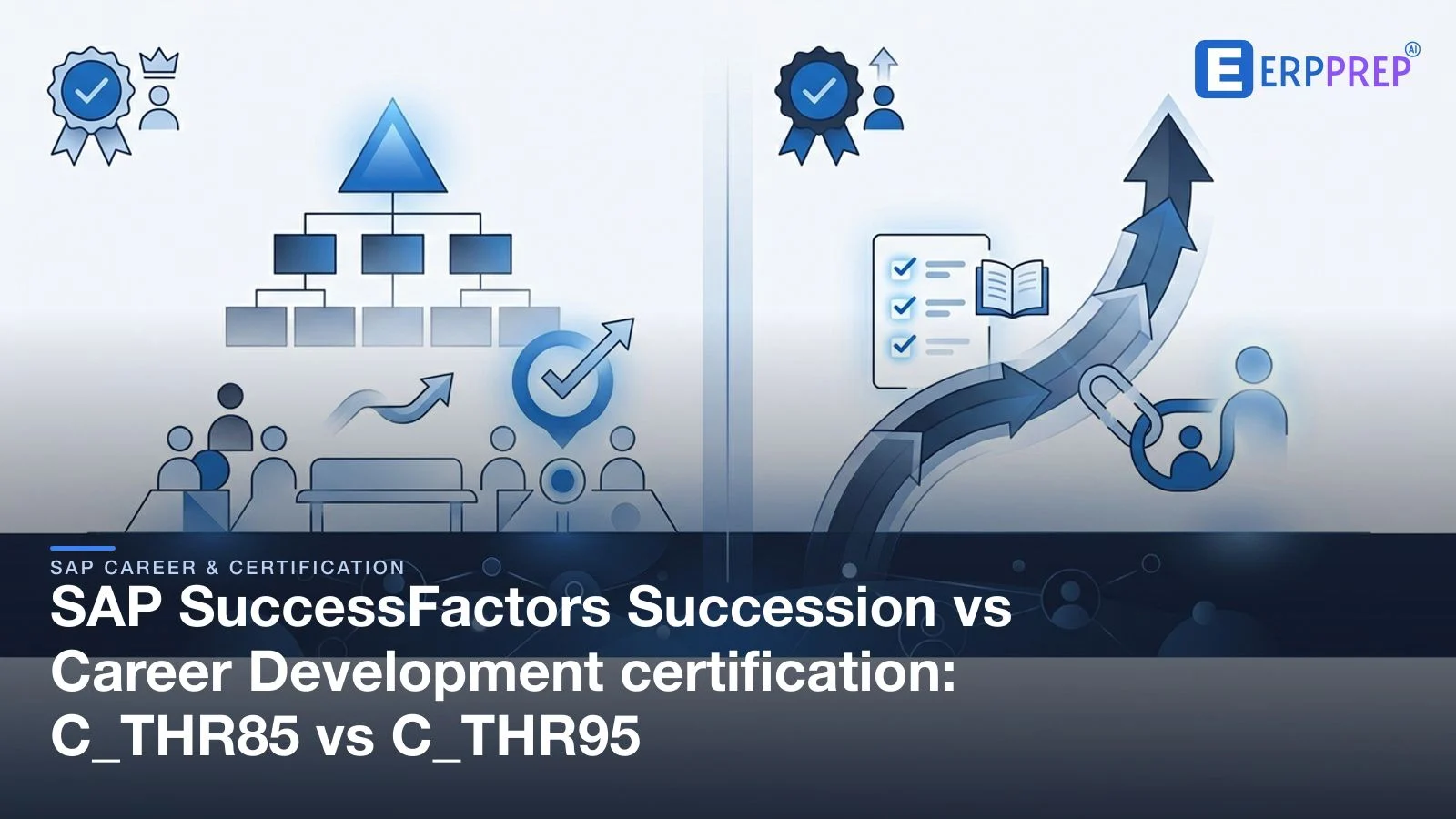
C_THR85 certifies SAP SuccessFactors Succession Management — succession planning, talent pools, nominations, the succession org chart, and matrix grid reports. C_THR95 certifies Career Development Planning and Mentoring — development goal plans, career worksheets, the opportunity marketplace, and mentoring programs. Both are associate consultant credentials in the same Succession & Development product. Choose by whether you build the talent pipeline or the individual growth path.
Two SAP® SuccessFactors certifications sit right next to each other in the same product family, and it is easy to assume they are the same exam wearing different names. They are not. C_THR85 covers Succession Management — the discipline of planning who could step into critical roles — while C_THR95 covers Career Development Planning and Mentoring — helping individuals grow toward those roles. Both are recently available, both are associate consultant credentials, and both live inside the SAP SuccessFactors Succession & Development product. This guide compares what each certifies, how they differ, and how to choose. For the wider question of which HR credential fits your path, see whether SAP certification is worth it and how to choose.
Key takeaways
- C_THR85 is the organisation-facing track — it certifies planning pipelines, pools, and readiness for the roles a business cannot afford to leave empty.
- C_THR95 is the individual-facing track — it certifies the tools that help a single employee plan and pursue their own growth.
- Both are associate-level consultant credentials in the same Succession & Development product, so the split is about subject matter, not seniority.
- The two use different formats. C_THR85 is a System-Based Assessment (SyBA) at 58%; C_THR95 is a Scenario-Based Assessment (SBA) at 60% — so they reward different preparation.
- They pair naturally: succession identifies who could move up, career development builds the path that gets them ready.
C_THR85 vs C_THR95 at a glance
Both certifications sit on official SuccessFactors learning journeys (SAP, learning.sap.com) and share a product home — but they answer different business questions. Here they are side by side:
| C_THR85 — Succession Management | C_THR95 — Career Development | |
|---|---|---|
| Core question | Who could step into our critical roles? | How does each person grow toward their next role? |
| What it covers | Succession planning, nomination methods, talent pools, talent search, the succession org chart, matrix grid reports, talent cards | Development goal plans, career worksheets, the opportunity marketplace, learning activities, mentoring programs |
| Best for | Talent / succession implementation consultants | Career-development and mentoring implementation consultants |
| Format | System-Based Assessment (SyBA), single activity | Scenario-Based Assessment (SBA), single activity |
| Cut score | 58% | 60% |
What C_THR85 (Succession Management) covers
Succession Management is about protecting the organisation against the roles it cannot leave vacant. Rather than developing one person, you build the machinery that tells leadership who is ready, who is nearly ready, and where the bench is thin. The earned skills reflect that organisation-wide lens — building talent pipelines, planning succession, managing talent, shaping the job architecture, and the underlying HR information system (HRIS) that holds the data.
In practice the module spans the succession toolset from configuration through to the reports leadership actually reads:
- Nomination methods and the position model — deciding how successors are named, whether nominations attach to positions or roles, and maintaining the position data behind them.
- Talent search and talent pools — finding candidates across the workforce, ranking them on background and competency criteria, and grouping them into pools for pool-based nominations.
- The succession org chart — navigating and configuring the chart, setting position criticality and bench strength, and tracking nomination history.
- Position tile view and lineage chart — visualising successors and the chain of moves that a single promotion sets off.
- Matrix grid reports — the classic performance-versus- potential grid, including rating scales, retirement-eligibility signals, and the permissions that decide who can see it.
- Talent cards, presentations, and calibration — packaging talent data for review meetings and aligning succession with calibration sessions.
Two threads run through the whole module and the exam leans on both. The first is permissions and who sees what: succession data is sensitive, so a large part of the work is deciding which managers can nominate, view a pool, or read a matrix grid — get that wrong and you expose confidential talent judgements. The second is reasoning across the pipeline: a nomination feeds the org chart, the org chart feeds bench-strength analysis, and calibration adjusts the ratings that drive the matrix grid. A strong candidate can trace that chain rather than treating each tool in isolation — which is exactly what a performance-based question is built to test.
What C_THR95 (Career Development Planning and Mentoring) covers
Career Development turns the lens around and points it at the individual. Where succession asks who could fill a role, career development asks how a specific employee builds the skills, plan, and support to get there. The earned skills mirror that — learning and growth, developing careers, managing talent, growing people, and again the underlying HRIS.
The module is broad, moving from the skills framework through personal plans and out to mentoring:
- Job architecture and the skills framework — defining skills, competencies, and behaviours and mapping them to job roles, so growth can be measured against something concrete.
- Development goal plans — setting up plan templates, managing development goals, attaching activities and learning opportunities, and surfacing them on the employee profile.
- Career worksheets — enabling the worksheet, adding templates, configuring role-readiness forms, and exposing recommended roles and career paths so an employee can see where they might go next.
- Opportunity marketplace — surfacing internal assignments and roles, with recommendation logic and the permissions that control who sees them.
- Learning activities — connecting development plans to SAP SuccessFactors Learning, and supporting customers who run a non-SAP learning system.
- Mentoring programs — enabling mentoring, creating and administering programs, and managing custom program types.
What makes this module demanding is that the pieces support a personal journey, and the exam rewards candidates who understand how they connect. A skill defined in job architecture becomes a development goal; a development goal draws on a learning activity; a career worksheet reads role readiness against those same skills; and a mentoring program wraps human support around the whole plan. Change how a skill is modelled and the ripple runs through worksheets, recommendations, and goals alike. If Succession rewards knowing the pipeline, Career Development rewards knowing how one person's growth is assembled from configurable parts.
The two sides of the same product family
The cleanest way to choose is to notice that these modules are two halves of one story, told from opposite ends. Both belong to SAP SuccessFactors Succession & Development, and they are designed to complement each other.
A Succession Management consultant works with leadership and HR business partners on the organisation's risk: which roles are critical, who could fill them, and how deep the bench is. The work is pipeline-and-visibility shaped — pools, org charts, matrix grids, and the governance around sensitive talent data. It suits someone who enjoys the strategic, org-wide view of talent.
A Career Development consultant works closer to the employee and their manager on personal growth: goals, worksheets, recommended roles, and mentoring. The work is plan-and-support shaped — how an individual sets a target, finds the learning to reach it, and gets a mentor alongside. It suits someone who enjoys the enablement and people-development side of HR.
There is a career-shape difference too. Succession skills make you the person leadership relies on for talent-risk conversations, which sits close to strategic HR and workforce planning. Career-development skills make you the person who operationalises growth across a workforce, which sits close to learning and enablement. Neither is "better" — they are different bets on which HR conversation you want to own. For how both fit against the rest of the suite, the SuccessFactors talent modules compared guide places them alongside their neighbours.
Format and cut score: two exams, two different formats
This is where the two exams genuinely diverge, and it is the single most important difference for how you prepare. C_THR95 is a Scenario-Based Assessment (SBA) built around a single activity, with a 60% cut score. The SBA style asks you to reason through a connected business situation and pick the best configuration or recommendation instead of recalling isolated facts.
C_THR85 went the other way. The format change its certification page was flagged for is now complete, and the exam is published as a System-Based Assessment (SyBA) with a 58% cut score. That means succession work is assessed by doing — carrying out the configuration in a system and showing the evidence it worked — rather than by advising across a narrative. Two exams in the same product family, two different formats: rehearse each in the style it actually uses, and confirm both on learning.sap.com before you book, since SAP revises these on a schedule. The guide to the performance-based exam format covers how SyBA and SBA differ and how to work each under time pressure.
Not sure how a Scenario-Based Assessment feels? A free sample shows the reason-through-a-scenario style before you commit to a module. Try a free sample.
Prerequisites and the platform foundation
Neither exam is gated behind a formal prerequisite certification — both are positioned as entry points for a consultant getting acquainted with the module. What matters more is the platform grounding underneath them: both learning journeys open on the same SuccessFactors platform foundations — administration, role-based permissions, the data model, and business rules — before branching into their own subject. If you are new to SuccessFactors entirely, expect to build that platform base first, and treat any assumed dependency such as Employee Central as something to verify on the exam page rather than a stated requirement.
There is also a partner consideration worth understanding before you invest. For at least one of these modules, SAP notes that registered partner consultants are granted the back-end provisioning access needed to implement the solution once they certify, whereas customers and independent consultants are not. The certification proves the skill for everyone, but the elevated access that lets you configure a customer instance can be tied to partner status. If you are studying as an independent, factor that into your expectations and confirm the exact terms on each exam's page at learning.sap.com.
One practical note on effort: the two learning journeys are not the same size. Career Development carries a longer chain of distinct topics — job architecture, goal plans, worksheets, the opportunity marketplace, learning integration, and mentoring — while Succession concentrates on a tighter set of succession-specific tools used with real depth. That does not make either objectively harder, but it does shape how you budget your study, so match the plan to the module you choose.
Which one should you choose?
Work backwards from the role you hold or want, not from whichever exam looks easier. Three rules of thumb:
- Choose C_THR85 if your world is the pipeline. You configure succession plans, talent pools, and org charts, or you sit close to leadership talent-risk conversations. Succession is the organisation-facing specialism.
- Choose C_THR95 if your world is individual growth. You set up development goals, career worksheets, and mentoring, or you sit close to learning and enablement. Career Development is the person-facing specialism — and its Scenario-Based format suits you if you prepare better by reasoning through a business case than by rehearsing configuration in a system.
- Consider both — in sequence — for a broad talent role. The two modules tell one story: succession finds the people, career development readies them. Lead with the module you already touch daily, then add the second once you have real project exposure.
Still weighing these against the rest of the HR field? The SuccessFactors certification map lays out every module and how they connect, and each exam hub below carries the scenarios, skill drills, and exam facts for that specific certification.
Prepare for whichever you pick
Once you have chosen, the approach is similar because the family style is shared. Practise doing the work in a realistic setting rather than only reading — configure the nominations, pools, org chart, and matrix grids for C_THR85, or the development goals, career worksheets, and mentoring programs for C_THR95. Trace whole scenarios end to end, and rehearse under time pressure so your accuracy holds when it counts. Start from the exam hub for your module, try a free sample to feel the Scenario-Based style, and build from there.
Frequently asked questions
- What is the difference between C_THR85 and C_THR95?
- C_THR85 certifies SAP SuccessFactors Succession Management — planning who could step into critical roles, using talent pools, nominations, the succession org chart, position criticality, and matrix grid reports. C_THR95 certifies Career Development Planning and Mentoring — helping individuals grow through development goal plans, career worksheets, the opportunity marketplace, and mentoring programs. Both live in the same Succession & Development product but answer different questions: pipeline versus personal growth.
- What exam format does C_THR85 use?
- C_THR85 is a System-Based Assessment (SyBA) — the format change its page was flagged for is complete. You carry out succession-management tasks in a live system rather than reasoning through a connected business narrative, and its published cut score is 58%. That makes it differ from C_THR95, which is Scenario-Based, so do not assume the two prepare the same way. Confirm the current format on learning.sap.com before you book.
- What exam format does C_THR95 use?
- C_THR95 is a Scenario-Based Assessment (SBA) built around a single activity, according to its certification page. You reason through a connected business situation and choose the best configuration or recommendation rather than answering isolated recall questions. Always re-check the current format on learning.sap.com, as SAP refreshes these exams on a schedule.
- What is the cut score for C_THR85 and C_THR95?
- C_THR95 publishes a 60% cut score and C_THR85 publishes 58%. The two sit close together, but they are reached in different formats — C_THR85 is System-Based and C_THR95 is Scenario-Based — so the number matters less than matching your practice to the format. Verify the exact threshold for each exam on learning.sap.com before you register.
- Which SuccessFactors talent certification should I take first?
- Lead with the module you already touch on projects. If you configure succession plans, talent pools, and org charts, start with C_THR85. If you set up development goals, career worksheets, and mentoring, start with C_THR95. If you are new to both, let format decide: C_THR85 is System-Based and rewards hands-on system time, while C_THR95 is Scenario-Based and rewards reasoning through a business case — so pick the one matching the practice you can realistically get.
- Do I need both C_THR85 and C_THR95?
- No single project forces both, but they pair naturally. Succession Management identifies who could move up; Career Development Planning builds the growth path that gets them ready. A consultant who owns the whole talent-growth story for a customer benefits from holding both, usually earned in sequence rather than at once.
- Is talent management the same as career development in SuccessFactors?
- They overlap but are not the same. Talent management is the umbrella — both exams list it as an earned skill. Succession Management (C_THR85) is the organisation-facing side: pipelines, pools, and readiness for critical roles. Career Development (C_THR95) is the individual-facing side: personal development plans, worksheets, and mentoring. One looks at the org chart, the other at the person.
- Do I need Employee Central before these certifications?
- Neither exam lists a formal certification prerequisite, but both learning journeys start from the same SuccessFactors platform foundations — administration, role-based permissions, the data model, and business rules — before branching into their own subject. Employee Central is not stated as a hard requirement on the pages, so confirm any assumed dependency on learning.sap.com rather than treating it as mandatory.
- Are C_THR85 and C_THR95 associate-level certifications?
- Yes. Both are associate consultant credentials, positioned so a certified consultant can apply the skills on projects under the guidance of a more experienced colleague. Both sit in the SAP SuccessFactors Succession & Development product and target the consultant role rather than an administrator or professional tier.
ERPPrep is an independent platform and is not affiliated with, endorsed by, or sponsored by SAP SE. SAP and other SAP products are trademarks of SAP SE, referenced here only to describe the certification exams ERPPrep helps you prepare for.
Ready to practise the way the exam tests?
ERPPrep provides original, performance-style scenarios and skill drills built for the 2026 SyBA and SBA formats. Try a free sample and judge the quality yourself.
Practice for these exams
Related guides
SAP SuccessFactors Compensation vs Variable Pay certification: C_THR86 vs C_THR87
Two SAP SuccessFactors reward-management associate certifications. C_THR86 (Compensation — base pay, merit and salary planning) vs C_THR87 (Variable Pay — bonus and incentive programs): what each covers, the shared format and cut score, and which to sit first.
SuccessFactors Reporting vs Time Management certification: C_THR92 vs C_THR94
Two SAP SuccessFactors associate certifications, two very different HR roles. C_THR92 (Platform: Reporting / people analytics) vs C_THR94 (Time Management) — what each covers, the format, the cut score, and which to choose.
SAP SuccessFactors talent modules compared: Performance & Goals vs Variable Pay vs Learning
The SuccessFactors talent cluster certifies by module. Performance & Goals (C_THR82), Variable Pay (C_THR87), and Learning (C_THR88) each cover a different slice of talent management. Here's how to pick the talent-management certification for your HR role.