

SuccessFactors Reporting vs Time Management certification: C_THR92 vs C_THR94
Two SAP SuccessFactors associate certifications, two very different HR roles. C_THR92 (Platform: Reporting / people analytics) vs C_THR94 (Time Management) — what each covers, the format, the cut score, and which to choose.
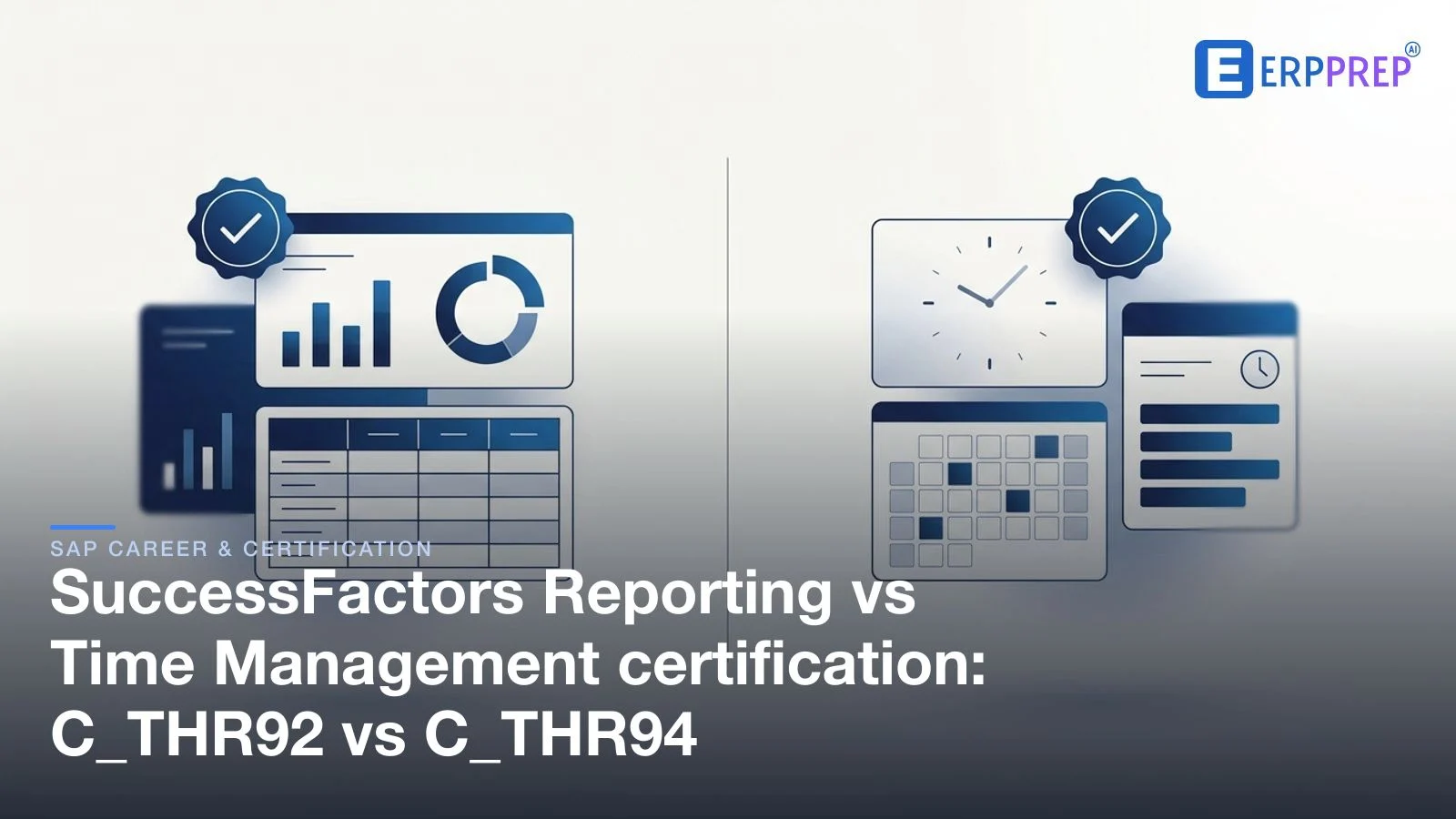
C_THR92 (SAP SuccessFactors Platform: Reporting) certifies people-analytics and reporting configuration — Report Center, Story, Table and Canvas reports, and dashboards. C_THR94 (SAP SuccessFactors Time Management) certifies time-off, absences, time sheets, accruals and time valuation. Both are associate, Scenario-Based Assessments with a 60% cut score. Choose by the HR work you own: analytics and reporting, or time and attendance.
SAP® SuccessFactors is certified module by module, and two of its associate exams look adjacent on the catalogue but point at genuinely different HR jobs. C_THR92 covers SuccessFactors Platform: Reporting — the people-analytics and reporting side of the platform — while C_THR94 covers SuccessFactors Time Management — time off, time sheets, and time valuation. This guide compares what each certifies, the shared format, and how to choose. For the wider question of which HR certification fits your career, see whether SAP certification is worth it and how to choose.
Key takeaways
- C_THR92 is the analytics track — it certifies building reports and dashboards from HR data, not configuring an HR process.
- C_THR94 is the time-and-attendance track — it certifies configuring absences, accruals, time sheets, and time valuation.
- Both are associate-level and use the same Scenario-Based Assessment (SBA) format with a 60% cut score, so the pass mark is not the differentiator — the subject matter is.
- They map to different HR sub-roles: an HRIS / reporting analyst versus a time-and-attendance implementation consultant.
- A partner-provisioning policy applies to SuccessFactors modules — provisioning rights generally follow registered SAP partner consultants, not customers or independents.
C_THR92 vs C_THR94 at a glance
Both certifications sit on official SuccessFactors learning journeys (SAP, learning.sap.com) and share a format — but almost nothing else. Here they are side by side:
| C_THR92 — Platform: Reporting | C_THR94 — Time Management | |
|---|---|---|
| What it covers | People analytics and reporting — Report Center, Story, Table and Canvas reports, and tile-based dashboards | Time off and absences, time accounts and accruals, time sheets, time valuation, and time tracking |
| Best for | HRIS / people-analytics and reporting consultants | Time-and-attendance implementation consultants |
| Format | Scenario-Based Assessment (SBA) | Scenario-Based Assessment (SBA) |
| Cut score | 60% | 60% |
| Partner provisioning | Applies (registered SAP partner consultants) | Applies (registered SAP partner consultants) |
What C_THR92 (Platform: Reporting) covers
The Reporting certification is about turning HR data into answers. Rather than configuring a business process, you learn to build the reports, queries, and dashboards that let managers and HR business partners see what is happening across the workforce. Its earned skills sit squarely in the analytics space — people analytics, management reporting, reporting tools, and the broader HR information system (HRIS) that holds the data.
In practice, the module spans the platform's reporting toolset from the ground up:
- Report Center — the hub for managing reports and the permissions that control who can see them.
- Story reports — building richer, visual reports on a defined data source, with calculated columns, filters, tables, and charts.
- Table reports — tabular output where you set the report scope, choose the data sets and columns, sort, filter, and manage the finished report.
- Canvas reports — detailed and advanced reporting queries, people scope, static and runtime filters, pivots, and report pages for more complex analytical needs.
- Tile-based dashboards — assembling standard and custom tiles into dashboards, with filters, date ranges, and access control for the people who consume them.
The through-line is that a Reporting consultant is a builder of insight: someone who understands the data model well enough to expose the right numbers, safely, to the right audience.
Two threads run through the whole module and are worth calling out, because the exam tests them repeatedly. The first is permissions and scope: a report is only as safe as the audience it reaches, so much of the work is deciding who can run a report, whose data appears in it, and how role-based access shapes both. Get the people scope wrong and a manager sees data they should not — a governance failure, not just a formatting one. The second is picking the right report type for the question. Story, Table, and Canvas reports overlap in what they can show but differ in how they are built and where they shine, and a strong candidate can explain why a particular ask belongs in one tool rather than another instead of forcing everything into a single format. That judgement — the right tool, the right scope, the right audience — is exactly what a Scenario-Based Assessment is designed to probe.
What C_THR94 (Time Management) covers
Time Management is an operational process module. Where Reporting reads the data, Time Management generates a large part of the HR data an organization runs on — how much leave people have, when they were absent, what they worked, and how those hours translate into pay-ready results. Its earned skills reflect that: time management, time-sheet preparation, data integration, HR service delivery, and again the underlying HRIS.
The module is broad, moving from absence management through to hours worked and payroll integration:
- Time off and absences — activating time off, configuring holiday calendars, work schedules, absence time types, time profiles, and the approval workflows behind them.
- Time accounts and accruals — setting up accounts and accrual rules, running account generation, and handling seniority-based, new-hire, and termination cases.
- Long-term absences — configuring leave of absence alongside the short-term absence setup.
- Time sheets — activating time-sheet functionality, choosing recording variants and methods, and configuring entry rules, workflows, and approvals.
- Time valuation — turning recorded time into results with collectors and containers, overtime handling, flextime, and cross-midnight processing.
- Time tracking and payroll integration — clock in / clock out setup, validating configurations, and integrating time data with SAP Payroll.
A Time Management consultant, then, owns a process that has to be right: errors here surface as wrong pay and unhappy employees, so the exam leans on getting the configuration and its downstream effects correct.
What makes this module demanding is that the pieces are chained. A work schedule feeds a time type; a time type feeds an accrual rule; an accrual rule fills a time account; the account is drawn down by an absence; recorded hours are then valued into results that a payroll run consumes. Change one link and the effect ripples downstream, so the exam rewards candidates who can reason about the whole chain rather than a single setting in isolation. Edge cases are where it bites: a new hire part-way through an accrual period, an employee who works across midnight, overtime that only counts past a threshold, or a public holiday that lands mid-week. Each of these is a small configuration decision with a real, testable consequence, which is precisely the shape of a good Scenario-Based question. If Reporting rewards knowing the data model, Time Management rewards knowing the rulebook and how its rules interact.
The very different HR sub-roles
The clearest way to choose is to look at who actually does each job. They rarely overlap on a project team.
A Reporting specialist tends to be the HRIS or people-analytics person — the one a CHRO or an HR business partner turns to for a headcount dashboard, an attrition trend, or a self-service report the line managers can run themselves. The work is data-and-visualization shaped: understand the question, model the data, expose it safely. If you enjoy building the thing everyone reads off, this is the role — and it pairs naturally with a broader analytics career.
A Time Management specialist is a process implementation consultant. The work is rules-and-edge-cases shaped: accrual policies, overtime rules, public-holiday calendars, and the integration that feeds payroll. It suits someone who likes precise, testable configuration where the correct answer is defensible and the cost of being wrong is concrete. It sits closer to the operational HR and payroll side of an implementation than to analytics.
There is a career-shape difference too. Reporting skills travel well beyond SuccessFactors — the instinct for modelling a question and building a clear, well-governed view of data is useful anywhere an organization runs on numbers, so a Reporting consultant can drift toward a broader people-analytics or business-intelligence role over time. Time Management skills are deeper but more specialised: they make you the person a project cannot deliver without when time and attendance are in scope, and that scarcity has its own value, but the expertise is more tightly bound to the module and its payroll neighbours. Neither is "better" — they are simply different bets on how you want your expertise to compound.
For a full picture of how these modules fit alongside the rest of the suite, the SuccessFactors certification map lays out every module and how they connect.
Prerequisites and partner provisioning
Neither exam is gated behind a formal prerequisite certification — both are positioned as entry points for a consultant getting acquainted with the module. What matters more is the platform grounding underneath them: both learning journeys start from the same SuccessFactors platform foundations (administration, role-based permissions, the data model, business rules) before branching into their own subject. If you are new to SuccessFactors entirely, expect to build that platform base first.
There is one policy worth understanding before you invest, and it applies across SuccessFactors modules, not just these two. A recruiting-style provisioning arrangement governs who gets the elevated back-end access needed to implement the solution: those rights generally follow consultants who work through a registered SAP partner and have certified, whereas customers and independent consultants typically are not granted them even when certified. In other words, the certification proves the skill for everyone, but the provisioning access that lets you configure a customer instance is tied to partner status. If you are studying as an independent, factor that into your expectations, and confirm the exact terms on each exam's page at learning.sap.com.
One more practical point on effort. The two learning journeys are not the same size — Time Management carries more distinct topics to configure and validate, from absences through valuation to payroll integration, while Reporting concentrates on a smaller set of tools used with real depth. That does not make one exam objectively harder, since the cut score is identical, but it does shape how you budget your study: Time Management asks you to hold a longer chain of settings in your head, whereas Reporting asks you to be genuinely fluent with fewer tools. Match the plan to the module you choose rather than assuming they take the same preparation.
Not sure how a Scenario-Based Assessment feels? A free sample shows the reason-through-a-scenario style before you commit to a module. Try a free sample.
Format and cut score: both SBA at 60%
This is where the two exams converge. Both C_THR92 and C_THR94 use the Scenario-Based Assessment (SBA) format — SAP's performance-based style for SuccessFactors, where you work through a connected business scenario and choose the best configuration or recommendation rather than recalling isolated facts. Both also publish the same 60% cut score at the time of writing.
Because the format and pass mark are identical, difficulty is a function of the module's breadth and your hands-on familiarity with it, not of the exam mechanics. Time Management arguably has more moving parts (absence, accruals, sheets, valuation, integration), while Reporting rewards genuine fluency with the reporting tools and the data model behind them. Either way, the winning preparation is the same: practise reasoning through realistic situations. If you want the technique for this exam family, the guide to the performance-based exam format covers how SBAs are built and how to work them under time pressure.
Which one should you choose?
Work backwards from the role you hold or want, not from the exam that looks easier — the cut score is the same, so that is not a real tie- breaker. Three rules of thumb:
- Choose C_THR92 if your world is data and reporting. You build dashboards, answer workforce questions, or own the HRIS reporting layer. Reporting is also the more transferable of the two if you see yourself moving toward analytics generally.
- Choose C_THR94 if your world is time and attendance. You implement absence and leave policies, configure time sheets, or sit close to payroll. Time Management is the deeper operational process specialism.
- Consider both — in sequence — for a broad role. On a full SuccessFactors implementation the two complement each other, because clean time data is exactly what good reporting surfaces. Lead with the module you already touch daily, then add the second once you have real project exposure.
Still weighing SuccessFactors against the rest of the HR field? The best SAP certification for an HR career hub places these two among the wider set of HR options, and each exam hub below carries the scenarios, skill drills, and exam facts for that specific certification.
Prepare for whichever you pick
Once you have chosen, the approach is the same because the format is shared. Practise doing the work in a realistic setting rather than only reading — build the reports and dashboards for C_THR92, or configure the time-off, time-sheet, and valuation rules for C_THR94. Trace whole scenarios end to end, and rehearse under time pressure so your accuracy holds when it counts. Start from the exam hub for your module, try a free sample to feel the Scenario-Based style, and build from there.
Frequently asked questions
- What is the difference between C_THR92 and C_THR94?
- C_THR92 certifies SAP SuccessFactors Platform: Reporting — the people-analytics and reporting side of the platform, including Report Center, Story, Table and Canvas reports, and tile-based dashboards. C_THR94 certifies SAP SuccessFactors Time Management — time off, absences, time sheets, accruals, time valuation, and time tracking. They live in the same HR suite but serve completely different roles.
- Are C_THR92 and C_THR94 associate-level certifications?
- Yes. Both are associate-level SAP SuccessFactors certifications, positioned as entry-level qualifications that let a consultant apply the skills on projects under the guidance of a more experienced colleague. Neither is a professional or specialist tier exam.
- What exam format do C_THR92 and C_THR94 use?
- Both are Scenario-Based Assessments (SBA), the performance-based format SAP uses across the SuccessFactors line. You reason through a connected business scenario rather than answering isolated multiple-choice trivia. Confirm the current activity count and any updates on each exam's page at learning.sap.com.
- What is the cut score for C_THR92 and C_THR94?
- Both exams publish a 60% cut score at the time of writing. That is the same threshold across the two, so difficulty comes from the breadth of the module rather than the pass mark. Always check the current cut score on each exam's page before you book.
- Which SuccessFactors certification is better for a career in HR analytics?
- C_THR92 (Platform: Reporting) is the analytics-facing choice. It maps to people-analytics, management-reporting, and reporting-tools skills, so it fits an HRIS or HR-reporting analyst who builds dashboards and self-service reports for the business.
- Do I need to be an SAP partner consultant to certify?
- You can take either exam and earn the credential, but a recruiting-style partner-provisioning policy applies to SuccessFactors modules: provisioning rights are generally granted only to consultants working under a registered SAP partner after they certify. Customers and independent consultants typically do not receive those rights even when certified. Check the exact terms on each exam's page.
- Can I hold both C_THR92 and C_THR94?
- Yes, and pairing them can be sensible for a broad SuccessFactors implementation consultant, because time-management data often feeds analytics and reporting. Most people lead with the one closest to their day-to-day work, then add the second once they have real project exposure to that module.
- How should I prepare for a SuccessFactors SBA exam?
- Because both are Scenario-Based Assessments, practise reasoning through connected configuration situations rather than memorizing definitions. Work hands-on in the relevant tools — reports and dashboards for C_THR92, time-off and time-sheet configuration for C_THR94 — and rehearse under time pressure so your accuracy holds.
ERPPrep is an independent platform and is not affiliated with, endorsed by, or sponsored by SAP SE. SAP and other SAP products are trademarks of SAP SE, referenced here only to describe the certification exams ERPPrep helps you prepare for.
Ready to practise the way the exam tests?
ERPPrep provides original, performance-style scenarios and skill drills built for the 2026 SyBA and SBA formats. Try a free sample and judge the quality yourself.
Practice for these exams
Related guides
SAP SuccessFactors Compensation vs Variable Pay certification: C_THR86 vs C_THR87
Two SAP SuccessFactors reward-management associate certifications. C_THR86 (Compensation — base pay, merit and salary planning) vs C_THR87 (Variable Pay — bonus and incentive programs): what each covers, the shared format and cut score, and which to sit first.
SAP SuccessFactors Succession vs Career Development certification: C_THR85 vs C_THR95
Two adjacent talent-growth modules in the same SuccessFactors product family. C_THR85 (Succession Management) vs C_THR95 (Career Development Planning and Mentoring) — what each covers, the format, the cut score, and which to sit first.
The full SAP SuccessFactors certification map
SAP SuccessFactors certifies by HR module — Employee Central, Performance, Recruiting, Learning, Time, Reporting, Pay — with each cert's format and cut score.