

SAP HANA interview questions for DBAs and data engineers
What a HANA database administrator or HANA data engineer is asked in a job interview — memory, backup, monitoring, calculation views, provisioning.
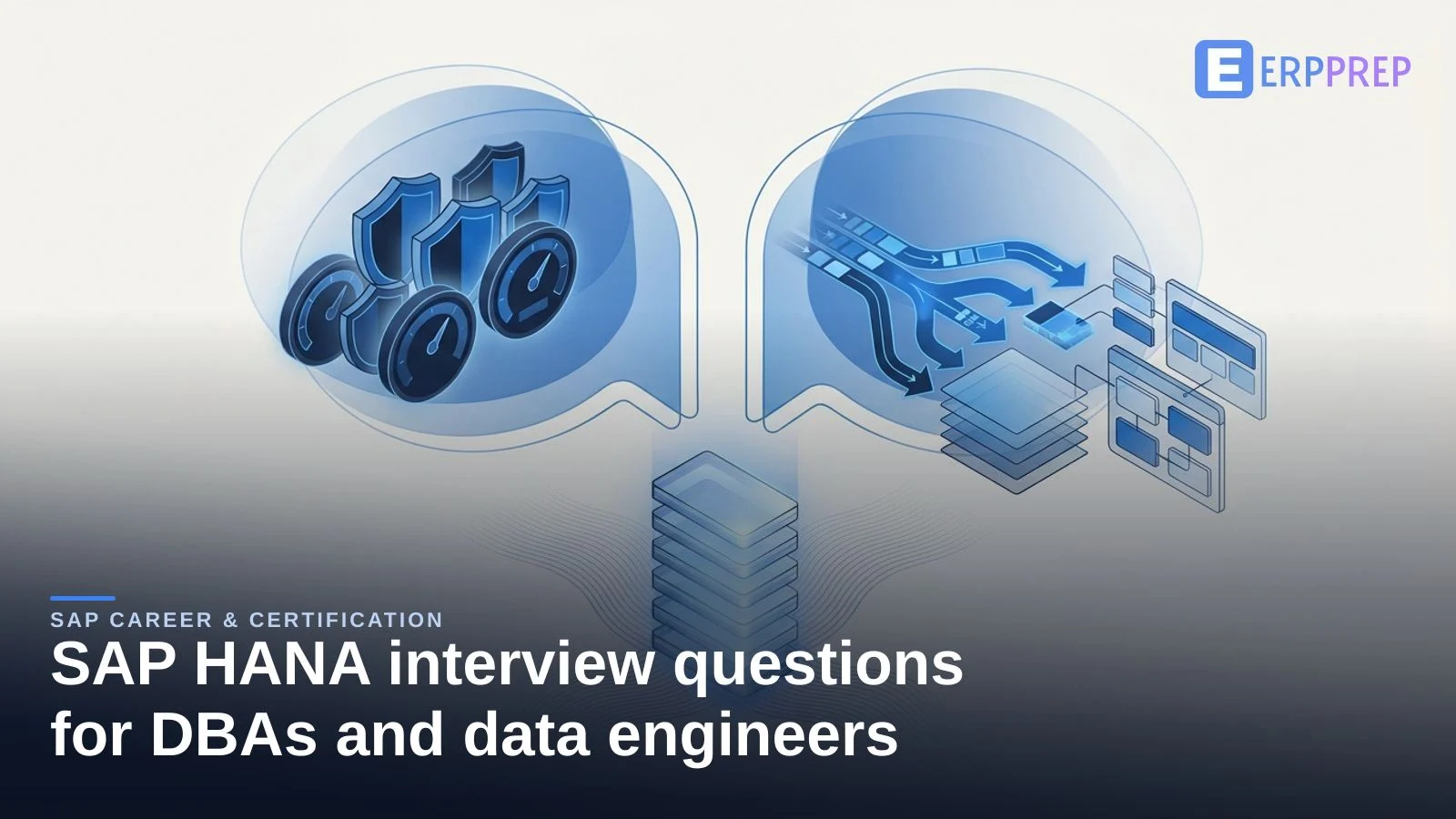
SAP HANA interviews split by role. Database administrators are asked about in-memory architecture, installation and upgrades, monitoring memory and SQL workload, data and log backups, recovery, security and moving to SAP HANA Cloud. Data engineers are asked about calculation views, dynamic models, virtualisation versus replication, project lifecycle and analytic privileges. Strong answers show method, not memorised terms.
An SAP® HANA interview can mean two very different conversations. One is for the database administrator, who keeps the database installed, healthy, secure, backed up and recoverable — on-premise, in SAP HANA Cloud, or both. The other is for the data engineer, who builds the models and data flows that sit on top of the database and make it useful to analysts and applications. Both roles need to understand what makes HANA different, but the questions after the first few minutes barely overlap. For how certification fits into a wider plan, start with whether SAP certification is worth it.
This guide is a job-interview question bank organised by role. It is not a certification comparison — for that, read SAP HANA and database administration certifications. If your interview is for a broader analytics position spanning SAP Analytics Cloud or SAP BW/4HANA, the wider SAP analytics and data interview guide is the better starting point. If you would rather practise reasoning through a task than read about it, a free performance-based sample is good rehearsal for explaining decisions out loud.
Key takeaways
- Two roles, two question banks. DBAs are probed on memory, monitoring, backup, recovery, security and cloud migration; data engineers on calculation views, provisioning and model lifecycle.
- Both start from the same idea. In-memory, column-oriented storage explains almost every design choice in either role.
- Method beats trivia. Interviewers want an ordered investigation, not a memorised parameter name.
- Cloud is now part of the DBA job. Be ready for at least one SAP HANA Cloud question, even for an on-premise role.
- These are job-interview questions, not exam questions. A different genre, though performance-based certification builds the same applied fluency.
What do HANA interviews start with, whatever the role?
Nearly every HANA interview opens with "what makes HANA different?" Keep it short and tie it to consequences. SAP describes an in-memory database as one that holds data in main memory rather than on disk, and explains that HANA's column-oriented, in-memory design lets analytics run alongside high-speed transactions in a single system. That is the mechanism. The consequences are what the interviewer is listening for: for a DBA, memory becomes the resource you size and watch most closely, and persistence to disk still matters for restart and recovery; for a data engineer, it means calculations can be pushed down to the database rather than dragging data out to an application layer.
| A question you are likely to hear | Who gets it | What it really tests |
|---|---|---|
| "If the data is in memory, how does it survive a restart?" | DBA | Understanding of persistence, savepoints and logs |
| "Memory usage is climbing. What do you check?" | DBA | An ordered monitoring method |
| "Walk me through a point-in-time recovery." | DBA | Data and log backups working together |
| "Dimension or cube calculation view — how do you choose?" | Data engineer | Modelling for the consumer, not the source |
| "Would you virtualise or replicate this source?" | Data engineer | Trade-offs between freshness, load and speed |
What do SAP HANA database administrator interviews ask?
SAP's administrator learning journey covers SAP HANA Cloud and on-premise systems side by side — architecture, installation and upgrades, starting and stopping, configuration, monitoring, backup and recovery, and migration to the cloud. Interviews follow the same arc.
How do architecture and memory questions come up?
After the opening question, expect follow-ups on how HANA writes changes to disk. Describe it at concept level: changes are recorded in a log as they happen, and the in-memory state is periodically written to persistent storage, so after a restart the database reloads from that saved state and replays the log. Then the column store: why compression and column storage suit analytics, and why newly written data first lands in a write-optimised area that is later merged into the main store. That "delta merge" concept is a favourite follow-up, because a DBA who understands it can explain a whole class of performance symptoms.
What do they ask about installation, upgrades and tenants?
Installation questions are rarely about clicking through an installer. They are about preparation: sizing memory and storage from the expected data, choosing supported hardware and operating system versions, and deciding on a deployment option. Expect a question on tenant databases — what the system database is for, why you might create several tenants, and what that means for isolation and backups. Upgrade questions test planning: reading the revision strategy before picking a target, testing in a non-production system, having a fallback, and scheduling the downtime with the business rather than for it.
How do you answer monitoring and performance questions?
This is where DBA interviews are won. The scenario is usually "users say the system is slow" or "memory usage keeps growing." Show an order: check alerts and service status first, then memory usage by service and by component, then the SQL workload to find the expensive or long-running statements, then persistence and disk. Name the tools at the level you know them — the course material centres on SAP HANA cockpit and the database explorer on-premise, and SAP HANA Cloud Central in the cloud. Finish with what you would not do: change configuration parameters before you have evidence, or restart the database to make the symptom go away. A good answer also mentions traces as a targeted tool, switched on for a reason and switched off afterwards.
How do backup and recovery questions work?
Every DBA interview has one. Separate data backups from log backups, explain that recovery restores a data backup and replays logs up to the point you choose, and connect that to the business question: how much data can we afford to lose, and how long can we be down? Then show operational maturity — scheduled backups, monitoring that they succeed, retention, and restores that are actually tested. Advanced follow-ups may touch on snapshots as a fast fallback before a risky change, and on copying a database to refresh a test system. In SAP HANA Cloud, be ready to say what the service handles for you and what you still own.
What about security, SAP HANA Cloud and migration?
Security questions cover authentication versus authorisation, how privileges are grouped into roles and roles assigned to users, why you avoid using powerful system users for daily work, encryption, and auditing so you can show who did what. Cloud questions test whether you understand the shift in responsibility: provisioning an instance, scaling it, choosing data tiering options, using elastic compute for heavy read workloads, and configuring alert rules and notifications. Migration questions usually ask how you would move an on-premise database to SAP HANA Cloud; the course covers a self-service migration tool, so describe the shape — assess compatibility, prepare the target, migrate, validate — and the risks you would watch. SAP's SAP HANA learning hub is the authoritative place to check current tooling before the interview.
If you are weighing the DBA path against platform or security administration, the comparisons of BTP administrator vs HANA DBA and security vs HANA DBA set out how the jobs differ.
What do SAP HANA data engineer interviews ask?
The data engineer interview moves from modelling to provisioning to the engineering discipline around both. SAP's data engineer learning journey centres on building models in SAP HANA Cloud and getting data into it, and interviewers tend to follow that split.
How do calculation view questions come up?
Start with the choice of view type: a dimension view describes master data, a cube view carries measures for aggregation, and the consumer decides which you need. Then the nodes. Be ready to explain projection and aggregation nodes, how you filter a join early and why join type and cardinality matter for both correctness and speed, when a union beats a join, and what minus, intersect and rank nodes are for. Interviewers often add a hierarchy question — how you model a parent-child or level-based hierarchy — and a dynamic-model question: the difference between a variable, which filters the result, and an input parameter, which feeds a value into the calculation itself.
The follow-up is almost always "when would you leave the graphical model and write SQL or SQLScript?" A balanced answer says you stay graphical for readability and optimisation where you can, and drop to code for logic the nodes cannot express — then you test that the custom logic does not block the optimiser.
How do you answer a slow-model question?
The scenario is a calculation view that has become slow. Show an order: reproduce it with realistic filters, inspect execution with the performance analysis and debug tools, look for joins that multiply rows or filters applied too late, change one thing and measure again. Only then mention heavier options such as controlling parallelisation, partitioning a large table, or caching or snapshotting results that change rarely. The interviewer is testing whether you prove performance with evidence or with intuition.
How do virtualisation, replication and transformation questions work?
Provisioning questions test trade-offs. Virtualisation reads data where it lives through a remote source and virtual tables, so it is always current but depends on the source's speed and availability. Replication copies data into HANA, trading storage and some latency for fast queries and less load on the source; know that it can be done with plain SQL, replication tasks or a replication service, and that replica tables are an option in between. Transformation questions ask how you would build a data flow from source to target and where cleansing belongs. Close any of these answers with the business question you would ask first: how fresh does this data need to be?
What about project lifecycle and modelling security?
Modern HANA modelling is project-based, built in SAP Business Application Studio and deployed rather than edited live. Expect questions on how you structure a modelling project, use Git for source control, give the project access to data outside its own container, and deploy safely from development to production. Security closes the interview: analytic privileges to restrict which rows a user can see, and masking for sensitive columns. A candidate who raises row-level security before being asked signals real project experience. For the career angle on this role, see the best SAP certification for a data-engineer career.
How should you structure a HANA interview answer?
A three-part shape works for either role. Name the mechanism — the log, the delta merge, the union node, the virtual table. Give the reason it exists — the problem it solves for the business or the system. Then say what goes wrong if it is handled badly — the recovery that cannot reach the point you need, the model that returns duplicated totals, the virtual table that brings a source system to its knees. When you reach the edge of what you know, say so and reason forward from what you do know. A confident invented parameter name costs more than an honest "I would check the documentation, but I expect it works like this."
What mistakes cost HANA candidates the offer?
- Answering for the wrong role. A DBA candidate who only talks about models, or a data engineer who only talks about backups, signals a mismatch.
- Treating memory as infinite. In-memory is the advantage and the constraint; ignoring sizing is a red flag for both roles.
- Tuning by restart. Restarting or changing parameters before finding the cause tells the interviewer you will do it in production.
- Never testing restores. A backup strategy without tested recovery is not a strategy.
- Ignoring the consumer. A technically clever model that answers the wrong business question is still the wrong model.
Which HANA certification supports the interview?
Certification will not answer the questions for you, but it gives you a shared vocabulary and often gets you into the room. The details below come from each exam's page on learning.sap.com; SAP updates exams, so confirm before you book.
| Exam | Interview it supports | Format | Published cut score |
|---|---|---|---|
| C_DBADM | Database administrator — SAP HANA Cloud and on-premise | System-Based Assessment (SyBA) | 73% |
| C_HAMOD | Data engineer — modelling and data provisioning | System-Based Assessment (SyBA) | 60% |
Note that C_HAMOD's current title is SAP Certified - Data Engineer - SAP HANA, despite the "MOD" in its code, and that SAP recommends hands-on practice-system time alongside the learning journey. SAP does not publish topic-area weightings for either exam. For what the hands-on format feels like, see how to practise for a system-based exam. For the broader interview approach across SAP roles, the guide to preparing for an SAP consultant interview is the hub.
How should you practise for a HANA interview?
There is a reason this guide gives themes instead of a script. A memorised answer key is the same failure mode as chasing dumps: it collapses as soon as the question is rephrased. What holds up is having monitored, backed up, restored, modelled and debugged enough that explaining it is simply narration. Pick your role, take each question above and answer it aloud in the mechanism-reason-consequence shape; where you hit a gap, close it with hands-on work in a trial or practice system rather than more reading.
SAP's 2026 performance-based formats reward the same habit, which is why practising the real task helps with both the exam and the interview. When you are ready to rehearse with a hands-on scenario, try a free sample and explain every decision as you make it.
Frequently asked questions
- Are these real SAP exam questions?
- No. These are the kinds of questions asked in a job interview for a HANA database administrator or HANA data engineer — a conversation with a hiring manager or technical lead. ERPPrep does not publish real exam questions or dumps, and no honest resource can. SAP's certification exams are separate, performance-based assessments; this guide is career preparation for the interview.
- What questions are asked in an SAP HANA DBA interview?
- Expect questions on why HANA keeps data in memory and in columns, how persistence works so data survives a restart, how you size, install and upgrade a system, how you monitor memory and expensive statements, how data and log backups combine for recovery, how users, roles and auditing are managed, and how you would move an on-premise database to SAP HANA Cloud.
- How do I explain HANA backup and recovery in an interview?
- Separate the two backup types. Data backups capture the database at a point; log backups capture the changes written since. Recovery restores a data backup and replays the logs, which is what makes point-in-time recovery possible. Then add the operational layer: a backup schedule, monitoring that backups actually succeed, retention, and regularly tested restores. An untested backup is the answer interviewers push back on.
- What does an SAP HANA data engineer get asked?
- Data engineer interviews focus on modelling and provisioning: choosing dimension or cube calculation views, how join, union, aggregation and rank nodes behave, variables versus input parameters, when to write SQL or SQLScript, virtual tables versus replication, managing a modelling project with Git and deployment, and securing a model with analytic privileges and data masking.
- What is the difference between data virtualisation and replication in SAP HANA?
- Virtualisation leaves data in the source and queries it on demand through a remote source and virtual table, so it is always current but depends on the source's speed and availability. Replication copies the data into HANA, so queries are fast and the source is spared repeated load, at the cost of storage and some latency. A strong answer picks based on freshness, volume and query patterns.
- Is a HANA DBA the same as an SAP Basis administrator?
- Not exactly. A HANA DBA specialises in the database itself — installation, configuration, memory, backup, recovery and database security — on-premise and in SAP HANA Cloud. Many system-administration roles include HANA duties, and the skills overlap, but an interview for a dedicated HANA DBA goes deeper on the database. Read the job description to see where the role draws that line.
- Which certification supports a HANA job interview?
- For an administrator role, SAP Certified - Database Administrator - SAP HANA (C_DBADM) covers both SAP HANA Cloud and on-premise administration. For a modelling and provisioning role, SAP Certified - Data Engineer - SAP HANA (C_HAMOD) is the match. Both are System-Based Assessments. Certification helps you reach the interview; the interview still tests how you reason.
- Should a HANA DBA learn SAP HANA Cloud?
- Yes. SAP's own administrator learning journey now covers SAP HANA Cloud alongside on-premise systems, including provisioning, cloud monitoring tools and migrating an on-premise database to the cloud. Interviewers increasingly ask how responsibilities change when the provider manages the infrastructure, so be ready to say what you still own — users, security, monitoring, performance and data — and what you no longer do.
ERPPrep is an independent platform and is not affiliated with, endorsed by, or sponsored by SAP SE. SAP and other SAP products are trademarks of SAP SE, referenced here only to describe the certification exams ERPPrep helps you prepare for.
Ready to practise the way the exam tests?
ERPPrep provides original, performance-style scenarios and skill drills built for the 2026 SyBA and SBA formats. Try a free sample and judge the quality yourself.
Practice for these exams
Related guides
SAP analytics and data interview questions (SAC, BW/4HANA, HANA, Business Data Cloud)
What SAP Analytics Cloud, BW/4HANA, HANA and Business Data Cloud interviews really test, role by role — and how to build answers you can defend.
SAP Fiori interview questions for developers and administrators
The questions a Fiori developer or Fiori system administrator is asked in a job interview — SAPUI5, Fiori elements, launchpad, Gateway — and how to answer.
SAP Customer Experience interview questions: marketing, commerce, customer data and architecture
SAP CX interview questions by product area — Emarsys marketing, Commerce Cloud, customer data and consent, and CX architecture — with how to answer each.