

SAP analytics and data interview questions (SAC, BW/4HANA, HANA, Business Data Cloud)
What SAP Analytics Cloud, BW/4HANA, HANA and Business Data Cloud interviews really test, role by role — and how to build answers you can defend.
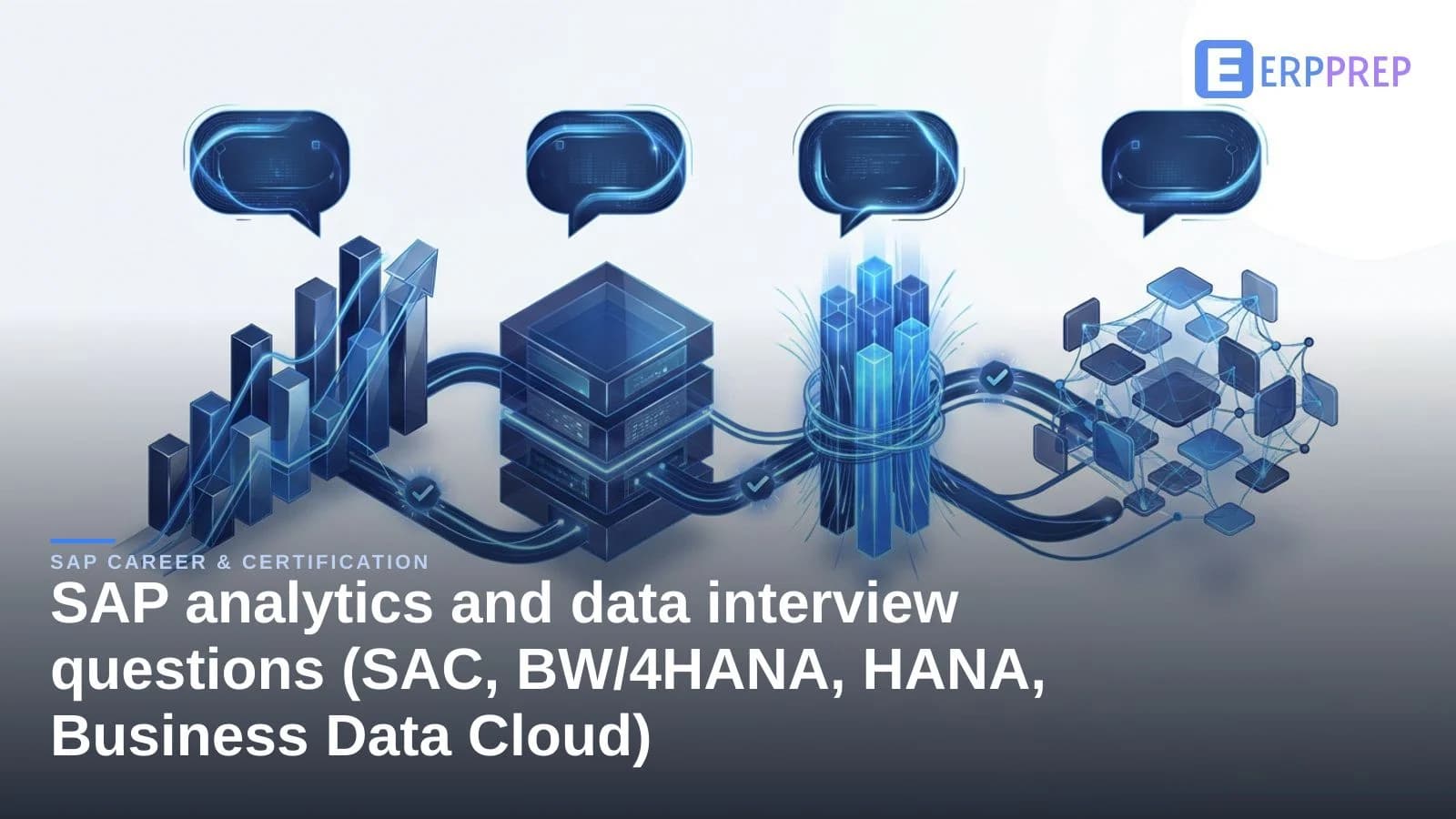
SAP analytics and data interviews split by role. SAP Analytics Cloud analysts and planners are tested on models, stories and planning logic; BW/4HANA modellers on data flows, layering and authorizations; HANA data engineers on calculation views, provisioning and performance; Business Data Cloud architects on data products, integration patterns and governance. Interviewers probe reasoning, so prepare trade-offs, not definitions.
An SAP® analytics or data interview rarely asks you to recite a menu path. The interviewer assumes you can find a setting; what they want to know is whether you can take a messy business question, decide where the data should live and how it should be shaped, and still be right when the volumes grow or the auditors arrive. That is why the questions are surprisingly predictable once you sort them by role rather than by tool. This guide maps the themes for four role families — the SAP Analytics Cloud analyst or planner, the SAP BW/4HANA modeller, the SAP HANA data engineer and the SAP Business Data Cloud data architect — and shows how to build an answer you can defend. For the broader question of whether the credential is worth it, start with whether SAP certification is worth it for your career.
A word on scope: these are job interview themes, not certification content. Nothing below is taken from an exam, and on a performance-based assessment there would be no answer key to take. The best preparation for both is the same — doing the work so the explanation comes naturally. If you want a feel for that, try a free sample scenario when you are ready, then come back with a decision of your own to talk about.
Key takeaways
- Prepare by role, not by product. SAP Analytics Cloud shows up in several jobs, but a planner and a warehouse modeller are asked very different follow-ups.
- Every role is really asked one question: where should this work happen, and how do you know the number is right?
- Trade-offs beat definitions. Name the constraint, give the options, pick one in business terms, say how you would verify it.
- Security and data quality are never optional extras. Candidates who raise them before being asked stand out in every role family.
- These are interview questions, not exam questions. No leaked content here — and no shortcut that replaces hands-on practice.
What do SAP analytics and data interviews actually test?
Underneath the tool names, each role family is screened for one core judgement. The table gives the short version; the sections after it unpack each role.
| Role family | Typical opening question | What it really tests |
|---|---|---|
| SAP Analytics Cloud analyst / planner | "Finance wants a forecast they can adjust themselves. How would you set it up?" | Whether you can turn a business process into a model, a story and a controlled plan. |
| SAP BW/4HANA modeller | "Walk me through a data flow you built, end to end." | Whether your layering, delta handling and authorizations keep the warehouse correct over time. |
| SAP HANA data engineer | "This calculation view is slow. Where do you start?" | Whether you understand where computation happens and measure before you change anything. |
| SAP Business Data Cloud data architect | "We run SAP BW and a separate data platform. What should the target look like?" | Whether you can design a target state and justify it to people who do not care about the technology. |
What do SAP Analytics Cloud analyst and planner interviews ask?
What you will be asked. For analyst roles: when you would import data into a model and when you would leave it in the source behind a live connection; how you build a story a manager can read without a walkthrough; how you filter, sort and calculate without silently breaking totals; how you keep a heavy story responsive. For planning roles the questions go deeper: how you set up versions, how planners enter and spread data, what a data action or a multi action is for, how you run an allocation or a currency conversion, and how you stop people overwriting each other with validation rules and data locking. Expect at least one question about forecasting or simulation — a rolling forecast layout, a value driver tree — and one about running the planning calendar as a process.
Why interviewers ask it. A dashboard that looks good and shows the wrong number is worse than no dashboard. The interviewer wants to know whether you think about the model first and the visual second, and — for planning — whether you treat a plan as a governed business process rather than a spreadsheet in the cloud.
What a strong answer demonstrates. That you start from the decision the user has to make. "The sales director needs to see which regions are behind plan, so I would put plan and actual side by side with a variance, filter by the region they own, and keep the detail one click away." For planning, show you know the moving parts: a private or working version for what-if work, a data action to copy or calculate rather than asking people to retype, an allocation driven by an agreed basis, and locks that close a period once it is signed off. Mention that planning increasingly sits alongside SAP Datasphere, so plan data can be written and consumed beyond the story — that shows you see the wider landscape.
How to build your own answer. Business decision, model, presentation, control. The credential mapping to this ground is SAP Certified - Data Analyst - SAP Analytics Cloud (C_SAC), which uses a Scenario-Based Assessment — you reason through a connected business situation rather than answering isolated recall items. You can check the current certification page in SAP Learning's catalogue.
What do SAP BW/4HANA modeller interviews ask?
What you will be asked. The classic opener is to walk through a data flow you built: where the data came from, how it was extracted, what each layer did and why. Follow-ups probe the building blocks — InfoObjects versus field-based modelling, which type of DataStore Object (advanced) suits a staging, corporate-memory or reporting layer, when an Open ODS view lets you avoid loading data at all, and how a CompositeProvider combines sources for a query. Expect questions on delta handling through the operational data provisioning framework, on extracting from SAP S/4HANA through ABAP CDS views, on transformation routines, and on keeping loads healthy with process chains. On the query side: restricted and calculated key figures, exception aggregation, variables and hierarchies. And almost always: how you restrict who sees which data with analysis authorizations.
Why interviewers ask it. Warehouses fail slowly. A shortcut in layering or delta logic looks fine for months and then produces numbers nobody can reconcile. The interviewer is screening for someone who designs for the second year, not the first demo.
What a strong answer demonstrates. A clear reason for every layer. "I kept an untouched copy of the source in the corporate memory layer so we could reload without going back to the source system; harmonised and cleansed in the warehouse layer; and exposed it through a CompositeProvider so the reporting model could change without reloading data." On history, show that you know the difference between a value that should be reported as it is today and one that must be reported as it was at the time. On security, separate the two concerns cleanly: standard authorizations control what someone may do; analysis authorizations control which data they may see.
How to build your own answer. Source, layers, consumption, security — and a sentence on how you would test a delta. The matching credential is SAP Certified - Data Engineer - SAP BW/4HANA (C_BW4H), assessed as a System-Based Assessment, so you carry out the modelling work in a system rather than describing it. If you are weighing it against the other analytics routes, our comparison of SAP analytics and data certifications sets them side by side.
What do SAP HANA data engineer interviews ask?
What you will be asked. How you choose between a dimension and a cube calculation view; how join, union, aggregation and rank nodes behave and when each earns its place; what union pruning buys you; how input parameters and variables differ; when you drop into SQL or SQLScript instead of staying graphical. On provisioning: when you would virtualise remote data through a virtual table and when you would replicate it, and how you would build a transformation with a flowgraph. On engineering hygiene: how you manage a modelling project in SAP Business Application Studio, version it with Git and deploy it safely. On security: analytic privileges, roles and masking sensitive columns.
Why interviewers ask it. In an in-memory platform the fastest query is the one that moves the least data, and a careless model can force huge intermediate results. The interviewer wants to hear that you think about where filtering and aggregation happen — and that you prove performance with evidence rather than intuition.
What a strong answer demonstrates. Method under pressure. For the slow-view question: reproduce it with realistic filters, check the execution with an analysis tool such as the SQL Analyzer or a performance analysis mode, look for joins that fan out or filters that are applied too late, change one thing, measure again. Only then mention the heavier options — partitioning a large table, caching results that change rarely, persisting a snapshot. For virtualisation versus replication, frame it as a trade-off between freshness, source-system load and query speed, and say which one the business actually cares about.
How to build your own answer. Consumer need, model shape, where the work happens, how you would measure it. The credential here is SAP Certified - Data Engineer - SAP HANA (C_HAMOD), also a System-Based Assessment centred on modelling and data provisioning in SAP HANA Cloud. For how this role compares with the BW route as a career, see the best SAP certification for a data-engineer career.
What do SAP Business Data Cloud data architect interviews ask?
What you will be asked. At foundation level: what problem SAP Business Data Cloud solves, what a data product is, how intelligent applications relate to it, and what the modernisation path looks like for an organisation with a large SAP BW estate — including moving to the private cloud edition of SAP BW and publishing existing BW data as data products through subscriptions. At architect level the questions widen: how you would share SAP data with a platform such as Databricks, Snowflake, Microsoft Fabric or Google BigQuery without losing its business meaning; whether ETL, ELT or federation suits a given pipeline; when a data fabric or a data mesh pattern fits the organisation; how you classify metadata and run governance; and how you would prepare the data estate for AI workloads.
Why interviewers ask it. Architecture decisions are expensive to reverse, and the people approving the budget are rarely technical. The interviewer is testing two things at once: whether your target state is sound, and whether you can explain it to a finance director in five minutes.
What a strong answer demonstrates. That you start from the business outcome and the current landscape, not from the newest pattern. A strong candidate asks how much of the reporting already depends on SAP BW, who owns which data domain, and which consumers need SAP semantics preserved before proposing anything. Frameworks such as TOGAF and DAMA-DMBOK are worth naming as a shared language — but only to structure the answer, never as a substitute for one. Close with how you would measure whether the strategy is working.
How to build your own answer. Business value, current state, target state, governance, measures of success. Two credentials map here, both Scenario-Based Assessments: SAP Certified - SAP Business Data Cloud (C_BCBDC) for foundational product knowledge, and Data Architect - SAP Business Data Cloud (C_BDCDA) for the architecture, strategy and stakeholder side. Our guide to SAP Business Data Cloud certifications explains how the two fit together.
Interviewers can tell when you have done the task recently. Working a scenario end to end gives you specific choices to describe — the version you created, the node you replaced, the trade-off you accepted — instead of definitions to recite.
Which questions cut across every SAP data role?
Whatever the role family, a handful of themes come up in almost every interview. Prepare one real example for each.
- "The number in the report does not match finance." The reconciliation question. Walk back through the layers — consumption, model, load, source — and check filters, currency, time and unit logic before blaming the data.
- "Who should be able to see this?" Every role has a security layer: story and model permissions, analysis authorizations, analytic privileges and masking, governance policies. Raising it unprompted is a strong signal.
- "It used to be fast." The performance question. Reproduce, measure, isolate, change one thing, re-measure — the same discipline whether it is a story, a query or a calculation view.
- "Explain this to someone non-technical." Data roles live between IT and the business. Practise explaining a model or an architecture in two sentences with no product names.
- "Tell me about a disagreement." The behavioural question. A STAR structure — situation, task, action, result — works here; our guide to preparing for an SAP consultant interview covers it in depth.
How should you structure an answer to an SAP data interview question?
The same four beats work for almost every question in this guide, from a story layout to a target architecture:
- Name the constraint. The decision the user makes, the data volume, the freshness requirement, who is allowed to see what.
- Lay out the options. Import or live; persist or virtualise; InfoObject or field-based; replicate, federate or share. Two or three, briefly.
- Choose, and justify in business terms. "Fresher for the sales team" or "one version of the number for finance" is a justification; "it is the newer feature" is not.
- Say how you would verify it. A reconciliation against the source, a performance trace, an authorization test with a restricted user. Ending on verification is the most senior-sounding habit you can build.
What mistakes sink otherwise strong SAP data candidates?
- Answering for the wrong role. Giving a planner's answer in a modeller interview, or a modeller's answer in an architect interview, signals you did not read the job.
- Leading with the visual. A beautiful chart on an unreliable model is the fastest way to lose a finance stakeholder's trust.
- Tuning before measuring. Naming a fix before you have looked at the execution is the reflex the performance question exists to catch.
- Treating new platforms as a clean slate. Most organisations have years of SAP BW and reporting already. An architect who ignores that estate is not credible.
- Hunting for a question list to memorise. Rehearsed answers break on the first rephrasing, and anything advertising leaked questions is selling something nobody can honestly deliver.
Do SAP analytics and data certifications help in the interview?
They help in two concrete ways. They get you past screening filters that many data roles use, and the current formats push you to practise the job rather than memorise it. A System-Based Assessment such as the BW/4HANA or HANA one has you carry out work in a system; a Scenario-Based Assessment such as the SAP Analytics Cloud or Business Data Cloud ones has you reason through a connected situation and commit to decisions. That is exactly the muscle an interviewer tests when they ask how you would choose and what you would check.
What a credential cannot do is answer the follow-up for you. Pick the one that matches the role you are interviewing for — our guide to the best SAP certification for a data and analytics career maps roles to routes — and then use the preparation to collect specific decisions you can talk about.
Prepare by role, answer in four beats, raise security and data quality before you are asked, and be honest about where your experience is deepest. For fresh decisions to bring to your next interview, try a free sample and work a scenario through from start to finish.
Frequently asked questions
- Are these actual SAP exam questions?
- No. These are themes employers raise in job interviews for analytics and data roles, not SAP certification exam content. ERPPrep does not publish leaked, real or actual exam questions and does not provide dumps. SAP's current assessments are performance-based, so this guide teaches reasoning, not an answer key.
- What questions are asked in an SAP Analytics Cloud interview?
- Expect questions on choosing between an imported model and a live connection, building a story readers trust, and calculating without breaking totals. Planning roles add versions, data entry, data actions, allocations, validation rules and data locking. Interviewers usually wrap these in a short business scenario and listen for how you decide.
- What do SAP BW/4HANA interview questions focus on?
- They centre on the data flow: extraction, which DataStore Object (advanced) type each layer needs, delta handling, and the CompositeProvider and query on top. Follow-ups cover master data history, field-based versus InfoObject-based modelling, process chains and analysis authorizations. The test is whether your warehouse stays correct as it grows.
- How do I answer an SAP HANA calculation view question?
- Start from the output the consumer needs, then explain the view type, the nodes you would use and where filtering and aggregation happen so less data moves. Mention input parameters if the requirement varies at runtime. Finish with how you would prove performance with an analysis tool rather than asserting it is fast.
- What does an SAP Business Data Cloud architect interview cover?
- Architect interviews test how you design rather than how you click. Expect questions on data products, modernising an existing SAP BW estate, sharing data with platforms such as Databricks or Snowflake, when data mesh or data fabric fits, and governance. Tying each choice to business value matters as much as the technology.
- Should I prepare for SAP data interviews by role or by tool?
- By role. The same tool appears in several jobs, but the questions change with the job. A planner and a BW modeller may both touch SAP Analytics Cloud, yet one is asked about versions and allocations, the other about queries and authorizations. Identify the role family in the job description and prepare those themes first.
- Does an SAP analytics or data certification help in the interview?
- It helps you clear screening and gives you shared vocabulary, and the current performance-based formats push you toward hands-on reasoning that transfers well. It does not replace the interview's real test: applying knowledge under follow-up questions. Treat the credential as the door opener and your own worked examples as the evidence.
- How do I prepare if I have never worked on a live SAP data project?
- Build a small example end to end and be honest about its scale. Model a dataset, build a view or story on it, add a simple security rule and note every decision and why. Interviewers respond far better to a modest example explained precisely than to inflated claims that collapse on the second question.
ERPPrep is an independent platform and is not affiliated with, endorsed by, or sponsored by SAP SE. SAP and other SAP products are trademarks of SAP SE, referenced here only to describe the certification exams ERPPrep helps you prepare for.
Ready to practise the way the exam tests?
ERPPrep provides original, performance-style scenarios and skill drills built for the 2026 SyBA and SBA formats. Try a free sample and judge the quality yourself.
Practice for these exams
Related guides
SAP project manager interview questions (SAP Activate) and how to answer them
The six themes an SAP delivery-lead interview returns to — fit-to-standard, phases, agile, Cloud ALM, public vs private edition, change — and how to answer
SAP Security interview questions and how to answer them
The six themes an SAP Security and authorisation interview returns to — what each question really tests, and how to build an answer you can defend.
SAP SuccessFactors interview questions and answers
The six themes an SAP SuccessFactors consultant interview keeps returning to — what each question really tests, and how to build an answer you can defend.