

SAP Security Administrator vs SAP HANA DBA certification: C_SEC vs C_DBADM
Two SAP associate administrator certifications, two different technical careers. C_SEC (Security Administrator — authorizations and identity) vs C_DBADM (Database Administrator — SAP HANA) — what each covers, the format, the cut score, and which to choose.
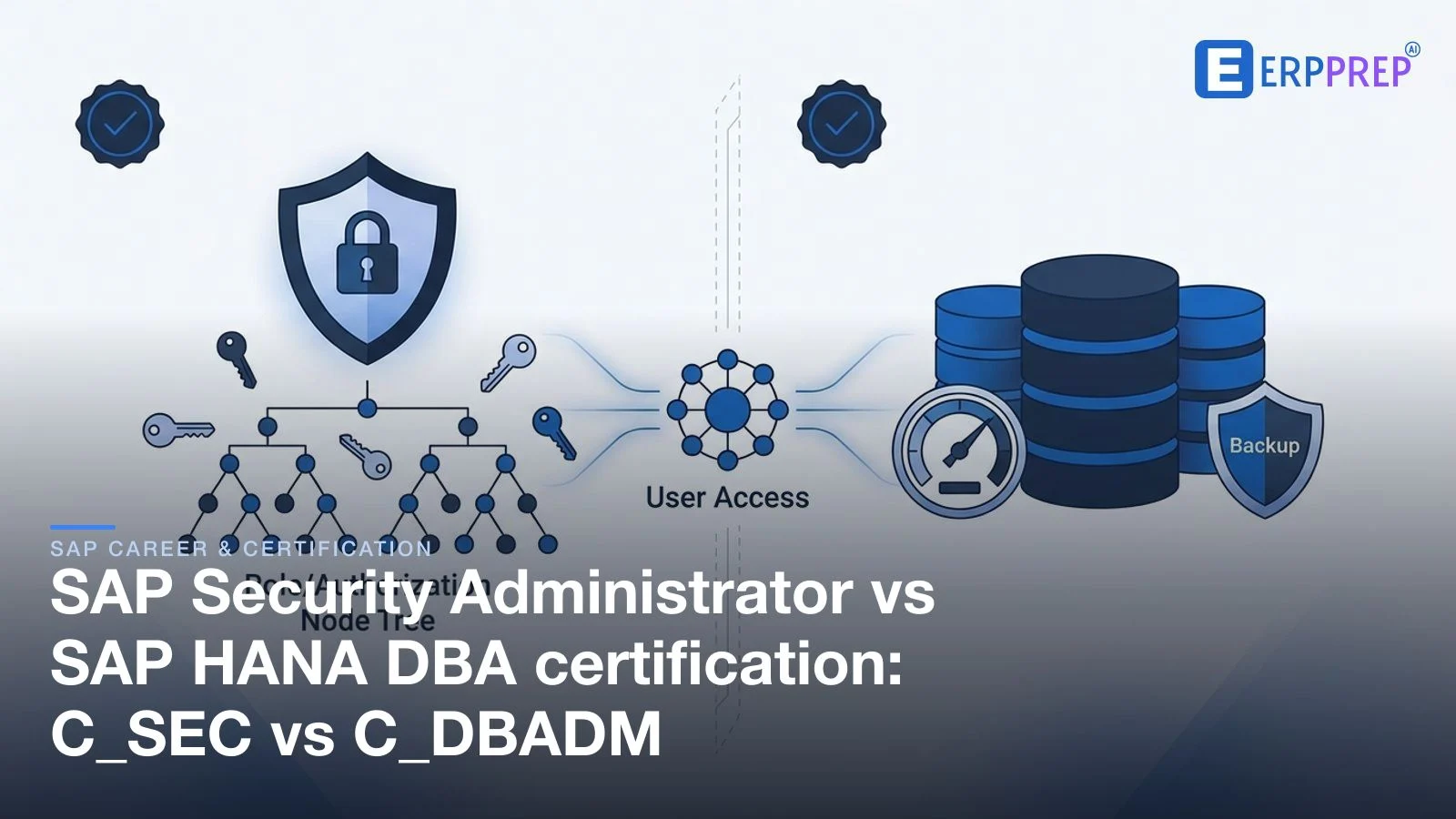
C_SEC (SAP Security Administrator) certifies authorization concepts, role design, Fiori authorizations, and cloud identity services — who may access an SAP system and what they can do. C_DBADM (SAP HANA Database Administrator) certifies installing, configuring, monitoring, and recovering the SAP HANA database itself. Both are associate System-Based Assessments. Choose security and access governance, or database operations and reliability.
SAP® certifies its administrator roles separately, and two associate exams sit near each other on the catalogue while pointing at genuinely different technical careers. C_SEC certifies the Security Administrator — authorizations, role design, and identity — while C_DBADM certifies the SAP HANA Database Administrator — installing, running, and recovering the database platform itself. This guide compares what each certifies, the shared format, and how to choose. For the wider question of which SAP certification fits your career, see whether SAP certification is worth it and how to choose.
Key takeaways
- C_SEC is the access-and-identity track — it certifies authorization concepts, business and technical roles, Fiori authorizations, user provisioning, and cloud identity services.
- C_DBADM is the database-operations track — it certifies installing, upgrading, configuring, monitoring, and backing up and recovering the SAP HANA database.
- Both are associate-level and use the same System-Based Assessment (SyBA) format built around a single practical activity.
- The cut score differs: C_DBADM publishes 73%, while C_SEC does not publish one on its page — confirm both on learning.sap.com.
- They map to different technical roles: a security and authorizations specialist versus a database platform administrator — meeting only at SAP HANA user and access management.
C_SEC vs C_DBADM at a glance
Both certifications sit on official SAP learning journeys (SAP, learning.sap.com) and share the administrator family and the SyBA format — but the subject matter diverges sharply. Here they are side by side:
| C_SEC — Security Administrator | C_DBADM — HANA DBA | |
|---|---|---|
| What it covers | Authorization concepts, ABAP and Fiori roles, user provisioning, and cloud identity services | Installing, configuring, monitoring, and backing up and recovering the SAP HANA database |
| Best for | Security and authorizations administrators | Database platform administrators |
| Format | System-Based Assessment (SyBA) | System-Based Assessment (SyBA) |
| Cut score | Not published — confirm on learning.sap.com | 73% |
| Core skills earned | Security controls, user roles and accounts, SSL security, security strategies | System administration, monitoring, and recovery |
What C_SEC (Security Administrator) covers
The Security Administrator certification is about controlling access. It verifies that you understand SAP authorization and security concepts well enough to work as part of a project or security team — deciding who can sign in to an SAP system and precisely what each user is permitted to do once inside. The earned skills sit in that space: security controls, user provisioning, user accounts and roles, SSL security, and the broader security strategy that ties them together.
In practice the module spans authorization from the on-premise ABAP world through to cloud identity services:
- Authorization concepts — the elements and terminology of the ABAP authorization model, how authorization checks fire in the system, and how to design a concept from first principles.
- Role maintenance — building standard and customizing roles, and applying composite and derived role strategies to keep large role catalogues maintainable.
- Fiori authorizations — the Fiori authorization model, business catalogs, spaces and pages, and analysing missing authorizations in launchpad content.
- User administration — maintaining users, the business user concept, and central user administration across a landscape.
- Cloud identity services — identity authentication and provisioning across BTP and cloud-hosted applications, plus single sign-on and secure authentication.
Two threads run through the whole module and are worth calling out, because a performance-based exam tests them repeatedly. The first is least privilege and traceability: a role is only safe if it grants exactly what a job needs and no more, so much of the work is reasoning about which authorization objects a task requires and how to prove, with traces and analysis reports, that access is correct. The second is the on-premise-to-cloud bridge: modern SAP landscapes mix classic ABAP authorizations with cloud identity and provisioning services, and a strong candidate can explain how a user's access is governed consistently across both. That judgement — the right access, provably scoped, across a hybrid landscape — is exactly what the practical assessment is designed to probe.
What C_DBADM (HANA DBA) covers
The HANA Database Administrator certification is about keeping the database platform healthy. It validates the essential skills for managing both HANA Cloud and on-premise HANA databases: deploying and upgrading them, configuring and tuning performance, monitoring and troubleshooting, and running the backup and recovery process. Where the Security Administrator governs access, the DBA governs availability and reliability of the system underneath.
The module is operational and broad, moving from installation through to disaster recovery:
- Architecture and installation — the SAP HANA architecture, sizing and hardware requirements, installation and upgrade, and the post-installation tasks that make a system usable.
- Administration tooling — working with SAP HANA cockpit, database explorer, HANA Cloud Central, and the command-line tools to run day-to-day administration.
- Monitoring and troubleshooting — checking services, memory usage, persistence, alerts, and SQL statements, and using traces to diagnose problems.
- Configuration and operations — starting and stopping the database, changing configuration parameters, scaling, and understanding concepts such as the delta merge.
- Backup and recovery — data and log backups, scheduling them, performing a database recovery, and the advanced techniques and fallback snapshots that protect against data loss.
- Migration to the cloud — moving an on-premise SAP HANA database to SAP HANA Cloud with the self-service migration tooling while minimising downtime.
A HANA DBA, then, owns a system that has to stay up and stay fast: errors here surface as outages, slow reports, or — worst of all — lost data, so the exam leans on getting the operational decisions right. What makes the module demanding is that the duties are chained to consequences. A missed alert becomes a memory problem; an untested backup becomes an unrecoverable outage; a misjudged configuration parameter becomes a performance incident. The practical assessment rewards a candidate who can reason about the health of the whole system — what to monitor, when to intervene, and how to recover — rather than one who has memorised a menu path. If security rewards knowing the access model, database administration rewards knowing the operational runbook and the failure modes it guards against.
The very different technical roles
The clearest way to choose is to look at who actually does each job. They are distinct roles that happen to share the word "administrator."
A Security Administrator is the access-and-governance person — the one a project turns to when a new team needs roles, when an audit asks who can post a payment, or when a Fiori launchpad shows the wrong tiles because an authorization is missing. The work is policy-and-precision shaped: understand the business need, model it as roles and authorizations, and prove it is correctly scoped. It pairs naturally with a career in access governance, compliance, and identity management.
A HANA Database Administrator is the platform-reliability person — the one on call when a database is slow, when a backup needs verifying, or when a system has to be recovered after a failure. The work is operations-and-resilience shaped: install it correctly, watch it closely, tune it, and be ready to bring it back. It sits close to the Basis and platform-engineering side of an SAP landscape.
There is a career-shape difference too. Security expertise travels across the whole SAP landscape and increasingly toward the cloud identity and compliance space, so a Security Administrator can grow into access governance or identity architecture over time. Database administration is deeper and more platform-specific: it makes you the person a landscape cannot run without, and that operational scarcity has real value, but the expertise is more tightly bound to SAP HANA and its tooling. Neither is "better" — they are different bets on how you want your expertise to compound.
Where they overlap: SAP HANA access management
For all their differences, the two certifications meet at one point: SAP HANA user and access management. The security learning journey includes a course on SAP HANA users, user groups, roles, and privileges — because governing access to the database is part of a Security Administrator's remit. The database journey, in turn, includes user and authorization maintenance and HANA security features such as encryption and auditing — because a DBA has to create users and protect the data they hold.
The difference is framing. For C_SEC, HANA access is one instance of a broad authorization discipline that also spans ABAP roles, Fiori, and cloud identity. For C_DBADM, user and authorization maintenance is one operational duty among installation, monitoring, and recovery. So a small amount of study genuinely transfers between the two — but it is a shared edge, not a shared core. If you want the wider map of how SAP's administrator and platform certifications relate, the SAP certification career paths overview places both among the technical tracks.
Not sure how a System-Based Assessment feels? A free sample shows the do-the-task-in-a-system style before you commit to a track. Try a free sample.
Format and cut score: both SyBA, different thresholds
Both C_SEC and C_DBADM use the System-Based Assessment (SyBA) format — SAP's performance-based style for these administrator certifications, built around a single practical activity where you carry out realistic system work rather than recalling isolated facts. That much they share.
The pass mark, though, is not identical. C_DBADM publishes a 73% cut score at the time of writing, while C_SEC does not publish a cut score on its certification page. Do not assume the two are the same threshold — check each exam's current cut score on its page before you book, because SAP updates these details over time. Either way, the winning preparation is the same: practise doing the work under realistic conditions. If you want the technique for this exam family, the guide to the performance-based exam format covers how SyBA activities are built and how to work them under time pressure.
Prerequisites and preparation
Neither exam is gated behind a formal prerequisite certification — both are positioned as associate entry points into their administrator role. What matters more is the hands-on grounding underneath them. Both assume you are comfortable with SAP system administration in general; from there C_SEC layers on authorization concepts, role maintenance, and identity services, while C_DBADM layers on SAP HANA architecture, the cockpit and database-explorer tooling, and the backup-and-recovery discipline. If you are new to either domain, expect to build that base first through the recommended courses on each learning journey.
One practical point on effort: the two journeys are not the same shape. The security journey is broad, spanning on-premise ABAP authorizations, Fiori, access governance, and cloud identity across several courses, so it asks you to hold a wide model of access in your head. The database journey is deep on a single platform — install, operate, monitor, recover, migrate — so it asks you to be genuinely fluent with SAP HANA and its tools. That does not make one objectively harder, but it does shape how you budget your study, so match the plan to the track you choose rather than assuming they take the same preparation.
Which one should you choose?
Work backwards from the role you hold or want, not from the exam that looks easier. Three rules of thumb:
- Choose C_SEC if your world is access and governance. You design roles, control who can do what, answer audits, or own the authorization layer across a landscape. Security is also the more transferable of the two toward identity and compliance careers.
- Choose C_DBADM if your world is running the platform. You install and operate systems, watch performance and alerts, and are responsible for backups and recovery. Database administration is the deeper operational specialism.
- Consider both — in sequence — for a platform role. In smaller teams one person often owns both access governance and database operations, and the two meet at HANA access management. Lead with the one you already touch daily, then add the second once you have real project exposure.
Still weighing these against the wider SAP technical field? The SAP certification career paths hub places both among the broader set of administrator and platform options, and each exam hub below carries the scenarios, skill drills, and exam facts for that specific certification.
Prepare for whichever you pick
Once you have chosen, the approach is the same because the format is shared. Practise doing the work in a realistic setting rather than only reading — build and analyse roles and authorizations for C_SEC, or run the monitoring, backup, and recovery tasks for C_DBADM. Trace whole tasks end to end, and rehearse under time pressure so your accuracy holds when it counts. Start from the exam hub for your track, try a free sample to feel the System-Based style, and build from there.
Frequently asked questions
- What is the difference between C_SEC and C_DBADM?
- C_SEC certifies the SAP Security Administrator role — authorization concepts, business roles, ABAP and Fiori authorizations, user provisioning, and cloud identity services. It is about who may access an SAP system and what they are allowed to do. C_DBADM certifies the SAP HANA Database Administrator role — installing, upgrading, configuring, monitoring, backing up, and recovering the SAP HANA database. It is about keeping the database itself healthy and available. Same administrator family, very different daily work.
- What exam format do C_SEC and C_DBADM use?
- Both are System-Based Assessments (SyBA), the performance-based format SAP uses for these administrator certifications, built around a single practical activity. You work through realistic system tasks rather than answering isolated multiple-choice trivia. Confirm the current activity count and any format updates on each exam's page at learning.sap.com before you book.
- What is the cut score for C_SEC and C_DBADM?
- C_DBADM publishes a 73% cut score at the time of writing. C_SEC does not publish a cut score on its certification page, so treat the pass mark as unstated and confirm it on learning.sap.com before you sit the exam. Because the threshold is not the same across the two, do not assume one from the other.
- Which SAP certification is better, security or HANA database administration?
- Neither is objectively better — they lead to different technical careers. C_SEC suits someone who wants to own access governance, authorizations, and identity across SAP landscapes. C_DBADM suits someone who wants to run the database platform: performance, monitoring, backup, and recovery. Choose by the work you want to be responsible for, not by which looks easier.
- Which should I take first, C_SEC or C_DBADM?
- Lead with the one closest to the role you already hold or are moving into. If your work is user access, role design, and compliance, start with C_SEC. If your work is keeping systems running — installs, monitoring, backups, recovery — start with C_DBADM. There is no formal ordering requirement between them, so day-to-day relevance is the right tie-breaker.
- Do C_SEC or C_DBADM have prerequisites?
- Neither is gated behind a formal prerequisite certification; both are positioned as associate entry points into their respective administrator roles. What matters more is hands-on grounding — comfort with SAP system administration for both, plus authorization concepts for C_SEC and SAP HANA architecture and tooling for C_DBADM. Each exam's learning journey on learning.sap.com lists the recommended courses that build that base.
- Do C_SEC and C_DBADM overlap at all?
- They meet at SAP HANA user and access management. The security learning journey includes SAP HANA users, roles, and privileges, and the HANA database journey includes user administration, authorization maintenance, and security features such as encryption and auditing. So both touch HANA access control, but from opposite ends: C_SEC treats it as one part of a broad authorization remit, while C_DBADM treats it as one operational duty among installation, monitoring, and recovery.
- Can I hold both C_SEC and C_DBADM?
- Yes, and the pairing is coherent for a landscape or platform administrator who owns both access governance and database operations, especially in smaller teams where one person wears both hats. Most people earn the one that matches their current role first, then add the second once they have real project exposure to the other side.
ERPPrep is an independent platform and is not affiliated with, endorsed by, or sponsored by SAP SE. SAP and other SAP products are trademarks of SAP SE, referenced here only to describe the certification exams ERPPrep helps you prepare for.
Ready to practise the way the exam tests?
ERPPrep provides original, performance-style scenarios and skill drills built for the 2026 SyBA and SBA formats. Try a free sample and judge the quality yourself.
Practice for these exams
Related guides
SAP HANA & database administration certifications
The SAP HANA and database-administration certifications split into three hands-on roles — HANA DBA, data modeler, and BTP administrator. Who each suits.
SAP integration certifications compared
Compare SAP's integration certification options — the Integration Developer (C_CPI) and BTP Administrator (C_ADBTP) — and where legacy Process Orchestration fits.
SAP BTP certifications explained: which one is right for you
A map of the SAP BTP certification family — administrator, architect, integration, ABAP and generative-AI developer, LeanIX EA — and how to choose.