

SAP Customer Experience certifications compared: which CX exam is yours?
SAP CX certifications compared: Sales Cloud, Service Cloud, Customer Data Cloud, Customer Data Platform, Commerce Cloud and the CX architect exam.
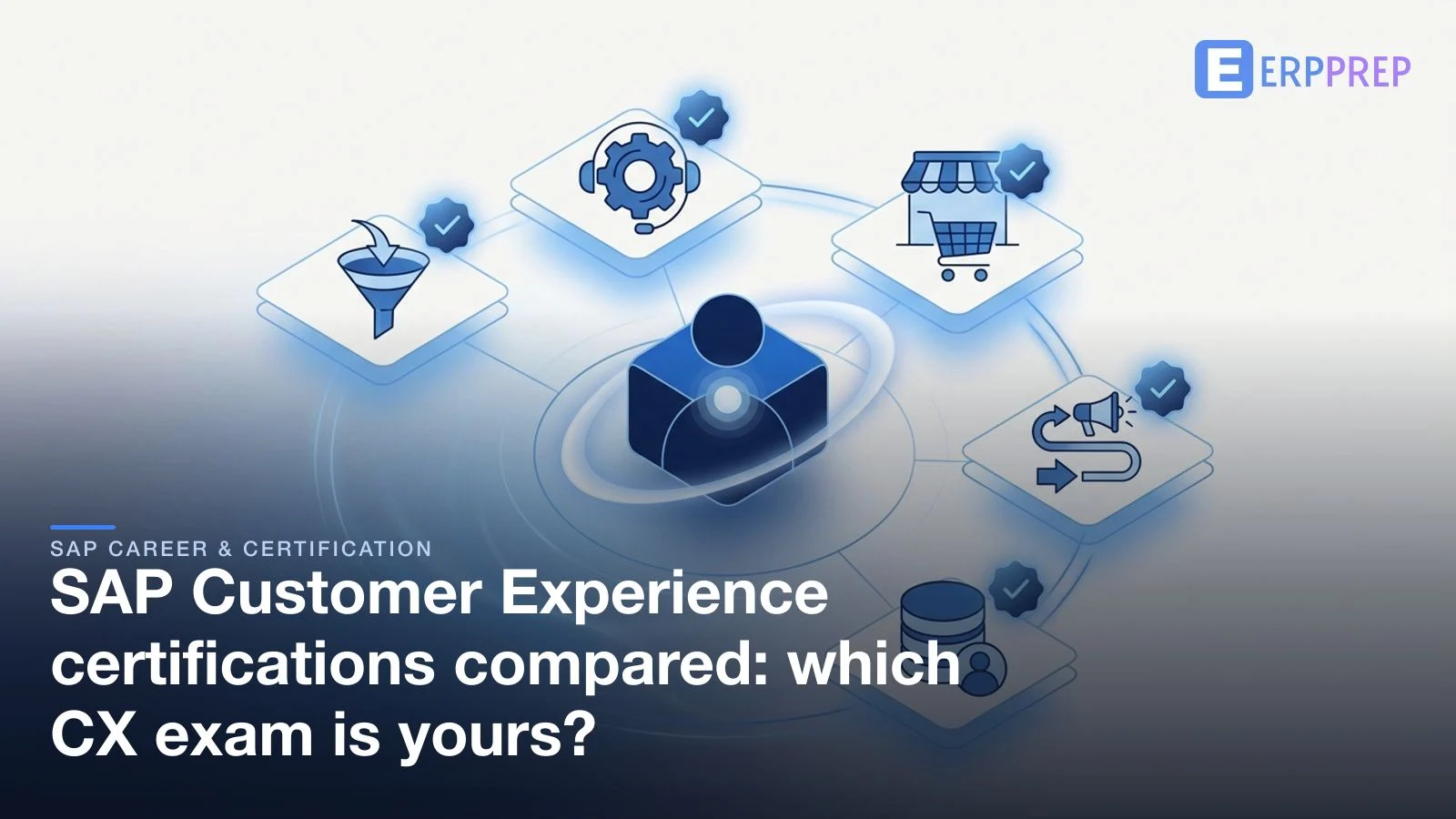
SAP's Customer Experience family certifies by product, not by seniority. Sales Cloud (C_C4H47) and Service Cloud (C_C4H56) cover front-office processes; Customer Data Cloud (C_C4H62) covers identity and consent while Customer Data Platform (C_C4H63) unifies profiles; Commerce Cloud splits business user (C_C4H32) from developer (P_C4H34); Emarsys (C_C4H22) covers campaigns, and C_C4HCX certifies the architect across all of them.
The SAP® Customer Experience portfolio is the hardest family in the certification catalogue to navigate by name alone. Two of its credentials differ by a single word — Customer Data Cloud versus Customer Data Platform — and one product, Commerce Cloud, carries two completely separate exams written for two completely different people. Pick by the product name on your project and you will book the wrong one. For where CX sits among the other tracks, see whether SAP certification is worth it and how to choose.
The confusion is understandable, because SAP does not organise these exams the way most vendors organise a certification track. There is no bronze, silver, and gold tier climbing toward one summit. Instead there are eight credentials, each attached to a different product in the CX suite and, in most cases, to a specific role on a project team. The suite itself grew partly through acquisition — the data and marketing pieces came from separate companies before SAP folded them under one Customer Experience banner — which is why the products feel distinct and the exams read as independent qualifications rather than steps in a sequence. Once you stop treating the catalogue as a ladder and start reading it as a map of products, the choice becomes far less intimidating.
This guide groups the eight exams into four practical clusters, walks through what each credential actually assesses using its published learning journey, and gives you a way to match an exam to the work you already do. Every fact here is drawn from the certification pages on learning.sap.com, which SAP updates periodically — so treat the cut scores and formats below as a current snapshot to confirm, not a permanent rule.
SAP's Customer Experience family certifies by product, not by seniority. Sales Cloud (C_C4H47) and Service Cloud (C_C4H56) cover front-office processes; Customer Data Cloud (C_C4H62) covers identity and consent while Customer Data Platform (C_C4H63) unifies profiles; Commerce Cloud splits business user (C_C4H32) from developer (P_C4H34); Emarsys (C_C4H22) covers campaigns, and C_C4HCX certifies the architect across all of them.
Key takeaways
- Four groups, not eight random exams: front-office engagement, customer data, commerce, and architecture.
- The two "customer data" exams are not tiers. C_C4H62 is identity and consent; C_C4H63 is profile unification and activation.
- Commerce Cloud is role-split. C_C4H32 certifies the business user; P_C4H34 is a professional developer credential.
- Formats differ. Most CX exams are system-based; Emarsys and the architect exam are scenario-based.
- Cut scores are not uniform. They range from 60% up to 75% across the family — verify each on learning.sap.com before booking.
Which SAP CX certification matches which job?
Every one of these credentials is published on an SAP learning journey (SAP, learning.sap.com). The fastest way to cut through the naming is to ask what you touch on a project: a sales or service process, a customer record, a storefront, or the diagram that connects them all.
| Exam | What it certifies | Best for | Format & cut score |
|---|---|---|---|
| C_C4H47 — Sales Cloud V2 | Leads, opportunities, quotes, orders, visits, forecasting | Front-office sales consultants and administrators | System-based (SyBA), 75% |
| C_C4H56 — Service Cloud V2 | Service organisation, cases, agreements, routing, channels | Customer-service implementation consultants | System-based (SyBA), 67% |
| C_C4H62 — Customer Data Cloud | Registration, consent, web SDK, organisation onboarding | Identity and privacy-minded consultants | System-based (SyBA), 63% |
| C_C4H63 — Customer Data Platform | Identity resolution, ingestion, segments, audiences, journeys | Data-driven marketing consultants | System-based (SyBA), 63% |
| C_C4H32 — Commerce Cloud (business) | Product content, storefront content, promotions, search, orders | Business analysts and store operators | System-based (SyBA), 60% |
| P_C4H34 — Commerce Cloud (developer) | Type system, extensions, service layer, facades, deployment | Experienced commerce engineers | System-based (SyBA), 65% |
| C_C4H22 — Emarsys Edition | Contacts, segmentation, omnichannel campaigns, integrations | Marketing-automation consultants | Scenario-based (SBA), 60% |
| C_C4HCX — CX solution architect | Suite architecture, integration patterns, extensibility, delivery | Architects working across several CX products | Scenario-based (SBA), 60% |
Because most of the family is assessed inside a system rather than through pure multiple choice, the honest preparation question is not "what will they ask?" but "can I complete the task?" If you have never met that style, try a free sample before you commit to a CX path — it is a five-minute way to feel the difference.
How the SAP CX suite fits together
Before choosing an exam it helps to see how the products relate on a real project, because the certifications mirror that shape. Picture a single customer moving through a business. Marketing reaches them first: the Emarsys platform (C_C4H22) runs the segmented campaigns, the loyalty offers, and the omnichannel messages that pull them toward a purchase. When they arrive at a storefront, Commerce Cloud (C_C4H32 for the business side, P_C4H34 for the engineering) presents the catalogue, the promotions, and the checkout. A salesperson working a larger deal lives in Sales Cloud (C_C4H47), and once the customer needs help after the sale, Service Cloud (C_C4H56) handles the case.
Underneath all of that sit the two data products. Customer Data Cloud (C_C4H62) governs who the customer is and what they consented to, capturing identity at registration so every other product trusts the same record. Customer Data Platform (C_C4H63) then stitches the fragments those products generate into one profile and feeds unified segments and journeys back out. Holding the whole picture together — deciding how these clouds integrate, where SAP Business Technology Platform and the Integration Suite fit, and how to extend the landscape — is the job the architect credential (C_C4HCX) certifies. Read that way, the four clusters are not an arbitrary carve-up: they are engagement, commerce, customer data, and the architecture that connects them.
Sales Cloud or Service Cloud — which front-office exam?
These two are the closest siblings in the family, and they split neatly by the moment in the customer relationship you support. C_C4H47 is the pre-sale credential: lead handling, opportunity management, quotes and orders, visit planning, pricing setup, pipeline and forecasting, plus the machine-learning and assistant features layered on top, and the mobile experience a representative works in. It reads as one continuous story — how a seller's day is configured.
C_C4H56 is the post-sale credential. It starts with standing up a service organisation and its master data, then moves to registered products, warranties and installed bases, case types and status schemas, categories, service-level agreements, routing rules, and the email and phone channels a customer reaches you through. Of the two, the Sales Cloud exam carries the higher published cut score — 75% against 67% — which leaves noticeably less margin for a careless task.
It is worth noting how much of the Service Cloud journey is groundwork before the service objects appear. The learning path opens with the customer-service process itself, scoping the implementation, confirming system requirements, and activating base configuration, then builds user management, role-based access restrictions, and interface tailoring — page layouts, extensibility, and code-list restriction rules — before you ever create a case. That ordering is not incidental; a system-based exam tends to reward candidates who understand what must exist before the next step will succeed. If you are drawn to defining how a support desk is structured and governed, C_C4H56 is the natural fit; if you are energised by pipeline, forecasting, and the guided-selling playbooks a representative follows, C_C4H47 is yours.
Both front-office exams share a modern layer that reflects where the products are heading. Sales Cloud includes machine-learning lead scoring, generative-AI features, the CX AI Toolkit and AI agents, Microsoft Teams integration, relationship intelligence, and a dedicated mobile app — so the configuration you rehearse is broader than classic CRM data entry. Service Cloud similarly threads AI and channel integration through its case-handling flow. Do not treat these as footnotes: on a performance-based assessment, the AI and integration steps are configuration tasks like any other, and skipping them in revision leaves easy marks on the table.
What is the difference between Customer Data Cloud and Customer Data Platform?
This is the pair that catches people out. C_C4H62 is about who the customer is and what they agreed to: creating a site in the console, building light and full registration flows, configuring the web interface and screen sets, and setting up consent statements so a record is captured and verifiable. Its second half covers business-to-business arrangements — organisation onboarding, approval workflows, delegated administration, and policy-based access.
C_C4H63 is about what you do once the data exists: resolving fragments into a single profile, ingesting events through a schema, building activity indicators and segments, assembling audiences, and designing flows and journeys — with an administration layer for retention and monitoring, an API layer for developers, and predictive indicators such as churn and lifetime value. Both publish a 63% cut score, so choose by subject matter rather than difficulty.
A useful tell is the shape of each learning journey. Customer Data Cloud is the more compact of the two, built around customer identity and access management — often shortened to CIAM — with a second course devoted entirely to the business-to-business side: onboarding organisations, delegated administration, approval workflows, and policy-based access control. If your projects involve registration, login, consent, and letting partner organisations manage their own members, that is the exam. Customer Data Platform is broader and more analytical: alongside its essentials course it carries separate administration, developer, and AI-workbench courses, so it reaches from console setup and data-retention rules through the Query and Ingestion APIs to predictive models. Data-minded consultants who think in profiles, segments, and activation will find C_C4H63 the more natural home.
The practical risk with this pair is booking on a hunch about seniority. Nothing in the naming signals that one is advanced and the other introductory — both are described as entry-level qualifications for a mentored role, and both pass at the same 63%. The only reliable way to choose is to read what each one asks you to do in a system and match it to your day. Identity and consent point to Customer Data Cloud; unification and activation point to Customer Data Platform.
Commerce Cloud: business user or developer?
Commerce Cloud is the only CX product with two entirely separate certifications, and the gap between them is large. C_C4H32 is the business-user credential — managing products and hierarchies in the back-office cockpit, editing storefront pages, running promotions and coupons, tuning search, handling orders and returns, and supporting customers. Its learning journey is broad but functional, spread across roughly ten courses.
P_C4H34 is a professional-level developer credential and assumes about three years of hands-on platform work. It goes into the type system and data modelling, extensions and build configuration, import tooling and query syntax, the service and facade layers, event and process handling, scheduled jobs, the web-services module, and deployment through the cloud portal. Booking the developer exam because you administer a store is the single most expensive mistake in this family.
The scale gap between the two journeys makes the point on its own. The business-user path is functional and hands-on but stays within the cockpits and SmartEdit, extending into B2B storefront setup, order fulfilment, customer support, and the AI-driven Intelligent Selling Services and CX AI Toolkit. The developer path is a deep technical curriculum: the ImpEx import framework, Flexible Search syntax, the type-system data model, the service and facade layers, the process engine, cronjobs, the OCC RESTful web-services module, the composable storefront, and adaptive-search personalisation. Its skills are listed as extension methods, the service layer, software and application deployment, and the object model — engineering competencies, not configuration ones.
There is one more signal that separates them: the developer credential is aprofessional-level exam, reflected in its P_ code rather than the C_ prefix the associate exams carry. That is why it assumes roughly three years of practical platform work where the business-user exam is positioned as an entry-level qualification. If you write extensions and manage builds, the developer exam validates what you already do; if you curate products and run campaigns from Backoffice, the business-user exam is the honest match. Read the role on the exam page, not just the product name.
Where do Emarsys and the architect credential fit?
C_C4H22 sits slightly apart: it certifies marketing execution — contact data, segment building, personalised email, automations, loyalty and digital advertising, web and mobile channels, reporting, and the data inputs and connectors behind them. Usefully for career changers, its published overview states that previous project experience is not a prerequisite, and it is assessed as a scenario rather than a system task.
C_C4HCX is the capstone. Instead of one product it spans the suite plus SAP Business Technology Platform: describing each solution's capabilities, choosing integration patterns and middleware, proposing extensibility approaches, translating requirements into components, justifying trade-offs, and planning delivery. Its learning journey is by far the longest in the family, and the credential is framed for an architect with roughly two or more years of CX experience — which is exactly why it belongs at the end of a sequence, not the start.
Emarsys deserves a second look from anyone entering the field, because it is the most accessible door into SAP CX. Its curriculum runs from contact data and segmentation through personalised email, automations and tactics, into a full omnichannel spread — loyalty, digital advertising, web push, mobile-first design, mobile wallet, and SMS — before closing on the data inputs, connectors, and CX integrations that feed it. Crucially, it is assessed as a scenario rather than a system task, and its published overview states that previous project experience is not required. For a marketer moving toward SAP, or a consultant who wants a certification that does not assume years of prior delivery, it is a rational first step.
The architect exam sits at the opposite end of the difficulty curve, and its breadth is the point. Its learning journey folds in the essentials of Sales Cloud, Service Cloud, Commerce Cloud, Customer Data Cloud, Customer Data Platform, and Emarsys, then layers on SAP Business Technology Platform, the Integration Suite, and SAP Build — integration patterns, middleware choices, event-driven messaging, and clean-core extensibility. You are not being tested on how to configure one product but on whether you can defend a design that spans several. That is why a candidate who has only ever worked in one cloud will struggle with it regardless of raw ability: the exam assumes you have already felt the friction of making these products talk to each other on a live project.
Which SAP CX certification fits your role?
If the four clusters still leave you undecided, work backwards from the job title on your project. A front-office consultant configuring sellers' pipelines and playbooks belongs in Sales Cloud (C_C4H47); one standing up support desks, cases, and service-level agreements belongs in Service Cloud (C_C4H56). An identity or privacy consultant who owns registration, login, and consent belongs in Customer Data Cloud (C_C4H62), while a data or marketing-operations consultant who builds unified profiles and segments belongs in Customer Data Platform (C_C4H63).
On the commerce side the split is by craft rather than subject. A business analyst or store operator managing catalogues, storefront content, and promotions wants the business-user exam (C_C4H32); a platform engineer writing extensions and managing deployments wants the professional developer exam (P_C4H34). A marketer or campaign specialist — especially one new to SAP — starts with Emarsys (C_C4H22). And the solution architect who already moves between these products and owns the integration diagram is the person the suite-wide credential (C_C4HCX) was written for. Match the seat you hold, not the product that sounds most impressive.
How should you sequence the CX certifications?
There is no official ladder, but a practical order falls out of the structure. First, certify the product you deliver today — that is the credential an employer can verify against your project history. Second, add the neighbouring product your integrations keep touching: sales consultants drift into service, commerce people into customer data, marketers into the platform that feeds their segments. Third, once you can hold a design conversation about two or more CX products, sit the architect exam. If you are still deciding where to start at all, read which SAP certification to get first.
That progression tends to compound in value. A single product certification proves you can implement one cloud; a second in an adjacent product signals you understand how CX fits together, which is precisely the perspective an employer pays a premium for. By the time you have delivered across two or three products, the architect exam stops being an intimidating capstone and becomes a natural way to certify the judgement you have already built. There is no rule that forces this order, and nothing stops a specialist from earning a single deep credential and stopping there — but for consultants who want to grow their scope, building outward from the product they know is far more reliable than starting with the broadest exam and hoping the depth follows.
What mistakes do CX candidates make?
- Treating the two data exams as levels. They are different subjects at the same cut score, not a beginner and an advanced version.
- Booking Commerce Cloud by product name. Check whether you want the business credential or the professional developer one.
- Assuming a shared cut score. The family spans 60% to 75%; the Sales Cloud exam is the least forgiving.
- Preparing for the wrong format. Most CX exams are system tasks; two are scenarios. The revision method should differ.
- Starting with the architect exam. It is written for someone who has already delivered across several CX products.
How should you prepare for a CX exam?
Whichever credential you choose, the preparation principle is the same, because the assessment style is the same across the family: rehearse the task, not the definition. Work through configuration end to end in a practice environment until the dependency chain — what must exist before the next step will succeed — is second nature, then repeat it under time pressure so accuracy survives the clock. That exam technique is what the performance-based exam preparation guide covers in depth. From there, each hub above — including C_C4H47, C_C4H56, and C_C4H32 — links to the scenarios, skill drills, and exam facts for that specific certification. Always confirm the current format and cut score on learning.sap.com before you book, because SAP revises these pages.
Two adjustments make that principle concrete. First, respect the format split. For the system-based exams — Sales Cloud, Service Cloud, both data exams, and both Commerce Cloud exams — build a checklist of the configuration objects each learning journey names and practise creating them in order until the sequence is automatic; the assessment cares whether the finished setup works, not whether you can describe it. For the scenario-based Emarsys and architect exams, practise reading a business situation and defending a single well-reasoned choice, because that is the muscle those assessments exercise. Second, budget your time against the cut score: a 75% Sales Cloud pass leaves far less room for a fumbled task than a 60% one, so rehearse until accuracy, not just familiarity, survives the clock.
Finally, remember that every credential in this family assumes some level of hands-on exposure, whether it is the mentored project role behind the associate exams or the multi-year experience behind the developer and architect ones. No amount of reading substitutes for having done the task. That is the whole reason ERPPrep's practice content is built around scenarios and skill drills rather than flashcards — and the fastest way to know whether a CX path suits you is to work through a free sample and feel the performance-based format for yourself before you book.
Frequently asked questions
- What are the SAP Customer Experience certifications?
- The CX family covers Sales Cloud (C_C4H47), Service Cloud (C_C4H56), Customer Data Cloud (C_C4H62), Customer Data Platform (C_C4H63), Commerce Cloud for business users (C_C4H32) and for developers (P_C4H34), Emarsys (C_C4H22), and a solution-architect credential spanning the whole suite (C_C4HCX). Each associate exam certifies one product and one role rather than a seniority tier, so the family behaves more like a menu than a ladder. Most are titled as implementation-consultant credentials for a mentored project role; the Commerce business-user and developer exams and the architect exam sit slightly apart. You choose by the product on your project first, then by the seat you hold on the team.
- What is the difference between Customer Data Cloud and Customer Data Platform?
- They solve different problems despite the near-identical names. Customer Data Cloud (C_C4H62) is customer identity and access management — creating a site in the console, building lite and full registration flows, configuring screen sets through the web SDK, capturing consent, and onboarding business-to-business organisations with delegated administration and policy-based access. Customer Data Platform (C_C4H63) unifies fragmented data into a single profile, then drives identity resolution, ingestion, segments, audiences, journeys, and predictive indicators such as churn and lifetime value. Think identity and consent first, profile unification and activation second. Both publish a 63% cut score, so pick by subject, not difficulty.
- Should I take the Commerce Cloud business user or developer certification?
- Match the exam to your hands. The business-user credential (C_C4H32) is about running the store from the Backoffice cockpits — product content and hierarchies, storefront pages in SmartEdit, promotions and coupons, search tuning, order fulfilment, and customer support. Its learning journey is broad but functional, spread across roughly ten courses. The developer credential (P_C4H34) is professional-level engineering: the type system, extensions, ImpEx, Flexible Search, the service and facade layers, the process engine, and cloud-portal deployment, with about three years of practical Commerce Cloud work assumed. Booking the developer exam because you administer a store is this family's most expensive mistake.
- Which SAP CX certification is hardest?
- Difficulty depends on your background, but the published cut scores give a signal: the Sales Cloud exam passes at 75%, the Service Cloud exam at 67%, and the Commerce Cloud developer exam at 65%, while Customer Data Cloud, Customer Data Platform, the Commerce business-user exam, Emarsys, and the architect exam sit at 60% to 63%. Cut score is not the whole story, though. The Commerce developer credential assumes around three years of platform work, and the architect credential is framed for two or more years across several CX products, so both are demanding regardless of the percentage. Always confirm current values on learning.sap.com before booking.
- Are the SAP CX exams scenario-based or system-based?
- Most of the family is system-based (SyBA), where you work through tasks inside a system: Sales Cloud, Service Cloud, Customer Data Cloud, Customer Data Platform, and both Commerce Cloud exams all use that format. The Emarsys consultant exam and the CX solution-architect exam are scenario-based (SBA), where you reason through a connected business situation rather than click through configuration steps. The distinction matters for revision: a system exam rewards rehearsing the configuration path end to end until the dependency order is automatic, while a scenario exam rewards being able to justify a design choice. Both reward practice over recall.
- Which SAP CX certification should I take first?
- Start with the product your projects actually deliver, because that is the credential an employer can verify against your history. Consultants doing front-office work usually begin with Sales Cloud or Service Cloud; identity and privacy consultants begin with Customer Data Cloud; data-driven marketers begin with Customer Data Platform or Emarsys; commerce people begin with the business-user Commerce Cloud exam. Career changers often find Emarsys the gentlest entry, since its overview states prior project experience is not required. Leave the architect credential until you have real delivery experience across more than one CX product — it is written for exactly that person.
- Do I need experience before an SAP CX certification?
- It varies by credential. The Emarsys consultant exam explicitly states that previous project experience is not a prerequisite, which makes it unusually accessible. Several associate exams — Customer Data Cloud and Customer Data Platform among them — are described as entry-level qualifications aimed at a mentored project role. The Commerce Cloud developer exam is the outlier that expects around three years of practical platform work, and the CX architect credential is written for someone with roughly two or more years across CX solutions. In every case the assessments are performance-based, so hands-on rehearsal matters more than the stated minimum.
- Does one SAP CX certification cover the whole suite?
- Only one credential spans the suite, and it is deliberately the most demanding. The CX solution-architect exam (C_C4HCX) covers Sales Cloud, Service Cloud, Commerce Cloud, Customer Data Cloud, Customer Data Platform, and Emarsys together, plus SAP Business Technology Platform and the Integration Suite — its learning journey is by far the longest in the family. The seven product-level exams each certify a single cloud and role. So there is no single associate badge that proves breadth across all of CX; breadth is what the architect credential is for, and it assumes you have already delivered across more than one CX product.
- How much hands-on practice do the SAP CX exams need?
- A lot, because the format is performance-based rather than multiple-choice recall. The system-based exams ask you to complete real configuration — standing up a service organisation, building a registration flow, assembling a segment, or setting up a promotion — so the honest preparation question is whether you can finish the task under time pressure, not whether you can recite a definition. The scenario-based Emarsys and architect exams instead ask you to reason through a connected situation and defend a choice. Either way, working through the steps repeatedly, rather than reading about them, is what transfers to exam day.
- Does ERPPrep provide real SAP exam questions or dumps?
- No. ERPPrep publishes original practice content written to the published exam structure — scenario walkthroughs and skill drills that rehearse the reasoning a performance-based assessment asks for. Dumps are unreliable, often outdated, and put your certification at risk, because a leaked answer key does not teach you to complete a configuration task inside a live system. Practising the task, not memorising an answer, is what actually transfers to a system-based or scenario-based exam. Each exam hub linked from this article points to ERPPrep's own scenarios and drills for that specific CX certification.
ERPPrep is an independent platform and is not affiliated with, endorsed by, or sponsored by SAP SE. SAP and other SAP products are trademarks of SAP SE, referenced here only to describe the certification exams ERPPrep helps you prepare for.
Ready to practise the way the exam tests?
ERPPrep provides original, performance-style scenarios and skill drills built for the 2026 SyBA and SBA formats. Try a free sample and judge the quality yourself.
Practice for these exams
Related guides
SAP integration certifications compared
Compare SAP's integration certification options — the Integration Developer (C_CPI) and BTP Administrator (C_ADBTP) — and where legacy Process Orchestration fits.
SAP BTP certifications explained: which one is right for you
A map of the SAP BTP certification family — administrator, architect, integration, ABAP and generative-AI developer, LeanIX EA — and how to choose.
SAP S/4HANA vs SuccessFactors: which certification career should you choose?
Core ERP / S/4HANA or cloud HR / SuccessFactors? Two very different SAP career worlds compared — the roles, the job markets, and how to choose — using C_TS4FI (Financial Accounting) and C_THR81 (Employee Central) as examples.