

Entry-level SAP certifications: where beginners should start in 2026
New to SAP? Here are the most approachable associate-level certifications by interest — finance, HR, development, and analytics — with how the tier works and how to pick your first exam.
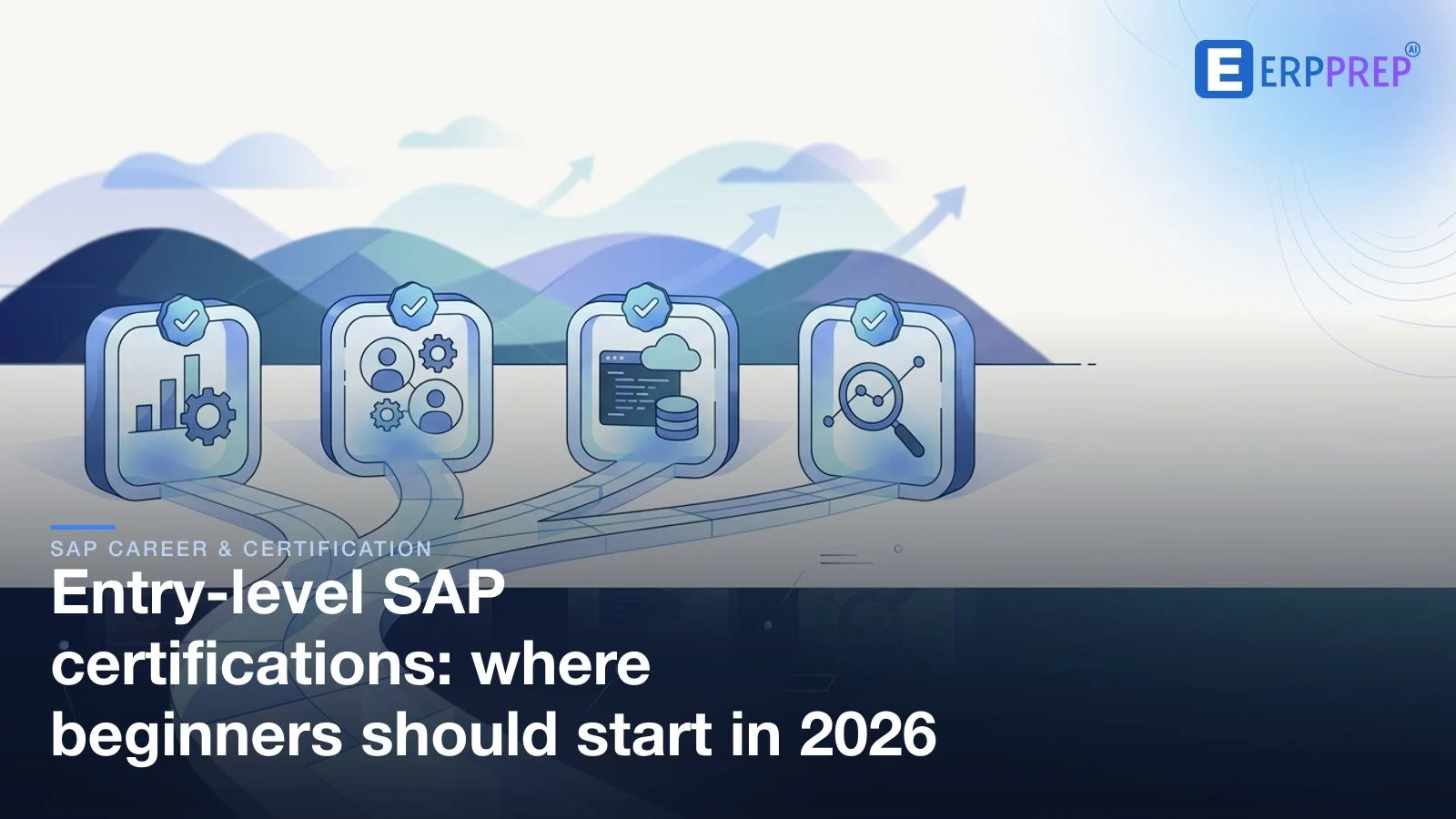
Every SAP® associate (C_) certification is an entry point — the tier is designed for people new to a topic. Beginners usually start by interest: finance points to C_TS4FI, HR to C_THR81 or C_THR82, development to C_FIORD or C_ABAPD, and analytics to C_SAC. Choose the area that matches your background or curiosity, not the badge that looks hardest.
If you're new to SAP®, the certification catalog can feel like a wall of codes — dozens of exams, cryptic prefixes, and no obvious front door. The good news is that there is a beginner tier, it's clearly marked, and you don't have to understand the whole map to take a sensible first step. This guide explains what "entry-level" actually means in SAP, then lays out the most approachable associate certifications organised by interest — finance, HR, development, and analytics — so you can pick a first exam that fits you. For the wider question of whether certification is worth it at all, start with whether SAP certification is worth it and how to choose.
Key takeaways
- The associate tier (exam codes starting with C_) is SAP's entry level — several associate exams are explicitly described as entry-level qualifications for people newer to a solution.
- There is no single "beginner" certification — there are many approachable associate exams, one cluster per interest area.
- Start by interest and background: C_TS4FI (finance), C_THR81 / C_THR82 (HR), C_FIORD / C_ABAPD (development), and C_SAC (analytics).
- The 2026 exams are performance-based (SyBA / SBA), so hands-on practice matters more than memorising facts.
- A certification is a credible signal, not a guaranteed job — pair it with practice and a clear target role.
What "entry-level" actually means in SAP
SAP organises its certifications into levels, and the one that matters for a beginner is the associate tier. You can spot it by the exam code: associate exams start with C_ (for example C_TS4FI), while the more advanced professional tier uses a P_ prefix and targets architecture and design roles. Associate certifications verify that you possess core, fundamental knowledge of a solution and can participate in a project team — in several cases explicitly in a mentored role. That framing is the whole point: the tier assumes you are early in your journey.
Some official exam pages say this in almost so many words. The SuccessFactors Employee Central certification, for instance, is described as recommended as an entry-level qualification for consultants getting acquainted with the fundamentals, and the Fiori Application Developer certification states plainly that it is an entry-level certification. So when people ask whether there are entry-level SAP certifications, the answer is that the entire associate tier is exactly that. The confusion usually comes from the sheer number of them — not from any of them being off-limits to beginners.
One nuance worth internalising early: the associate tier is beginner in seniority, not effortless in practice. The exams still expect real competence with the solution. What makes them entry points is that they assume no prior SAP career, pair with foundational learning content, and certify fundamentals rather than deep specialisation. If you'd like the full breakdown of tiers, the SAP certification levels explained guide walks the associate, specialist, and professional bands in detail.
How the 2026 exams are tested — and why it changes your prep
Before choosing an area, it helps to understand how these exams work now, because it shapes how you should prepare. SAP's 2026 associate exams are largely performance-based. Many use the System-Based Assessment (SyBA) format, where you complete realistic tasks in a live system, while others use the Scenario-Based Assessment (SBA) format, where you reason through a connected business scenario. Both reward the ability to do the work rather than recite facts about it.
For a beginner, this is genuinely encouraging news, because it means you can't really fake readiness with memorisation — but it also means your study has to include hands-on rehearsal, not just reading. The technique you build transfers across every area below, so learning to prepare for the performance-based format once pays off whichever first exam you pick. Formats do get adjusted as products evolve, so always confirm the current structure on each exam's page at SAP's learning site (learning.sap.com) before you book.
If your interest is finance: start with C_TS4FI
Finance and accounting is one of the most common — and most approachable — ways into SAP, because the domain knowledge is transferable. If you already understand ledgers, payables, receivables, or period-end close, you're learning the SAP way of something you already grasp, which is far gentler than learning both at once. The lead exam here is C_TS4FI, the associate certification for financial accounting on S/4HANA Cloud Private Edition.
C_TS4FI verifies core skills in configuring and running Financial Accounting — organisational units and master data, the general ledger, accounts payable and receivable, asset accounting, and period-end close. It uses the System-Based Assessment (SyBA) format and, per its official page, carries a 60% cut score. The role it points at is functional consultant, which is a well-trodden entry route for career changers coming from an accounting or finance-operations background. If finance is your world, this is the most natural first badge — and the best SAP certification for a finance career guide maps where it leads next.
If your interest is HR and people: C_THR81 or C_THR82
If your background is in human resources, recruiting, or people operations, the SuccessFactors family is your entry cluster — and two exams stand out as beginner-friendly. C_THR81 covers Employee Central Core and Position Management, the foundational people-and-org data layer, while C_THR82 covers Performance and Goals, the appraisal-and-objectives side. SAP pitches both as beginner-tier credentials for people still finding their feet in the module, which is about as clear an invitation to newcomers as SAP gives.
Which of the two you start with comes down to the HR work you care about: pick C_THR81 if you gravitate toward core employee data, org structures, and workflows; pick C_THR82 if performance reviews, goal-setting, and calibration are more your thing. On format, both exam cards were showing a new format while the exams were under maintenance, so the assessment style and cut score weren't published at capture time — confirm the current details on learning.sap.com before you plan. For a fuller side-by-side, see which SuccessFactors certification to choose.
Not sure a performance-based exam is for you? A free sample lets you feel the doing-over-recalling style before you pick an area. Try a free sample.
If you like to build: C_FIORD or C_ABAPD
If you come from a coding or web-development background, SAP has two very approachable developer entry points, and the right one depends on which layer you enjoy. For the front-end — building the apps users actually touch — C_FIORD (Fiori Application Developer) is the natural start. SAP frames it as a beginner-tier credential for front-end developers, it uses the Scenario-Based Assessment (SBA) format, and it carries a 60% cut score. If you already know HTML and JavaScript, the SAPUI5 and Fiori material will feel familiar rather than alien.
For the back-end — writing business logic inside the system — C_ABAPD (Back-end Developer, ABAP Cloud) is the counterpart. It covers core ABAP and the ABAP RESTful Application Programming Model, uses the System-Based Assessment (SyBA) format, and its page lists a 67% cut score. Note that C_ABAPD has been offered as a beta version, so confirm its current status and format on learning.sap.com before booking. A simple rule of thumb: choose C_FIORD if you love the visible, user-facing layer, and C_ABAPD if you prefer the logic underneath. The Fiori vs ABAP developer comparison breaks down the trade-off, and the developer-career hub shows how each path grows.
If your interest is data and analytics: C_SAC
If you enjoy working with data — building dashboards, modelling numbers, telling a story with a chart — the analytics path is an approachable and increasingly popular entry point. The lead beginner exam is C_SAC, the associate Data Analyst certification for SAP Analytics Cloud. It verifies the fundamental knowledge the data-analyst profile needs: navigating the tool, designing and presenting stories, formatting and blending data, modelling, and manual planning.
C_SAC uses the Scenario-Based Assessment (SBA) format and, per its official page, carries a 60% cut score. Its associated beginner learning journey is designed to build up the basics from scratch, which is exactly what you want as a newcomer. This is a strong pick for career changers coming from business intelligence, reporting, or spreadsheet-heavy analyst roles, because the mental model — turn data into decisions — carries straight over. For the broader family, the data & analytics career hub shows where C_SAC sits among the other data credentials.
How to choose your first exam
With four viable clusters in front of you, the decision can stall — so here is a simple way through it. Work in this order, and stop at the first clear yes:
- Follow your existing domain. If you already work in finance, HR, development, or analytics, start there. Learning the SAP version of a domain you know is dramatically easier than learning a new domain and a new tool together.
- If you're starting fresh, follow genuine interest. With no prior domain, pick the area you find most engaging — motivation carries you through the hands-on practice the format demands.
- Check the target roles. Look at what jobs in your region actually ask for. A certification that matches local demand is worth more than one that merely looks impressive.
- Confirm the current exam details. Formats and cut scores shift, so verify each candidate exam on learning.sap.com before you commit.
Notice what this list does not say: it never tells you to pick the "easiest" exam. Chasing the lowest cut score is a trap, because difficulty is relative to your background — a finance professional will find C_TS4FI easier than C_ABAPD, and a developer will find the reverse. Fit beats perceived difficulty every time. If you want a second lens on sequencing your very first credential, the which SAP certification to get first guide complements this one.
What a certification does — and doesn't — do
It's worth being honest here, because a lot of beginner disappointment comes from an inflated expectation. An associate certification is a credible, verifiable signal that you've learned a solution to a defined standard. That signal genuinely helps: it gives an employer a reason to take a newcomer seriously, and it gives you a structured way to learn a large product. Those are real benefits, and they're worth the effort.
What a certification is not is a guaranteed job or a substitute for hands-on ability. It doesn't replace practice, it doesn't manufacture experience, and it won't carry an interview on its own. The candidates who convert a certification into a role are the ones who can also talk through real tasks and show they can actually do the work — which is precisely why the performance-based format exists. Treat the credential as one strong ingredient of a plan, alongside practice and a clear target role, rather than the whole plan. For breaking in from zero, the getting into SAP with no experience guide covers the surrounding steps.
How to prepare for your first exam
Once you've chosen an area, preparation follows the same shape in every cluster. Start with the official learning journey for your exam — each of the certifications above maps to a structured journey on SAP's learning site that builds the fundamentals in order. Then, crucially, practise the tasks, not just the reading. Because the exams are performance-based, rehearsing realistic system work and connected scenarios under time pressure is what actually moves you toward ready.
Space that practice out rather than cramming: consistent sessions over several weeks beat a single intensive push, especially for a format that rewards fluency over recall. Build the habit of understanding whole flows rather than isolated facts, and rehearse until your accuracy holds when the clock is running. That approach transfers across finance, HR, development, and analytics alike — the domain changes, the study technique doesn't.
The fastest way to know whether the performance-based style suits you is to experience it before you commit to a path. Try a free sample and see the doing-over-recalling format for yourself — then pick the entry exam that fits the direction you want your career to take.
Frequently asked questions
- What is a good first SAP certification?
- A good first SAP® certification is an associate (C_) exam in a topic you already have some feel for. If you have a finance or accounting background, C_TS4FI is a natural start; if your world is HR, the SuccessFactors exams C_THR81 or C_THR82 fit; if you like to build, C_FIORD or C_ABAPD suit developers; and if you enjoy data, C_SAC targets the analytics path. The best first exam is the one closest to your existing interest.
- Are there entry-level SAP certifications?
- Yes. The associate tier — exam codes that begin with C_ — is the entry level of SAP's certification framework. Several associate exams are even described on their official pages as entry-level qualifications intended for people getting acquainted with a solution under the guidance of an experienced colleague. So rather than one single beginner certification, SAP offers many associate entry points across finance, HR, development, and analytics.
- Do I need SAP experience before I get certified?
- Not formally — associate certifications are built for people newer to the topic, and many pair with beginner-level learning courses. That said, the 2026 exams are performance-based, so you do need genuine hands-on familiarity with the tasks, not just reading. The honest framing is that you need practice, not prior job experience. Working through the learning journey and rehearsing realistic tasks is how beginners close that gap before booking.
- Which SAP certification is easiest to start with?
- There isn't a single 'easiest' one, because difficulty depends on your background — a finance professional finds C_TS4FI more approachable, while a JavaScript developer finds C_FIORD more natural. A better question than 'easiest' is 'closest to what I already know'. Starting in a familiar domain means you're learning the SAP® way of doing something you already understand, which is far more manageable than learning both the domain and the tool at once.
- How long does it take to prepare for a first SAP certification?
- It varies widely with your starting point and study time, so avoid fixed promises. A realistic approach is to budget several weeks of consistent, hands-on preparation alongside the official learning journey rather than a crash cram. Because the exams reward doing over recalling, spaced practice that rehearses real tasks tends to work better than a single intensive push. Confirm each exam's current structure on learning.sap.com as you plan.
- What does 'associate' mean in SAP certification?
- Associate is the foundational tier of SAP's certification levels, marked by exam codes starting with C_. It verifies that you possess core, fundamental knowledge of a solution and can contribute to a project team, often in a mentored role. It sits below the professional (P_) tier, which targets architecture and design roles you grow into with experience. For a beginner, associate is the right and intended place to start.
- Does an SAP certification get me a job?
- A certification helps, but it is not a guarantee. It's best understood as evidence that you've learned a solution to a verifiable standard — a credible signal to employers, not an automatic hire. Certification works best combined with hands-on practice, a clear target role, and the ability to talk through real tasks in an interview. Treat it as one strong ingredient of a job search, not a shortcut that replaces the rest.
- How much does a beginner SAP certification cost?
- Exam and learning-access pricing is set by SAP and changes over time, so always check the current figures on learning.sap.com rather than relying on a number you read elsewhere. When you budget, remember the real cost is exam access plus preparation time, and that the performance-based format rewards practice. Plan for the preparation, confirm the official pricing directly, and factor both into your decision before you commit.
ERPPrep is an independent platform and is not affiliated with, endorsed by, or sponsored by SAP SE. SAP and other SAP products are trademarks of SAP SE, referenced here only to describe the certification exams ERPPrep helps you prepare for.
Ready to practise the way the exam tests?
ERPPrep provides original, performance-style scenarios and skill drills built for the 2026 SyBA and SBA formats. Try a free sample and judge the quality yourself.
Practice for these exams
Related guides
How to become an SAP consultant
The honest, step-by-step pathway into SAP consulting: pick a track and module, build hands-on skill, certify, prove experience, and land the first role.
What is an SAP ERP certification?
There is no single SAP ERP certification. It means a role-based S/4HANA certification — SAP's current ERP — by area and cloud. Here's how to map the term.
SAP certification vs experience: what matters more?
Certification or experience for an SAP career? Both matter, at different stages — how employers weigh them by seniority, and how to build both.