

SAP Production Planning vs Project Systems certification (PP vs PS)
C_TS422 (Production Planning & Manufacturing) and C_TS412 (Project Systems) sound alike but certify different jobs. What PP and PS each cover, formats, cut scores, difficulty, and how to choose the right S/4HANA exam.
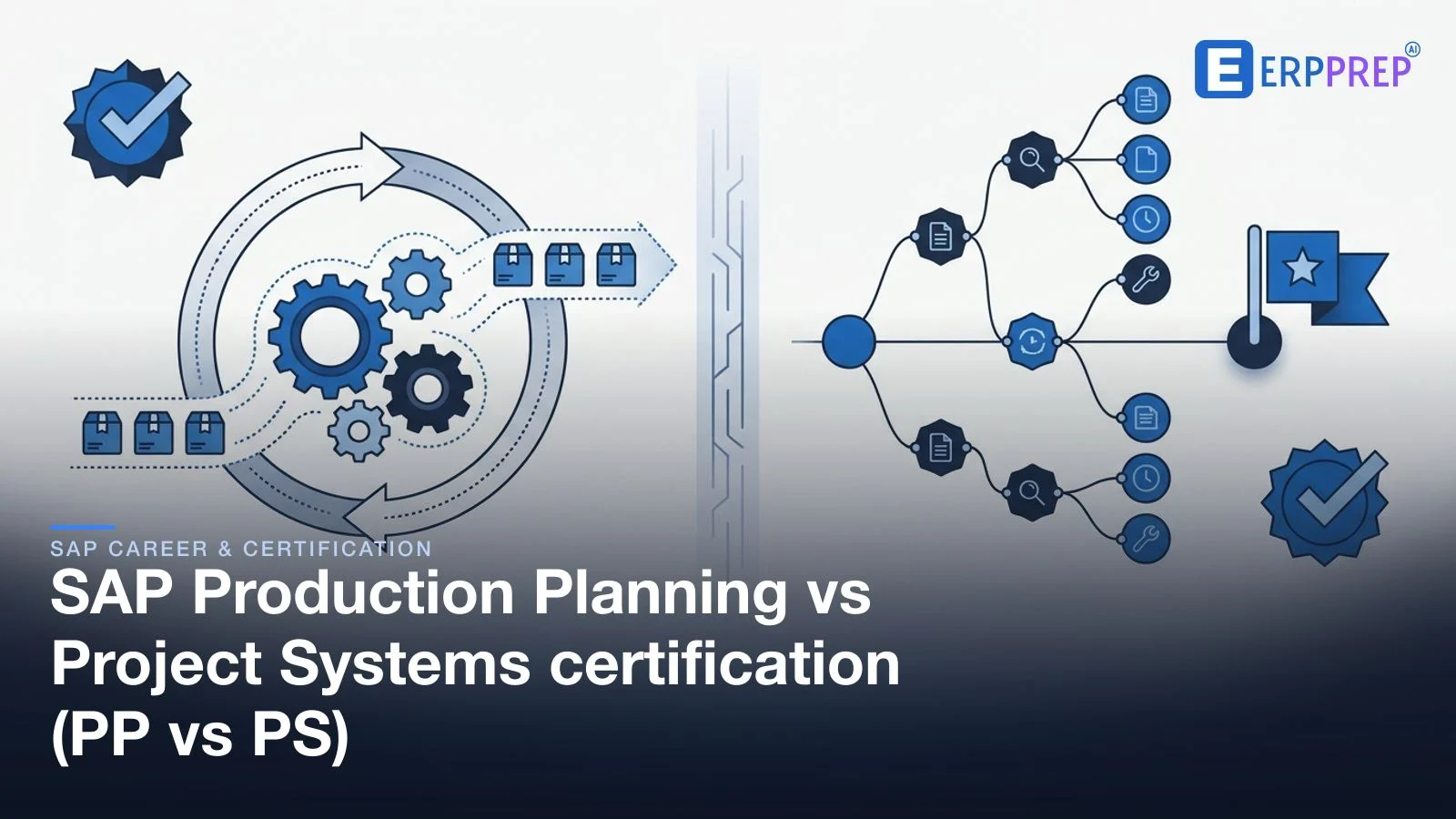
C_TS422 certifies Production Planning & Manufacturing on SAP S/4HANA — demand management, MRP, capacity, and shop-floor execution for repetitive, high-volume production. C_TS412 certifies Project Systems — work breakdown structures, networks, cost and budget planning, scheduling, and period-end settlement for one-off, project-driven work. Both are associate-level System-Based Assessments (SyBA); C_TS422 passes at 64%, C_TS412 at 55%. Choose by whether your work is repetitive manufacturing or project delivery.
Two SAP® S/4HANA certifications get confused constantly because their shorthand looks almost identical — "PP" for Production Planning and "PS" for Project Systems. They sound like neighbours, but they certify genuinely different jobs: C_TS422 is about making products repeatedly at volume, and C_TS412 is about running one-off, budgeted projects. This guide maps what each one actually covers, the very different career worlds behind them, the formats and cut scores, and how to choose — so you never study the wrong module. For the wider landscape of every certification family, see whether SAP certification is worth it and how to choose your path.
Key takeaways
- C_TS422 is manufacturing; C_TS412 is projects. PP plans and executes repetitive production; PS structures, budgets, and settles one-off projects. Same platform, different disciplines.
- The deciding question is repetitive vs project-driven: do you make the same products again and again, or deliver unique, budgeted work with milestones?
- Both are System-Based Assessments (SyBA) — you configure and run tasks in a live system, so hands-on fluency beats memorization on either exam.
- Cut scores: C_TS422 sits at 64%, C_TS412 at 55% (SAP, learning.sap.com) — PP leaves less margin, but the format matters more than the number.
- Both are associate-level. They lead to different roles, so most people specialize on the one that matches their work rather than holding both.
The two certifications at a glance
Each sits on an SAP learning journey (SAP, learning.sap.com) and certifies a distinct functional role. Here they are side by side:
| Dimension | C_TS422 — Production Planning & Manufacturing | C_TS412 — Project Systems |
|---|---|---|
| What it covers | Demand management, MRP, capacity planning, and shop-floor execution on S/4HANA | Work breakdown structures, networks, cost/budget planning, scheduling, period-end settlement |
| Best for | Manufacturing & supply-chain consultants in repetitive, high-volume production | Consultants supporting project-driven work — engineering, construction, R&D, services |
| Format | System-Based Assessment (SyBA) | System-Based Assessment (SyBA) |
| Cut score | 64% | 55% |
| Difficulty | Higher bar; broad planning-to-execution chain to configure fluently | Lower cut score; deep in structures, costing, and settlement mechanics |
The rows tell the story: these are not two flavours of the same exam. They share a platform — SAP S/4HANA — and a format, but the work they certify sits at opposite ends of how a business gets things done. Start at the C_TS422 exam hub or the C_TS412 exam hub for the scenarios and skill drills specific to each.
What C_TS422 (Production Planning & Manufacturing) covers
C_TS422 certifies the person who plans and runs repetitive production — the flow from a demand signal all the way down to finished goods coming off the line. It is built on SAP S/4HANA Cloud Private Edition, and its scope is the classic planning-to-execution chain:
- Demand management and make-to-stock vs make-to-order. Planning strategies decide whether you produce to a forecast and hold stock, or produce only against a confirmed sales order. Getting this framing right is foundational — it shapes everything downstream.
- Material Requirements Planning (MRP). The heart of the module: net-requirements calculation, procurement proposals, planned orders, lot sizing, and how the MRP run turns demand into a coherent supply plan across bills of material and routings.
- Capacity planning. Evaluating whether work centres can actually absorb the planned load, and levelling capacity so the plan is realistic rather than merely arithmetically correct.
- Shop-floor execution. Converting planned orders into production (or process) orders, confirming operations, backflushing components, and completing the cycle with goods receipt of finished product.
The through-line is volume and repetition. This is the module for a plant that makes the same products over and over, where the value is in a smooth, well-sequenced, capacity-aware plan that keeps the line running. Because it spans the whole chain — demand, planning, capacity, execution — it rewards a candidate who can configure and connect the pieces, not just recite them.
What C_TS412 (Project Systems) covers
C_TS412 certifies a completely different mode of working: project-driven delivery, where the unit of work is a unique, time-boxed, budgeted project rather than a repeating production run. Its scope on SAP S/4HANA Project Systems is:
- Project structures and work breakdown structures (WBS). The hierarchical backbone of a project — how you decompose a large endeavour into manageable, individually costed and scheduled elements.
- Networks and activities. The activity-level detail beneath the structure: what work happens, in what order, with what dependencies — the engine that drives scheduling and resource planning.
- Cost and budget planning. Planning costs against the structure, assigning and controlling budgets, and tracking commitments and actuals so a project stays financially on the rails.
- Scheduling. Determining dates across the network, respecting dependencies and constraints so the plan is executable in time as well as in cost.
- Period-end settlement. The financial close-out mechanics that move project costs to their receivers — a defining part of the module that has no direct equivalent in the manufacturing world.
The through-line here is uniqueness and accountability. Every project is a one-off with its own budget, schedule, and cost accountability, and Project Systems is the module that gives that one-off work a structure, a financial spine, and a clean way to settle when it's done. It suits industries where the deliverable is a project: engineering, construction, large services engagements, capital investment, and R&D.
Not sure how a System-Based Assessment feels? A free sample shows the configure-and-run, doing-over-recalling style before you commit to either module. Try a free sample.
Project-driven vs repetitive manufacturing: the real divide
Strip away the codes and the split is a business-model one. Ask a single question: does your organization make the same thing repeatedly, or deliver unique, budgeted work?
- Repetitive manufacturing (C_TS422). A factory that produces the same catalogue of products at volume plans in cycles: forecast demand, run MRP, check capacity, release production, repeat. The rhythm is continuous and the optimization target is throughput and a stable, executable plan.
- Project-driven work (C_TS412). An organization that delivers distinct engagements — build this plant, run this R&D programme, deliver this capital project — structures each one on its own, budgets it, schedules it, and settles its costs at the end. The rhythm is one-off and the optimization target is delivering to budget and schedule.
Some businesses genuinely straddle both — an engineer-to-order manufacturer, for instance, plans production against a project structure. But even there, the two certifications answer different questions, and most consultants live predominantly in one world. Naming your world correctly is the whole decision.
The very different career worlds
Because the modules serve different business models, they open onto different career paths — and the people who succeed in each tend to have different instincts.
- A PP/Manufacturing consultant lives close to the shop floor and the supply chain. The work is planning runs, capacity headaches, master data for bills of material and routings, and keeping production and procurement in sync. It sits naturally alongside the wider logistics and supply-chain family — see the logistics & supply-chain certifications compared for the neighbouring modules.
- A PS/Project Systems consultant lives closer to finance and controlling. The work is structuring projects, planning and controlling their budgets, integrating with cost accounting, and getting settlement right. It attracts people who think in cost objects and financial accountability rather than production throughput — and it's frequently confused with the project-manager certifications, which is a different role again (see the disambiguation below).
Neither world is inherently "better" — they pay attention to different things, and your fit depends on whether you gravitate toward operations and planning or toward structure, cost, and control.
Prerequisites & fit
Both are associate-level certifications with no formal published exam prerequisites, but each assumes real familiarity with its module — and because both are System-Based Assessments, that familiarity has to be hands-on, not theoretical.
- C_TS422 fits manufacturing and supply-chain consultants, production planners moving into configuration, and switchers from another ERP who already understand planning and shop-floor concepts and need to prove S/4HANA-specific competence.
- C_TS412 fits consultants supporting project-based industries, controllers or finance-adjacent professionals who work with project costing, and switchers with project-delivery or engineering backgrounds.
If you're earlier in your SAP journey and unsure which functional lane suits you at all, weigh the options in the best SAP module for beginners before committing to either of these.
How hard are they? Cut scores & difficulty
The published cut score is the clearest single signal, and the two differ noticeably (SAP, learning.sap.com):
| Exam | Format | Cut score | Difficulty note |
|---|---|---|---|
| C_TS422 — Production Planning & Manufacturing | SyBA | 64% | Broad planning-to-execution chain; less margin for error on paper |
| C_TS412 — Project Systems | SyBA | 55% | Lower bar; but deep in structures, costing, and settlement detail |
On paper, C_TS422's 64% leaves less room for error than C_TS412's 55%. But the cut score is only half the story: because both are System-Based Assessments, the real determinant is whether you can configure and run the process live, under time pressure. A planner who runs MRP for a living will find C_TS422 manageable despite the higher bar; a consultant fluent in work breakdown structures and settlement will find C_TS412 comfortable even though it looks "harder" is the wrong instinct — the lower cut score doesn't make PS a soft option, because its costing and settlement mechanics are unforgiving of gaps.
Which should you choose?
Work backwards from the business you support, not from the exam that looks easier:
- Choose C_TS422 if your organization makes products — repetitive or discrete manufacturing, planning runs, capacity, production orders. If there's a shop floor and a production plan, PP is your module.
- Choose C_TS412 if your organization delivers projects — unique, budgeted, scheduled work with cost accountability and settlement. If the deliverable is a project rather than a product, PS is your module.
- Don't pick by cut score. C_TS412's lower number is not a reason to choose it — you'd be certifying for the wrong job. The right exam is the one that matches your work; the cut score only tells you how much margin you have once you're in the right lane.
- Consider both only for genuine hybrids. Engineer-to-order and similar models that plan production against project structures can justify both — but lead with the one you spend most of your time on, and add the second later.
One disambiguation worth making explicit: C_TS412 (Project Systems) certifies configuring the PS module, which is a different job from running an SAP implementation project. If you deliver implementation programmes rather than configure the module, the project-manager certifications are the better fit — see SAP project-management certifications: Public vs Private edition to keep the two apart.
How to prepare — and where to go next
Preparation for both is shaped by the shared format: they're System-Based Assessments that reward doing over recalling. Whichever you choose, build your study around configuring and running the real process — trace it end to end (demand to finished goods for PP; structure to settlement for PS), rehearse under time pressure, and treat reading as the scaffold, not the substance. The performance-based exam preparation guide covers the system-task technique in depth, and each exam hub — C_TS422 and C_TS412 — has the scenarios and skill drills for that specific certification. If you're still placing this decision on the wider map, start with which SAP certification to get first, then come back and pick your module. And to see how the whole doing-over-recalling style feels before you commit, try a free sample.
Frequently asked questions
- What's the difference between SAP PP and PS certification?
- They certify different jobs on the same platform. C_TS422 (Production Planning & Manufacturing) is about making products repeatedly at volume — demand management, material requirements planning, capacity, and shop-floor execution. C_TS412 (Project Systems) is about running one-off, budgeted projects — work breakdown structures, networks, cost planning, scheduling, and settlement. PP suits repetitive manufacturing; PS suits project-driven delivery like engineering, construction, or R&D.
- Which is harder, C_TS422 or C_TS412?
- By published cut score, C_TS422 sits higher at 64% while C_TS412 passes at 55% (SAP, learning.sap.com), so C_TS422 leaves less margin for error on paper. But both are System-Based Assessments where hands-on fluency decides the outcome, not the number. Someone who configures MRP daily will find C_TS422's 64% manageable; someone who lives in project structures will find C_TS412 natural even though it looks easier by the cut score alone.
- Are C_TS422 and C_TS412 associate-level exams?
- Yes. Both are associate-level SAP S/4HANA certifications, positioned as implementation-level qualifications for one solution area rather than senior architecture exams. Associate exams carry the C_ prefix; both of these do. They verify that you can configure and operate their respective modules, not that you design cross-solution landscapes.
- What format are the PP and PS exams?
- Both are System-Based Assessments (SyBA), where you complete configuration tasks directly in a live system rather than answering isolated multiple-choice questions. That means preparation has to be hands-on: reading about MRP or work breakdown structures is not enough when the exam asks you to actually configure and run the process. Confirm current details on each exam's page before booking.
- Which certification should a manufacturing consultant choose?
- If your work is making products on a shop floor — repetitive or discrete manufacturing, planning runs, capacity, production orders — C_TS422 (Production Planning & Manufacturing) is the match. Project Systems (C_TS412) only fits if your organization delivers work as budgeted projects with milestones and settlement. A plant that runs continuous production almost always needs PP, not PS.
- Can I hold both PP and PS certifications?
- You can, and in some industries it makes sense — for example an engineer-to-order manufacturer that plans production against project structures touches both worlds. But most people specialize: the two certifications lead to different roles and different day-to-day work, so the usual pattern is to certify on the one that matches your job and add the second only if your projects genuinely span both.
- Do I need production experience to pass C_TS422?
- The exam assumes familiarity with how planning and manufacturing actually run in S/4HANA — demand management, the MRP run, capacity evaluation, and production or process orders on the shop floor. Because it is a System-Based Assessment, hands-on configuration experience in the module matters far more than memorizing terminology. Candidates who have configured or operated PP find the format much more manageable than those who have only read about it.
- Is Project Systems the same as SAP project management certification?
- No. Project Systems (C_TS412) is a functional configuration certification for the PS module — work breakdown structures, networks, cost and budget planning, and settlement. It is different from the project-manager certifications that certify running an S/4HANA implementation. If you deliver implementation projects rather than configure the PS module, the project-management certifications are the better fit; PS is for the consultant configuring the module.
ERPPrep is an independent platform and is not affiliated with, endorsed by, or sponsored by SAP SE. SAP and other SAP products are trademarks of SAP SE, referenced here only to describe the certification exams ERPPrep helps you prepare for.
Ready to practise the way the exam tests?
ERPPrep provides original, performance-style scenarios and skill drills built for the 2026 SyBA and SBA formats. Try a free sample and judge the quality yourself.
Practice for these exams
Related guides
SAP S/4HANA vs SuccessFactors: which certification career should you choose?
Core ERP / S/4HANA or cloud HR / SuccessFactors? Two very different SAP career worlds compared — the roles, the job markets, and how to choose — using C_TS4FI (Financial Accounting) and C_THR81 (Employee Central) as examples.
SAP Business One vs S/4HANA certification: which ERP path? (C_TB120 vs C_TS4FI)
SAP Business One or the S/4HANA path? C_TB120 certifies a broad small-and-midsize ERP implementer; C_TS4FI certifies module-deep enterprise Financial Accounting. Scope, format, cut score, and how to choose your ERP career.
SAP Asset Management vs Production Planning certification: C_S43 vs C_TS422
Maintain the asset or make the product? C_S43 (SAP S/4HANA Asset Management / plant maintenance) vs C_TS422 (Production Planning and Manufacturing) — what each covers, the format, the cut score, and which to choose.