

SAP Business One vs S/4HANA certification: which ERP path? (C_TB120 vs C_TS4FI)
SAP Business One or the S/4HANA path? C_TB120 certifies a broad small-and-midsize ERP implementer; C_TS4FI certifies module-deep enterprise Financial Accounting. Scope, format, cut score, and how to choose your ERP career.
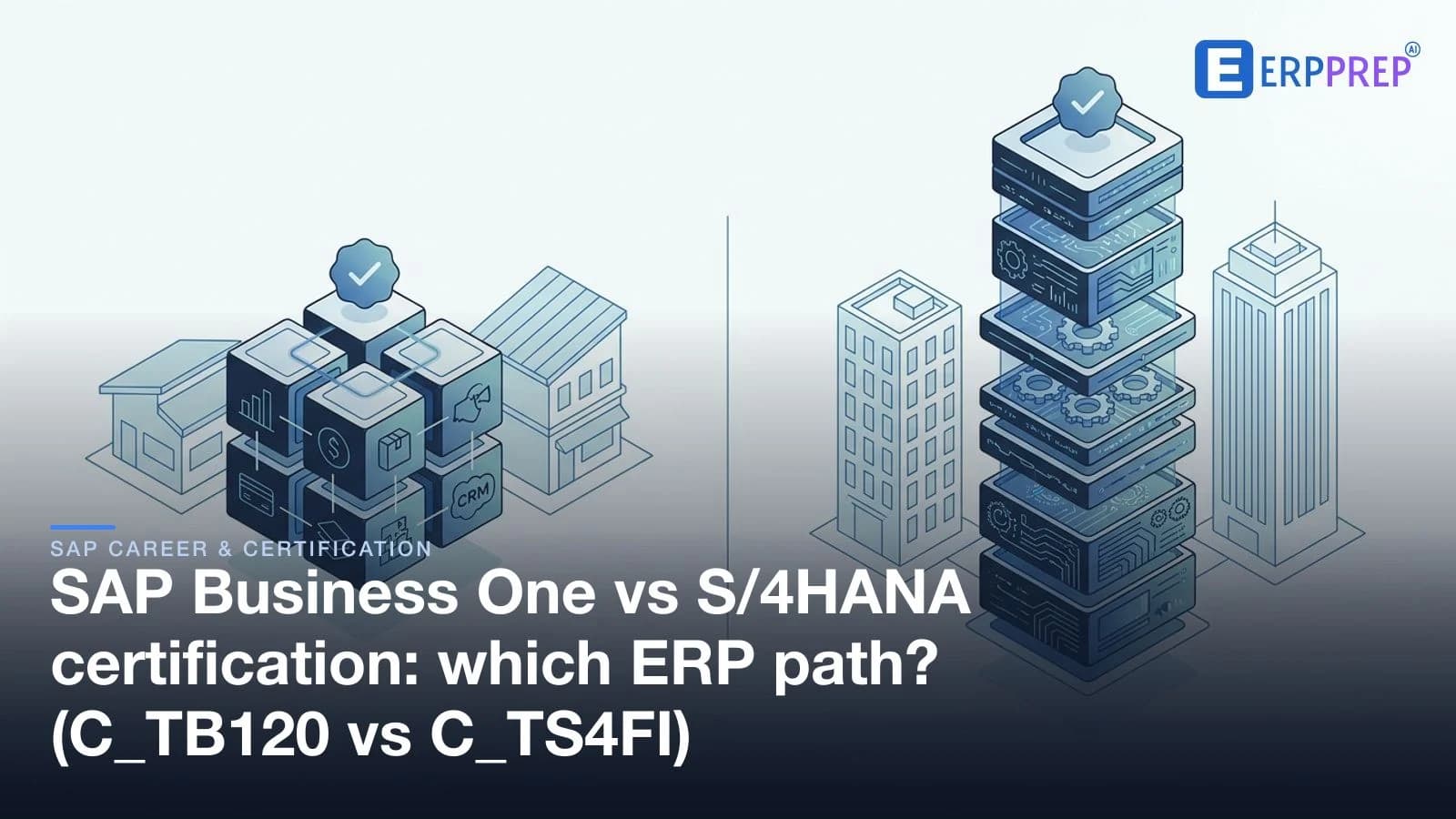
C_TB120 certifies SAP Business One — one integrated ERP for small and midsize businesses, so you learn breadth across logistics, financials, and implementation. The S/4HANA path (represented by C_TS4FI, Financial Accounting) is enterprise-scale and module-deep. Both are associate credentials with a 60% cut score. Choose by the market you want: SME generalist implementer, or enterprise specialist consultant.
SAP® sells ERP for very different kinds of company, and two certifications sit at opposite ends of that range. C_TB120 certifies SAP Business One — one integrated system built for small and midsize businesses — while C_TS4FI certifies Financial Accounting in SAP S/4HANA, a single deep module of the enterprise suite. This is not a feature-for-feature duel between two products; it is a decision about the scale of ERP you want to work on and the career market that comes with it. For the wider question of which SAP credential fits your goals, see whether SAP certification is worth it and how to choose.
Key takeaways
- C_TB120 is the small-and-midsize (SME) path — one system, learned broadly across logistics, finance, implementation, and the product's web client.
- C_TS4FI is the enterprise path, seen through one module — deep Financial Accounting configuration inside SAP S/4HANA, where finance is only one of many specialist tracks.
- The exams use different formats: Business One is a Scenario-Based Assessment (SBA), while C_TS4FI is a System-Based Assessment (SyBA). Both are single-activity and both publish a 60% cut score.
- The real split is breadth versus depth: a generalist SME implementer who owns a whole small business's system, versus a specialist consultant who owns one enterprise process end to end.
- You rarely need both. Pick the market you work in — SME or large enterprise — and only add the second credential if your projects genuinely span both worlds.
C_TB120 vs C_TS4FI at a glance
Both certifications sit on official SAP learning journeys (SAP, learning.sap.com), but they point at different customers, different work, and even different exam formats. Here they are side by side:
| C_TB120 — SAP Business One | C_TS4FI — S/4HANA Financial Accounting | |
|---|---|---|
| ERP scale | Small and midsize businesses (one integrated system) | Large enterprise (a module within the wider suite) |
| Market / role | Generalist SME implementation consultant | Specialist enterprise finance consultant |
| Breadth vs depth | Broad — implementation, logistics, financials, web client in one credential | Deep — one process (Financial Accounting) configured thoroughly |
| Format | Scenario-Based Assessment (SBA), single activity | System-Based Assessment (SyBA), single activity |
| Cut score | 60% | 60% |
| Positioned level | Beginner learning journey (associate) | Intermediate learning journey (associate) |
What C_TB120 (SAP Business One) covers
SAP Business One is a single ERP aimed at smaller companies, so the certification is about knowing that one system well across many areas rather than mastering a single deep process. The overview frames the credential around core knowledge of the product's logistics, finance, and implementation, plus the web client, and around delivering a first project with support from a seasoned colleague. The earned skills reflect that spread: invoicing, managing master data, financial accounting, project rollout, and stock handling all sit under a single exam.
In practice the learning journey moves through the whole business in one system:
- Logistics — purchasing and sales flows, inventory and warehouse handling, pricing, and the production and materials-planning processes a small manufacturer or distributor runs.
- Financials — the chart of accounts, journal entries, banking and payments, controlling reports, fixed assets, and cost accounting, all inside the same product.
- Implementation and setup — company configuration, users and authorisations, numbering, queries, alerts, approvals, and user-defined fields and objects.
- The web client — running master data, sales, purchasing, inventory, service, and analytics through the modern browser-based experience.
The through-line is that a Business One consultant is a generalist for a whole small business. On a small-company project you may be the only SAP person in the room, so the value is being able to connect a sales process to its inventory effect to its financial posting without handing off to three other specialists. Breadth is the job, not a compromise — and it maps naturally to regional partners who implement one product for many SME customers.
What C_TS4FI (S/4HANA Financial Accounting) covers
C_TS4FI takes the opposite shape. It certifies one process — Financial Accounting — inside the large enterprise suite SAP S/4HANA, and it goes deep. The certification describes verifying core skills to configure and run Financial Accounting as part of an implementation project team, which tells you two things at once: this is a specialist role, and it lives on big projects staffed by many specialists. Its earned skills are correspondingly focused: system configuration, financial accounting, financial management, the record-to-report cycle, and accounting.
The learning journey drills into the finance module in a way a broad SME exam never would:
- Organisational units and master data — the finance structures, general-ledger accounts, profit centres, and business partners that everything else posts against.
- General ledger, payables, and receivables — document control, posting rules, clearing, automatic payments, dunning, and correspondence.
- Asset accounting — asset classes, acquisitions, retirements, transfers, depreciation, and year-end handling.
- Period and year-end close — financial statements, valuations, accruals, ledger-specific postings, and the closing cockpit.
- Reporting — the financial-reporting layer that surfaces all of the above for the enterprise.
A C_TS4FI consultant, then, owns a single process to a professional depth. On an enterprise implementation you sit alongside colleagues who own logistics, sales, or production, and your job is to make finance correct — because the cost of a wrong posting rule at that scale is large and very visible. If Business One rewards knowing one system broadly, C_TS4FI rewards knowing one module thoroughly.
Breadth vs depth: two different careers
The clearest way to choose is to picture the project you would be staffed on, because the two rarely overlap.
A Business One consultant tends to work with small and midsize customers, often through a regional SAP partner, implementing one product that runs the customer's entire operation. The work is wide: you are trusted to understand purchasing, inventory, invoicing, and the books well enough to stand up a working system and support the people who use it. It suits someone who likes seeing the whole business, enjoys being the versatile go-to person, and would rather own a complete small system than a slice of a huge one.
A C_TS4FI consultant works on large-enterprise programmes where finance is one specialist workstream among many. The work is deep: precise configuration, defensible design decisions, and integration with neighbouring modules and the close calendar. It suits someone who wants to be the person a programme cannot deliver without when Financial Accounting is in scope, and who is happy trading breadth for authority in one domain.
There is a career-shape difference underneath this. Business One breadth builds a versatile SME profile — valuable across many small customers and close to the whole business — while enterprise depth builds specialist authority that compounds within a domain and travels across large organisations. Neither is "better"; they are different bets on how you want your expertise to grow. For a broader look at how finance credentials sit across SAP's product lines, the guide to choosing an SAP certification path maps the options.
Curious how a performance-based SAP exam actually feels? A free sample lets you experience the reason-through-a-scenario style before you commit to a path. Try a free sample.
Format and cut score: SBA vs SyBA, both at 60%
Here the two exams differ in a way worth planning around. Both publish the same 60% cut score at the time of writing, and both are built around a single activity — but the assessment styles are not identical. C_TB120 uses a Scenario-Based Assessment (SBA), where you reason through a connected business situation and choose the best implementation response. C_TS4FI uses a System-Based Assessment (SyBA), which leans toward configuration and system-behaviour reasoning inside the finance module.
Because the pass mark is the same, difficulty is a function of scope and format, not the threshold. Business One asks you to be comfortable across a broad system in a scenario style; C_TS4FI asks you to be precise inside one module in a system-behaviour style. If you want the technique for working SAP's 2026 performance-based formats under time pressure, the performance-based exam format guide explains how both SBA and SyBA are built and how to approach them. Always confirm the current format, activity count, and cut score on each exam's page at learning.sap.com, since SAP updates these.
Which one should you choose?
Work backwards from the customer you want to serve, not from the exam that looks lighter — the cut score is identical, so that is not a real tie-breaker. Three rules of thumb:
- Choose C_TB120 if you want the small-and-midsize world. You like being a broad, hands-on implementer who can stand up and support a whole system for a smaller company, often through a partner. Breadth is the point.
- Choose C_TS4FI if you want enterprise finance depth. You want to specialise in Financial Accounting on large S/4HANA programmes and be the domain authority on a multi-specialist team. Depth is the point.
- Consider both only if your work truly spans both. Some careers bridge SME and enterprise, or move finance skills between product lines — but that is the exception. Lead with the market you are in and add the second credential when a real project demands it, not by default.
If you are early in your SAP journey and unsure which market suits you, Business One's beginner-positioned, breadth-first path is an approachable on-ramp to how SAP ERP fits together; if you already work in or near enterprise finance, C_TS4FI's intermediate, depth-first path builds directly on that. Neither locks you out of the other later.
Prerequisites and how to prepare
Neither exam is gated behind a formal prerequisite certification. C_TB120 is positioned at beginner level and starts from SAP Business One fundamentals, so it is designed to be a genuine entry point. C_TS4FI is positioned at intermediate level and assumes you are comfortable with core enterprise finance concepts before you configure them — the depth is real, and the learning journey is substantially longer. Check the current recommended courses and any updates on each exam's page at learning.sap.com before you plan.
Once you have chosen, prepare in the style the exam uses. For C_TB120, practise reasoning across a whole small-business scenario — connect a sales or purchasing step to its inventory and financial consequences, since breadth and joined-up thinking are exactly what an SBA probes. For C_TS4FI, rehearse the finance configuration chain — organisational units, posting and clearing rules, asset accounting, and the close — because a SyBA rewards knowing how one setting changes system behaviour downstream. Either way, work through realistic situations under time pressure so your accuracy holds. Start from the exam hub for your path, try a free sample to feel the performance-based style, and build from there.
Frequently asked questions
- What is the difference between the SAP Business One and S/4HANA certifications?
- C_TB120 certifies SAP Business One, a single integrated ERP built for small and midsize companies, so it rewards breadth — implementation, logistics, financials, and the web client in one system. C_TS4FI certifies one deep slice of enterprise S/4HANA: Financial Accounting configuration. Business One makes you a broad SME implementer; the S/4HANA path makes you a module specialist for large organisations.
- What exam format does C_TB120 (SAP Business One) use?
- C_TB120 is a Scenario-Based Assessment (SBA) built around a single activity — you reason through a connected business situation rather than answering isolated trivia. It carries a 60% cut score at the time of writing. Always confirm the current format and activity count on the exam page at learning.sap.com before you book.
- What exam format does C_TS4FI (S/4HANA Financial Accounting) use?
- C_TS4FI is a System-Based Assessment (SyBA) with a single activity — it leans toward configuration and system-behaviour reasoning inside Financial Accounting, and publishes a 60% cut score at the time of writing. This is a different format from Business One's SBA, so match your practice style to it. Confirm details on learning.sap.com.
- What is the cut score for C_TB120 and C_TS4FI?
- Both exams publish a 60% cut score at the time of writing, so the pass mark is not the differentiator between them. Difficulty comes from scope — one broad SME system versus one deep enterprise module — not from the threshold. Check the current cut score on each exam's page before booking, since SAP can revise it.
- Which certification is better for a small-and-midsize-business ERP role?
- SAP Business One (C_TB120) is the SME-facing choice. It is designed around one integrated system that a smaller company runs end to end, so the credential fits a generalist implementer who configures logistics, financials, and the web client for small and midsize customers rather than specialising in one enterprise module.
- Do I need both C_TB120 and C_TS4FI?
- No — they target different markets, so most people pick one to start. Holding both can make sense if you want to move between SME and enterprise projects or bridge finance across product lines, but it is not a required sequence. Lead with the market you work in today and add the second only if your projects genuinely span both.
- Which SAP ERP path has the bigger job market?
- Enterprise S/4HANA typically appears in more large-organisation consulting roles, while SAP Business One serves a large volume of small and midsize customers, often through regional partners. Neither is objectively 'bigger' for you — enterprise work tends to be deeper and more specialised, SME work broader and closer to the whole business. Choose by the kind of customer you want.
- Is the SAP Business One certification easier than the S/4HANA one?
- Not simply easier — different. Both sit at associate level with the same 60% cut score. Business One's learning journey is positioned at beginner level and rewards breadth across one system, whereas the S/4HANA Financial Accounting path is positioned at intermediate level and rewards depth in one module. Business One asks you to know more areas lightly; C_TS4FI asks you to know one area thoroughly.
- What are the prerequisites for C_TB120 and C_TS4FI?
- Neither exam is gated behind a formal prerequisite certification. C_TB120's learning journey is aimed at beginners and starts from Business One fundamentals, while C_TS4FI's journey is positioned at intermediate level and assumes comfort with core enterprise finance concepts before you configure them. Confirm the current recommended courses and any updates on each exam's page at learning.sap.com.
ERPPrep is an independent platform and is not affiliated with, endorsed by, or sponsored by SAP SE. SAP and other SAP products are trademarks of SAP SE, referenced here only to describe the certification exams ERPPrep helps you prepare for.
Ready to practise the way the exam tests?
ERPPrep provides original, performance-style scenarios and skill drills built for the 2026 SyBA and SBA formats. Try a free sample and judge the quality yourself.
Practice for these exams
Related guides
SAP S/4HANA vs SuccessFactors: which certification career should you choose?
Core ERP / S/4HANA or cloud HR / SuccessFactors? Two very different SAP career worlds compared — the roles, the job markets, and how to choose — using C_TS4FI (Financial Accounting) and C_THR81 (Employee Central) as examples.
SAP Finance vs Controlling certification: C_TS4FI vs C_TS4CO
SAP FI certification (C_TS4FI) vs CO (C_TS4CO): statutory books vs cost control — what each SyBA exam covers and how to pick your finance track.
SAP S/4HANA Public vs Private Cloud certifications: how the edition shapes your exam
The S/4HANA deployment edition — Public Cloud or Private Cloud / on-premise — decides which SAP certification you should take and how the consulting work differs. The edition axis across the catalog, with example exams and how to choose.