

SAP Asset Management vs Production Planning certification: C_S43 vs C_TS422
Maintain the asset or make the product? C_S43 (SAP S/4HANA Asset Management / plant maintenance) vs C_TS422 (Production Planning and Manufacturing) — what each covers, the format, the cut score, and which to choose.
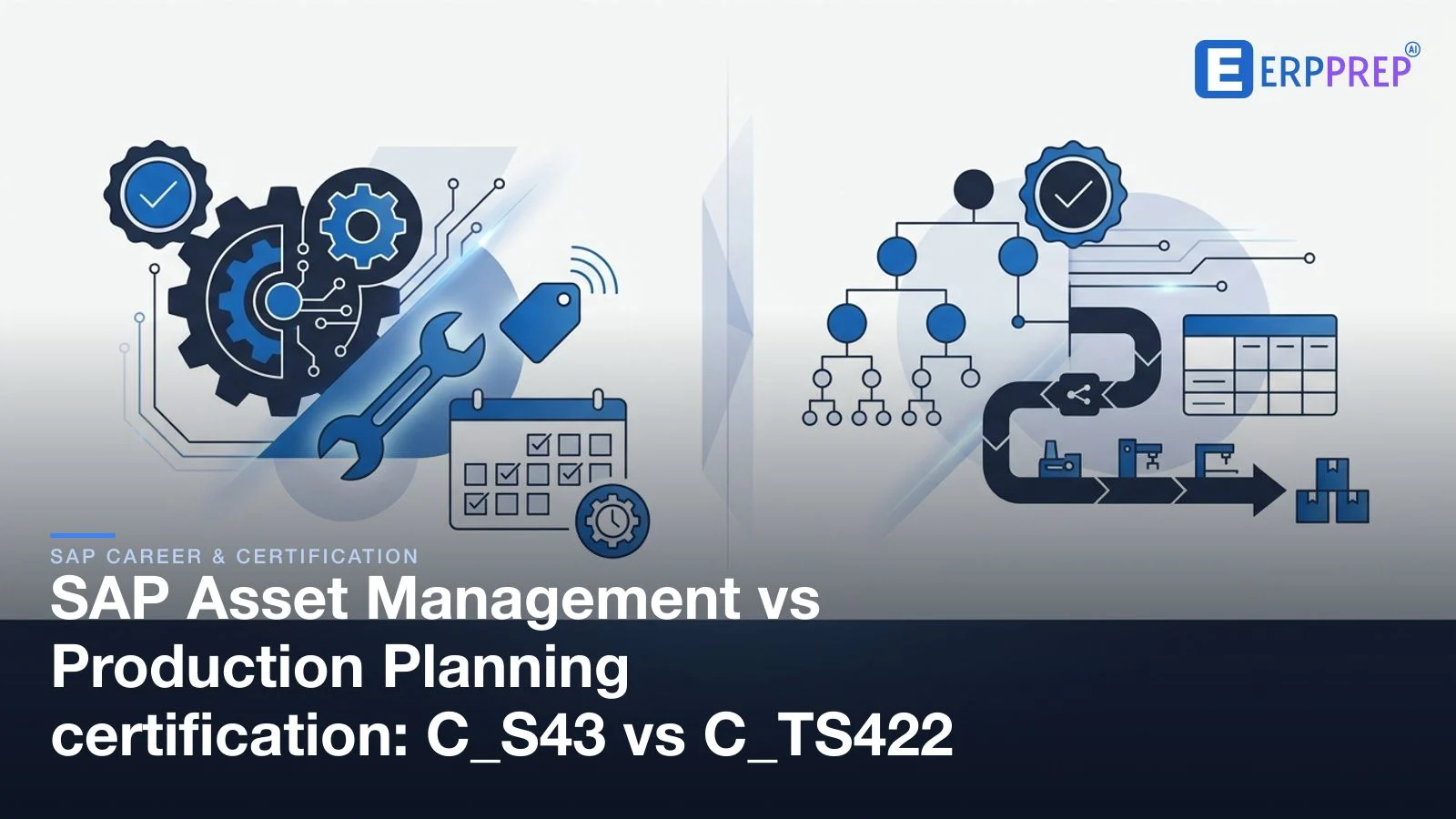
C_S43 certifies Asset Management on S/4HANA (Cloud Private Edition) — technical objects, maintenance notifications and orders, and preventive maintenance planning for the teams who keep equipment running. C_TS422 certifies Production Planning and Manufacturing — bills of material, routings, MRP, capacity, and production or process orders that turn materials into finished goods. Both are associate System-Based Assessments. Choose by whether you maintain the asset or make the product.
SAP® certifies its S/4HANA logistics world module by module, and two associate exams sit close on the catalogue while pointing at opposite jobs on the shop floor. C_S43 covers Asset Management — the enterprise asset management and plant maintenance side, where the goal is to keep equipment running — while C_TS422 covers Production Planning and Manufacturing, where the goal is to turn materials into finished product. This guide compares what each certifies, the shared SyBA format, the differing cut scores, and how to choose. For the wider question of which SAP credential fits your direction, see whether SAP certification is worth it and how to choose.
Key takeaways
- C_S43 is the maintain-the-asset track — it certifies configuring and running enterprise asset management and plant maintenance: technical objects, notifications, orders, and preventive maintenance.
- C_TS422 is the make-the-product track — it certifies planning and executing manufacturing: master data, MRP, capacity, and production or process orders.
- Both are associate-level System-Based Assessments (SyBA), so you demonstrate the work in a system rather than recall definitions — but their published cut scores differ (C_S43 higher than C_TS422 at the time of writing).
- They map to different roles and industries: a maintenance / EAM consultant in asset-heavy sectors versus a production-planning consultant in discrete or process manufacturing.
- Neither is a prerequisite for the other, and most consultants specialise in one — holding both suits only a broad S/4HANA logistics generalist.
C_S43 vs C_TS422 at a glance
Both certifications sit on official SAP S/4HANA Cloud Private Edition learning journeys (SAP, learning.sap.com) and share an assessment style, but the subject matter barely overlaps. Here they are side by side:
| C_S43 — Asset Management | C_TS422 — Production Planning & Manufacturing | |
|---|---|---|
| What it covers | Technical objects (functional locations, equipment, BOMs), notifications and maintenance orders, preventive maintenance planning, and maintenance customizing | Master data (material, BOM, routing, work centres), MRP and demand management, capacity planning, and production or process order execution |
| Best for | Plant maintenance / enterprise asset management consultants | Production-planning and manufacturing consultants |
| Format | System-Based Assessment (SyBA) | System-Based Assessment (SyBA) |
| Cut score | 70% (confirm on learning.sap.com) | 64% (confirm on learning.sap.com) |
| Typical industries | Utilities, transport, process plants, asset-heavy operators | Discrete and process manufacturers |
What C_S43 (Asset Management) covers
The Asset Management certification is about the equipment an organisation depends on and the maintenance work that keeps it available. Rather than making a product, you learn to model the physical asset landscape and drive the maintenance processes around it. The skills sit in the enterprise asset management and plant maintenance space — the world of preventive maintenance, logistics-side master data, and the day-to-day of the maintenance workshop.
In practice the module works up from the asset structure to the processes that act on it:
- Technical objects — functional locations, equipment and serial numbers, bills of material for assets, measuring points and counters, and linear asset structures that describe what is being maintained and how it is organised.
- Corrective and emergency maintenance — raising notifications, creating and releasing maintenance orders, planning materials and services, confirming the work, and completing the order.
- Preventive maintenance — task lists, maintenance plans, and scheduling, including time-based and performance-based (counter-driven) maintenance strategies and multiple-counter plans.
- Customizing — configuring notification and order types, plants and work centres, catalogs and priorities, and the controlling side of settlement and costing for maintenance work.
- Advanced processing — phase-based maintenance, inspection checklists, and the refurbishment of repairable spare parts, both internally and via external services.
The through-line is availability and cost control: a maintenance consultant makes sure the right work happens on the right asset at the right time, with the paperwork and costs flowing correctly behind it. Because the exam is a System-Based Assessment, it leans on your ability to actually build and drive that configuration and those transactions, not merely describe them.
What C_TS422 (Production Planning & Manufacturing) covers
Production Planning and Manufacturing is about making things. Where Asset Management keeps the plant running, C_TS422 is concerned with planning demand, converting it into supply, and executing the orders that turn raw materials into finished goods across both discrete and process industries. The earned skills reflect that: production planning, manufacturing processes, material components, and the production process itself.
The module is broad, spanning master data through advanced planning to shop-floor execution:
- Manufacturing master data — materials and the product master, bills of material (including phantoms, co-products and variant BOMs), routings and reference operation sets, and work centres with their capacities.
- Demand management and planning strategies — make-to-stock and make-to-order approaches, and how requirements are represented before planning runs.
- Material requirements planning — the MRP run (including MRP Live), predictive MRP, demand-driven replenishment, and evaluating the planning results.
- Advanced planning and scheduling — embedded PP/DS heuristics, detailed scheduling, and optimisation for tighter, constraint-aware plans.
- Capacity planning — evaluating work-centre load and levelling capacity with the planning tables and scheduling boards.
- Order execution — the lifecycle of production and process orders: creation, release, material availability checks, goods issues, confirmations, and goods receipts.
A production-planning consultant, then, owns the chain from a forecast to a finished-goods receipt. What makes the module demanding is that the pieces are linked: a BOM and routing feed a planning run; the plan becomes a production order; the order draws components, loads a work centre, and posts a receipt. Change one link and the effect ripples downstream — which is exactly the kind of dependency a System-Based Assessment is built to test.
The very different roles behind each exam
The clearest way to choose is to look at who actually does each job. They rarely share a seat on a project team.
A C_S43 specialist is a plant-maintenance or enterprise asset management consultant. The work is asset-and-reliability shaped: model the equipment hierarchy, configure notification and order types, and stand up preventive maintenance so that breakdowns fall and planned work rises. It fits asset-heavy operators — utilities, transport, mining, oil and gas, and process plants — where the maintenance function is a core cost centre and uptime is the business. If you like tangible, equipment-grounded problems and the discipline of scheduled work, this is the track.
A C_TS422 specialist is a production-planning and manufacturing consultant. The work is planning-and-execution shaped: master data quality, MRP behaviour, capacity trade-offs, and the order lifecycle on the shop floor. It fits discrete makers (assembled products) and process industries (formulated or batch products) alike. It suits someone who enjoys reasoning about flow, constraints, and the knock-on effects of a planning decision across a supply chain.
There is a career-shape difference too. Maintenance expertise is portable across any industry that runs physical assets, so a C_S43 consultant can move between very different sectors on the strength of the same process knowledge. Manufacturing expertise is deep but more tied to how a given plant makes things, and it pairs naturally with neighbouring supply-chain and materials-management work. Neither is "better" — they are different bets on where you want your expertise to compound.
For a wider view of how these logistics modules sit alongside the rest of the S/4HANA field, the best SAP certification for a supply-chain career hub places maintenance and manufacturing among the broader set of options.
Not sure how a System-Based Assessment feels? A free sample shows the work-in-the-system style before you commit to a module. Try a free sample.
Format and cut score: both SyBA, different pass marks
This is where the two exams partly converge and partly diverge. Both C_S43 and C_TS422 use the System-Based Assessment (SyBA) format — SAP's performance-based style delivered as a hands-on activity, where you carry out realistic system work rather than recalling isolated facts. Where they differ is the pass mark: at the time of writing C_S43 publishes a 70% cut score and C_TS422 a lower 64% cut score. Because SAP revises these as content is updated, confirm the current figure on each exam page before you book.
The practical read: a higher cut score on C_S43 leaves a slightly tighter margin for error, while C_TS422 spreads a broader set of manufacturing topics — from master data through advanced planning — over a lower bar. Neither fact makes one exam universally harder; difficulty is really a function of the module's breadth and your hands-on fluency with it. Either way, the winning preparation is the same: practise doing the work. If you want the technique for this exam family, the guide to the performance-based exam format covers how SyBA activities are built and how to work them under time pressure.
Can you hold both C_S43 and C_TS422?
Yes — nothing stops you certifying in both, and neither is a formal prerequisite for the other. But for most people it is not the efficient move. The two credentials describe different jobs, and depth in one is usually worth more on a project than breadth across both. Holding the pair makes sense mainly for a broad SAP S/4HANA logistics generalist, or for a consultant whose plant genuinely spans both worlds — for example where maintenance work orders draw on the same work centres, materials, and plant structures that manufacturing planning uses. In that overlap, understanding both sides is a real advantage.
If you do pursue both, sequence them. Lead with the module you already touch daily so the first credential compounds your current work, then add the second once you have real project exposure to it. Trying to absorb enterprise asset management and full manufacturing planning at the same time usually means learning both shallowly rather than either one well.
Prerequisites and how to prepare
Neither exam is locked behind a required certification — both are positioned as associate entry points for a consultant who contributes to an implementation in a mentored capacity. What matters more is the foundation underneath them: comfort with core SAP S/4HANA navigation and logistics fundamentals, and the shared master-data concepts (materials, BOMs, work centres) that both maintenance and manufacturing lean on. If you are new to S/4HANA logistics entirely, build that base first before specialising.
Once you have chosen, the approach is the same because the format is shared. Practise doing the work in a realistic setting rather than only reading — model technical objects and drive maintenance orders for C_S43, or build master data and run planning and production orders for C_TS422. Trace whole processes end to end so the dependency chains become second nature, and rehearse under time pressure so your accuracy holds when the clock is running. Start from the exam hub for your module, try a free sample to feel the System-Based style, and build from there.
Frequently asked questions
- What is the difference between C_S43 and C_TS422?
- C_S43 is the Asset Management on S/4HANA (Cloud Private Edition) certification — enterprise asset management and plant maintenance, covering technical objects, notifications, maintenance orders, and preventive maintenance planning. C_TS422 is the Production Planning and Manufacturing certification — bills of material, routings, material requirements planning, capacity, and production and process orders. One keeps equipment running; the other makes the product.
- What exam format do C_S43 and C_TS422 use?
- Both use SAP's System-Based Assessment (SyBA) format, delivered as a single hands-on activity in the current SAP S/4HANA Cloud Private Edition line. You work through realistic system tasks rather than answering isolated multiple-choice trivia. Confirm the live activity count and any updates on each exam's page at learning.sap.com before you book.
- What is the cut score for C_S43 and C_TS422?
- At the time of writing C_S43 publishes a 70% cut score, while C_TS422 publishes a lower 64% cut score. The two thresholds are not identical, so check the current figure on each exam page before booking, because SAP revises cut scores as the underlying content is updated.
- Which SAP certification should I take first, C_S43 or C_TS422?
- Lead with the exam that matches the work you already own. If you configure or run maintenance, notifications, and technical objects, start with C_S43; if you plan and execute manufacturing, MRP, and production orders, start with C_TS422. Neither is a prerequisite for the other, so there is no forced sequence — pick the one closest to your day-to-day role.
- Do I need both the Asset Management and Production Planning certifications?
- Usually not. The two map to different roles on an SAP project, so most consultants specialise in one. Holding both makes sense only for a broad SAP S/4HANA logistics generalist, since maintenance and manufacturing meet where a work centre, a material, or a shared plant sits in both worlds. Lead with one and add the second only when a project genuinely needs it.
- Is Asset Management or manufacturing the better SAP career path?
- Neither is objectively better — they are different bets. Asset management and plant maintenance skills travel across asset-heavy industries such as utilities, transport, and process plants. Manufacturing and production-planning skills fit discrete and process makers. Choose by the industry and role you want to compound expertise in, not by which credential looks easier.
- Are there prerequisites for C_S43 or C_TS422?
- Neither exam is gated behind a formal prerequisite certification; both are positioned as associate entry points for a consultant contributing to an implementation in a mentored capacity. Both learning journeys assume comfort with core SAP S/4HANA navigation and logistics fundamentals first, so build that base before specialising in maintenance or manufacturing.
- Is C_S43 harder than C_TS422?
- Difficulty is more about breadth and your hands-on familiarity than the pass mark. C_S43 currently carries a higher cut score (70% versus 64%), so its margin for error is tighter, while C_TS422 spans a wider set of manufacturing topics from master data through advanced planning. Match your study to the module you pick rather than assuming one is universally harder.
ERPPrep is an independent platform and is not affiliated with, endorsed by, or sponsored by SAP SE. SAP and other SAP products are trademarks of SAP SE, referenced here only to describe the certification exams ERPPrep helps you prepare for.
Ready to practise the way the exam tests?
ERPPrep provides original, performance-style scenarios and skill drills built for the 2026 SyBA and SBA formats. Try a free sample and judge the quality yourself.
Practice for these exams
Related guides
SAP integration certifications compared
Compare SAP's integration certification options — the Integration Developer (C_CPI) and BTP Administrator (C_ADBTP) — and where legacy Process Orchestration fits.
SAP BTP certifications explained: which one is right for you
A map of the SAP BTP certification family — administrator, architect, integration, ABAP and generative-AI developer, LeanIX EA — and how to choose.
SAP consultant vs SAP developer: certification paths compared
Two SAP career forks, two kinds of certification. The functional-consultant path (e.g. C_TS4FI) configures business processes; the developer path (e.g. C_ABAPD) writes code. What each role does, what its exams look like, and how to choose.