

SAP IBP vs supply-chain execution certifications (C_IBP): planning vs execution
Plan the chain or run it? How the SAP IBP certification (C_IBP, supply-chain planning) differs from the S/4HANA execution certifications for warehouse (C_S4EWM) and transport (C_S4TM), and which to choose.
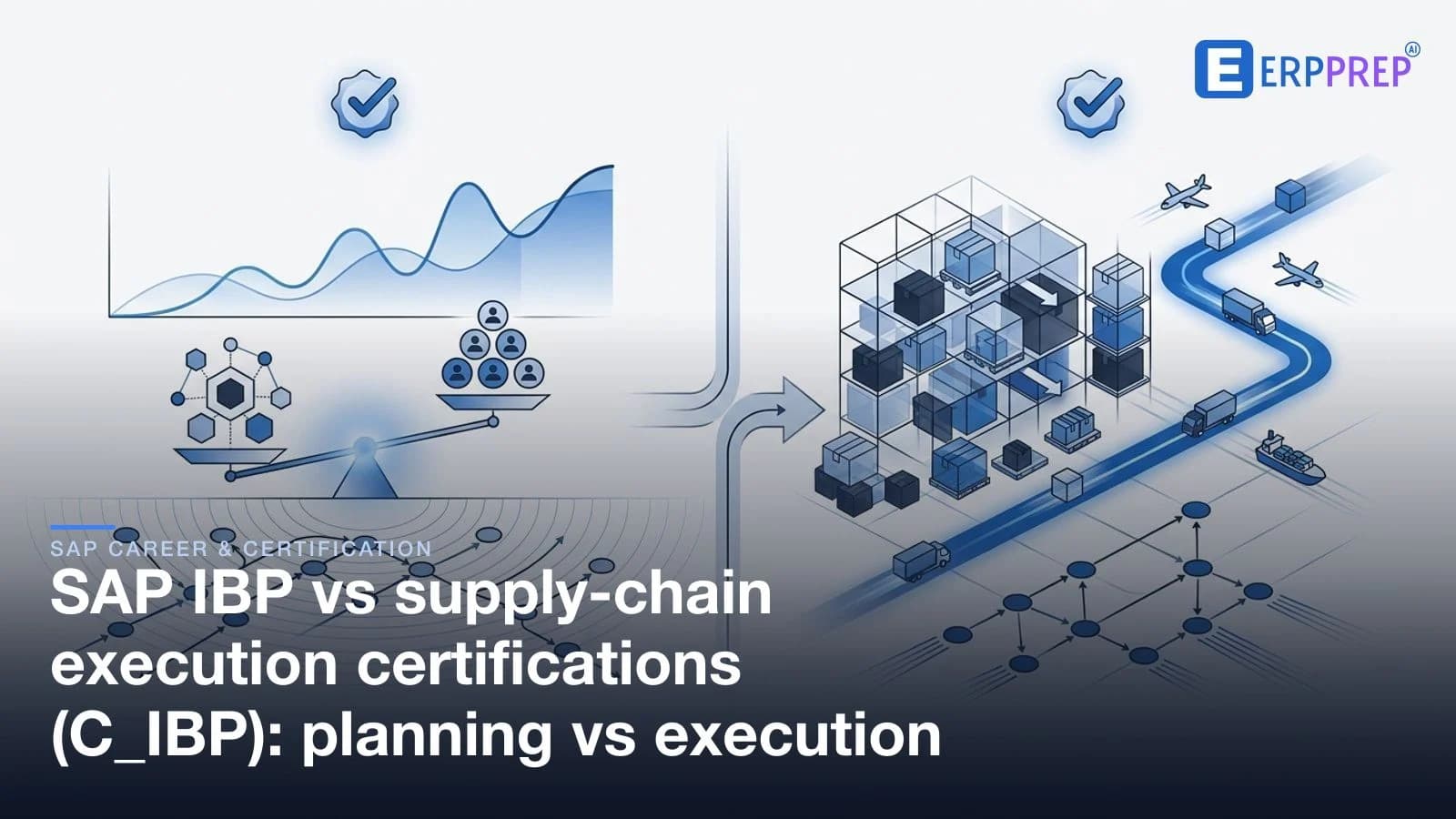
SAP IBP certification (C_IBP) validates supply-chain planning — demand, supply and response, S&OP, and inventory optimization. The S/4HANA execution certifications validate running the physical chain: Extended Warehouse Management (C_S4EWM) for warehouse operations and Transportation Management (C_S4TM) for freight and transport. Choose planning if you shape what should happen; choose execution if you make it happen on the ground.
Every supply-chain career eventually splits along one question: do you want to decide what the chain should do, or make it happen on the ground? That split runs straight through SAP® certification. On the planning side sits SAP Integrated Business Planning (C_IBP), newly available and focused on demand, supply, and inventory strategy. On the execution side sit the S/4HANA certifications for warehouse and transport operations. Picking between them is a career decision, not just an exam-shopping one. For the wider "is certification worth it and how do I choose" framing, start with whether SAP certification is worth it and how to choose a path.
Key takeaways
- Planning vs execution is the real fork — not one exam being harder than another. They certify different jobs.
- SAP IBP (C_IBP) is the planning path: demand planning, supply and response, S&OP, and inventory optimization.
- Extended Warehouse Management (C_S4EWM) and Transportation Management (C_S4TM) are the execution paths — running the warehouse and moving the freight.
- The formats differ: C_IBP and C_S4EWM are System-Based (SyBA); C_S4TM is Scenario-Based (SBA). Cut scores also differ sharply.
- Choose by the work you own — analytical planning or operational execution — then deepen there before spanning both.
Plan the chain vs run the chain: the framing that matters
Supply-chain software divides cleanly into two layers, and your career tends to live in one of them. The planning layer is where an organization figures out, ahead of time, how much to make, hold, and move: it forecasts demand, balances that against available supply, reconciles the numbers across sales and operations, and sets inventory targets. The execution layer is where those decisions become physical reality — goods received and put away, orders picked and shipped, trucks planned, freight tendered and settled.
SAP's certifications mirror that divide. IBP is a planning solution; Extended Warehouse Management and Transportation Management are execution solutions inside the S/4HANA supply-chain stack. So the honest first question is not "which exam is best?" but "which layer do I want to work in?" A planner who loves forecasting models and a warehouse consultant who loves throughput and slotting are both in supply chain, but their strongest first certification is different — and that is exactly what this guide untangles.
The three certifications at a glance
Each of the three sits on its own SAP learning journey (SAP, learning.sap.com) and points to one associate, consultant-profile exam. Start from the layer you want to own:
| If your work is… | Certification | Format & cut score (verify current) |
|---|---|---|
| Deciding demand, supply, S&OP, and inventory strategy | C_IBP — SAP Integrated Business Planning (planning) | System-Based (SyBA); listed at a 90% cut score. |
| Running warehouse operations end to end | C_S4EWM — Extended Warehouse Management (execution) | System-Based (SyBA); listed at a 65% cut score. |
| Planning and settling freight and transport | C_S4TM — Transportation Management (execution) | Scenario-Based (SBA); listed at a 60% cut score. |
One detail stands out: IBP's cut score is high. A 90% bar leaves little room for guesswork and rewards precise command of planning configuration and logic. The execution exams sit lower, but they are format-different — one asks you to do the work in a system, the other to reason through a scenario. Confirm the current format and cut score on each exam's page at learning.sap.com before you book, because SAP adjusts these as products evolve.
SAP IBP: certifying the planning brain of the chain
C_IBP validates that you can operate the planning solution that sits above execution. Its scope, drawn from the official learning journey, spans the core planning disciplines: demand planning (statistical forecasting and demand sensing), supply and response planning (balancing supply against demand across time horizons, using time-series and order-based approaches), sales and operations planning (S&OP), and inventory optimization. Around those sit the supply-chain control tower for visibility, the planning model configuration, and the analytics that make plans decision-ready.
SAP lists C_IBP as a System-Based Assessment (SyBA) — you demonstrate competence by working through planning activities rather than reciting definitions — and it carries a 90% cut score, one of the more demanding bars in the supply-chain portfolio. That combination tells you what the exam values: not surface familiarity with planning vocabulary, but accurate, hands-on fluency with how key figures, planning areas, and planning operators actually behave. It is positioned as an entry-level, consultant-profile qualification, meaning it is designed to be taken alongside training and guided project work, not in a vacuum. If your instinct is toward models, forecasts, and trade-off decisions, this is your path.
Extended Warehouse Management: certifying the warehouse floor
C_S4EWM is the first of the two execution certifications, and it is about running the warehouse. Its scope covers warehouse structures and master data, inbound processes (goods receipt and putaway), outbound processes (picking, packing, and goods issue), storage control, and the operational machinery in between — waves, resource management, physical inventory, and radio-frequency-driven floor work. Where IBP asks "how much should we hold and where?", EWM asks "how does this pallet physically move from the dock to the bin and back out the door?"
SAP lists C_S4EWM as a System-Based Assessment (SyBA) with a 65% cut score. Like the other execution content, it rewards people who understand whole operational flows — how a configuration choice in putaway ripples into stock removal later — rather than isolated settings. It is relevant across S/4HANA deployment options and is aimed at the consultant profile. Choose it if your center of gravity is the warehouse: throughput, slotting, storage strategy, and the physical accuracy of stock.
Curious how a System-Based exam actually feels? A free sample shows the doing-over-recalling style — the same style both C_IBP and C_S4EWM use — before you commit to a supply-chain path. Try a free sample.
Transportation Management: certifying freight and movement
C_S4TM is the second execution certification, and it moves the goods between locations. Its scope covers the transportation network and master data, transportation planning (interactive and optimizer-driven), freight order management and carrier selection, and freight settlement — charge calculation, agreements, and cost distribution. It is the discipline of getting the right freight onto the right vehicle at the right cost, and reconciling what the carrier bills.
Here the format changes. SAP lists C_S4TM as a Scenario-Based Assessment (SBA) with a 60% cut score — you reason through a connected transport scenario rather than completing isolated system tasks. That is a meaningful difference in how you prepare: SBA rewards judgment across a joined-up situation, while SyBA rewards precise execution of discrete tasks. EWM and TM are close neighbors on the execution side and are often confused, so if you are weighing the two against each other specifically, the dedicated SAP EWM vs TM certification comparison breaks down warehouse-versus-transport in depth so this guide doesn't have to repeat it.
How planning and execution differ day to day
The exams differ because the jobs differ. A planning consultant on IBP spends the week in forecasts, planning runs, key-figure logic, and S&OP alignment meetings — the horizon is weeks to months, and the output is a defensible plan. An execution consultant on EWM or TM spends the week in process configuration, operational exceptions, and the physical flow of goods — the horizon is hours to days, and the output is material that actually moved correctly.
Neither is superior; they attract different temperaments. Planning suits people who enjoy modeling uncertainty and reconciling competing numbers. Execution suits people who enjoy making a complex operational process run cleanly and predictably under pressure. That is why the "which certification?" question is answered best by looking at which of those two weeks you would rather have — a point the broader best SAP certification for a supply-chain career guide develops across the whole logistics portfolio.
Choose planning (C_IBP) if…
- You work in or want to move into demand planning, S&OP, or inventory strategy, and you are comfortable with forecasting and trade-off analysis.
- You are energized by shaping decisions ahead of time rather than running operations in real time.
- You can commit to a demanding 90% cut score and the precise, system-based fluency it implies.
- Your organization is investing in integrated planning and wants consultants who can stand up the planning layer above S/4HANA execution.
Choose execution (C_S4EWM or C_S4TM) if…
- Your center of gravity is the physical chain — goods actually moving through warehouses and across transport networks.
- You prefer operational process work: configuring, running, and troubleshooting how material and freight flow.
- Warehouse-centric roles point to C_S4EWM (SyBA); transport-and-freight roles point to C_S4TM (SBA).
- You want to specialize in a well-defined execution domain with strong, durable project demand.
Do you need both sides?
Rarely at the same time. Because planning and execution are genuinely different day jobs, most consultants go deep on one side first and earn credibility there before broadening. The value of spanning both comes later — typically for architecture or solution-lead roles that have to reason about the end-to-end chain, where understanding how a planning decision lands in warehouse and transport execution is a real advantage. But that is a deliberate second move, not a starting requirement. Early on, a thin spread across planning and execution is weaker than clear depth in one.
A sensible sequence for many people is: certify in the layer that matches your current role, deliver real project work there, then add an adjacent certification as your responsibility widens. A planner might later add an execution certification to understand downstream constraints; a warehouse consultant might add transport, or eventually planning, to move toward an end-to-end architecture role.
Preparing for planning vs execution exams
The preparation habit is shared even though the domains diverge. All three exams are performance-based rather than recall-based, so the winning approach is the same: work in a realistic environment, understand whole flows rather than isolated facts, and rehearse under time pressure so accuracy holds when it counts. Learn to prepare for the performance-based format once and the technique carries across IBP, EWM, and TM — even though one is about forecasts, one about pallets, and one about freight.
Where they differ is emphasis. For the two System-Based exams (C_IBP and C_S4EWM), practice the doing: reproduce configuration and process tasks until the dependency chains are second nature — and for IBP, respect that 90% bar by drilling for precision, not just familiarity. For the Scenario-Based exam (C_S4TM), practice the judgment: work through joined-up transport scenarios and defend the best decision under competing constraints. Match your rehearsal to the format, and confirm the live exam details on each page at learning.sap.com, since SAP updates formats and cut scores over time.
Choosing your supply-chain certification
Work backward from the layer you want to own. If you shape what the chain should do — demand, supply, S&OP, inventory — start with C_IBP. If you make it happen in the warehouse, start with C_S4EWM. If you move the freight, start with C_S4TM. Each exam hub above holds the scenarios, skill drills, and exam facts for that specific certification, and the EWM vs TM comparison goes deeper on the two execution options if that is where you have landed.
Once you know your layer, the fastest way to gauge whether you are ready is to practise the format itself. Try a free sample and see the doing-over-recalling style that both the planning and execution exams reward — before you commit to plan-the-chain or run-the-chain.
Frequently asked questions
- What is the difference between SAP supply-chain planning and execution certifications?
- Planning certifications validate deciding what the supply chain should do — forecasting demand, balancing supply, running sales-and-operations planning, and optimizing inventory. The SAP IBP exam (C_IBP) sits here. Execution certifications validate carrying those decisions out physically: Extended Warehouse Management (C_S4EWM) runs warehouse operations and Transportation Management (C_S4TM) moves freight. Planning is upstream and analytical; execution is downstream and operational.
- What format is the SAP IBP certification exam?
- SAP lists C_IBP as a System-Based Assessment (SyBA) built around a live activity, rather than a pure multiple-choice test. That means you demonstrate competence by working through planning tasks in a system context. Formats change as SAP updates its portfolio, so confirm the current format on the C_IBP page at learning.sap.com before you book.
- What format are the SAP EWM and TM certification exams?
- The two execution exams are formatted differently. Extended Warehouse Management (C_S4EWM) is listed as a System-Based Assessment (SyBA), where you complete tasks in a system. Transportation Management (C_S4TM) is listed as a Scenario-Based Assessment (SBA), where you reason through a connected business scenario. Always verify the current format on each exam's page at learning.sap.com.
- What are the cut scores for C_IBP, C_S4EWM, and C_S4TM?
- At the time of writing, SAP lists C_IBP with a 90% cut score, C_S4EWM with a 65% cut score, and C_S4TM with a 60% cut score. IBP's high bar reflects a precise, planning-configuration focus. Cut scores are adjusted over time, so treat these as a starting point and confirm the live values on each exam's page at learning.sap.com.
- Which SAP supply-chain certification should I take first?
- Start from the work you do or want to do. If your role is analytical — forecasting, S&OP, inventory strategy — begin with SAP IBP (C_IBP). If your role is operational and warehouse-centric, begin with Extended Warehouse Management (C_S4EWM); if it is transport and freight-centric, begin with Transportation Management (C_S4TM). Match the certification to your day-to-day responsibility rather than to exam difficulty.
- Is SAP IBP different from S/4HANA supply chain?
- Yes. SAP Integrated Business Planning is a dedicated planning solution focused on demand, supply, response, S&OP, and inventory optimization, and it can integrate with S/4HANA. The execution certifications (C_S4EWM, C_S4TM) sit inside the S/4HANA supply-chain execution stack that runs warehouse and transport operations. They complement each other: IBP decides the plan, S/4HANA execution carries it out.
- Do I need both a planning and an execution certification?
- Usually not at once. Most consultants specialize on one side first because the day-to-day work is genuinely different — analytical planning versus operational execution. Broadening into the other side is valuable later, especially for architecture roles that span the end-to-end chain, but it is a deliberate second step rather than a prerequisite. Depth in one domain beats a thin spread across both early on.
- What background helps before taking these SAP supply-chain exams?
- SAP positions all three as associate, consultant-profile certifications intended to be taken alongside training and guided project experience rather than in isolation. Comfort with core supply-chain concepts helps everywhere; planning candidates benefit from forecasting and S&OP familiarity, while execution candidates benefit from logistics and warehouse or transport process exposure. Check each learning journey at learning.sap.com for the recommended preparation.
ERPPrep is an independent platform and is not affiliated with, endorsed by, or sponsored by SAP SE. SAP and other SAP products are trademarks of SAP SE, referenced here only to describe the certification exams ERPPrep helps you prepare for.
Ready to practise the way the exam tests?
ERPPrep provides original, performance-style scenarios and skill drills built for the 2026 SyBA and SBA formats. Try a free sample and judge the quality yourself.
Practice for these exams
Related guides
SAP EWM and supply chain interview questions
What SAP warehouse and supply-chain consultants are really asked at interview — six question themes, what each one tests, and how to structure your answer.
The best SAP certification for a manufacturing career in 2026
A manufacturing-first guide to SAP certification: the three plant-floor paths — production planning, asset management, and warehouse execution — and how to choose the one that fits your factory role.
SAP procurement vs supply-chain certification: buy vs plan-and-move
How the SAP procurement track (Sourcing & Procurement, C_TS452) compares with the supply-chain track (Integrated Business Planning C_IBP and Extended Warehouse Management C_S4EWM) — and which SCM certification to choose.