

SAP procurement vs supply-chain certification: buy vs plan-and-move
How the SAP procurement track (Sourcing & Procurement, C_TS452) compares with the supply-chain track (Integrated Business Planning C_IBP and Extended Warehouse Management C_S4EWM) — and which SCM certification to choose.
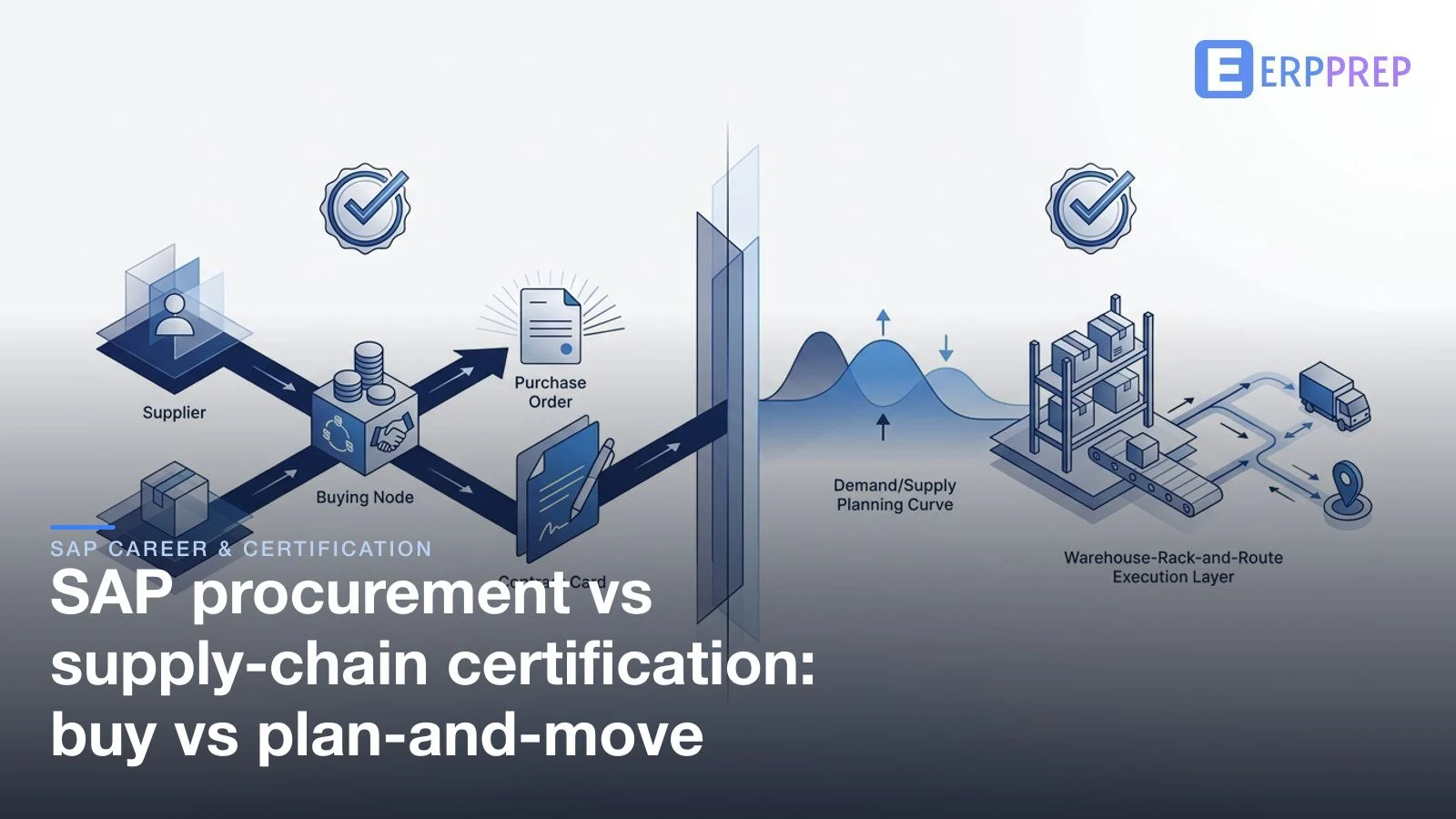
SAP procurement and supply-chain certifications sit in adjacent-but-different tracks. The procurement track (Sourcing & Procurement, C_TS452) is about buying: suppliers, purchasing, contracts, invoices. The supply-chain track is about planning and moving goods — Integrated Business Planning (C_IBP) plans demand and supply, while Extended Warehouse Management (C_S4EWM) runs the warehouse. Choose by whether your work is spend-side or flow-side.
People often treat "SAP® procurement" and "SAP supply chain" as one career, then discover on the job that they are two adjacent-but-different worlds. One is about buying — finding suppliers, raising purchase orders, running contracts, checking invoices. The other is about planning and moving goods — forecasting what you will need and then physically receiving, storing, and shipping it. The certifications follow that split. This guide compares the procurement track (C_TS452) with the supply-chain track (C_IBP for planning and C_S4EWM for warehouse execution), so you choose by the work rather than the label. For the wider view of the whole logistics family, the supply-chain career hub maps every track at once.
SAP procurement and supply-chain certifications sit in adjacent-but-different tracks. The procurement track (Sourcing & Procurement, C_TS452) is about buying: suppliers, purchasing, contracts, and invoices. The supply-chain track is about planning and moving goods — Integrated Business Planning (C_IBP) plans demand and supply, while Extended Warehouse Management (C_S4EWM) runs the warehouse. Choose by whether your work is spend-side or flow-side.
Key takeaways
- The split is buy versus plan-and-move — procurement is source-to-pay, supply chain is planning plus physical flow.
- Procurement (C_TS452) certifies Sourcing & Procurement: suppliers, purchasing, contracts, and invoice verification.
- Planning (C_IBP) certifies Integrated Business Planning — demand, supply, inventory, and S&OP — while execution (C_S4EWM) certifies Extended Warehouse Management.
- All three currently use the System-Based (SyBA) format, so hands-on fluency matters more than memorising facts.
- Choose by the problem you want to solve — spend and suppliers, forecasting and balancing supply, or the physical warehouse — then go deep in one track before adding another.
Procurement and supply chain at a glance
Each track certifies a different slice of how goods reach an organisation and move through it. All three are consultant-profile, associate-level certifications that sit on their own SAP learning journeys (SAP, learning.sap.com). Start from what you actually do:
| If your work is about… | Certification | Notes |
|---|---|---|
| Suppliers, purchasing, contracts, invoices (the spend side) | C_TS452 — Sourcing & Procurement | Associate; System-Based (SyBA), around a 76% cut score. |
| Forecasting demand and balancing supply across horizons | C_IBP — Integrated Business Planning | Associate; SyBA with a notably high cut score near 90%. |
| Receiving, storing, and shipping goods in the warehouse | C_S4EWM — Extended Warehouse Management | Associate; SyBA, around a 65% cut score. |
Confirm the current format and cut score on each exam's page at learning.sap.com before you book — SAP revises these as the underlying products change.
The procurement track: everything about the buy
The procurement track is anchored by C_TS452, the Sourcing & Procurement certification for S/4HANA. Its centre of gravity is the source-to-pay flow: how a business decides what to buy, finds a source of supply, raises a purchase order, receives the goods, and settles the invoice. On a real project that means working with supplier master data, purchasing info records, contracts and scheduling agreements, source determination, release procedures, and logistics invoice verification. If your world revolves around buyers, spend, and supplier relationships, this is your certification.
C_TS452 is associate-level and uses the System-Based Assessment (SyBA) format, sitting around a 76% cut score. Because it is performance-based, you are expected to actually perform the configuration and process steps rather than recall them — set up a purchasing document type, run a release strategy, verify an invoice with variances. It is the natural first certification for people coming from a purchasing, category-management, or accounts-payable background. Note that this is the operational procurement path inside S/4HANA; the separate strategic-sourcing and supplier- network angle is covered in the S/4HANA Sourcing versus Ariba comparison, which is worth a look if your work leans toward supplier collaboration and spend management rather than the core purchasing engine.
The supply-chain track, part one: planning
Cross over from procurement and the first half of the supply-chain track is planning — deciding what the organisation will need and making sure supply can meet it. That is the domain of C_IBP, the Integrated Business Planning certification. Where procurement asks "how do we buy this?", planning asks "how much will we need, and can we supply it?" The work spans statistical forecasting and demand sensing, sales and operations planning (S&OP), inventory optimization, and response-and-supply planning that balances demand against lead times, capacities, and inventory across time horizons.
C_IBP is associate-level and System-Based (SyBA), and it carries the highest bar of the three — a cut score in the region of 90%. That is a strong signal about the nature of the work: planning models are precise, and small configuration or key-figure mistakes propagate through a whole plan, so the exam expects near-complete accuracy. If you are drawn to forecasting, scenario simulation, control-tower visibility, and the analytical side of the supply chain rather than the physical handling of goods, IBP is the track for you. For the neighbouring question of where planning ends and physical execution begins, the IBP versus supply-chain execution comparison draws that line in detail.
Curious how a System-Based exam actually feels? A free sample shows the doing-over-recalling style that all three of these certifications share, before you commit to a track. Try a free sample.
The supply-chain track, part two: execution
The second half of the supply-chain track is execution — the physical movement and storage of goods once a plan exists. That is where C_S4EWM, the Extended Warehouse Management certification, lives. It covers the day-to-day operation of a warehouse: structuring the warehouse and its master data, inbound processes such as goods receipt and putaway, outbound processes such as picking and goods issue, storage control, wave management, resource management, and the radio-frequency framework that warehouse staff use on the floor.
C_S4EWM is associate-level and System-Based (SyBA), sitting around a 65% cut score — the most forgiving threshold of the three, though still a performance-based exam that rewards hands-on configuration fluency. It suits people who like the tangible side of logistics: how goods physically flow through a building, how storage bins and process types are set up, and how exceptions are handled. Warehouse execution also has a close neighbour in transportation; if you are weighing warehouse work against the moving-between-sites side, the EWM versus Transportation Management comparison separates those two execution domains.
The core differences, side by side
The three tracks share a format and a consultant profile, but they answer different business questions and reward different instincts. Here is how they line up on the dimensions that actually shape a career choice:
| Dimension | Procurement (C_TS452) | Planning (C_IBP) | Execution (C_S4EWM) |
|---|---|---|---|
| Core question | How do we buy it well? | How much will we need, and can we supply it? | How do we receive, store, and ship it? |
| Centre of gravity | Suppliers, purchasing, contracts, invoices | Forecasting, S&OP, inventory, supply balancing | Warehouse layout, inbound/outbound, storage control |
| Temperament it rewards | Negotiation, spend governance, process control | Analytical, model-precise, scenario-minded | Operational, spatial, exception-handling |
| Format & cut score | SyBA, ~76% | SyBA, ~90% | SyBA, ~65% |
Two things stand out. First, procurement is one cohesive line of business, while supply chain splits cleanly into planning and execution — so "supply chain" is really two career doors, not one. Second, the cut scores hint at the working style each rewards: the high IBP bar reflects how unforgiving planning models are, while the warehouse exam's lower threshold reflects a broad operational surface rather than an easier subject.
Where the tracks touch
The reason these certifications feel related is that the domains genuinely meet at the seams. Procurement and planning connect through material requirements: the planning run generates procurement proposals and reorder signals that buyers then act on, so a consultant who understands both sides reads the full loop from forecast to purchase order. Planning and execution connect through supply and stock: a plan is only as good as the goods that physically arrive and get put away, so warehouse reality feeds back into what planning can promise.
That overlap is exactly why some consultants eventually earn a second certification across the seam they work at — but it is a poor reason to start with two. The overlap is a bridge you cross once you are established on one side, not a case for spreading thin at the outset. Go deep enough in one track that you can deliver confidently, and the adjacent track becomes far easier to add because you already understand the handshake between them.
Choose the procurement track if…
Pick C_TS452 if your instinct is toward the commercial and supplier side of the business. You enjoy supplier relationships and negotiation, you care about contract governance and spend control, and you want to understand how purchasing documents, release strategies, and invoice verification hold an organisation's buying under control. It is also the most transferable starting point for anyone coming from a purchasing, category-management, or finance-adjacent background, because almost every company buys — the process you certify in is close to universal.
Choose a supply-chain track if…
Pick C_IBP if you are drawn to the analytical, forward-looking side: forecasting, balancing supply against constraints, running S&OP cycles, and simulating scenarios. You like working with numbers and models, and you are comfortable with a high-precision exam. Pick C_S4EWM instead if you are drawn to the physical operation: how goods flow through a warehouse, how storage and picking are configured, and how exceptions on the floor are resolved. Both are "supply chain," but planning and execution are genuinely different day jobs — one lives in a planning cockpit, the other on the warehouse floor.
How to prepare, whichever track you pick
Because all three exams are performance-based, the preparation habit transfers cleanly across them: build in a realistic environment, understand whole process flows rather than isolated facts, and rehearse under time pressure so your accuracy holds — which matters most on the high-bar IBP exam. Each certification maps to its own SAP learning journey that builds the underlying process and configuration knowledge, and each exam's hub here holds the scenarios and skill drills that rehearse the specific competencies. Learn to weigh which SAP certification is worth it for your career once, and the framework applies whether you land on procurement, planning, or execution.
The practical sequencing advice is the same in every case: match the certification to the work you do now or want to do next, go deep enough to deliver with it, and let any second certification follow the seam your career actually moves toward — procurement into planning, or planning into execution. Collecting all three up front rarely pays off; deliberate depth in one, then a bridge into the next, is how these tracks compound.
Deciding your first SCM certification
Work backwards from the problem you want to own. If it is suppliers, purchasing, and spend, start with C_TS452. If it is forecasting and balancing supply, start with C_IBP. If it is the physical warehouse, start with C_S4EWM. Each exam hub above holds the practice content for that specific certification, and the supply-chain career hub puts all the logistics tracks in one place if you are still mapping the terrain. When you've settled on a direction, the fastest way to know whether the format suits you is to practise it. Try a free sample and see the doing-over-recalling style for yourself.
Frequently asked questions
- What is the difference between SAP procurement and supply-chain certification?
- Procurement certification (Sourcing & Procurement, C_TS452) covers the buy side — how an organisation sources suppliers, raises purchase orders, manages contracts, and verifies invoices. Supply-chain certification covers planning and physical flow: Integrated Business Planning (C_IBP) plans demand and supply, and Extended Warehouse Management (C_S4EWM) runs warehouse operations. They are neighbouring domains, but one is about spend and the other about planning and moving goods.
- Which is bigger, SAP procurement or SAP supply chain?
- Neither is a single thing you can rank. Procurement is one broad line of business (source-to-pay), while supply chain spans several sub-domains — demand and supply planning, warehousing, and transportation. In headcount terms procurement roles are very common because almost every company buys, but supply-chain planning and execution roles are numerous too and often more specialised. Pick by the work you want, not by which label sounds larger.
- What format are the SAP procurement and supply-chain exams?
- All three lead exams currently use the System-Based Assessment (SyBA) format, where you complete tasks in a live system rather than only answering multiple-choice questions. That is true of Sourcing & Procurement (C_TS452), Integrated Business Planning (C_IBP), and Extended Warehouse Management (C_S4EWM). Always confirm the current format on each exam's page at learning.sap.com before you book, because SAP adjusts formats as products evolve.
- What are the cut scores for these SAP certifications?
- At the time of writing, Sourcing & Procurement (C_TS452) sits around a 76% cut score, Integrated Business Planning (C_IBP) around 90%, and Extended Warehouse Management (C_S4EWM) around 65%. The higher IBP threshold signals how precise planning-model work has to be. Cut scores move over time and are only part of the difficulty picture, so verify the current value on learning.sap.com before relying on it.
- Which SAP SCM certification should I do first?
- Start with the one closest to your current or intended role. If you work with buyers, contracts, or accounts payable, the procurement track (C_TS452) is the natural first step. If your work is forecasting and balancing supply, take Integrated Business Planning (C_IBP). If you run or configure warehouses, take Extended Warehouse Management (C_S4EWM). Depth in one track beats a thin spread across all three.
- Do I need both procurement and supply-chain certifications?
- Usually not at once. Most consultants go deep in one track first and add an adjacent one only when a project or role demands the overlap. Procurement and planning meet at material requirements and reorder logic; planning and warehousing meet at supply and stock. Earning a second certification makes sense when you regularly work across that seam — not as a badge-collecting exercise early in a career.
- Which track fits my career better — procurement or supply chain?
- Choose procurement if you are drawn to supplier relationships, negotiation, contract governance, and spend control. Choose supply-chain planning if you like demand forecasting, scenario analysis, and balancing supply against constraints. Choose supply-chain execution if you like the physical operation — inbound, outbound, and warehouse layout. All three are consultant-profile certifications, so the differentiator is the kind of problem you want to solve day to day.
- Are there prerequisites for the SAP procurement or supply-chain exams?
- SAP positions these as associate, consultant-level certifications that assume you can contribute to a project team in a mentored role rather than requiring a prior certificate. Each maps to a recommended learning journey on learning.sap.com that builds the underlying process and configuration knowledge. There is no hard chain forcing procurement before supply chain or vice versa — you enter at the track that matches your work. Confirm any current requirements on the official exam page.
ERPPrep is an independent platform and is not affiliated with, endorsed by, or sponsored by SAP SE. SAP and other SAP products are trademarks of SAP SE, referenced here only to describe the certification exams ERPPrep helps you prepare for.
Ready to practise the way the exam tests?
ERPPrep provides original, performance-style scenarios and skill drills built for the 2026 SyBA and SBA formats. Try a free sample and judge the quality yourself.
Practice for these exams
Related guides
SAP MM interview questions and how to answer them
The six themes an SAP MM interview returns to — structure, procure to pay, config, valuation, integration, scenarios — and how to build your own answers.
The best SAP certification for a manufacturing career in 2026
A manufacturing-first guide to SAP certification: the three plant-floor paths — production planning, asset management, and warehouse execution — and how to choose the one that fits your factory role.
SAP IBP vs supply-chain execution certifications (C_IBP): planning vs execution
Plan the chain or run it? How the SAP IBP certification (C_IBP, supply-chain planning) differs from the S/4HANA execution certifications for warehouse (C_S4EWM) and transport (C_S4TM), and which to choose.