

The best SAP certification for a manufacturing career in 2026
A manufacturing-first guide to SAP certification: the three plant-floor paths — production planning, asset management, and warehouse execution — and how to choose the one that fits your factory role.
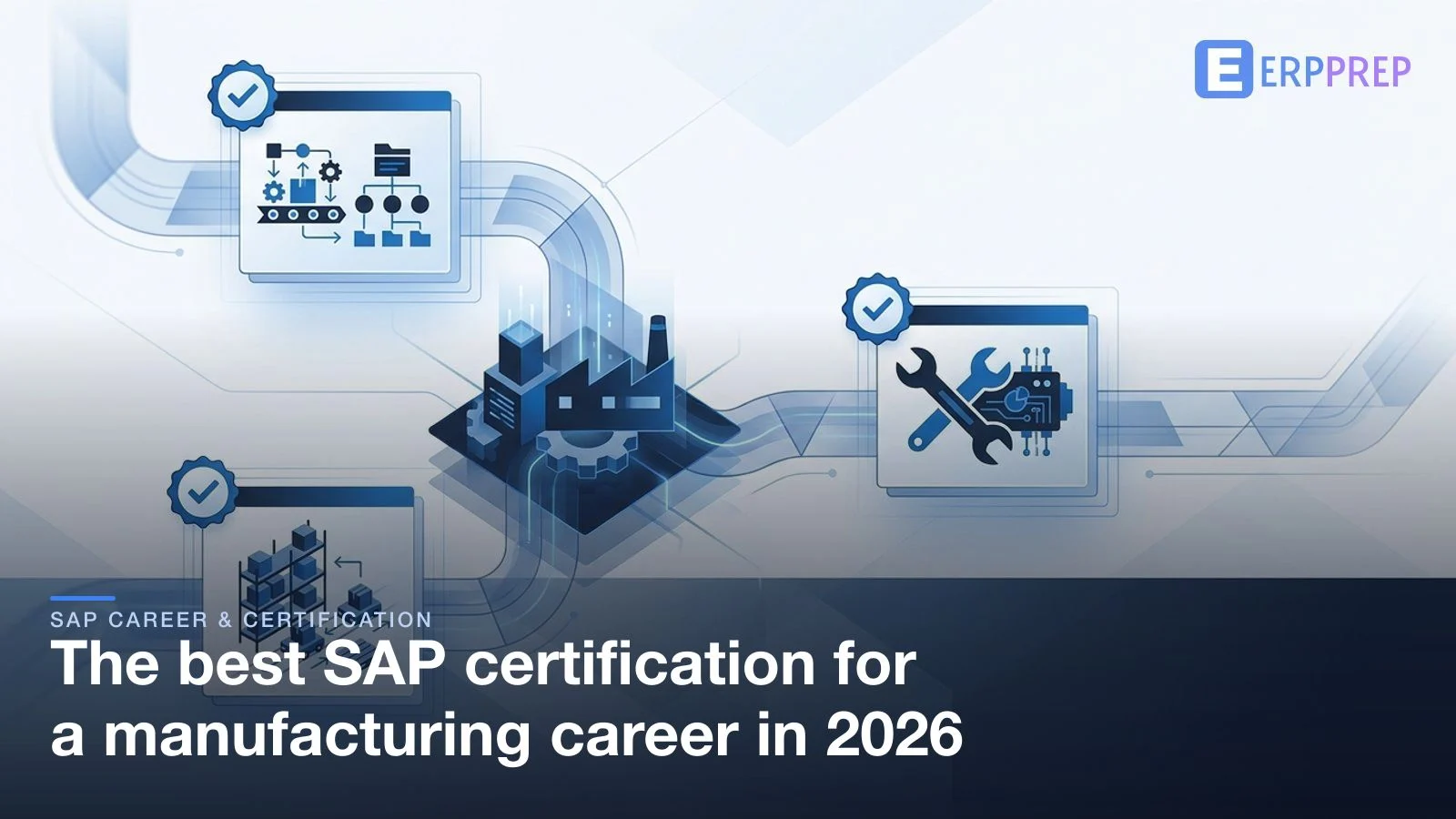
For a manufacturing career, the best SAP certification is the one matching where you work in the plant. If you plan and make product, choose Production Planning & Manufacturing (C_TS422); if you keep equipment and assets running, choose Asset Management (C_S43); if you run the warehouse feeding and shipping the line, choose Extended Warehouse Management (C_S4EWM). All three are associate-level, System-Based exams.
"Which SAP® certification should I get for a manufacturing career?" is really a question about where in the plant you work — not which badge is best in the abstract. A factory running on SAP S/4HANA has people who plan and make the product, people who keep the equipment and assets running, and people who move material in, store it, and ship it out. Those are three different day-to-day roles, and they map cleanly onto three different certifications. Get your role straight and the right exam falls out of it. For the wider "is certification even worth it" framing, start with whether SAP certification is worth it and how to choose.
For a manufacturing career, the best SAP certification is the one matching where you work in the plant. If you plan and make product, choose Production Planning & Manufacturing (C_TS422); if you keep equipment and assets running, choose Asset Management (C_S43); if you run the warehouse feeding and shipping the line, choose Extended Warehouse Management (C_S4EWM). All three are associate-level, System-Based exams — pick by the work, not the badge.
Key takeaways
- There is no single "best" manufacturing certification — there are three, one per function on the factory floor.
- Production Planning & Manufacturing (C_TS422) is the path for planning demand and making product — MRP, capacity, and shop-floor control.
- Asset Management (C_S43) is the plant-maintenance path — keeping equipment reliable through preventive and corrective work.
- Extended Warehouse Management (C_S4EWM) covers moving material in, storing it, and shipping it out around the line.
- All three are associate-level, System-Based (SyBA) exams, so hands-on fluency in the real processes matters more than memorization.
Manufacturing certifications at a glance
Each path certifies a different part of the same operation, sits on its own SAP learning journey (SAP, learning.sap.com), and points to one associate exam. Start from what you actually do on the floor:
| If your work is… | Certification | Notes |
|---|---|---|
| Planning demand and making the product | C_TS422 — Production Planning & Manufacturing | Associate; System-Based (SyBA), around a 64% cut score. The broadest make-oriented anchor. |
| Keeping equipment and assets running | C_S43 — Asset Management (plant maintenance) | Associate; SyBA, around a 70% cut score. Newly available on ERPPrep. |
| Moving, storing, and shipping material | C_S4EWM — Extended Warehouse Management | Associate; SyBA, around a 65% cut score. |
Confirm the current format and cut score on each exam's page at learning.sap.com before you book — SAP adjusts these as the products evolve, and where a value isn't published on the exam page you should verify it there rather than assume.
What an SAP manufacturing career actually looks like
"Manufacturing" on SAP is not one job. Walk a real plant and you will find planners deciding what to make and when, shop-floor teams converting planned orders into finished goods, maintenance crews keeping the machines available, and warehouse staff receiving components and dispatching product. Each of those functions leans on a different slice of SAP S/4HANA, and each has its own associate certification. Your career is usually a sequence: go deep in one function, earn credibility there, then broaden into an adjacent one as the plant or the project demands it.
That's why the "best certification" question is answered best by looking at your current or intended role rather than by comparing exam difficulty. A production planner and a maintenance specialist are both "in manufacturing," but their strongest first certification is different. The rest of this guide walks each path so you can match it to where you sit — or want to sit — in the operation.
Production Planning & Manufacturing: making the product
For anyone who plans what the plant makes and then runs it through the floor, Production Planning & Manufacturing is the centre of gravity — and the C_TS422 exam is its associate certification. The scope spans the make-oriented core of a factory: setting up manufacturing master data such as bills of material, work centers, and routings; running material requirements planning and capacity evaluation; and executing the production-order or process-order lifecycle on the shop floor for both discrete and process industries.
C_TS422 is associate-level and uses the System-Based Assessment (SyBA) format, sitting around a 64% cut score, so you work through realistic system tasks rather than answering trivia about them. It also reaches into advanced planning — predictive MRP, demand-driven replenishment, and detailed scheduling with PP/DS — which is why it's the broadest anchor for a make-oriented manufacturing career. For most planners and shop-floor specialists this is the right first certification. If you're weighing planning against the maintenance path directly, the Asset Management vs Production Planning comparison breaks down which fits which role.
Asset Management: keeping the plant running
Making product is only half the plant; the other half is keeping the equipment that makes it available and reliable. That's the Asset Management path — plant maintenance — and its associate certification is C_S43, newly available as a practice track on ERPPrep. It covers the maintenance side of a manufacturing operation: modelling technical objects such as functional locations and equipment, running corrective and emergency maintenance, and — importantly — building out preventive maintenance with task lists, maintenance plans, and time- or performance-based strategies.
C_S43 is associate-level and System-Based (SyBA), sitting around a 70% cut score. It suits people whose plant role is reliability and uptime rather than production volume — maintenance planners, reliability engineers, and consultants implementing the maintenance processes that keep a factory from grinding to a halt. It also reaches into specialised areas like refurbishment of spare parts and phase-based maintenance, which is why it stands as its own career track rather than a footnote to production planning. If you want the deeper prep view, see how to prepare for the SAP Asset Management certification.
Curious how a System-Based exam actually feels? A free sample shows the doing-over-recalling style before you commit to a manufacturing path. Try a free sample.
Extended Warehouse Management: moving material around the line
A production line is only as smooth as the flow of material feeding it and the finished goods leaving it. That flow is the domain of Extended Warehouse Management, and its associate certification is C_S4EWM. It covers the warehouse execution layer around manufacturing: structuring the warehouse and its master data, handling inbound goods receipt and putaway, managing outbound picking and shipping, and configuring storage control, wave management, and physical inventory.
C_S4EWM is associate-level and System-Based (SyBA), sitting around a 65% cut score. It fits people whose role is material movement and warehouse operations rather than planning or maintenance — a distinct specialisation that becomes more valuable the more distribution complexity a plant carries. Warehouse execution is often confused with transportation; the two are separate SAP paths. If your work leans toward moving goods between sites rather than inside the four walls, the EWM vs Transportation Management comparison spells out which is which so you don't book the wrong one.
How the three fit together in one plant
It helps to picture a single factory floor. Planning decides what to make and schedules it (C_TS422). The warehouse receives the components, stores them, and stages them for the line (C_S4EWM). The line converts them into finished product, confirming operations and posting goods movements (C_TS422 again). Maintenance keeps the machines that do all this available and safe (C_S43). And when the product is done, the warehouse picks, packs, and ships it (C_S4EWM). One operation, three certifications, each covering a different link in the chain.
That interlock is exactly why you rarely need all three. The functions hand off to each other, but the people running them specialise. A planner who tries to master warehouse configuration and maintenance strategy at once will spread thin; a specialist who owns one link and understands how it connects to the next is far more useful on a project. So think of the three certifications less as a checklist and more as a map of where you could stand in the operation.
Choose C_TS422 if…
Pick Production Planning & Manufacturing if your work is about what the plant makes and when — building the demand program, running MRP and capacity planning, and driving production or process orders through the shop floor. It's the strongest choice for planners, production supervisors, and consultants implementing the make-to-stock and make-to-order processes at the heart of a manufacturer. It's also the broadest first step if you're early in a manufacturing career and not yet specialised, because planning and production touch nearly every other function around them.
Choose C_S43 if…
Pick Asset Management if your world is uptime and reliability rather than production volume — maintaining technical objects, running corrective and preventive maintenance, and configuring the maintenance plans and strategies that keep equipment available. It fits maintenance planners, reliability specialists, and consultants in asset-intensive industries. If you've ever been the person the plant calls when a machine goes down — or the one making sure it doesn't — this is your track, and it's freshly available to practise on ERPPrep.
Choose C_S4EWM if…
Pick Extended Warehouse Management if your role is material movement and warehouse operations — receiving and putting away inbound stock, picking and shipping outbound orders, and configuring the storage control and wave management that keep a busy warehouse flowing. It suits warehouse leads, logistics analysts, and consultants implementing the execution layer that feeds and follows the production line. The busier and more complex the distribution, the more this specialisation is worth.
How to prepare for a System-Based manufacturing exam
All three certifications share the same exam style, which is good news for your prep: learn the technique once and it carries across the trio. Because they are System-Based (SyBA) rather than multiple-choice recall, the exams reward candidates who can work whole processes in a realistic environment — a full planning run, a maintenance order from notification to completion, a goods receipt through to putaway — rather than people who have memorised isolated facts. The underlying habit is the same across production planning, asset management, and warehouse execution.
The practical implication is to rehearse the processes end to end and under time pressure, so accuracy holds when it counts. Learn to prepare for the performance-based format once and it transfers from C_TS422 to C_S43 to C_S4EWM — the domain changes, the exam technique doesn't. Certification is also best treated as something you keep current rather than a one-time trophy, since SAP evolves these products and shifts formats over time.
Choosing your first manufacturing certification
Work backwards from where you stand in the plant. If you plan and make the product, start with C_TS422. If you keep the equipment running, take C_S43. If you run the warehouse around the line, aim at C_S4EWM. Each exam hub above holds the scenarios, skill drills, and exam facts for that specific certification, so once you've chosen a direction you can dig into the detail there.
To go wider than manufacturing alone, the broader supply chain career hub sets these three in the context of the full logistics and supply-chain landscape, and the logistics certifications compared guide lines up the adjacent options. When you've settled on a path, the fastest way to know whether you're ready is to practise the format itself. Try a free sample and see the doing-over-recalling style for yourself.
Frequently asked questions
- What is the best SAP certification for a manufacturing career?
- There isn't one universal answer — it depends on where you sit in the plant. If you plan production and run the shop floor, Production Planning & Manufacturing (C_TS422) fits best. If your work is keeping machines and assets running, Asset Management (C_S43) is the plant-maintenance path. If you run the warehouse that feeds and ships the line, Extended Warehouse Management (C_S4EWM) is yours. All three are associate-level, so the choice is about role fit, not difficulty tier.
- What's the difference between the production planning, maintenance, and warehouse SAP certifications?
- They certify three different parts of the same factory. C_TS422 covers planning demand and making the product — MRP, capacity planning, and production or process orders. C_S43 covers asset management and plant maintenance — keeping equipment reliable through preventive and corrective work. C_S4EWM covers moving material in, storing it, and shipping it out. One plans and makes, one maintains, one moves; most plants need all three functions working together.
- Which SAP manufacturing certification should I get first?
- Start with the one closest to your current or intended day-to-day role. Planners and shop-floor specialists usually begin with C_TS422; maintenance and reliability people with C_S43; warehouse and logistics people with C_S4EWM. If you're unsure, C_TS422 is the broadest anchor for a make-oriented manufacturing career, since planning and production touch nearly every other function on the floor. Confirm each exam's current scope on learning.sap.com before you book.
- Do I need all three manufacturing certifications?
- No. Each certification targets a distinct role, and most people go deep in one rather than collecting all three. A planner rarely needs the full warehouse-configuration depth of C_S4EWM, and a maintenance specialist doesn't need production-planning mastery. Earn the one that matches your work, deliver with it, then add a second only if your role genuinely spans two areas — for example a plant that asks you to cover both planning and maintenance.
- Which SAP certification fits a shop-floor or plant career?
- For a shop-floor role — running production orders, confirming operations, managing work centers — Production Planning & Manufacturing (C_TS422) is the natural fit, because it covers discrete and process shop-floor control end to end. If your plant role is really about equipment uptime and maintenance rather than making product, Asset Management (C_S43) is the better match. Both are plant-facing; the split is whether you make the product or keep the plant running.
- Do I need work experience before taking an SAP manufacturing certification?
- SAP positions these associate certifications for a consultant profile contributing in a mentored role, so they assume you can apply the skills in a project rather than requiring years of prior experience. Hands-on familiarity with the processes — planning runs, maintenance orders, or warehouse movements — helps a lot because the exams are performance-based. Check the current prerequisites on each exam's page at learning.sap.com, as SAP updates recommended experience over time.
- Are there prerequisites for the SAP manufacturing certifications?
- SAP's associate manufacturing certifications generally don't list hard prerequisites, but each has a recommended learning journey covering the processes and configuration it tests. For C_TS422 that spans planning, capacity, and shop-floor control; for C_S43 it covers technical objects and maintenance processing; for C_S4EWM it covers warehouse structure, inbound, and outbound. Working through the relevant journey is the practical prerequisite. Always verify the current recommendations on learning.sap.com.
- Which SAP manufacturing certification is most in demand?
- Demand varies by industry and region, so treat any ranking cautiously and verify against live job postings. Broadly, production planning skills (C_TS422) appear widely because almost every manufacturer plans and makes product; warehouse execution (C_S4EWM) is in demand wherever distribution complexity is high; and asset management (C_S43) is strong in asset-intensive industries such as utilities, energy, and heavy manufacturing. The most in-demand certification for you is the one matching the plants that hire in your market.
ERPPrep is an independent platform and is not affiliated with, endorsed by, or sponsored by SAP SE. SAP and other SAP products are trademarks of SAP SE, referenced here only to describe the certification exams ERPPrep helps you prepare for.
Ready to practise the way the exam tests?
ERPPrep provides original, performance-style scenarios and skill drills built for the 2026 SyBA and SBA formats. Try a free sample and judge the quality yourself.
Practice for these exams
Related guides
SAP procurement vs supply-chain certification: buy vs plan-and-move
How the SAP procurement track (Sourcing & Procurement, C_TS452) compares with the supply-chain track (Integrated Business Planning C_IBP and Extended Warehouse Management C_S4EWM) — and which SCM certification to choose.
SAP IBP vs supply-chain execution certifications (C_IBP): planning vs execution
Plan the chain or run it? How the SAP IBP certification (C_IBP, supply-chain planning) differs from the S/4HANA execution certifications for warehouse (C_S4EWM) and transport (C_S4TM), and which to choose.
SAP Production Planning vs Project Systems certification (PP vs PS)
C_TS422 (Production Planning & Manufacturing) and C_TS412 (Project Systems) sound alike but certify different jobs. What PP and PS each cover, formats, cut scores, difficulty, and how to choose the right S/4HANA exam.