

How to practise for SAP exams with AI stakeholder roleplay
SAP's SBA exams reward joined-up reasoning, not recall. Here's how practising with an AI stakeholder and a graded debrief builds that skill.
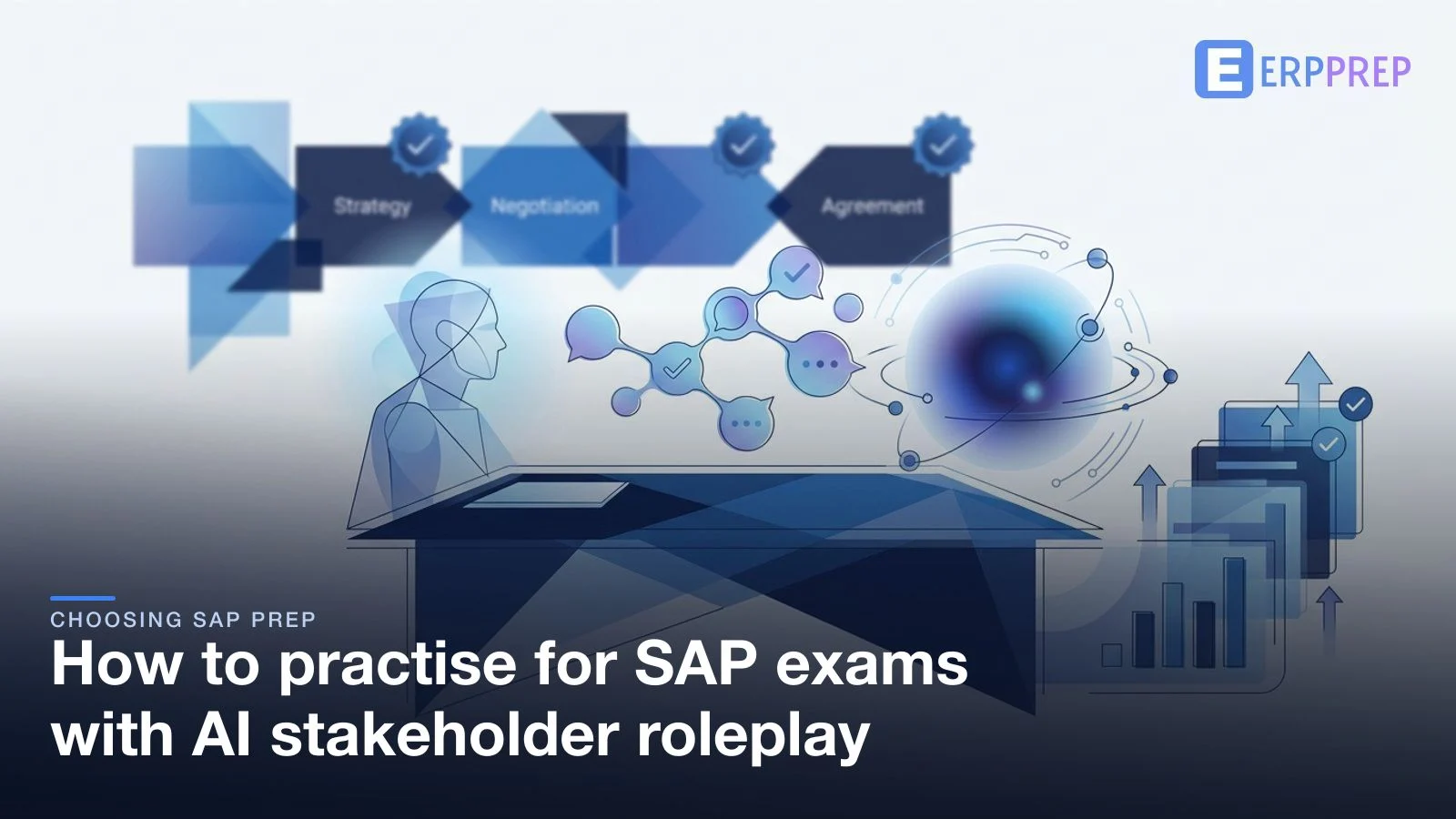
AI stakeholder roleplay is practice for SAP's Scenario-Based Assessment (SBA) exams: you hold a realistic business conversation with an AI client, manager, or colleague inside a scenario, then receive a graded debrief on your reasoning. It works because SBA exams reward joined-up judgement under pressure, which passive reading never rehearses. It is original practice, never real or leaked exam content, and it applies only to SBA-format exams — not system-task SyBA ones.
Most SAP® certification study is something you do to a page: you read the material, watch the courses, run drills, and hope it adds up on exam day. That works well for recall — and for the System-Based Assessment (SyBA) exams that ask you to perform configuration tasks. But a whole class of SAP exams now uses the Scenario-Based Assessment (SBA) format, where you reason through a connected business situation and defend a course of action. That is a conversation-shaped skill, and it is very hard to build by reading alone. This guide explains a practice method that rehearses it directly: holding a realistic business conversation with an AI stakeholder, then reading a graded debrief on how you did. For the wider picture, see how to prepare for SAP certification.
Key takeaways
- Scenario exams test judgement, not recall. An SBA asks you to read a situation, weigh constraints, and defend a decision — the kind of reasoning that passive study rarely rehearses.
- A conversation is the closest safe rehearsal. Making a recommendation to an AI stakeholder and handling their pushback trains the exact muscle the format scores, without touching any real exam content.
- The debrief is where the learning lands. A graded, practice-only review of your own words shows you where the reasoning held and where it thinned — far more useful than a bare right/wrong.
- It is SBA-only, by design. Roleplay fits the scenario format; it does not replace the hands-on, system-task practice a SyBA exam needs.
- It is rehearsal, not the real exam. The content is original, there is no answer key to memorise, and transcripts are kept only briefly — a privacy promise, not a permanent record.
Why scenario exams need active practice
SAP's 2026 exams split into two performance-based shapes. In a System-Based Assessment you carry out tasks in a live system; in a Scenario-Based Assessment you work through a single connected business scenario and make decisions within it. The exams that use the SBA format are unmistakably reasoning exams: an exam like Project Manager – SAP Activate (C_ACT) is built around stakeholder management, communication, change management, and steering a project through transitions — skills you demonstrate by deciding and explaining, not by reciting. Others, like Solution Transformation Consultant with SAP Cloud ALM (C_STC), are framed around leading a project team through a transformation journey. You can read every course twice and still be unpractised at the actual test: forming a defensible position and holding it.
The gap is a well-known one in skill learning. Recognising a correct answer in a list and generating a correct answer from a blank page are different abilities, and the second is the one an SBA measures. Re-reading notes builds a comfortable sense of familiarity that feels like competence but often is not — you understand the material when it is in front of you, yet stumble when asked to produce a joined-up recommendation under time pressure. Active practice closes that gap precisely because it forces production: you have to commit to a course of action, justify it, and adjust when the situation pushes back. For the format itself, see what a Scenario-Based Assessment is and what SyBA and SBA actually test.
It helps to picture how the gap shows up on the day. You open a scenario, you recognise the topic, you even remember the relevant concepts — and then you stall, because knowing the pieces is not the same as assembling them into a single recommendation you can stand behind. Candidates who have only read tend to produce answers that are accurate but scattered: a list of considerations rather than a decision. A scenario exam is looking for the decision. The only reliable way to get comfortable making one is to have made a lot of them before, in a setting where a weak answer costs nothing but teaches you something.
This is also why generic multiple-choice banks fall short here. A bank can teach you facts about a module — and facts matter — but it rehearses recognition, and a scenario exam rewards the messier work of synthesising several facts into one defensible decision. The right practice for an SBA has to look like the exam: a situation with constraints, a stakeholder with needs, and a moment where you have to say what you would do and why. That is what a conversation provides — and it is why a resource's format fidelity, not its question count, is what decides whether it prepares you for a scenario exam at all.
What AI stakeholder roleplay is, and how a session works
AI stakeholder roleplay drops you inside a realistic scenario and lets you talk to the people in it. Instead of reading a case and picking an option, you hold a live business conversation with an AI stakeholder — a client explaining a problem, a project sponsor with a deadline, a colleague raising a risk — and you work the situation the way a consultant actually would. ERPPrep calls this Scenario Roleplay, and it is built specifically for SBA-format exams. A typical session runs like this:
- You get a scenario brief. A short setup establishes the business context, the stakeholder you are speaking with, and what they need from you — the same kind of connected situation an SBA presents.
- You open the conversation. Rather than jumping to an answer, you ask questions, surface the real constraints, and let the stakeholder reveal the detail that a good consultant would dig for.
- You make and defend a recommendation. You commit to a course of action and explain the reasoning behind it — the pivotal moment, because this is exactly what the exam asks you to produce.
- The stakeholder pushes back. They raise a complication, a competing priority, or a follow-up question, and you have to respond without contradicting what you said a minute ago. Consistency under pressure is part of the skill.
- The conversation wraps, and you get a debrief. Once you have worked through the exchange, the session closes and a graded review of your reasoning follows — covered in the next section.
Two design choices are worth calling out. First, the AI stakeholder stays in character and never coaches you mid-conversation — it does not hold a hint, a checkpoint, or an answer key, so the rehearsal is honest: you cannot lean on the examiner to rescue a weak position, any more than you could in the exam. Second, the practice is original throughout. It mirrors the reasoning style of an SBA, but it uses invented scenarios written for practice — never real, leaked, or "actual" exam questions. There is no answer key to memorise because there is no fixed answer to a judgement you have to construct yourself. If a resource ever promises you real questions or dumps, that is a reason to walk away — see whether SAP exam dumps are safe.
How the graded debrief helps
A conversation on its own is good rehearsal; a conversation you can learn from is far better. That is the job of the graded debrief. After the session, a separate grading pass reads the whole transcript with fresh eyes and returns a practice-only assessment of how your reasoning held up: where you were strong, where an argument thinned, where you missed a constraint the stakeholder had handed you. Crucially, it quotes your own words back as evidence, so the feedback is specific to what you actually said rather than generic advice.
The debrief is deliberately framed as a study signal, not a verdict. It uses descriptive bands — think of a spread from "developing" through to "strong" — rather than a percentage, a pass/fail, or any prediction of your real exam result. That restraint is a feature, not a limitation: nobody outside SAP can forecast your outcome, and a fake score would only distract you. What you want from practice is direction — a clear read on which part of your reasoning to work on next — and that is exactly what a well-built debrief gives you. Reading it honestly, and noticing the same weakness recurring across two scenarios, tells you where to spend your remaining study time.
There is a subtle reason the grading runs as its own step rather than coming from the stakeholder you were just talking to. Keeping the two apart means nothing you said during the conversation can steer the assessment, and the review stays anchored to the substance of your answer. For you, the practical upshot is simple: the debrief is measuring your judgement, not how persuasively you talked to the AI.
Getting value from the debrief is a small skill in itself. Read it for the pattern, not the verdict: one soft moment in one conversation may just be a bad day, but the same weakness surfacing across two different scenarios is a real gap worth naming. Look especially at the evidence quotes — seeing your own words back is often the moment it clicks that you hedged instead of deciding, or answered the question you wished you had been asked rather than the one in front of you. Then do the unglamorous part: turn each finding into one concrete thing to change next time, whether that is asking a clarifying question earlier or committing to a recommendation sooner. A debrief you act on is worth ten you merely read.
How to fit roleplay into a study plan
Roleplay is a finishing tool, not a starting one. It works best once you have built real knowledge of the module — through SAP's official learning and quality practice — because a conversation reveals the holes in understanding you already have; it does not teach the syllabus from scratch. A sensible sequence looks like this:
- Learn the module first. Work through the official learning journey for your exam and build the underlying knowledge. Confirm your exam is SBA-format before you plan roleplay into the mix.
- Drill to consolidate. Use reasoning-based practice to firm up the facts and the why behind each decision, so you are not reaching for basics mid-conversation.
- Roleplay to pressure-test. In the final stretch, run scenario conversations to rehearse producing and defending decisions. Do one, read the debrief closely, then do another on a different scenario to see whether the same weakness recurs.
- Close the loop. Let each debrief point you back to the material — if your reasoning on, say, change management kept thinning, revisit that topic, then rehearse it again.
On timing, resist the urge to start too early. Roleplay in the first week — before the module has settled — mostly surfaces gaps you already know you have, and a stream of weak debriefs can dent confidence without teaching much. Save it for when you can hold a decent conversation on the topic, then use it to sharpen. Equally, do not leave it to the night before: you want time to feed each debrief back into the material and rehearse the fixed version. A rhythm of converse, debrief, revisit, and converse again over the final stretch is where the method pays off.
Quality matters more than volume. Two conversations you debrief and act on will teach you more than a dozen you rush through, because the learning is in the analysis, not the repetition. If you are studying around a job, this fits neatly into short, deliberate sessions — see how to build an SAP study plan around a full-time job, and for the exam-technique layer, how to work a connected SBA scenario.
Want to feel the format before you plan around it? The fastest way to judge whether scenario practice suits how you study is to try it. Try a free sample and see how a scenario and the reasoning practice feel.
Who it suits — and the SBA-only scope
Roleplay earns its place for anyone preparing for a scenario exam, but a few groups get outsized value from it:
- Consultants preparing for a reasoning-heavy exam. If your target is something like C_ACT or C_STC, where stakeholder handling and defensible decisions are the point, rehearsing the conversation is the most direct practice there is.
- Career switchers new to consulting conversations. If you know the material but have not spent years in front of clients, roleplay is a low-stakes way to build the habit of structuring and defending a recommendation before it counts.
- Sponsored candidates who need to convert knowledge to judgement. When an employer is funding the certification, rehearsing the applied reasoning — not just the facts — is what turns a course completion into a genuine skill.
- Anyone who freezes under pressure. The value of a rehearsal is that the first time you have to defend a shaky position is in practice, not in the exam.
Now the honest limit: this is for SBA exams only. Scenario exams span many modules — from SAP Fiori Application Developer (C_FIORD) and SuccessFactors Variable Pay (C_THR87) to the professional-level SAP Enterprise Architect (P_SAPEA) — and all of them reward the connected reasoning a conversation rehearses. But if your exam uses the System-Based Assessment format, you need hands-on practice performing tasks in a system, not a business conversation; roleplay is the wrong tool for that job. Always confirm your exam's format on its official page before you build a plan around any one method — item types and formats differ between certifications and change over time. You can look yours up on SAP's official certification pages, and read the difference in how to practise for a SyBA system-based exam.
Honesty and privacy: what roleplay is not
A rehearsal is only trustworthy if it is honest about what it is, so it is worth being plain. Roleplay does not give you real, leaked, or "actual" exam questions, and it makes no promise about your result — there is no guaranteed pass, no predicted score, and no answer key, because a judgement you construct yourself has no fixed key to leak. That is not a weakness of the method; it is the point. The skill it builds — reading a situation and defending a decision — is the only thing that transfers to a performance-based exam, and it is exactly what a dumps-style shortcut cannot give you. ERPPrep is an independent platform and is not affiliated with, endorsed by, or sponsored by SAP; the practice mirrors the exam's reasoning style without reproducing its content.
Privacy is handled with the same candour. Because your conversation is processed by an AI provider, ERPPrep tells you up front what happens to it: transcripts are kept only for a limited retention window and then deleted. Your practice scores are retained so you can track progress over time, while the free text of the conversation itself is purged on schedule — a promise made in writing before you begin, not buried afterwards. In short, it is rehearsal that disappears, and you always know that going in.
How to start: try it on a free sample
The best way to understand scenario roleplay is to do a little of it. A free sample lets you feel how a scenario reads and how the reasoning practice works before you commit to anything — the same try-before-you-buy test you should apply to any practice provider. From there, an ERPPrep Exam Pass includes a set of practice conversations for eligible SBA exams, at least one of them with a full graded debrief, so you can run the format end to end; upgrade tiers add more conversations for people who want to rehearse repeatedly. Whichever route you take, the method is the same: converse, get your debrief, learn from it, and go again.
If your exam is scenario-based, this is the practice that most closely resembles the thing you are being tested on. Deepen the surrounding plan with how to prepare for SAP certification and how to practise for an SBA scenario-based exam, then put the reasoning to the test: try a free sample and hold your first scenario conversation.
Frequently asked questions
- What is AI stakeholder roleplay for SAP exams?
- It is a practice format for SAP's Scenario-Based Assessment (SBA) exams. You hold a realistic business conversation with an AI stakeholder — a client, manager, or colleague — inside a scenario, making and defending decisions the way an SBA rewards. Afterwards you get a graded debrief on your reasoning. It is original rehearsal, never real or leaked exam questions, and it only fits SBA-format exams.
- Why is roleplay better than reading for scenario-based exams?
- Because an SBA measures joined-up judgement — reading a situation, weighing constraints, and defending a course of action — and reading only rehearses recall. A conversation forces you to commit to a decision, handle a follow-up, and stay consistent under pressure, which is the exact skill the exam scores. Passive study can leave you fluent in the facts yet unpractised at the reasoning the format tests.
- Which SAP exams does AI roleplay suit?
- Only Scenario-Based Assessment (SBA) exams — the format where you reason through a connected business scenario rather than perform system tasks. Examples include Project Manager – SAP Activate (C_ACT), Solution Transformation Consultant with SAP Cloud ALM (C_STC), and SAP Enterprise Architect (P_SAPEA). It does not fit System-Based Assessment (SyBA) exams, which test hands-on configuration in a live system. Confirm your exam's format on its official page first.
- Does roleplay give me real SAP exam questions or answers?
- No. It is original practice built to mirror the SBA reasoning style, never real, leaked, or 'actual' exam content, and there is no answer key to memorise. Anything advertising real questions or dumps risks your certification and does not prepare you for a scenario exam anyway. Roleplay builds the underlying judgement the exam measures, which is the only thing that transfers.
- How does the graded debrief work?
- After the conversation, a separate grading pass reviews the transcript and returns a practice-only debrief: where your reasoning was strong, where it thinned, and short quotes from your own words as evidence. It uses descriptive bands rather than a pass/fail verdict, a percentage, or any prediction of your real result — it is a study signal to act on, not a score to fixate on.
- Is roleplay included with the ERPPrep Exam Pass?
- The Exam Pass includes a set of practice conversations for eligible SBA exams, at least one of them with a full graded debrief, so you can try the format end to end. Upgrade tiers add more conversations for people who want to rehearse repeatedly. The best first step is the free sample, where you can see how a scenario and the reasoning practice feel before committing.
- How many roleplay conversations should I do before the exam?
- Enough to stop being surprised by the format and to see your reasoning hold up across different scenarios — usually a few focused sessions rather than one. Treat each conversation as a rehearsal you debrief and learn from, not a score to chase. Quality beats volume: two conversations you analyse carefully will teach you more than many you rush through.
- What happens to my roleplay transcripts?
- Transcripts are kept only for a limited retention window and then deleted — a privacy promise made in writing before you start, because the conversation is processed by an AI provider. Your practice scores are retained so you can track progress, while the free text of the conversation is purged on schedule. It is rehearsal that disappears, not a permanent record.
- Can roleplay replace studying the SAP learning material?
- No — it complements it. You still need to learn the module through SAP's official learning and quality practice; roleplay is where you rehearse applying that knowledge as connected judgement under pressure. Think of reading and drills as building the knowledge, and roleplay as pressure-testing whether you can actually use it in a scenario. Both matter, and they work best together.
- Is roleplay useful if English is not my first language?
- It can be especially useful, because it lets you rehearse explaining and defending a recommendation in a low-stakes setting before the exam. The debrief focuses on the substance of your reasoning rather than fluency, so you build confidence in structuring an argument. As with any practice, do a couple of unhurried sessions so you get comfortable with the conversational format first.
ERPPrep is an independent platform and is not affiliated with, endorsed by, or sponsored by SAP SE. SAP and other SAP products are trademarks of SAP SE, referenced here only to describe the certification exams ERPPrep helps you prepare for.
Ready to practise the way the exam tests?
ERPPrep provides original, performance-style scenarios and skill drills built for the 2026 SyBA and SBA formats. Try a free sample and judge the quality yourself.
Practice for these exams
Related guides
The best way to practise for SAP case-study exams
A roundup of the ways to practise for SAP case-study (SBA) exams — notes, official learning, hands-on time, question banks, and AI roleplay — and which builds the reasoning that actually passes.
How to prepare for an SAP Business One certification
A practical, breadth-first study plan for the SAP Business One certification (C_TB120) — how to cover one integrated system and rehearse for a Scenario-Based Assessment.
How to prepare for an SAP Master Data Governance certification
A practical, format-faithful study guide for the SAP MDG (C_MDG) exam: master the SBA format, map the governance blueprint, practise reasoning through scenarios, and rehearse under time.