

The best way to practise for SAP case-study exams
A roundup of the ways to practise for SAP case-study (SBA) exams — notes, official learning, hands-on time, question banks, and AI roleplay — and which builds the reasoning that actually passes.
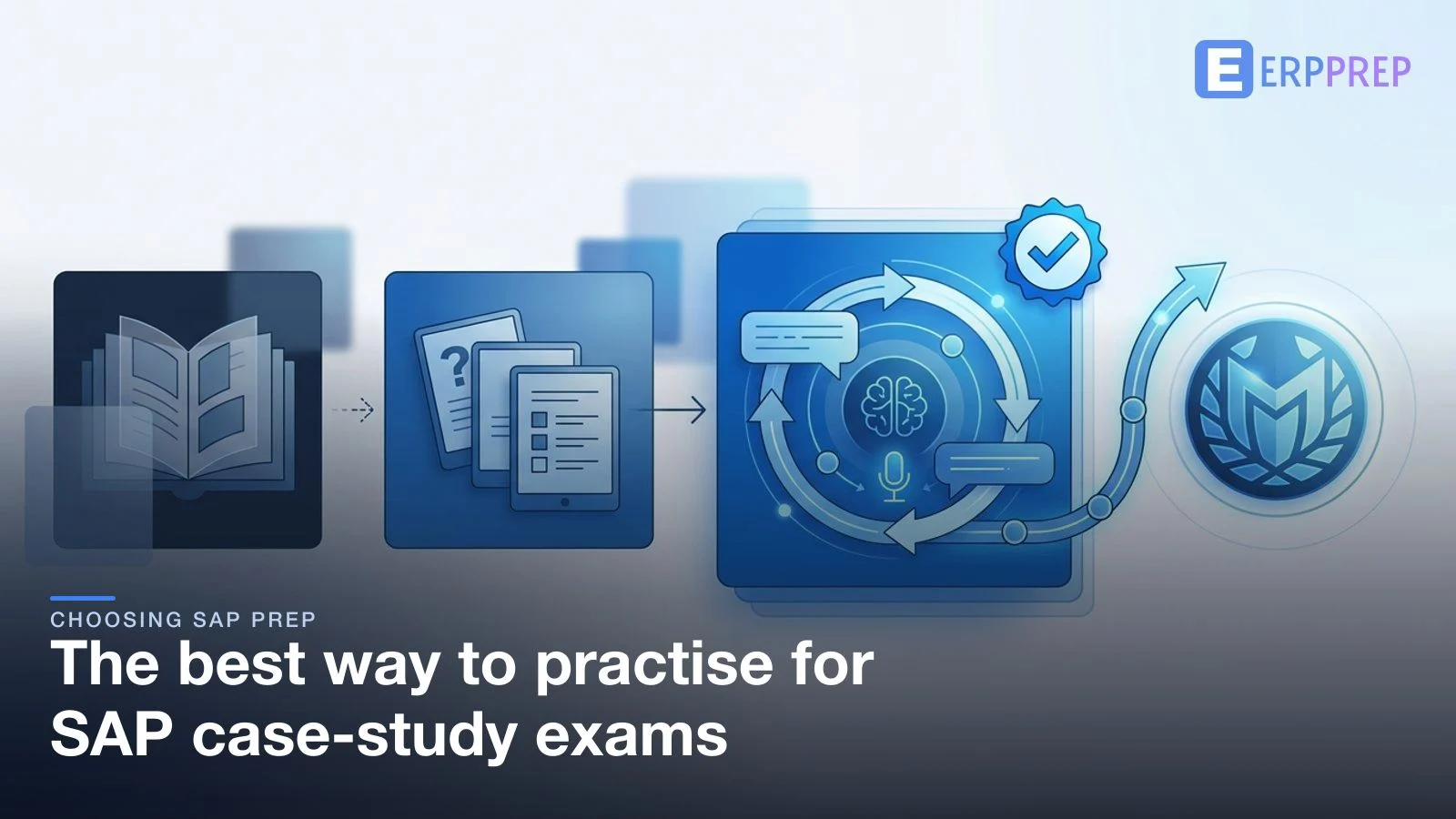
The best practice for SAP® case-study (SBA) exams is active, feedback-driven work that makes you reason through a connected business scenario — not passive review. Re-reading notes and watching official courses build familiarity but not judgement; hands-on system time and worked scenario practice build more; and conversational practice, where you question a stakeholder, justify a recommendation, and get a graded debrief, most directly rehearses the decision-making an SBA rewards. Combine a base of official learning with repeated scenario reasoning.
If you're preparing for an SAP® case-study exam, the hard part isn't deciding to practise — it's deciding how. Re-read your notes? Work through the official course again? Book hands-on system time? Grind a bank of practice questions? Try something more conversational? All of these have a place, but they don't build the same skill, and a case-study exam rewards one skill in particular. This roundup compares the main methods head to head — with an at-a-glance table — and shows which ones actually build the reasoning a Scenario-Based Assessment measures. For the wider picture, see how to prepare for SAP certification.
Key takeaways
- Case-study exams test judgement, not recall. An SBA gives you one connected scenario and asks you to decide and justify — so practice that only rehearses facts trains the wrong muscle.
- Passive methods build familiarity, not decision-making. Re-reading notes and re-watching courses feel productive because the material looks familiar, but familiarity isn't the skill the exam measures.
- Active, feedback-driven practice wins. The methods that make you commit to a decision and then tell you where your reasoning held up are the ones that transfer to the exam.
- AI stakeholder roleplay targets the exam skill most directly. Talking through a scenario, defending a recommendation, and reading a graded debrief rehearses exactly what an SBA asks you to do.
- No single method is enough. The strongest routine layers official learning, hands-on time, question-bank diagnostics, and scenario reasoning — each covering a gap the others leave.
Why case-study exams defeat passive study
Under SAP's 2026 formats, a case-study exam is a Scenario-Based Assessment (SBA): instead of a long list of independent questions, you work through a single connected activity — one business situation you have to analyse, make decisions about, and justify. Exams as different as Project Manager – SAP Activate (C_ACT) and SAP Enterprise Architect (P_SAPEA) both use this format, and it changes what "knowing the material" even means. You can recall every fact in the syllabus and still stumble, because the exam isn't checking whether you remember the fact — it's checking whether you can apply it under the constraints of a specific scenario.
That's exactly where passive study falls short. Re-reading notes and re-watching a course produce a strong feeling of familiarity: the material looks recognisable, so you assume you've learned it. But recognition and decision-making are different skills. Recognising that a concept is true when you see it written down does nothing to rehearse choosing it, under time pressure, from among several plausible options, in a scenario you've never seen before. The exam lives entirely in that second skill — and passive review barely touches it. This is why so many well-read candidates are surprised by an SBA: they prepared to know, and the exam asked them to decide. For the format itself, see what an SBA scenario-based assessment is.
The practice methods compared
Here are the five methods most candidates reach for, weighed against the one thing that matters for a case-study exam: does it build reasoning? The table gives you the whole comparison at a glance; the sections below add the detail.
| Method | Builds reasoning? | Effort | Best for |
|---|---|---|---|
| Re-reading notes and summaries | Low | Low | Early recall and getting the vocabulary in place |
| Official SAP learning journeys | Partial | High | Authoritative coverage of what's in scope |
| Hands-on system time | Moderate | High | Procedural fluency — how tasks are actually performed |
| Static practice questions | Partial | Moderate | Diagnosing weak spots and checking recall |
| AI stakeholder roleplay (graded debrief) | High | Moderate | Rehearsing the decision-making an SBA measures |
Re-reading notes and summaries
The lowest-effort method, and the one candidates over-rely on. Notes are genuinely useful as a base layer — they get the vocabulary and the shape of the syllabus into your head, which you need before any higher-order practice can work. The trap is mistaking the comfort of familiarity for readiness. Because re-reading never asks you to make a decision, it can't build the judgement a case-study exam tests. Use notes to establish the ground floor, then move on quickly; time spent re-reading past the point of familiarity has a steeply falling return.
Official SAP learning journeys
SAP's own learning journeys are the authoritative source for what's in scope, and your foundation should be built there — you can browse the official catalogue at SAP Learning. Official material is unmatched for coverage and correctness: it's the ground truth for the concepts a given exam expects. What it's not designed to do is rehearse exam-day decision-making. Learning journeys teach the material; they don't put you in the seat of a candidate who has to choose and defend an approach under scenario constraints. Treat official learning as essential input, not as a stand-in for scenario practice. For how the two fit together, see official SAP learning versus third-party practice.
Hands-on system time
Working in a real or trial environment builds procedural fluency: you learn where things live, how a task is carried out, and what the system does in response. For a developer- or configuration-heavy case-study exam like SAP Fiori Application Developer (C_FIORD), that fluency is valuable — it removes the friction of the mechanics so you can think about the decision. But hands-on time on its own tends to rehearse the click-path rather than the judgement. Knowing how to perform a task is not the same as knowing which task fits this client's constraints and why. The fix isn't to drop system time; it's to pair it with scenario reasoning so you're practising the decision, not only the procedure.
Static practice questions
A well-built bank of practice questions — with full explanations, not just an answer key — is an excellent diagnostic. It checks your recall efficiently and shows you exactly where the gaps are, which is hard to see from the inside when you're re-reading. The limitation is structural: most questions test a single fact in isolation, while a case-study exam tests connected reasoning across a whole scenario. So questions are a means, not an end — use them to find your weak spots, then close those gaps with practice that mirrors the SBA format. For how to get the most from them, see how to use practice exams for SAP certification.
AI stakeholder roleplay
The newest method, and the one that maps most closely onto what a case-study exam actually asks. Instead of picking an answer from a list, you work a business scenario by talking through it — asking a stakeholder clarifying questions, proposing a course of action, and defending it when it's challenged — then receiving a graded debrief on the quality of your reasoning. Because it makes you decide and justify, it rehearses the SBA skill head-on. We unpack how it works below.
Why active, feedback-driven practice wins
Step back from the individual methods and a pattern emerges: the further a method sits from "make a decision and find out how good it was," the less it prepares you for a case-study exam. Re-reading is pure input with no decision. Official learning is rich input with little rehearsal of choice. Hands-on time adds action but not always judgement. Question banks add a decision but usually an isolated one. Scenario roleplay closes the loop — a real decision, in context, with feedback on the reasoning behind it.
Two things make that closed loop so effective. The first is retrieval under constraint: you're not recognising a fact, you're pulling the right knowledge out and applying it to a situation that pushes back — which is precisely the exam's demand. The second is feedback on reasoning, not just on outcome. Being told you were wrong teaches little; being shown where your reasoning broke down — a constraint you missed, an option you dismissed too early — is what turns one scenario into a lesson that generalises to the next. A case-study exam like Solution Transformation Consultant with SAP Cloud ALM (C_STC) rewards exactly that transferable judgement, and it's built only by repeatedly deciding and reflecting. For a deeper method, see how to practise for an SBA scenario-based SAP exam.
Want to feel the difference between recognising and deciding? A free sample lets you try scenario-style practice before committing anything. Try a free sample and judge for yourself whether it feels like the exam.
AI stakeholder roleplay, explained
Because it's the least familiar method, it's worth explaining plainly. ERPPrep's Scenario Roleplay is AI stakeholder practice built for case-study (SBA) exams. You enter a business scenario and hold a conversation with an AI stakeholder — someone playing the client, the sponsor, or a colleague — who gives you the situation, answers your questions, and pushes back on your thinking. You ask what you need to ask, propose an approach, and defend it. At the end you get a graded debrief: an assessment of how well your reasoning held together, where it was strong, and where it slipped. It's the closest a practice tool gets to sitting across from the stakeholder a case-study exam imagines.
A few things are worth stating honestly about how it's built:
- It's for SBA exams specifically. Scenario Roleplay is offered for case-study (SBA) certifications, because that's the format whose skill it rehearses — not every SAP exam uses it.
- It's original practice, not real questions. Every scenario is generated to mirror the case-study format — never real, actual, or leaked exam content. On an exam with no fixed answer key, memorised answers would buy you nothing anyway; the point is to build the reasoning that transfers.
- It comes with the Exam Pass as an included allowance. Roleplay practice is bundled into the pass for eligible SBA exams as part of your preparation — you don't buy the conversations separately.
- Your transcripts are kept only briefly, then purged. The text of your practice conversations is retained for a limited window and then deleted — it's there to support your session and your debrief, not to be stored indefinitely.
None of this replaces knowing the material — it rehearses using it. Roleplay works best once you've built a foundation from official learning and shored up recall with practice questions, so the conversation is spent on judgement rather than looking things up. Paired that way, it turns your knowledge into the decisions a case-study exam actually scores.
A combined practice routine
No single method is sufficient, and you don't have to choose. The strongest preparation layers them so each covers a gap the others leave. A routine that works for most case-study exams:
- Build the base with official learning. Work the relevant SAP® learning journey first, so you have accurate coverage of what's in scope. This is your ground truth; everything else rehearses applying it.
- Add hands-on time where the exam is task-heavy. For developer- or configuration-oriented exams, spend enough time in the system to make the mechanics automatic, so practice can focus on the decision rather than the click-path.
- Use question banks as a diagnostic. Run through practice questions with full explanations to find your weak spots quickly, then send yourself back to the source on anything you missed.
- Make scenario reasoning the core rehearsal. In the final weeks, centre your practice on worked scenarios and stakeholder roleplay — decide, justify, read the debrief, and go again. This is where familiarity hardens into reliable judgement.
- Space it out and reflect between reps. Short, frequent sessions beat one long cram, because reasoning is a skill that improves with reps and reflection. Review where your thinking held up each time, not just whether you were right.
Notice the shape: passive methods front-load the routine to build knowledge, and active methods carry the back end to build judgement. An exam such as SuccessFactors Variable Pay (C_THR87) rewards a candidate who has done both — who knows the material and has rehearsed deciding with it. For the technique of working through connected scenarios under exam conditions, see SBA exam strategy for connected scenarios.
What to avoid: dumps and shortcuts
One "method" belongs on a different list entirely. Resources that advertise real, actual, or leaked exam questions — dumps — are worth naming only so you can avoid them. They put your certification at risk, and on a case-study exam they don't even work: there is no fixed answer key to memorise when the exam asks you to reason through a scenario and justify a decision. A remembered list of "correct" answers is useless against a task you have to actually perform. So the dumps trade is doubly self-defeating — it endangers the credential you're working toward and trains a skill the format doesn't reward.
The honest shortcut, if there is one, is the opposite of a dump: spend your time on the practice that most resembles the exam. For a case-study exam, that means active scenario reasoning with feedback — the method that builds the judgement the SBA measures. Everything else is scaffolding around it. For the fuller list of traps, see what to avoid in SAP exam prep, and to choose a resource well, how to choose a legitimate SAP practice provider.
Putting it together
The best way to practise for an SAP case-study exam isn't a single tool — it's a sequence that ends in active, feedback-driven reasoning. Build your knowledge from official learning, harden it with hands-on time and question-bank diagnostics, and make scenario practice the core of your final weeks so you're training the exact judgement an SBA scores. Passive review earns its place at the start; it just can't carry the finish. Deepen the plan with how to prepare for SAP certification, and when you're ready to feel the difference between recognising and deciding, try a free sample and practise the way the exam actually asks you to think.
Frequently asked questions
- What is the best way to practise for SAP case-study exams?
- Active, feedback-driven scenario practice. A case-study (SBA) exam asks you to reason through one connected business situation and defend your decisions, so the practice that transfers best is practice that makes you do exactly that — work a scenario end to end, commit to a recommendation, and get feedback on the reasoning, not just a right-or-wrong mark. Passive review supports this, but can't replace it.
- Why doesn't re-reading notes work for scenario-based exams?
- Re-reading builds recognition — you feel you know the material because it looks familiar. But an SBA doesn't ask you to recognise a fact; it asks you to apply it under the constraints of a specific scenario. That's a different skill, and the only way to build it is to practise deciding, not re-reading. Notes are a useful base layer, not the main event.
- Is hands-on system time enough to pass a case-study exam?
- It helps a lot, but on its own it's incomplete. Hands-on time builds procedural fluency — you learn where things live and how tasks are performed. A case-study exam layers judgement on top: which option fits this client's constraints, and why. Pair system practice with scenario reasoning so you're rehearsing the decision, not only the click-path.
- Do static practice questions help for SBA exams?
- Yes, as a diagnostic. A good bank of practice questions with full explanations checks your recall and surfaces gaps fast. The limit is that most questions test a single fact in isolation, while an SBA tests connected reasoning across a whole scenario. Use questions to find weak spots, then close them with scenario practice that mirrors the exam's format.
- What is AI stakeholder roleplay practice?
- It's conversational scenario practice: you work a business case by talking to an AI stakeholder — asking clarifying questions, proposing a course of action, and defending it — then receive a graded debrief on your reasoning. Because it makes you justify decisions the way a case-study exam does, it rehearses the exact judgement an SBA measures rather than just recall.
- Is scenario roleplay the same as real or leaked exam questions?
- No. Roleplay practice is original, generated scenarios built to mirror the case-study format — never real, actual, or leaked exam content, which would put your certification at risk and wouldn't help anyway on an exam that has no fixed answer key. The point is to build the underlying reasoning skill, which is the only thing that transfers to the live exam.
- How often should I practise before a case-study exam?
- Little and often beats one long cram. Because SBA reasoning is a skill, it improves with repeated reps and reflection between them. A workable rhythm is a short scenario session most days in the weeks before the exam, each followed by a review of where your reasoning held up and where it didn't — that spacing is what turns familiarity into reliable judgement.
- Can official SAP learning alone prepare me for a case-study exam?
- Official SAP® learning is the authoritative source for what's in scope, and you should build your foundation there. But learning journeys are designed to teach the material, not to rehearse exam-day decision-making under scenario constraints. Treat official learning as your ground truth and add active scenario practice on top so you're trained to decide, not only to know.
- Which SAP exams are case-study (SBA) exams?
- Case-study exams use SAP's Scenario-Based Assessment format — a single connected activity rather than a bank of separate questions. Examples span tracks: SAP Fiori Application Developer (C_FIORD), Project Manager – SAP Activate (C_ACT), Solution Transformation Consultant with SAP Cloud ALM (C_STC), SuccessFactors Variable Pay (C_THR87), and SAP Enterprise Architect (P_SAPEA). Check any exam's format before you plan your practice.
- How do I combine practice methods into a routine?
- Layer them. Start with official learning for coverage, add hands-on system time for procedural fluency, use static questions to find weak spots, and make active scenario practice — worked cases and stakeholder roleplay with feedback — the core rehearsal in the final weeks. Each method covers a gap the others leave; together they build both the knowledge and the judgement an SBA rewards.
ERPPrep is an independent platform and is not affiliated with, endorsed by, or sponsored by SAP SE. SAP and other SAP products are trademarks of SAP SE, referenced here only to describe the certification exams ERPPrep helps you prepare for.
Ready to practise the way the exam tests?
ERPPrep provides original, performance-style scenarios and skill drills built for the 2026 SyBA and SBA formats. Try a free sample and judge the quality yourself.
Practice for these exams
Related guides
How to prepare for your first SAP SBA exam
A first-timer's guide to preparing for an SAP Scenario-Based Assessment: what to expect, how it differs from multiple-choice, and a practical week-by-week plan.
What is AI stakeholder roleplay for SAP exams?
AI stakeholder roleplay is a spoken-style practice conversation with an AI client or manager, built for SAP's SBA exams — plus a graded debrief. Here's how it works.
How to practise for SAP exams with AI stakeholder roleplay
SAP's SBA exams reward joined-up reasoning, not recall. Here's how practising with an AI stakeholder and a graded debrief builds that skill.