

Official SAP learning vs third-party practice: an honest comparison
Official SAP Learning or third-party practice? Different jobs — authoritative content vs exam-day fluency. How they compare, and why most candidates use both.
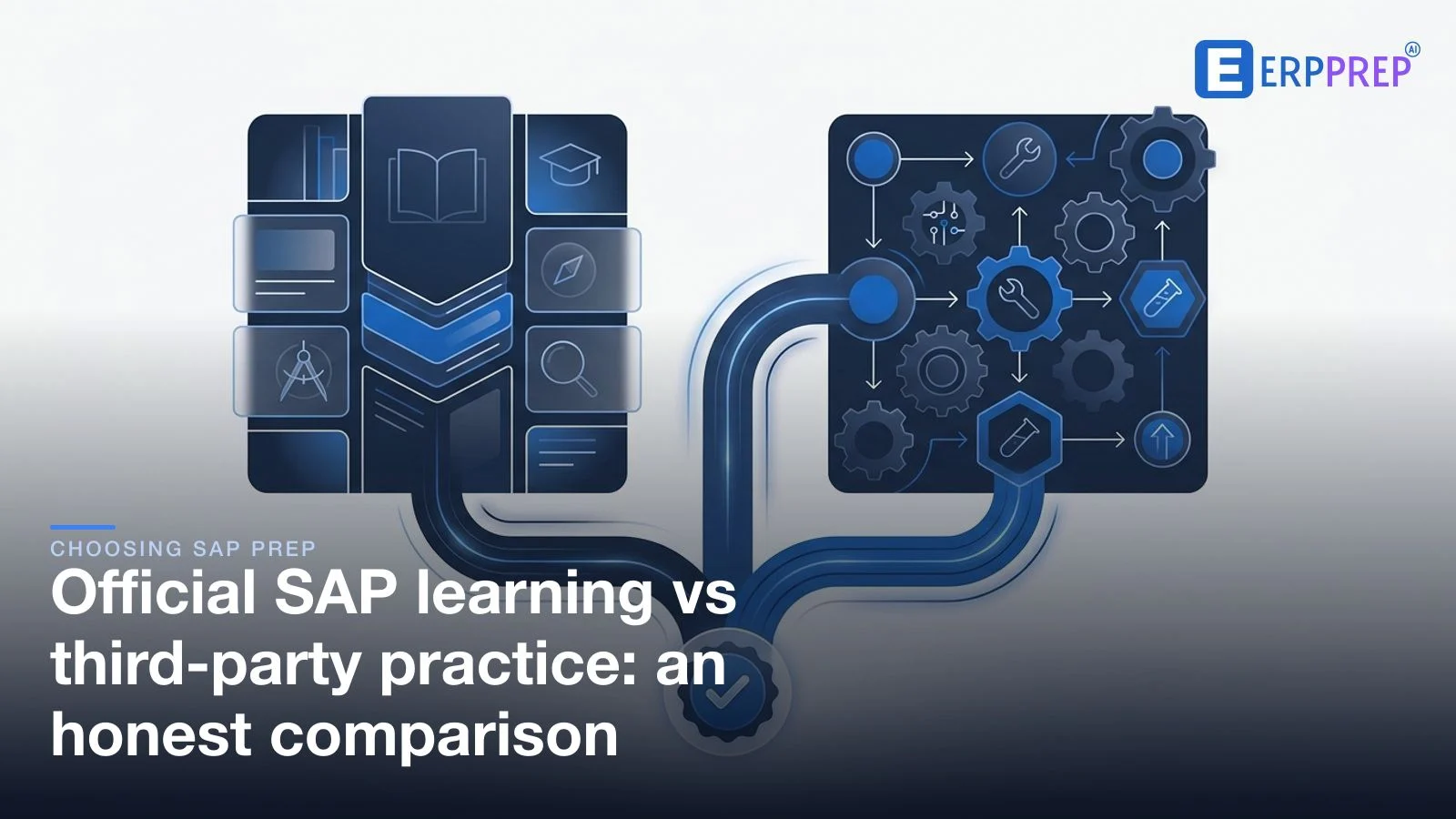
Official SAP Learning (learning.sap.com) is the authoritative source for what to learn — the learning journeys and content SAP itself defines. Third-party practice is where you build exam-day fluency by repeatedly doing performance-style tasks. They're complementary, not competing: official learning teaches the content; practice trains the doing. Most candidates combine authoritative learning with hands-on practice, then confirm exam specifics on the official page — using each for the job it does best rather than forcing one tool to cover both halves of readiness.
A common either/or question in SAP® prep is "official SAP Learning or third-party practice?" — but it's the wrong framing, because the two do different jobs. One is the authoritative content source; the other builds exam-day fluency. Treating them as rivals is what leads candidates to over-invest in one and skip the other, then wonder why they knew the material but froze on the tasks. This guide compares them honestly, section by section, and shows why most well-prepared candidates use both — deliberately, and in the right order. For the wider decision, see how to prepare for SAP certification.
Key takeaways
- They solve different problems. SAP's official learning defines and delivers the content; good third-party practice builds the doing-fluency a performance-based exam actually scores.
- It's not either/or. The reliable pattern is a pipeline — learn it from the authoritative source, then rehearse it until it's automatic — not a choice between two rivals.
- Scope comes from SAP. The official learning journey is the source of truth for what's in scope; judge every other resource against it, and confirm the current format and passing details on the exam page.
- Judge on value, not price. Costs are set by SAP and each provider and change over time; the expensive path is usually the underprepared one that ends in a retake.
- Sourcing is a quality gate. Legitimate, format-faithful practice with explained reasoning reinforces correct understanding; dumps and scraped material do the opposite — and carry real risk.
Official learning vs third-party practice at a glance
Before the detail, here is the whole comparison in one view. Read it as "different jobs," not "winner and loser" — the last row is the point:
| Aspect | SAP's official learning | Third-party practice |
|---|---|---|
| Authority & coverage | The authoritative definition of scope — the learning journeys and content SAP itself publishes for the exam. | Not authoritative on scope; the best practice aligns to the official journey rather than defining it. |
| Format-fidelity practice | Teaches the material, but isn't built primarily to rehearse the performance-based task style repeatedly under pressure. | Its core strength — repeated, performance-style tasks and scenarios that mirror how the exam asks you to do the work. |
| Cost profile (qualitative) | Set by SAP and varies by option; check current terms directly rather than relying on a forum figure. | Set by each provider and varies widely; judge by value and quality, not by the lowest sticker. |
| Hands-on drills | Some hands-on exposure, but not a high-repetition drill engine for exam-day rehearsal. | Purpose-built for repetition — many short, explained tasks that turn knowledge into fluency. |
| Best use | Learn the content correctly and completely; define your scope. | Rehearse doing it until it's automatic; find and close gaps. |
What SAP's official learning gives you
SAP's official learning (learning.sap.com) is the authoritative definition of what an exam covers — the learning journeys, content, and scope SAP itself publishes. If you want to be sure you've learned the right material, completely and correctly, this is the source of truth. Its role is to get the content into your head accurately.
That authority matters more than it first appears. Because it comes straight from SAP, the learning journey is the one place you can trust the scopewithout second-guessing: the topic areas, the relative emphasis, and the boundaries of what a given exam expects. Every other resource you use should be measured against it. When a third-party explanation and the official journey disagree on what's in scope, the official journey wins — that's the whole reason it exists. It is also where you confirm the moving parts that change over time: the current exam format, the number of items, and the passing details. Treat those as facts to read off the official page for your specific exam, never as numbers to memorise from a blog.
What official learning is not built to do is manufacture exam-day fluency. Reading and watching the authoritative content teaches you the material; it doesn't, on its own, rehearse the specific act of completing tasks accurately, under time pressure, in the performance-based style. That is a different readiness state — and closing the gap to it is the other half of the job.
What good third-party practice adds
Knowing the content and being able to perform under exam conditions are two different readiness states — and the gap between them is what third-party practice closes. Good practice has you repeatedly do performance-style tasks and reason through scenarios, with explained reasoning, until the doing is fluent. That's the half official content alone doesn't train, and it's exactly what a performance-based exam measures. (Choose practice carefully — see how to choose a legitimate practice provider.)
The mechanism is repetition with feedback. A single worked example teaches a concept once; a well-built practice set makes you apply it dozens of times, in varied situations, until the reasoning is automatic rather than effortful. Each attempt surfaces something specific — a step you skipped, a distinction you blurred, a scenario you misread — and the explained reasoning tells you whythe correct response is correct, not just that it is. Over a study block, that loop does two things at once: it converts passive knowledge into recall you can reach for instantly, and it builds the calibration to move at exam pace without sacrificing accuracy. Neither of those comes from reading alone, however authoritative the reading is.
Just as important, quality practice keeps you honest about where you actually stand. It's easy to finish a learning journey and feel ready; it's much harder to sit a realistic scenario and pass it cold. Practice replaces the feeling of readiness with evidence of it — which is precisely why it belongs in the plan even for candidates who already know the material well.
There is also a time-management dimension that only rehearsal can train. A performance-based exam rewards candidates who work steadily and accurately, and the only way to build that pacing is to practise against the clock until it becomes instinct. You learn how long a task should take you, where you tend to over-think, and when to move on and come back — judgment that no amount of reading produces because it's a physical, timed skill rather than a piece of knowledge. By exam day, the goal is that the mechanics feel routine, so your attention is free for the actual reasoning the question is testing.
Why they are complementary, not rivals
The framing that trips people up is competition: pick the "better" option and spend your budget there. But the two resources don't compete on the same axis. Official learning owns correctness and scope; practice owns fluency and calibration. Ask which is better and you're asking whether a map is better than a rehearsal — they answer different questions.
You can see the failure mode of over-committing to either. Candidates who lean entirely on official content often know the material but stumble on execution: they hesitate, misjudge the clock, or freeze on a task they'd have recognised instantly with more reps. Candidates who lean entirely on practice — especially cheap, unsourced practice — can build fluent habits around wrongcontent, drilling patterns that don't match the real scope. Each gap is exactly the thing the other resource is best at filling, which is why combining them isn't a nice-to-have; it's the structurally sound approach.
Notice that the two resources also check each other. The official journey keeps your practice honest about scope — if a practice set drifts into topics SAP doesn't list, or under-weights something it emphasises, the journey is how you catch it. Practice, in turn, keeps your reading honest about depth — it exposes the topics you thought you understood but can't yet apply under pressure. That mutual correction is only available when you run both; drop either one and you lose the check as well as the coverage. It's the same reason experienced consultants who already know a module still practise before an exam: the point isn't to relearn the content, it's to verify that the content converts into accurate, timed performance.
The "learn it, then do it" model
The simplest way to hold the two in your head is a pipeline: learn it, then do it until it's automatic. Official learning is your syllabus — the authoritative statement of what to know. Practice is your rehearsal — the repeated act of applying that knowledge in the exam's performance-based style until it stops feeling like effort.
The pipeline isn't strictly one-directional in practice, and that's a feature. When a practice task exposes a weakness, the fix usually isn't more practice on that task — it's a return trip to the relevant topic in the learning journey to repair the underlying understanding, then back to practice to re-test it. So the honest picture is a loop: content builds the foundation, practice stress-tests it, gaps route you back to the authoritative source, and the cycle tightens as the exam approaches. Framing prep this way also makes the technique portable — the same "learn it, then do it" rhythm carries across whichever performance-based exam you sit, which is why the performance-based exam preparation guide treats format fluency as a skill you build once and reuse.
Want to judge practice quality before you spend anything? A free sample lets you feel the performance-based format first-hand. Try a free sample.
How to combine them: cost, value and sequencing
Prices for official learning and third-party options are set by SAP and each provider and change over time, so check current terms directly rather than relying on a figure from a forum. The more useful lens is value: official learning buys authoritative content; good practice buys exam-day readiness. Under-investing in either tends to cost more in failed attempts than it saves — the most expensive path is usually the underprepared one.
Sequencing is where value is won or lost. A practical way to weight the two:
- Front-load content. Early on, spend most of your time in the authoritative learning journey, building accurate coverage of the scope. Thin practice here mostly tells you what you don't know yet — useful, but not the main event.
- Shift weight to practice as the exam nears. Once the content is broadly in place, tilt toward performance-style rehearsal so accuracy and pace become automatic. This is when practice earns its keep.
- Let failures route you. Treat every missed practice task as a pointer back to a specific topic in the journey, fix the understanding there, then re-test. This is the loop that turns two resources into one system.
- Re-confirm the official facts last. Before booking, read the current format and passing details off the official exam page — those are the details worth getting from the source, not from memory.
If you want to model the trade-offs in money terms rather than time, the full cost breakdown and the most cost-effective route walk through where each pound tends to pay back — and where SAP's Learning Hub compares to the alternatives for the content half.
What to avoid: dumps and low-quality "practice"
Not everything sold as "practice" belongs in this pipeline. The category to avoid outright is dumps — material that claims to reproduce real, live exam questions. ERPPrep does not provide dumps, and you shouldn't rely on anything that does. The reasons are practical as well as principled: dumps are a copyright and exam-integrity risk, they're often wrong or out of date, and — most damaging of all for a performance-based exam — they train recall of specific items rather than the hands-on skill the exam actually measures. Memorising leaked answers is the fastest way to feel prepared and be underprepared.
Low-quality legitimate practice fails you more quietly. Unsourced question sets, banks with no explained reasoning, or material that ignores the current performance-based format can drill you fluently in the wrong direction. The test to apply is simple: does the resource align to the official scope, mirror the real task style, and explain why each answer is right? If it can't, it's not building the readiness you need. For the fuller list of prep red flags, see what to avoid in SAP exam prep, and for the specific risks of dumps, whether SAP exam dumps are safe.
The pragmatic answer: combine them
For a performance-based exam, the reliable approach is to learn the content from the authoritative source and then build fluency through hands-on practice — on SAP S/4HANA Finance (C_TS4FI) or any exam. Treat official learning as your syllabus and practice as your rehearsal. Framing them as rivals leads people to over-invest in one and skip the other; treating them as a pipeline — learn it, then do it until it's automatic — is what actually gets people through.
From here, decide how to structure that pipeline. If you're weighing formats of study, self-study vs instructor-led maps the content-side options; to vet the practice side, how to choose a practice provider gives you the checklist; and the how to prepare for SAP certification pillar ties the whole plan together.
Frequently asked questions
- Do I need official SAP Learning to pass?
- Official SAP Learning is the authoritative source for what the exam covers, so it's a reliable way to learn the content correctly. Whether you use it or another route to the same knowledge, confirm scope against the official learning journey. What official learning doesn't do by itself is build the exam-day doing-fluency — that comes from practice.
- Is third-party practice a replacement for official learning?
- No — it's a complement. Third-party practice is where you rehearse performing tasks and reasoning through scenarios until they're fluent, which is what performance-based exams reward. But it works best on top of accurate content knowledge. Use official learning for the what, practice for the doing.
- Which is more cost-effective?
- It depends on your starting knowledge and the specific options, and prices are set by SAP and each provider, so check current terms directly. The more useful framing is value, not just price: official learning delivers authoritative content; good practice delivers exam-day readiness. Under-investing in either tends to cost more in retakes than it saves.
- Can I just use free resources?
- You can assemble a lot from free and low-cost material, especially for learning the content. The gap free resources rarely fill is realistic, performance-style practice with explained reasoning. Whatever mix you choose, judge it by whether it prepares you to do the tasks — not by price alone.
- In what order should I use official learning and practice?
- Front-load official learning to build accurate content knowledge, then shift weight to practice as the exam nears so you're rehearsing the doing under time pressure. In reality the two overlap: a failed practice task usually points you back to a specific topic in the learning journey, so you'll cycle between them rather than finishing one cleanly before starting the other.
- Does third-party practice teach me the wrong things?
- It can, if the material is low-quality or scraped, which is exactly why sourcing matters. Legitimate practice is aligned to the published scope and explains the reasoning behind each answer, so it reinforces correct understanding rather than rote patterns. Verify a provider's scope against the official learning journey and avoid anything positioned as leaked or real exam content.
- Are SAP exam dumps a shortcut past all this?
- No. Dumps — material claiming to reproduce real, live exam questions — are a copyright and integrity risk, are often wrong or outdated, and train recall rather than the hands-on skill a performance-based exam measures. Legitimate practice is the opposite: format-faithful rehearsal with explained reasoning, aligned to the official scope. Learn the difference before you buy anything.
- How do I check that practice matches what the exam covers?
- Start from the official learning journey for your exam, note its topic areas and weightings, then confirm your practice material touches the same areas in the same performance-based style. If practice drills a topic the journey doesn't list — or skips one it emphasises — trust the official scope and adjust. The official page is also where you confirm the current format and passing details.
ERPPrep is an independent platform and is not affiliated with, endorsed by, or sponsored by SAP SE. SAP and other SAP products are trademarks of SAP SE, referenced here only to describe the certification exams ERPPrep helps you prepare for.
Ready to practise the way the exam tests?
ERPPrep provides original, performance-style scenarios and skill drills built for the 2026 SyBA and SBA formats. Try a free sample and judge the quality yourself.
Practice for these exams
Related guides
SAP Learning Hub vs the legitimate alternatives: how to choose
SAP's own learning subscription (SAP Learning Hub / SAP Learning) is the authoritative content source — but it isn't your only legitimate option. Compare it with free learning journeys, hands-on practice, instructor-led training and self-assembled study.
Is an SAP mock test, question bank or simulator best?
Four labels, four different skills: what a question bank, mock test, practice exam and simulator each train — and which can rehearse a 2026 SAP exam.
SAP certification vs training course: what's the difference?
A training course teaches you; a certification tests you. What each one gives you, when you need which, and what the 2026 exam formats change.