

Self-study vs instructor-led SAP certification prep
Should you prepare for an SAP certification through self-study or an instructor-led course? Here's an honest comparison of cost, pace, structure, and — for the 2026 performance-based format — which actually builds exam-day fluency.
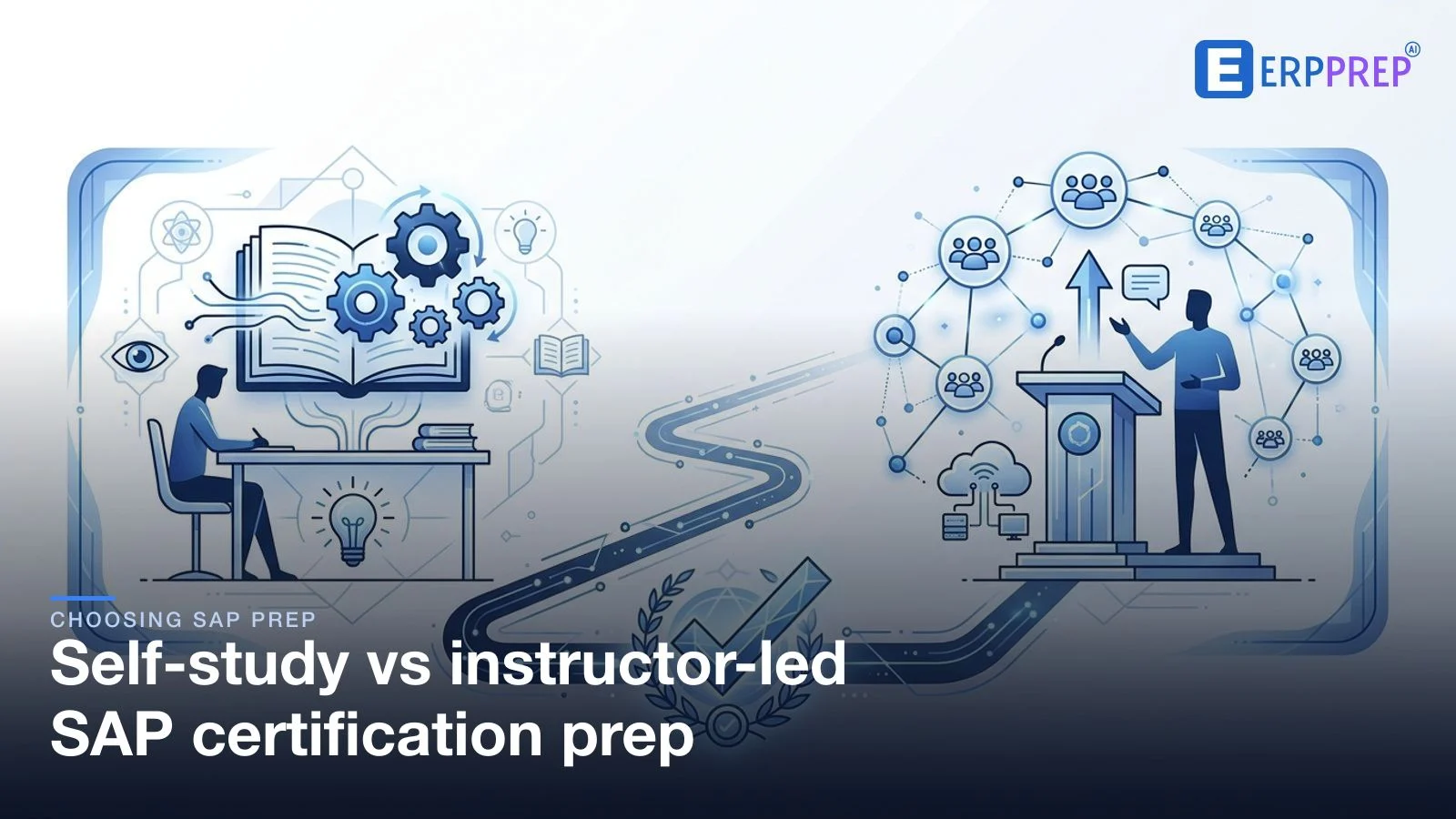
Self-study is lower-cost and flexible but demands discipline; instructor-led training adds structure, live guidance, and accountability at higher cost and a fixed schedule. For SAP's 2026 performance-based exams, what matters most isn't the delivery mode but how much hands-on, format-faithful practice it includes — which is why many candidates blend instructor-led or official learning with self-directed practice rather than choosing one outright.
One of the first forks in preparing for an SAP® certification is how to learn: teach yourself, or take an instructor-led course? Both can work, and the honest answer depends on your budget, your discipline, and how much guidance you need. This comparison lays out the trade-offs in detail — and the one factor that, for the 2026 performance-based exams, matters more than the mode itself. For the bigger decision this sits inside, see how to prepare for SAP certification.
Key takeaways
- Cost and flexibility favour self-study; structure and accountability favour instructor-led — that's the core trade-off, and it's about your working style, not which one is "better."
- Neither mode passes the exam by itself. The 2026 System-Based (SyBA) and Scenario-Based (SBA) formats reward doing tasks, so the deciding variable is how much hands-on, format-faithful practice your prep contains.
- Instructor-led guidance compresses the learning phase; it does not replace repetition — sitting through instruction still has to be followed by doing the tasks.
- The blend is the most common real-world answer: structured learning to absorb content, then self-directed practice to build exam-day fluency.
- Judge every option by one yardstick — how much realistic, repeated practice it actually gets you to — and let that, not the label on the method, drive your decision.
Self-study vs instructor-led at a glance
Before the detail, here is the whole comparison on five dimensions that actually decide the outcome. Read the "best-fit learner" row first — it usually tells you which column you belong in faster than the cost row does.
| Dimension | Self-study | Instructor-led |
|---|---|---|
| Cost profile | Lower — you pay for materials and practice rather than seat time, and you can scale spend to your budget. | Higher — you pay for live instruction and a curated path; often justified when an employer sponsors it. |
| Pace & flexibility | You set the pace and fit study around work; easy to pause, repeat, or accelerate a section. | Fixed schedule and shared pace; less flexible, but the calendar itself keeps you moving. |
| Structure & accountability | You supply both — a clear plan and self-discipline are non-negotiable; this is where some candidates stall. | Built in — a defined curriculum, an instructor, and a cohort create external accountability. |
| Hands-on access | Depends entirely on the practice you choose; the upside is that hands-on repetition is inherently self-directed. | Varies by offering — some include guided system time, some are mostly lecture; treat it as a checklist item, not a given. |
| Best-fit learner | Disciplined self-starters, those already familiar with the domain, and anyone needing maximum schedule flexibility. | Learners newer to the domain, those who study better with external pacing, and sponsored candidates with time allotted. |
What each approach really is
It helps to be precise about what you're actually comparing, because the two labels cover a range of things. Self-study spans everything from working through official learning content on your own schedule, to reading documentation, to grinding performance-style practice in a realistic environment. Its defining trait isn't the material — it's that you own the plan, the pace, and the follow-through. Instructor-led training, by contrast, is defined by a person and a schedule: a curated path through the syllabus, delivered live (in a room or virtually), with someone to answer questions as they come up and a calendar that pulls you along.
Neither is a monolith, and that matters when you compare them. A lecture-heavy course and a hands-on lab course are both "instructor-led" but prepare you very differently; a passive read-through and a disciplined practice regimen are both "self-study" and are worlds apart in results. So the real comparison isn't course-versus-no-course — it's which specific version of each gets you to the most repeated, realistic practice, a point the performance-based exam format makes unavoidable.
The case for self-study
Self-study is affordable and flexible. You set the pace, fit it around work, and spend on materials rather than seat time. For performance-based exams it has a real edge, too: the thing that builds exam-day capability — repeated hands-on practice — is inherently self-directed. You can repeat a task until it's automatic, revisit a weak area the day before, and shape the whole plan around the specific exam you're taking rather than a generic curriculum.
The trade-off is that you supply the structure, discipline, and accountability yourself, which is exactly where some candidates struggle. Without an external schedule it's easy to drift, to over-study the comfortable topics and avoid the hard ones, or to mistake passive reading for preparation. Good self-study closes those gaps deliberately: a written plan, a fixed weekly cadence, and — most importantly — a bias toward doing over reading. If you want a scaffold to borrow, the study plan for a full-time job and the realistic preparation timeline turn "I'll study on my own" into an actual schedule.
Who self-study suits
Self-study fits you well if several of these are true. You're a disciplined self-starter who reliably sits down without an external nudge. You already have working familiarity with the domain — you configure or use the module day to day — so you need reinforcement and exam technique more than first-principles teaching. Your schedule is unpredictable, so a fixed course calendar would be a liability rather than a help. And you're budget-conscious, whether self-funding or simply preferring to put your resources into practice rather than seat time.
If that's you, the risk to manage is passivity, not the mode itself. Build your plan around active recall and hands-on repetition, and be honest about weak areas rather than steering around them. A common failure pattern is spending the available time reading and re-reading, then meeting a performance task cold on exam day — a trap the guide to what to avoid in exam prep walks through in detail.
The case for instructor-led training
An instructor-led course buys you structure and guidance: a defined curriculum, someone to answer questions in real time, and the accountability of a schedule. If you're newer to the domain or know you study better with external pacing, that can be worth the higher cost and the fixed calendar. A good instructor also sequences the material for you — no small thing when a syllabus is broad — and can unblock a misunderstanding in minutes that might cost you an evening alone.
What it doesn't do by itself is make you fluent — sitting through instruction still has to be followed by doing the tasks. This is the most common misread of instructor-led prep: treating attendance as sufficient. Instruction compresses the learning phase; it does not substitute for the practising phase. When you evaluate a course, look past the topic list and ask how much guided, hands-on system time it actually includes, and whether it leaves you room to practise independently afterward. If you're weighing official versus third-party courses specifically, the comparison of official learning versus third-party training and the look at the SAP Learning Hub versus alternatives go deeper on that choice.
Who instructor-led training suits
Instructor-led training earns its higher cost when the guidance closes a real gap. It suits you if the domain is genuinely new and you'd benefit from a curated path rather than assembling one yourself. It suits you if you know from experience that you follow through on an external schedule far better than a self-imposed one. And it suits you especially when an employer sponsors it: if someone else covers the cost and gives you time, the two main drawbacks — price and a fixed calendar — largely evaporate, and guided pacing becomes an easy win.
The caveat is the same one that runs through this whole comparison. Even the best course is a head start, not the finish line. Plan to convert what you learned into repeated, format-faithful practice afterward — otherwise you'll have absorbed the content without building the fluency the exam actually measures.
The factor that beats both
Here is the part most comparisons miss: for SAP's 2026 formats, the delivery mode is secondary to how much performance-style practice your prep contains. The exam measures whether you can perform tasks and reason through scenarios, the way SyBA and SBA actually test — and no amount of reading or listening substitutes for repeated doing. So judge any option, course or self-study, by the same yardstick: how much realistic, repeated, hands-on practice does it get you to?
This reframes the entire decision. A course that's all lecture and a self-study plan that's all reading fail for the same reason — not enough doing — even though they look like opposites. Conversely, a lab-heavy course and a disciplined practice regimen succeed for the same reason. Once you see the format clearly, the mode stops being the question and practice volume becomes it, which is exactly why the two so often get combined.
Want to calibrate what "hands-on practice" should feel like? A free sample task shows you the standard to hold any prep path to. Try a free sample.
The blended middle path — and why the format rewards it
In practice, many successful candidates blend the two: use official learning or an instructor-led course to absorb the content efficiently, then spend the bulk of their remaining time on self-directed, format-faithful practice to build speed and judgement. That combination gives you the structure of a course and the repetition the format rewards — the structured learning does the teaching, and the practice does the fluency-building.
The performance-based shift makes this blend especially compelling. When exams were mostly recall, a strong course could carry you a long way, because knowing the material and being tested on it were nearly the same thing. Now that the exam asks you to do the task under time pressure, there's a gap between knowing and doing that only repetition closes — and repetition is self-directed by nature. So even a great course leaves a practising phase that looks a lot like self-study. That's not a knock on courses; it's why treating the two as a spectrum rather than a binary is the honest framing. If the idea of ranking prep tools by practice quality is new, the guide to choosing a practice provider gives you the criteria.
How the performance-based format shifts the calculus toward hands-on
It's worth stating plainly why the 2026 change tilts the decision. A SyBA has you complete configuration tasks in a live system; an SBA has you reason through a connected business scenario. Both replace pure recall with doing — and doing is a skill that degrades without practice and sharpens with it. Reading about a configuration step and performing it fluently under time pressure are different capabilities, and only the second one is tested. For a fuller picture of what the formats put in front of you, see what SyBA and SBA actually test.
The practical consequence is a scheduling one. Whatever mode you choose, plan your calendar so that hands-on practice is the largest single block of time — not an afterthought squeezed in at the end. A course compresses the content-absorption phase, which frees time for practice; self-study spreads absorption out, so you have to guard practice time deliberately. Either way, budget backward from the amount of repeated practice you need, then fit the learning around it.
Making either approach work
Whichever mode you land on, a few habits separate a plan that passes from one that merely accumulates hours:
- Lead with a written plan. Map the topics to your calendar and decide in advance where the practice blocks go. A plan you can see is far harder to quietly abandon than one that lives in your head.
- Practise in a realistic environment. Do the tasks the way the exam asks, not just read about them. If your chosen mode is light on hands-on access, add it — that's the gap the format punishes hardest.
- Rehearse under time pressure. Accuracy that holds only when you're relaxed won't survive the clock; build speed deliberately so it does.
- Attack weak areas on purpose. The comfortable topics don't need more attention; the ones you avoid do. Track which is which and spend accordingly.
- Trace whole processes end to end. The scenario formats reward understanding how steps connect, not isolated facts — follow a process from start to finish rather than studying it in fragments.
None of these depend on whether an instructor or you own the schedule. They depend on whether the schedule is built around doing — which is the whole thesis of this comparison in one line.
How to decide
Bring it down to three honest questions. First, how new is the domain to you? Newer favours the curated path of a course; familiar favours going straight to structured self-study plus practice. Second, how reliably do you follow through alone? If an external schedule is the only thing that gets you to sit down, pay for one; if you follow a self-imposed plan without trouble, you can skip it. Third, who's paying, and do you have time? Sponsorship and allotted time remove the two biggest drawbacks of instructor-led training and make it an easy yes; self-funding while working full-time usually tips toward self-study's flexibility.
Then apply the tie-breaker that overrides all three: whichever path gets you to the most realistic, repeated, hands-on practice wins. If two options are close on cost and convenience, choose the one with more doing. Whichever path you pick — preparing for SAP S/4HANA Finance (C_TS4FI) or any other exam — let the amount of real practice, not the label on the method, drive your decision.
From here, place this choice inside the full preparation picture with how to prepare for SAP certification, calibrate your timeline with how long preparation really takes, and — whatever mode you land on — hold every option to the standard a free sample task sets.
Frequently asked questions
- Is self-study enough to pass an SAP certification?
- It can be, especially for performance-based exams that reward repeated hands-on practice you can do on your own. Self-study demands discipline and a clear plan, but it's both affordable and flexible. The risk isn't the mode — it's preparing passively; active, format-faithful practice is what passes either way.
- When is instructor-led training worth it?
- When you value structure, live answers to questions, and built-in accountability — or you're newer to the domain and want guided pacing. It costs more and ties you to a schedule, so weigh that against how much you'd benefit from guidance versus self-direction. Many people use it to learn content, then practise independently to build speed.
- Which is better for the 2026 performance-based exams?
- Neither delivery mode passes the exam by itself — hands-on practice does. What matters is how much doing-the-task practice your preparation includes, regardless of whether the content came from a course or self-study. Choose the mode (or blend) that gets you to the most realistic, repeated practice.
- Can I combine both?
- Yes, and many candidates do: take instructor-led or official learning to absorb the content efficiently, then spend the bulk of your remaining time on self-directed, performance-style practice to build fluency. The blend often gives the structure of a course and the repetition the format rewards.
- How does an employer sponsorship change the decision?
- If your employer pays and gives you time, the higher cost and fixed schedule of instructor-led training stop being obstacles, so guided pacing becomes an easy win. If you're self-funding and working full-time, self-study's flexibility and lower cost usually matter more. Either way, protect dedicated time for hands-on practice — that's the part sponsorship can't complete for you.
- Does instructor-led training give me hands-on system access?
- Sometimes, but not always — and the amount varies a lot between offerings. Because the 2026 exams test doing tasks in a live environment, treat system access and guided practice time as a checklist item when comparing courses, not something you can assume. If a course is mostly lecture, plan to add your own hands-on repetition on top of it.
- How much time should I budget either way?
- Enough that hands-on practice is the largest single block, not an afterthought. A course compresses the content-absorption phase; self-study spreads it out. In both cases the deciding variable is total repeated practice, so plan your schedule backward from that rather than from the number of lecture hours.
- I learn well on my own — is there any reason to still take a course?
- Possibly, if the domain is new to you, if you want a curated path through a large syllabus, or if an external schedule is the only thing that reliably gets you to sit down. Strong self-learners often skip the course and go straight to structured self-study plus practice. The honest test is whether guidance would close a real gap for you or just add cost.
ERPPrep is an independent platform and is not affiliated with, endorsed by, or sponsored by SAP SE. SAP and other SAP products are trademarks of SAP SE, referenced here only to describe the certification exams ERPPrep helps you prepare for.
Ready to practise the way the exam tests?
ERPPrep provides original, performance-style scenarios and skill drills built for the 2026 SyBA and SBA formats. Try a free sample and judge the quality yourself.
Practice for these exams
Related guides
How to self-study for an SAP certification (without a bootcamp)
A practical method for preparing for an SAP certification on your own — assembling resources, building a solo plan, going hands-on, staying accountable, and rehearsing the performance-based format.
How to prepare for SAP certification: the legitimate options compared
Compare the legitimate ways to prepare for SAP certification in 2026 — official SAP learning, free journeys, third-party practice, courses, and self-study.
Is an SAP mock test, question bank or simulator best?
Four labels, four different skills: what a question bank, mock test, practice exam and simulator each train — and which can rehearse a 2026 SAP exam.