

Is an SAP mock test, question bank or simulator best?
Four labels, four different skills: what a question bank, mock test, practice exam and simulator each train — and which can rehearse a 2026 SAP exam.
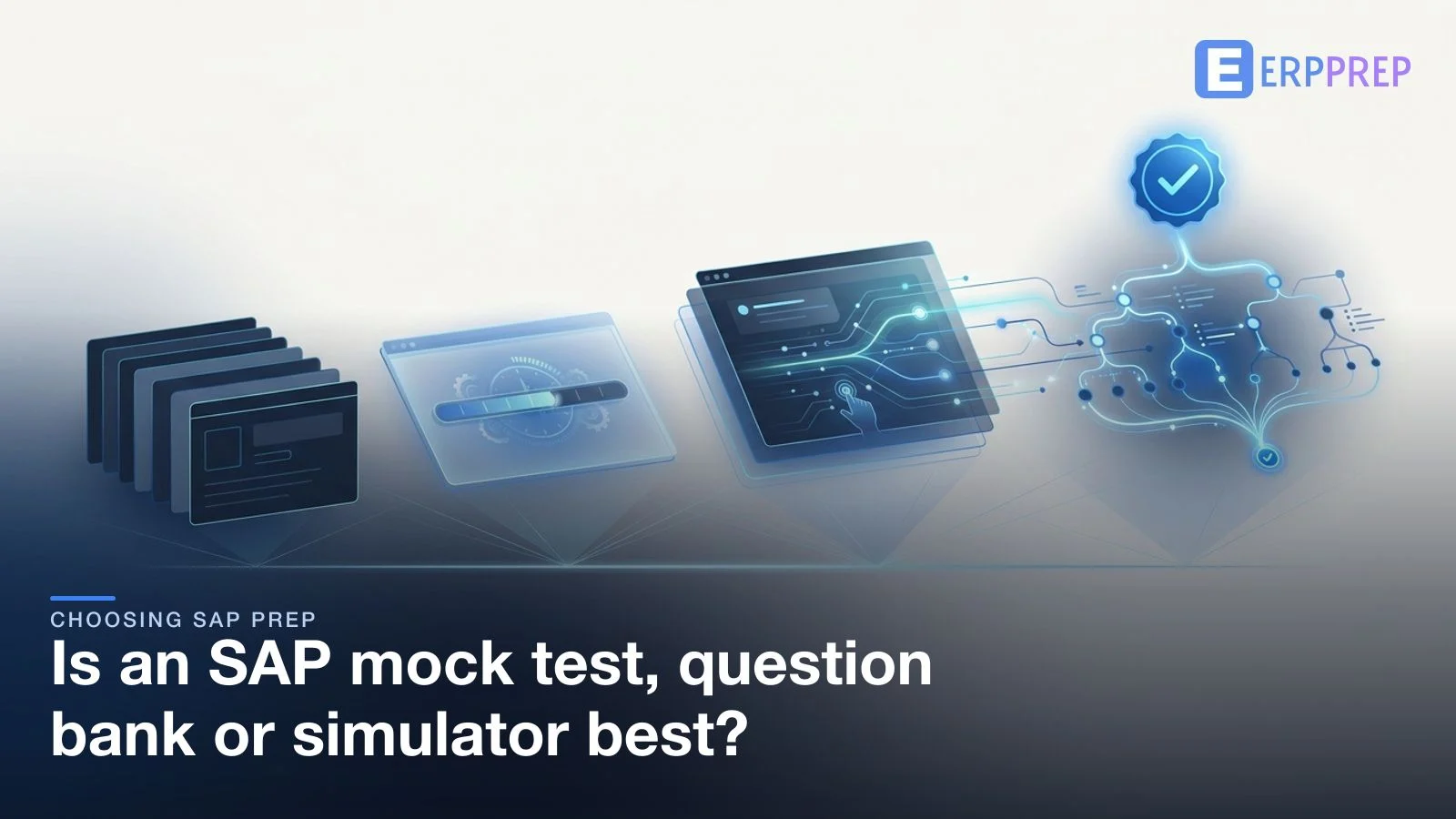
These four labels are not interchangeable. A question bank is a searchable pool that trains recall. A mock test is one timed sitting that trains pacing. A practice exam is a full-length rehearsal of a paper's shape. A simulator means doing tasks in a working environment. Only task-shaped and scenario-shaped practice rehearses SAP's 2026 performance-based exams.
Search for SAP® certification practice and you will be offered a question bank, a mock test, a practice test and a simulator — often by the same seller, often describing the same product. The words have become interchangeable marketing, which is a problem, because the things behind them are not interchangeable at all. Each one trains a different skill, and since 2026 only some of them can rehearse the exam you are actually sitting. This article is the vocabulary: what each artifact genuinely is, what it builds, what it cannot touch, and the order to use them in. For the wider decision about preparation, start from how to prepare for SAP certification.
Key takeaways
- The four labels name four different skills. A bank trains recall, a mock test trains pacing, a practice exam rehearses the shape of a paper, and a simulator rehearses doing. Confusing them is why people feel prepared and then stall.
- Only task-shaped and scenario-shaped practice rehearses the 2026 formats. A System-Based Assessment asks you to carry out work; a Scenario-Based Assessment asks you to reason forward through a connected situation. Neither has a list to recognise.
- "Simulator" is the least reliable word in the category. Honestly used it means an environment you act inside. Loosely used it means a question player with a timer.
- Nobody polices the vocabulary, so judge the artifact, not the label. Open a sample and ask one question: does this make me recognise something, or do something?
- Sequence beats selection. Coverage material early, task and scenario work through the middle, timed full-length sittings near the end — not the other way round.
What the four labels actually mean
Before anything else, pin down the words. These definitions are not official — no standards body owns them — but they are the honest distinctions the artifacts themselves make once you look past the product page. Each one describes a different relationship between you and the material.
Question bank: a pool you draw from
A bank is a large collection of standalone items, indexed by topic, meant to be browsed rather than sat. You choose an area, work through a handful, read the reasoning, and move on. It is usually untimed and almost never sequential — item forty has nothing to do with item thirty-nine.
What a bank genuinely trains is recall and coverage. Worked honestly, it tells you which parts of a syllabus you can talk about and which you cannot, which is real information early in preparation. What it cannot train is anything cumulative: because every item stands alone, no item ever depends on a decision you made earlier. That independence is the bank's whole design, and also its ceiling.
Mock test: one sitting, under the clock
A mock test is a single assembled sitting, taken start to finish, scored at the end. The defining feature is not the content — the items may be the same ones sitting in a bank — but the conditions. One attempt, a running clock, no looking things up, and a number at the finish.
That makes its real product behavioural rather than factual. A timed sitting teaches you how fast you actually read, where your attention sags, how you behave when you are unsure and the clock is visible, and whether you are the kind of candidate who rushes the opening or the closing. Those are genuine exam skills and they are difficult to build any other way. But a mock test is a poor teacher of content, because you meet each item once, under pressure, and the scoring arrives after the learning window has closed. The method for extracting value from one is its own subject, covered in how to use practice exams effectively.
Practice exam: a full-length rehearsal of a paper
In ordinary use, "practice exam" and "practice test" describe a mock test with an added claim: that this particular sitting mirrors the shape of a specific certification — its length, its spread of topics, its difficulty curve. The claim is the product.
Which means the claim is also the weak point, and it fails in two ways. First, SAP does not publish topic weightings for these certifications, so any resource asserting that it reproduces the exam's internal balance is guessing and presenting the guess as fidelity. Second, and more fundamentally, a paper can only mirror an exam that is a paper. Where an assessment is delivered as work to perform, there is no paper shape to copy. Whether that gap can be closed at all is the subject of do SAP practice tests match the real exam.
Simulator: somewhere you actually do the work
Used honestly, a simulator is not a set of questions at all. It is an environment: you are given a situation, you carry out steps, and the environment reflects what you did. The learning comes from the doing and from the consequences, not from a key telling you which letter was correct.
Used loosely — which is most of the time — "simulator" means a question player with a timer bar and a progress ring. There is a third, legitimate sense worth separating out: in SAP preparation, people often say simulator when they mean system access, a live environment where they can configure something for themselves. That is a genuinely different thing, with its own routes and its own costs, mapped in how to get hands-on SAP practice. It is also worth saying plainly that no independent provider can or should clone SAP's own screens — the interface is not theirs to reproduce. What an independent resource can rehearse is the decision and the sequence: what you would do, in what order, and why the tempting alternative is wrong.
Why the labels stopped being interchangeable
For most of the time these words have been in circulation, the distinctions barely mattered. When a certification was a multiple-choice paper, a bank, a mock test and a practice exam really were three arrangements of one substance: items with a correct option. Shuffle them, time them, or let people browse them — the underlying skill being trained was the same recognition each time. The labels were packaging.
The 2026 performance-based formats broke that equivalence. A System-Based Assessment (SyBA) asks you to carry out work and judges what you produced. A Scenario-Based Assessment (SBA) gives you a connected business situation and judges the chain of reasoning you follow through it. In both cases the thing being measured is an action, and an action cannot be recognised from a list. Overnight, the difference between "material arranged as a paper" and "material arranged as work" stopped being packaging and became the whole question. If the shift itself is new to you, what SyBA and SBA actually test is the shortest way in.
This is also why the vocabulary is now worth arguing about. A product page that still talks fluently about banks and papers, and never mentions performing or reasoning, is usually telling you when it was built.
Which formats can rehearse a performance-based exam?
Here is the whole taxonomy in one view. Read the last column first: it is the only one that changes your study plan. The honest answer for several rows is "partly", and the partial answers matter — a format that cannot rehearse the task can still train something you need.
| Artifact type | What it actually trains | Can it rehearse a performance-based exam? |
|---|---|---|
| Question bank | Recall, vocabulary and syllabus coverage; finding blind spots early | No — items stand alone, so nothing cumulative or task-shaped is ever rehearsed |
| Mock test | Pacing, stamina, decision fatigue and composure under a visible clock | Partly — it rehearses the conditions well and the task not at all |
| Practice exam / practice test | The shape of a paper: length, spread and difficulty curve as the author imagines them | Only if the exam is a paper — and the 2026 formats are not |
| Simulator (environment sense) | Carrying out steps and living with their consequences; procedural fluency | Yes for system-based work — this is the closest analogue to a SyBA |
| Simulator (question-player sense) | Recognition, with a timer attached; effectively a mock test rebranded | No — the label changed, the skill did not |
| Task drill | One decision or configuration step at a time, with reasoning for every option | Yes — it rehearses the unit of work a system-based assessment asks for |
| Connected scenario | Chained judgement, where an early choice constrains a later one | Yes — this is the closest analogue to a scenario-based assessment |
Two things fall out of that table. One: no single row is sufficient, which is why the question "which is best" has no answer and the question "in what order" has a good one. Two: the row you need most depends on how your own certification is delivered, and that is published on the certification page for your exam code in the SAP certification catalogue. Check it before you buy anything, because the format decides which rows are even relevant to you.
What a question bank is genuinely good for
It would be easy to read the table as a verdict against banks, and that is not quite right. The bank has a real job; it has simply been promoted far beyond it. Being precise about the boundary is more useful than dismissing the format.
Where recall genuinely earns its place
You cannot reason about a process you cannot name. Before anyone can judge whether a posting belongs in one ledger or another, they need the vocabulary of ledgers; before anyone can sequence an implementation, they need the names of the phases. That layer is recall, and a well-written pool with real explanations builds it efficiently — particularly in the first weeks, when your most valuable output is a reliable map of what you do not yet know.
A bank is also unusually good at a job nothing else does well: breadth sweeps. Working a few items across every area of a syllabus in one evening is a fast, cheap way to find the blind spot you have been unconsciously avoiding. Used that way — as a diagnostic instrument rather than a curriculum — a bank is worth having. The free courses and lesson trees in SAP's own learning journeys give you the structure to sweep against, and the SAP Help Portal gives you somewhere authoritative to go when a sweep turns up a gap.
Where a bank quietly misleads you
The failure mode is not inaccuracy. It is that a bank is extremely good at generating the feeling of progress. A rising percentage, a shrinking list of unseen items, a streak — all of it reads as readiness, and none of it measures the thing a performance-based exam asks for. You can clear a large pool at a high rate and still never once have decided a sequence of steps under constraints.
There is a second, subtler problem. Repeated exposure to a fixed pool trains you on the pool. You start recognising items rather than reasoning about them, and the score keeps climbing while the underlying skill flattens. The tell is simple and worth checking on yourself: when you get an item right, can you say why the two plausible wrong options are wrong? If not, you are remembering, not reasoning — and the exam will ask you to reason.
How to sequence these formats across a study plan
The useful question was never which artifact to buy. It is which artifact belongs in which week, because each one is excellent at a job that only matters at a particular stage. Here is a sequence that works regardless of how long your runway is — compress or stretch the phases, but keep the order.
Early weeks: coverage and vocabulary
Spend the opening phase building the map. Read the structure of your exam's learning journey, then use coverage-oriented material — the bank-shaped job — to find out which areas you can actually discuss and which collapse under a single follow-up question. The output of this phase is not a score. It is a short, honest list of weak areas, written down. Resist timing anything yet; a clock this early only tells you what you already know, which is that you are not ready.
Middle weeks: task rehearsal and connected reasoning
This is the long middle, and it should take the majority of your time, because it is the only phase that trains what the exam measures. Work task-shaped material: one decision at a time, each with written reasoning for every option, until the why comes before the answer rather than after it. Then move to connected work, where an early choice narrows what is available later — the shape of a Scenario-Based Assessment. The format-specific routines differ enough to be worth reading separately: practising for a SyBA and practising for an SBA.
Not sure which category a resource really belongs to? The label on the page will not tell you — a few minutes inside it will. Open a free sample and ask yourself the one diagnostic question: is this making me recognise something, or do something?
Final week: timing, composure and a dry run
Timed full-length sittings belong here, at the end, where they do their best work. By now a clock measures readiness instead of manufacturing anxiety, and the behavioural lessons — pacing, when to commit, how to recover from a bad opening — land because you have the underlying skill to apply them to. Keep the last few days for review rather than new material, and treat a weak timed result as information about pacing rather than a verdict on your preparation. If the end of the runway is where you are now, how to revise in the final week goes into the detail.
Where do so-called dumps fit?
They do not — and the reason is worth stating in taxonomy terms rather than moral ones. Every category above is defined by the skill it builds. Material advertised as leaked or recycled live exam content is defined by the answer it hands you, which makes it a different kind of object altogether: not a weaker practice format, but the absence of one.
The practical consequences are stacked against it too. Using such material breaches the certification terms you accept before testing and can cost you the credential, and the test-delivery provider actively invites reports of exactly that kind of violation — Pearson VUE maintains a test-security channel for it, and its test-taker resources guidance tells candidates to be wary of unauthorised material found online and to prefer study materials produced or approved by the exam programme itself. On top of which it no longer even works on its own terms: there is no answer key to a task you have to carry out. The full argument lives in practice questions versus dumps.
What ERPPrep provides — and what it does not
Because this article is a map of a market, it should be unambiguous about where we sit on it. ERPPrep does not sell mock tests, simulators or question banks. We deliberately avoid all three labels, because none of them describes what we build, and borrowing a familiar word to sell an unfamiliar thing is how this vocabulary got confused in the first place.
What we build is three things. Task drills — short rehearsals of one decision or configuration step, each with written reasoning for every option, including why the tempting wrong answer is tempting. Connected scenarios — single business situations that unfold across linked challenges, so an early judgement constrains a later one. And Scenario Roleplay — AI stakeholder practice for scenario-based exams, where you have to ask, interpret and defend rather than select, described in what AI stakeholder roleplay is. We are an independent resource, not affiliated with SAP, and nothing we publish is or claims to be live exam content.
That shape is not a marketing choice; it follows from the catalogue. There are 62 Scenario-Based and 40 System-Based exams among the 102 ERPPrep tracks (as of October 2026), and the two halves need different rehearsal: a scenario-based credential like SAP Activate project management (C_ACT) needs connected reasoning, while a system-based one like SAP S/4HANA Finance (C_TS4FI) needs task rehearsal. A single bank, or a single paper, could not serve either half properly, let alone both.
Sources
- SAP Learning — SAP Certifications, the certification catalogue (each exam's page states how that exam is delivered): learning.sap.com/certifications
- SAP Learning — SAP Learning Journeys, the free structured course and lesson trees behind each certification: learning.sap.com/learning-journeys
- Pearson VUE — Exam resources and test preparation for test-takers, on preferring programme-produced study material and treating unauthorised online resources with caution: pearsonvue.com/us/en/test-takers/resources.html
- Pearson VUE — Contact test security, the channel for reporting a testing violation: pearsonvue.com/us/en/contact-us/test-security.html
- SAP Help Portal — product documentation, for checking a configuration question against the vendor's own reference: help.sap.com/docs
Delivery formats, exam scope and certification terms are SAP's to state and can change; confirm the current details on the certification page for your own exam code before planning around them. The definitions in this article are editorial, not official — no body owns these words.
Which rehearsal does your exam need?
Start from the format rather than the label. Look up how your certification is delivered, then work backwards: a system-based assessment needs task rehearsal above everything else, a scenario-based one needs connected reasoning, and both benefit from a coverage sweep early and a timed sitting late. The words on the product page — bank, mock, practice, simulator — are only worth as much as the thing behind them, so use them to narrow the field and then test the artifact yourself.
That one diagnostic question does more work than any amount of comparing feature lists: does this make me recognise something, or do something? From here, apply the provider criteria in how to choose an SAP practice provider, learn the exam technique itself in how to pass SAP performance-based exams, or settle the fidelity question with do SAP practice tests match the real exam. Then answer the diagnostic for yourself — try a free sample and see which kind of practice it really is.
Frequently asked questions
- What is the difference between a question bank and a mock test?
- A question bank is a pool you browse — you pick a topic, work a handful of items, read the reasoning and move on, usually without a clock. A mock test is a single assembled sitting you take end to end under time pressure, with a score at the finish. The bank trains coverage; the sitting trains pacing and composure. Treating one as a substitute for the other is the most common sequencing mistake in SAP preparation.
- Is an exam simulator the same thing as a practice exam?
- Not in any useful sense, although vendors often use the words as synonyms. A practice exam is a paper: a fixed set of items arranged to resemble a real sitting. A simulator, honestly used, is an environment — somewhere you carry out a task and the environment responds to what you did. If a product calls itself a simulator but only ever asks you to choose between written statements, it is a practice exam with a progress bar.
- Can a mock test rehearse a performance-based SAP exam?
- Partly, and only for the things that are not about doing. A timed sitting is genuinely useful for pacing, for decision fatigue and for learning how you behave when the clock is visible. What it cannot rehearse is the act itself — carrying out a configuration task, or reasoning forward through a scenario where your earlier choice has already narrowed your options. For that you need practice shaped like the task, not like a paper.
- Does ERPPrep sell mock tests, simulators or question banks?
- No. We deliberately do not use any of those three labels for what we build, because none of them describes it. ERPPrep provides task drills, connected scenarios and Scenario Roleplay — AI stakeholder practice for scenario-based exams. We do not sell a bank of items to browse, a timed paper to sit, or a replica of an SAP system. This article describes those three categories as things that exist in the market, not as things you can buy from us.
- Where do dumps sit in this taxonomy of practice artifacts?
- Outside it. Material advertised as leaked or recycled live exam content is not a fifth category of practice — it is a breach of the certification terms you agree to before testing, and it can cost you the credential. It is also structurally useless now: there is no answer key to a task you have to perform. Every category in this article is defined by the skill it builds; that material is defined by the answer it hands you, which is why it belongs in neither the taxonomy nor your study plan.
- Which practice format should I start with, and which comes last?
- Start broad and finish narrow in format, not in difficulty. Early on, coverage-oriented material helps you learn the vocabulary and find the gaps. The bulk of the middle should be task-shaped and scenario-shaped work, because that is what the exam measures. Timed full-length sittings belong near the end, when they measure readiness rather than manufacture anxiety. Run them too early and you mostly learn that you are not ready yet.
- Do these labels mean the same thing from every vendor?
- No, and that is the practical problem. There is no standards body policing the words, so one vendor's simulator is another's question player and a third vendor's practice exam is a renamed bank. Because the labels are unreliable, judge the artifact instead: open a sample and ask what it makes you do. If it asks you to recognise, it trains recognition, whatever the product page calls it.
- Is a question bank still worth using in 2026?
- Yes, for a narrower job than it used to do. Recall still underpins judgement — you cannot reason about a process you cannot name — so a well-written pool with real explanations is a reasonable way to build vocabulary and find blind spots early. What changed is its status. It is no longer the main event, and a bank sold as sufficient preparation for a performance-based exam is mislabelled, however good the items are.
ERPPrep is an independent platform and is not affiliated with, endorsed by, or sponsored by SAP SE. SAP and other SAP products are trademarks of SAP SE, referenced here only to describe the certification exams ERPPrep helps you prepare for.
Ready to practise the way the exam tests?
ERPPrep provides original, performance-style scenarios and skill drills built for the 2026 SyBA and SBA formats. Try a free sample and judge the quality yourself.
Practice for these exams
Related guides
Is there a PDF of SAP exam questions and answers?
The honest answer is no. Why a downloadable answer key cannot work against SAP's 2026 performance-based exams — and what you can legitimately download.
SAP certification vs training course: what's the difference?
A training course teaches you; a certification tests you. What each one gives you, when you need which, and what the 2026 exam formats change.
Can you prepare for an SAP exam in one month?
A realistic answer: a focused month can be enough for some associate SAP exams — but not all. How to judge whether 30 days is enough for you, plus a sample plan.