

SAP service & monetization certifications: from delivering a service to billing it
Five SAP® certifications trace one lifecycle: service in S/4HANA, field execution, subscription orders, usage-to-cash billing, and digital adoption.
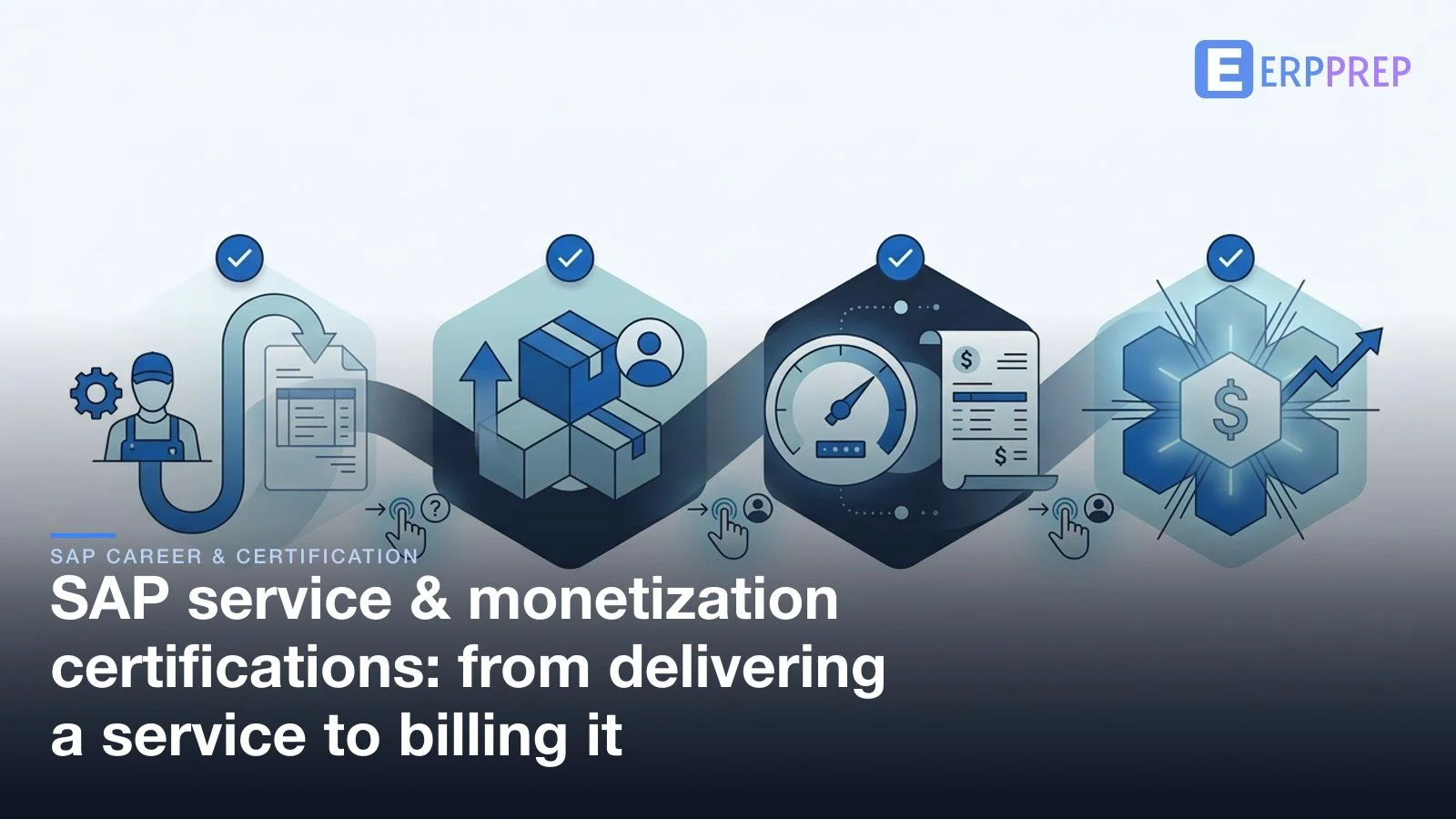
SAP® service and monetization certifications follow one lifecycle: C_TS470 runs service inside S/4HANA, C_FSM dispatches field technicians, C_BRSOM models subscription orders and contracts, and C_BRU2C rates, invoices and collects usage revenue. C_WME (WalkMe) is the adjacent digital-adoption credential, not a service or billing exam. Three are System-Based (SyBA); two are Scenario-Based (SBA).
If you work in service or after-sales, SAP®'s certification catalogue is oddly hard to read. The credentials that match your job are scattered across three different product worlds, and not one of them is simply labelled "service consultant". The useful way to sort them is to follow a single job through its life: a customer raises a request, a technician performs the work, the arrangement is contracted and metered, and eventually an invoice goes out and the money is collected. Five certifications sit along that line, and once you see the line, the catalogue stops looking random: each credential owns one stretch of the same customer relationship, and the "right" one is simply the stretch you already work in. For the wider question of whether any of this is worth your time, start with whether SAP certification is worth it and how to choose.
Two of these credentials live in the S/4HANA world, two live in SAP® Billing and Revenue Innovation Management, and one sits in a product bought to solve a completely different problem. That spread is exactly why so many people search for "the SAP service certification" and come away confused — there is no such single exam, only a relay of specialisms that pass work from one to the next. This guide walks the relay in order, says plainly who each stage suits, and is honest about the one credential that does not belong to the chain at all.
SAP® service and monetization certifications follow one lifecycle: C_TS470 runs service inside S/4HANA, C_FSM dispatches field technicians, C_BRSOM models subscription orders and contracts, and C_BRU2C rates, invoices and collects usage revenue. C_WME (WalkMe) is the adjacent digital-adoption credential, not a service or billing exam. Three are System-Based (SyBA); two are Scenario-Based (SBA).
Key takeaways
- There is no single SAP service certification. Four credentials divide the lifecycle between them, and a fifth sits alongside it as enablement.
- Read them as a hand-off chain: run the service (C_TS470), execute it in the field (C_FSM), contract and package it (C_BRSOM), then charge and collect for it (C_BRU2C).
- Formats are mixed. C_TS470, C_BRSOM and C_BRU2C are System-Based Assessments; C_FSM and C_WME are Scenario-Based.
- C_WME is not a service exam. WalkMe digital adoption is a genuinely different discipline — useful next to a rollout, never a substitute for one of the four above.
- Published cut scores run from 60% to 71%, so your margin for error changes noticeably depending on which one you book.
Which certifications sit on the service-to-cash line?
Each of the five has its own official learning journey (SAP, learning.sap.com). Here they are side by side before we go deeper on each:
| Exam | Stage of the lifecycle | Best for | Format & cut score |
|---|---|---|---|
| C_TS470 | Run the service in the core | S/4HANA service process consultants | SyBA · 71% |
| C_FSM | Execute it in the field | Dispatch, scheduling and mobile-workforce teams | SBA · 60% |
| C_BRSOM | Contract and package it | Subscription and solution-order consultants | SyBA · 64% |
| C_BRU2C | Charge, invoice and collect | Billing, invoicing and contract-accounting specialists | SyBA · 61% |
| C_WME | Adjacent: make people use it | Adoption, enablement and change roles | SBA · 65% |
Before you commit to a stage, it is worth feeling how these formats behave. Three of the five ask you to work in a system; two ask you to reason through a situation, and those are very different exam days. You can try a free sample to see what each style actually demands.
How does the deliver-to-bill chain actually connect?
It helps to picture a single subscription that bundles a physical product with an ongoing service — a piece of equipment that is installed, maintained on a recurring plan, and billed by usage every month. That one arrangement travels through all four of the core exams. C_TS470 stands the service up inside S/4HANA: it defines the equipment as a technical object, records the contract, and drives the service orders and confirmations that document work performed. When a technician has to visit the site, the job passes to the C_FSM world, where it is scheduled, dispatched, and closed out on a mobile device. The commercial shape of the arrangement — what the customer subscribes to, at what recurring and usage-based charges, under which master agreement — is C_BRSOM territory. And every metered event that arrangement generates is rated, invoiced, and collected in the C_BRU2C world of convergent charging, convergent invoicing, and contract accounting.
The hand-offs between those stages are not incidental; they are where the real integration work lives, and they are heavily represented in the learning journeys themselves. Subscription order management is taught alongside its integration with convergent charging and convergent invoicing, including how counters and allowances are shared across the boundary. Convergent invoicing is taught alongside financial contract accounting, because a billed item only becomes collected cash once it has moved through payment runs, clearing, and dunning. Knowing any one stage makes you useful on a project; understanding how the seams are stitched — how a renewing service contract in the core becomes a metered charge and then a settled receivable — is what separates a specialist from an architect. Few consultants can narrate the whole span, which is precisely why the pairing of adjacent credentials tends to be so well rewarded.
What does each certification actually cover?
Where does C_TS470 fit — service inside the core?
C_TS470 is the certification for service as a business process running inside S/4HANA Cloud Private Edition. Its journey builds up from organizational levels and service master data — technical objects such as functional locations, equipment, serial numbers, bills of material, and the measuring points and counters that make usage visible — and then works through the transactions themselves: service requests, quotations, orders and confirmations, in-house repair processing, service contracts, recurring service and the maintenance plans behind it, and finally service billing. Configuration depth is real here: transaction types, item categories and their determination, copying control, service pricing, and the integrations into controlling and the cross-application time sheet.
On the deliver-to-bill chain this is the origin point — the place where a service first becomes a recorded, structured business object rather than an email or a phone call. Everything downstream inherits from the decisions made here: whether an arrangement is a one-off order or a recurring contract, how it is priced, and how time and materials are captured. The journey deliberately spans discovery, business-process identification, organizational and master-data configuration, and basic customizing, so a candidate is expected to move between running a process and configuring the settings that make it possible, not just one or the other.
It suits the S/4HANA functional consultant whose day is spent inside the system defining transaction types and process flows, and equally the business user who owns service operations and wants to certify a genuine command of them. SAP frames it around the consultant and business-user roles and positions it for a mentored contribution rather than solo ownership, noting that prior project experience is helpful but not a strict prerequisite — a reasonable target for someone already close to service processes who wants a first formal credential in the core.
Where does C_FSM fit — the work at the customer site?
C_FSM picks up where the back office stops. Field Service Management is about getting the right technician, with the right parts and the right information, to the right place — so the journey covers account and company-level administration, master data, planning and dispatching, automated and assisted scheduling, and the mobile applications a technician actually holds. Around that sit business rules, Smartforms for structured on-site capture, analytics dashboards, customer self-service, crowd service for partner networks, integration design and monitoring, and applied artificial intelligence. It is the shortest journey of the five, and SAP describes it as an entry-level qualification — which makes it a common first credential for people coming from a dispatch or operations background rather than a configuration one.
On the chain, this is the execution stage — the moment the arrangement configured in the core actually gets fulfilled at a physical location. The learning journey leans hard into the two human roles that define field work: the dispatcher, who needs real-time, automated scheduling to place the right technician against the right job, and the technician, who needs a mobile application that works with intermittent connectivity and structured on-site capture through Smartforms. It extends beyond a company's own workforce, too, with crowd service for partner and contractor networks and customer self-service portals, so the exam expects awareness of collaboration models as well as the core dispatch loop.
Because it is a Scenario-Based exam, C_FSM rewards judgement about how those pieces fit a business situation rather than deep screen-by-screen configuration recall. It suits dispatch leads, field-operations managers, and consultants specialising in mobile-workforce rollouts, and its entry-level framing and shorter journey make it an approachable first certification for someone whose experience is operational rather than technical. What it does not do is teach you the back-office service process or the billing that follows — it is one link, and a deliberately focused one.
Where does C_BRSOM fit — turning service into an offer?
Once a service is something a customer subscribes to rather than buys once, you cross into SAP® BRIM. C_BRSOM owns the commercial front end of it: capturing a subscription order, creating and changing the subscription contract, modelling subscription products and bundles with their discounts and charges, phased contracts, cross-catalog mapping, master agreements and customer hierarchies, partner agreements, and the solution quotation that ties sales, subscription and service together. Crucially, it also covers the hand-offs — how order management integrates with convergent charging and convergent invoicing, how counters and allowances are shared, and how mass runs and their APIs keep a high-volume contract base moving.
This is where delivery turns into a repeatable commercial offer. The journey starts wide, with the quote-to-cash picture and how subscription order management sits inside the broader BRIM landscape, before drilling into the mechanics: business partners and contract accounts, capturing and changing subscription orders, modelling products and bundles with their calculation schemes, and the solution quotation that lets a single document carry sales, subscription, and service lines together. The skills SAP attaches to it — order management, order fulfilment, billing, convergent charging, payment processing, and the order-to-cash process as a whole — signal that this is a commercial-architecture credential, not a narrow order-entry one.
It suits the consultant who designs subscription commerce: someone shaping what customers can buy, how contracts change over their life, and how those contracts hand off cleanly to charging and invoicing. As a System-Based exam it expects genuine familiarity with the configuration objects, and its position on the chain makes it the natural neighbour of C_TS470 in one direction and C_BRU2C in the other. A consultant who pairs it with the service core can speak to a service that becomes a subscription; one who pairs it with usage-to-cash can speak to a subscription that becomes collected revenue.
Where does C_BRU2C fit — usage becomes cash?
C_BRU2C is the deepest of the four and the furthest from the customer site. It spans three heavy components: convergent charging, where you design charges, price plans and charge plans and manage allowances through their lifecycle; convergent invoicing, where billable items become bills and then invoices, with billing plans, invoice functions, partner settlement and complex discounting; and financial contract accounting, which carries the document lifecycle, account determination, payment lots and payment runs, clearing control, dunning and collections, installment plans and closing activities. Its journey is the longest of the five by recommended study time, and the published objectives are explicit that it is both functional and technical.
This is the terminal stage of the chain: the point where consumption a customer never sees as a document becomes a bill, an invoice, and finally money in the bank. Its journey is built from several substantial courses, each a discipline in its own right — a quote-to-cash overview, convergent charging, financial contract accounting, and convergent invoicing — and the depth on the accounting side is real, running through payment lots, payment runs, returns, clearing control, dunning by procedure or collection strategy, interest, installment plans, security deposits, and closing activities. Very little of that is customer-facing; almost all of it is the machinery that keeps high-volume revenue accurate and collectible.
Because of that reach, it is the hardest of the five to approach cold. It rewards people who already understand receivables, billing, or telco- and utility-style high-volume invoicing, and who are comfortable with content the objectives describe as technical as well as functional. It suits the billing or contract-accounting specialist who wants to certify the money engine of the subscription economy, and it is the stage where the phrase "usage to cash" is most literal — every rated event has to survive charging, invoicing, and collection before the lifecycle that began with a service order can be considered closed.
Where does WalkMe (C_WME) honestly fit?
Plainly: C_WME is not a service or billing certification, and you should not treat it as one. It is the WalkMe digital adoption consultant credential, and its subject is the software-guidance layer that sits on top of whatever application a user is in — a digital adoption methodology, then the building blocks: the editor and its condition logic, walk-throughs and their flow steps, tips, launchers, in-app messages, onboarding tasks, segmentation, publishing and troubleshooting, and engagement analytics at the end.
It earns a place in this map for one practical reason. A service or billing rollout can be configured perfectly and still fail on the day dispatchers, agents and billing clerks quietly go back to their old habits, and adoption tooling is how organisations attack that gap. But it is a genuinely different discipline: nothing in C_WME tests a service order, a charge plan or a dunning run. Take it because you want to own enablement, not because you think it will make you a stronger service consultant.
Read on its own terms, C_WME is a coherent and useful credential. Its journey moves from a digital-adoption methodology through building content in the WalkMe editor — walk-throughs and their flow steps, tips, launchers, onboarding tasks, segmentation, publishing and troubleshooting — and on to more advanced work with system integrations, multi-language content, lightweight scripting, and engagement analytics. SAP attaches it to architect, consultant, and data-analyst roles, which fits a discipline that is part solution design, part communication, and part measurement. It is a Scenario-Based exam, so it tests judgement about how to apply the platform to a business problem rather than rote feature recall.
The reason to be so explicit about the boundary is that adoption tooling and service or billing configuration are sold, staffed, and hired for separately. Someone who owns enablement for a large transformation may genuinely need C_WME and never touch a service contract; someone configuring convergent invoicing will never open the WalkMe editor. If your goal is to strengthen a service or monetization profile, one of the four exams above is the honest choice. If your goal is to make those rollouts actually stick with the people who use them, this is the exam that speaks to it — a complement to the chain, not a rung on it.
Which certification fits your role?
The fastest way to cut through five options is to name your job and let it choose:
- S/4HANA service process consultant. You configure service orders, contracts, and billing inside the core — start with C_TS470. It certifies the exact work you already do and anchors the rest of the chain.
- Dispatcher or mobile-workforce lead. Your day is scheduling, dispatching, and technician tooling at the customer site — C_FSM matches it most literally and, as the shortest and entry-level journey, is the gentlest on-ramp of the five.
- Subscription or solution-order consultant. You design what customers subscribe to and how contracts change — C_BRSOM owns the commercial modelling and its hand-off to charging and invoicing.
- Billing, invoicing, or contract-accounting specialist. You live in receivables, dunning, and high-volume invoicing — C_BRU2C is the deepest match, and your existing finance background is exactly what its technical layers reward.
- Adoption, enablement, or change lead. Your remit is making software land with the people who use it — C_WME is the credential that speaks to it, though it sits beside the service-to-cash chain rather than on it.
Which one should you take first?
The honest rule is the same one that applies across SAP's other certification families: certify the process you already touch, then add its neighbour. A consultant configuring service transactions in the core takes C_TS470 first and often reaches for C_BRSOM next, because the moment a service becomes a renewing contract the two meet. A dispatcher or mobile- workforce lead takes C_FSM first, since it is the shortest journey and matches daily work most literally. Someone already living in contract accounting or invoicing goes straight to C_BRU2C and treats C_BRSOM as the natural second step in the other direction — together they cover an end-to-end quote-to-cash flow that very few consultants can speak to across the whole span.
Career switchers should be realistic about depth. C_BRU2C is a long, technically dense journey that rewards people who already understand receivables and billing; C_FSM and C_TS470 are gentler entry points.
What do people get wrong when choosing here?
- Assuming "service" is one exam. Service delivery and service monetization are separate skill markets that happen to share a customer.
- Reading cut scores as difficulty. The spread from 60% to 71% sets how much room you have to slip, not how hard the content is. Your hands-on exposure decides that.
- Preparing for the wrong format. Studying configuration screens for a Scenario-Based exam, or rehearsing advisory judgement for a System-Based one, wastes the run-up.
- Adding C_WME to look broader. It signals adoption capability, not service or billing capability — and hiring managers can tell the difference.
- Booking on old information. Formats, cut scores and journey contents get revised; confirm the current details on the exam's official page before you schedule.
How should you prepare for these formats?
For the three System-Based exams, practise doing rather than reading: walk a service request through to a billed confirmation, or a subscription order through charging and invoicing to a collected receipt, until the dependencies feel obvious rather than memorised. Rehearse under a clock, because accuracy that only exists when you are relaxed will not survive the exam. For the two Scenario-Based exams, shift practice toward judgement — given a constrained situation, which recommendation actually holds. Learning to prepare for the performance-based format transfers across every one of these, and each certification above links down to its exam hub, where the scenarios, skill drills and exam facts for that specific stage of the lifecycle live.
Budget your run-up to the exam you actually chose, because these journeys are not the same size. The field-service path is the shortest and the usage-to-cash path the longest by a wide margin, with the service core and subscription order management in between — so a plan that works for one can badly under- or over-shoot another. Whichever you book, keep the format in mind while you study: for the System-Based exams, rehearse the dependency chains until you can predict what a configuration change will do downstream; for the Scenario-Based exams, practise defending a single best recommendation against plausible alternatives. And confirm the current format, cut score, and journey contents on the official exam page before you schedule, since SAP revises all three over time.
Once you know which stage of the deliver-to-bill chain is yours, the most useful next step is to feel the exam style for yourself rather than read about it. Try a free sample to see how System-Based and Scenario-Based practice actually reads, then follow your certification's link above to its exam hub.
Frequently asked questions
- Which SAP certification is right for a service consultant?
- There is no single service exam, so match the credential to where you sit in the lifecycle. If you configure service processes inside S/4HANA, take C_TS470. If you schedule and dispatch technicians in the field, take C_FSM. If you model subscriptions, bundles and contracts, take C_BRSOM. If you rate usage, invoice and collect revenue, take C_BRU2C. C_WME (WalkMe) is separate: it certifies digital adoption, not service. The safest rule is to certify the process you already touch first, then add its neighbour on the chain.
- What is the difference between C_TS470 and C_FSM?
- C_TS470 covers service running inside S/4HANA — organizational structures, service orders, confirmations, in-house repairs, contracts and service billing — as a System-Based exam that expects configuration depth. C_FSM covers the field execution layer: master data, planning and dispatching, mobile tools for technicians, Smartforms and scheduling — and is a Scenario-Based, entry-level exam with the shortest journey of the group. One is the back-office process that records and prices the work; the other is what happens at the customer site when a technician performs it. Many consultants eventually hold both, because the job flows from one to the other.
- What is the difference between C_BRSOM and C_BRU2C?
- Both sit in SAP® Billing and Revenue Innovation Management, but at opposite ends of it. C_BRSOM is the order side: subscription products, bundles, contracts, contract changes, master agreements, solution quotations, and their hand-over to charging and invoicing. C_BRU2C is the money side: convergent charging price design, convergent invoicing, and financial contract accounting — billing and invoicing runs, payment runs, clearing, dunning and collections. C_BRU2C is the longer, more technical journey and rewards a finance background, while C_BRSOM is the more commercial, modelling-focused credential. Together they span an end-to-end quote-to-cash flow few consultants can cover alone.
- Do I need to know BRIM to work in SAP service?
- No. Service delivery and subscription billing are separate skill sets, and most consultants own one, not both. The overlap is real, though: a service contract that renews, meters usage, or bundles a product with an ongoing service is exactly where S/4HANA Service hands off to SAP® BRIM. That seam — how a renewing service contract in the core becomes a rated charge and then a collected receivable — is where integration projects concentrate their effort. So knowing both is not required, but it is unusually valuable, and it is why pairing an S/4HANA service credential with a BRIM one tends to be well rewarded.
- Is C_WME a service certification?
- No. C_WME is the WalkMe digital adoption consultant credential, and its subject is guiding users through software — a digital-adoption methodology, then building walk-throughs, tips, launchers, onboarding tasks, segmentation and engagement analytics in the WalkMe editor. Nothing in it tests a service order, a charge plan, or a dunning run. It appears in this guide only because adoption often decides whether a new service or billing rollout is actually used by the dispatchers, agents and clerks it was built for. Take it to own enablement, not to strengthen a service or billing profile.
- What exam formats do these five certifications use?
- Three are System-Based Assessments, where you work in a live system and are judged on configuration and process execution: C_TS470, C_BRSOM and C_BRU2C. Two are Scenario-Based Assessments, where you reason through a business situation and choose the best recommendation: C_FSM and C_WME. Each is published as a single activity. The distinction matters for preparation — rehearsing configuration screens for a Scenario-Based exam, or advisory judgement for a System-Based one, wastes your run-up. Formats do change, so confirm the current format and cut score on the official exam page before you book.
- Which of these has the highest cut score?
- C_TS470 at 71% is the highest of the five, followed by C_WME at 65%, C_BRSOM at 64%, C_BRU2C at 61% and C_FSM at 60%. Read the cut score as your margin for error rather than a difficulty ranking: a higher bar simply means fewer questions you can afford to miss, not that the content is harder. What actually decides your result is hands-on familiarity with the process the exam covers. Cut scores are also revised from time to time, so treat these figures as a guide and verify the current number on the official exam page before you schedule.
- Which of these five is the hardest to prepare for?
- By recommended study time and technical depth, C_BRU2C (Usage to Cash) is the most demanding. Its journey is the longest of the five and spans convergent charging, convergent invoicing, and financial contract accounting, with the objectives explicitly describing both functional and technical content. It rewards people who already understand receivables and high-volume billing. At the other end, C_FSM is the shortest journey and is framed as entry-level, which makes it the gentlest on-ramp. C_TS470 and C_BRSOM sit in between. Remember, though, that difficulty is personal: the hardest exam is usually the one furthest from your day job.
- Can I combine two of these certifications?
- Yes, and adjacent pairs are the most valuable combinations. C_TS470 with C_BRSOM covers a service that becomes a subscription; C_BRSOM with C_BRU2C covers a subscription that becomes collected revenue, an end-to-end quote-to-cash span very few consultants can speak to. C_TS470 with C_FSM covers a service both configured in the core and executed in the field. C_WME pairs with any of them if your role also owns adoption, but treat it as a complement rather than a second service credential. Certify the process you touch first, then add its neighbour on the chain.
- Does ERPPrep provide real SAP exam questions or dumps?
- No. ERPPrep does not provide dumps or copies of live exam content, and material of that kind is unreliable, frequently out of date, and can put your certification at risk if it breaches SAP's rules. What you get instead is original practice built to the published exam structure for each of these five certifications — scenarios and skill drills that rehearse the reasoning and applied judgement these performance-based formats reward. The aim is to make the exam style feel familiar and to expose weak spots in your understanding, not to leak questions. That is the approach that actually prepares you to pass.
ERPPrep is an independent platform and is not affiliated with, endorsed by, or sponsored by SAP SE. SAP and other SAP products are trademarks of SAP SE, referenced here only to describe the certification exams ERPPrep helps you prepare for.
Ready to practise the way the exam tests?
ERPPrep provides original, performance-style scenarios and skill drills built for the 2026 SyBA and SBA formats. Try a free sample and judge the quality yourself.
Practice for these exams
Related guides
SAP S/4HANA logistics & supply-chain certifications compared
SAP's S/4HANA operations certifications each map to one line of business: procurement, sales, production planning, warehouse, transportation, project systems. A side-by-side comparison of what each covers, its format, its cut score, and which one to choose.
Every SAP certification track in 2026: the complete map
SAP's 2026 associate certifications map to seven tracks — Finance, logistics, HR, developer/BTP, analytics, Fiori, security — with their formats and cut scores.
Is SAP certification hard? What actually makes it tough
An honest take: how hard SAP certification really is depends on the module, your background, and the 2026 performance-based (SyBA/SBA) exam format.