

SAP Integration Developer vs BTP Administrator certification: C_CPI vs C_ADBTP
Two SAP cloud certifications, two different jobs on the same platform. C_CPI (SAP Integration Developer — building integrations on SAP Integration Suite) vs C_ADBTP (SAP BTP Administrator — running the platform) — scope, format, cut score, and how to choose.
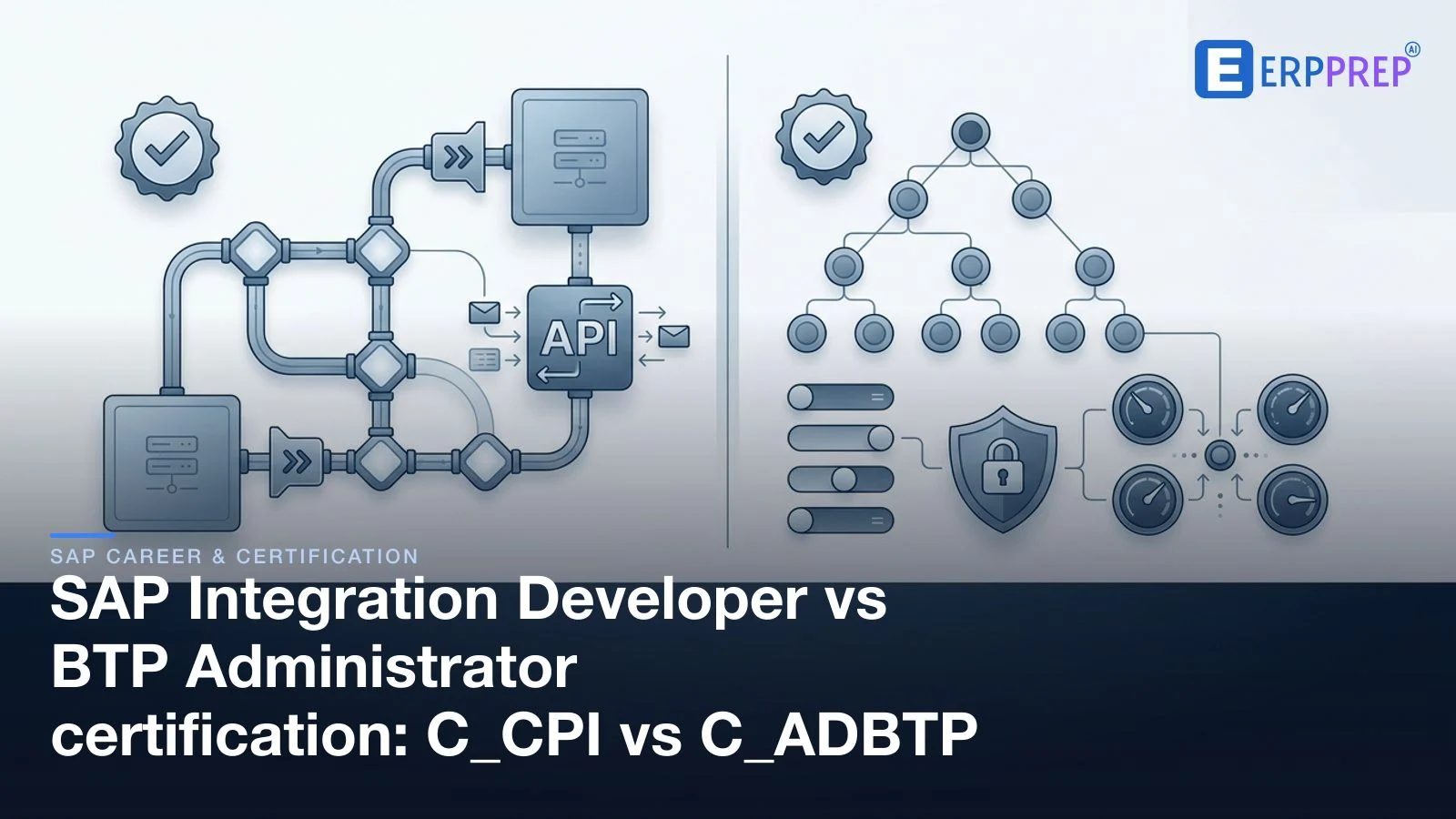
C_CPI (SAP Integration Developer) certifies building integrations on SAP Integration Suite — integration flows, adapters, mappings, APIs, and event-driven messaging. C_ADBTP (SAP BTP Administrator) certifies running the Business Technology Platform — accounts, subaccounts, entitlements, identity and access, connectivity, and operations. One is a build role, the other a run role. Choose C_CPI to develop integrations; choose C_ADBTP to administer the platform they run on.
SAP® Business Technology Platform is where a lot of modern SAP work now happens, and two associate certifications sit close together on it while pointing at genuinely different jobs. C_CPI certifies the SAP Integration Developer — the person who builds integrations on SAP Integration Suite — while C_ADBTP certifies the SAP BTP Administrator — the person who runs the platform those integrations live on. It is a classic build-versus-run decision. This guide compares what each certifies, the format of each exam, and how to choose. For the wider question of which SAP certification fits your career, see whether SAP certification is worth it and how to choose.
Key takeaways
- C_CPI is the build track — it certifies developing integrations on SAP Integration Suite: integration flows, adapters, mappings, API management, and event-driven messaging.
- C_ADBTP is the run track — it certifies administering SAP Business Technology Platform: accounts and subaccounts, entitlements, identity and access, connectivity, observability, and cost.
- The formats differ, and one is unconfirmed. C_ADBTP is a System-Based Assessment (SyBA) with a single hands-on activity and a 100% cut score at the time of writing; the C_CPI page did not publish its format or cut score at capture because the exam was under maintenance — confirm both on learning.sap.com.
- They map to different roles that often sit on the same project: an integration developer versus a platform administrator.
- Most people need only one. Lead with the certification closest to your day-to-day work; add the second only if your role genuinely spans building and operating.
C_CPI vs C_ADBTP at a glance
Both certifications sit on official SAP learning journeys (SAP, learning.sap.com) and both live on SAP Business Technology Platform — but they test opposite sides of it. Here they are side by side:
| C_CPI — Integration Developer | C_ADBTP — BTP Administrator | |
|---|---|---|
| What it covers | Building integrations on SAP Integration Suite — integration flows in Cloud Integration, adapters and connectivity, mappings, API management, and event-driven messaging | Administering SAP Business Technology Platform — accounts and subaccounts, entitlements, identity and access, connectivity, observability, cost, and operations |
| Role | Developer (integration builder) | Administrator / consultant (platform operator) |
| Build vs run | Build — develops the integration content | Run — operates the platform it runs on |
| Format | Not published at capture (exam under maintenance) — confirm on learning.sap.com | System-Based Assessment (SyBA), single activity |
| Cut score | Not published at capture — confirm on learning.sap.com | 100% (at the time of writing) |
What C_CPI (SAP Integration Developer) covers
The Integration Developer certification is about connecting systems. Its learning journey is aimed at integration designers and developers who build the flows that move data and events between cloud applications and the wider landscape. The earned skills sit in the development space — app development on the cloud, integration platforms, platform services, API management, and cloud architecture — which tells you the shape of the work: you are producing integration artifacts, not administering the platform.
In practice the module spans the SAP Integration Suite toolset from strategy down to running content:
- API management — building API providers and proxies, applying policies, editing and versioning APIs across their lifecycle, and publishing to a developer hub so consumers can find and use them.
- Cloud Integration (integration flows) — the heart of the exam: designing integration flows, choosing connectivity options and adapters, working with the underlying data model and expression language, and developing the content that carries a message from source to target.
- Message monitoring and logging — observing running integrations, tracing what a message did, and diagnosing where a flow went wrong.
- Event-driven messaging — event mesh concepts, the difference between direct and guaranteed delivery, and when an event-driven pattern beats a point-to-point call.
- Integration strategy and clean core — where integration fits SAP's broader architecture direction, so your flows extend the landscape without compromising a clean core.
The through-line is that an Integration Developer is a builder: someone who turns a connectivity requirement into a working, observable flow and knows which adapter, pattern, and API design fits the problem. The reasoning the exam rewards is design judgement — picking the right integration pattern for the constraint in front of you, not just wiring two systems together.
One important caveat on this exam. At the time the source page was captured, the Integration Developer certification was under maintenance and did not publish its assessment format, cut score, or language list. That is normal when SAP refreshes an exam, but it means you should treat those details as unconfirmed and read them fresh on the exam's page before you book — do not assume the format matches another SAP exam you have taken.
What C_ADBTP (SAP BTP Administrator) covers
BTP Administrator is an operations certification. Where the Integration Developer builds content, the Administrator sets up and runs the platform the content depends on. Its earned skills reflect that: platform services, cloud strategy, security, identity and access management, and cloud architecture across the Business Technology Platform itself. This is the person who owns the account structure, the permissions, the connectivity, and the health of the environment.
The learning journey is broad, moving from account setup through security to operations and automation:
- Account structure and entitlements — the BTP cockpit, the account and subaccount model, service subscriptions, and governing which services are available where.
- Runtime environments — provisioning and managing the Cloud Foundry, Kyma, and ABAP environments applications run in.
- Identity and access management — users and identity providers, authorization models, and managing access across the platform and its runtimes, plus the Cloud Identity Services that back authentication and provisioning.
- Connectivity — destinations and the Cloud Connector that links BTP to on-premise systems — an operational overlap with the integration world, but from the administrator's side.
- Observability, high availability, and cost — monitoring and observability tools, high-availability and disaster-recovery concepts, and reviewing consumption, billing, and entitlement transparency.
- Automation and DevOps — command-line tools, infrastructure-as-code with Terraform, and DevOps services for delivering and operating apps on the platform.
A BTP Administrator, then, owns the platform as a running service: secure, available, correctly entitled, and cost-aware. The exam reflects that operational weight in an unusually demanding way.
C_ADBTP is a System-Based Assessment (SyBA) built around a single hands-on activity, and at the time of writing it carries a 100% cut score. That combination is worth pausing on: a single practical task graded to full completion means there is little room for a partially-correct answer to carry you. You either performed the required administration work correctly in the system or you did not. That rewards genuine hands-on fluency with the platform over recognition-level familiarity — so preparation has to be practised, not just read. Confirm the current format, activity count, and cut score on the exam page at learning.sap.com, since SyBA details can be updated.
The two very different roles
The clearest way to choose is to look at who actually does each job. On a real SAP Business Technology Platform project these two roles collaborate constantly but rarely overlap.
An Integration Developer is a builder. The work is design-and-code shaped: understand the connectivity requirement, choose the pattern and adapter, build the integration flow or API, map the data, and make the result observable so it can be supported. If you enjoy solving how two systems should talk to each other and expressing that in integration content, this is the role — and it pairs naturally with a broader developer or integration-architect path.
A BTP Administrator is an operator. The work is setup-and-run shaped: stand up the account and subaccount structure, grant the right entitlements, wire identity and access, configure connectivity, watch observability, and keep cost and availability under control. It suits someone who likes owning a platform as a dependable service and being the person a team relies on to keep the environment healthy. It sits closer to cloud operations and platform engineering than to application development.
There is a career-shape difference too. Integration development skills travel with the broader move toward API-led and event-driven architectures, so an Integration Developer can grow toward integration-architect or platform-developer roles over time. Platform administration skills make you the person a project cannot run without — the operational backbone — and that expertise generalises toward cloud operations and site-reliability-style work across SAP's cloud estate. Neither is "better"; they are different bets on whether you want to compound as a builder or as an operator.
Not sure how a performance-based SAP exam feels? A free sample shows the reason-through-a-task style before you commit to a certification. Try a free sample.
Format and cut score: where they diverge
This is where the two exams differ most, so read the details carefully rather than assuming they match.
C_ADBTP is a System-Based Assessment (SyBA) — SAP's hands-on, do-the-work-in-the-system format — built around a single activity, with a 100% cut score published at the time of writing and delivered in English. A single practical task graded to full completion is unforgiving of gaps: you are demonstrating that you can actually perform the administration work, not that you can recognise the right answer among options.
C_CPI did not publish its format or cut score on the page at capture time, because the exam was under maintenance. That is a real difference you have to respect: do not assume it is the same format as C_ADBTP, and do not plan around a cut score that was not shown. Read the current details on the exam page before you schedule. If you want the technique for performance-based SAP exams in general, the guide to the performance-based exam format covers how SyBA and SBA assessments are built and how to work them under time pressure.
Which one should you choose?
Work backwards from the role you hold or want, not from the exam that looks lighter — and note that here you cannot even compare pass marks, because only one is published. Three rules of thumb:
- Choose C_CPI if you build integrations. You design integration flows, work with adapters and mappings, manage APIs, or troubleshoot event-driven messaging on SAP Integration Suite. This is the developer's certification.
- Choose C_ADBTP if you run the platform. You set up accounts and subaccounts, manage entitlements and identity, configure connectivity, and keep observability, availability, and cost under control. This is the administrator's certification — and its single-activity, full-completion format rewards real hands-on practice.
- Consider both only for a genuine build-and-run role. A small-team or hands-on architect who both develops integrations and administers the platform they run on can justify holding both. Most people lead with the one they touch daily and stop there.
Still weighing SAP Business Technology Platform against the rest of the field? Each exam hub below carries the scenarios, skill drills, and exam facts for that specific certification, and the SAP BTP, AI and architect certification paths guide places these two among the wider set of cloud and platform options.
Can you hold both?
Yes — nothing stops you certifying in both, and neither is a formal prerequisite for the other. The honest question is whether it helps your career. For most people the answer is that one certification matches the job and the second is optional. Because they are build and run, a person who genuinely owns both sides — common on smaller teams, or for a hands-on architect — gains real credibility from the pair: you can design an integration and stand up the platform entitlements and connectivity it needs. But if your role is squarely development or squarely administration, a second credential outside your daily work is a weaker investment than deepening the one that matches it. Sequence beats collecting: pick the role-fit certification first, get real project exposure, and add the second only when your responsibilities actually cross the build/run line.
Prepare for whichever you pick
Once you have chosen, the preparation principle is the same even though the formats differ: practise doing the work in a realistic setting rather than only reading. For C_CPI, build integration flows, wire adapters, design and manage APIs, and trace messages until diagnosing a broken flow is second nature — then confirm the current exam format before you book, since it was under maintenance at capture. For C_ADBTP, rehearse the administration tasks hands-on — account and subaccount setup, entitlements, identity and access, connectivity, observability — because a single-activity System-Based Assessment with a full-completion cut score rewards fluency, not recognition. Start from the exam hub for your certification, try a free sample to feel the performance-based style, and build from there.
Frequently asked questions
- What is the difference between C_CPI and C_ADBTP?
- C_CPI certifies the SAP Integration Developer role — designing and building integrations on SAP Integration Suite, including integration flows in Cloud Integration, adapters, message mappings, API management, and event-driven messaging. C_ADBTP certifies the SAP BTP Administrator role — setting up and operating the Business Technology Platform itself: accounts and subaccounts, entitlements, identity and access management, connectivity, observability, and cost. One builds integrations; the other runs the platform they live on.
- What exam format does C_CPI use?
- At the time of writing the Integration Developer exam page did not publish its assessment format because the exam was under maintenance during capture. Treat the format as unconfirmed and check the current details on the exam page at learning.sap.com before you book. Do not assume it matches another SAP exam — confirm it directly.
- What exam format and cut score does C_ADBTP use?
- C_ADBTP is a System-Based Assessment (SyBA) built around a single hands-on activity, and it publishes a 100% cut score at the time of writing — meaning the practical task is graded on completing the required work correctly rather than on a partial-credit percentage of questions. Always confirm the current format, activity count, and cut score on the exam page at learning.sap.com.
- What is the cut score for C_CPI?
- The Integration Developer exam page did not publish a cut score at capture time because the exam was under maintenance. Because a cut score can change and this one was not shown, do not rely on a specific number — confirm the current cut score on the exam's page at learning.sap.com before you schedule.
- Which SAP certification should I take first, C_CPI or C_ADBTP?
- Lead with the one that matches the work you do or want. If you build and troubleshoot integration flows and APIs, start with C_CPI. If you set up accounts, manage entitlements, and keep the platform healthy, start with C_ADBTP. Neither is a formal prerequisite for the other, so sequence them by role rather than by difficulty.
- Is integration development or platform administration the better career path?
- Neither is universally better — they are a build role versus a run role. Integration development (C_CPI) suits people who enjoy designing flows, mappings, and APIs and solving connectivity problems in code. Platform administration (C_ADBTP) suits people who enjoy owning accounts, security, entitlements, and operations. Pick the daily work you would rather own; both are in demand on SAP Business Technology Platform projects.
- Do I need both C_CPI and C_ADBTP?
- Most people do not need both. They map to different roles, so one usually matches your job. Holding both can make sense for a small-team or hands-on architect who both builds integrations and administers the platform they run on, but for most careers you lead with the certification closest to your day-to-day work and add the second only if your responsibilities genuinely span build and run.
- What prerequisites or background help for these exams?
- Neither is gated behind a formal prerequisite certification, but both assume cloud and platform grounding. C_CPI benefits from comfort with APIs, data mappings, and integration patterns on SAP Integration Suite. C_ADBTP benefits from familiarity with cloud accounts, identity and access management, connectivity, and operations on SAP Business Technology Platform. Confirm any recommended learning on each exam's page at learning.sap.com.
ERPPrep is an independent platform and is not affiliated with, endorsed by, or sponsored by SAP SE. SAP and other SAP products are trademarks of SAP SE, referenced here only to describe the certification exams ERPPrep helps you prepare for.
Ready to practise the way the exam tests?
ERPPrep provides original, performance-style scenarios and skill drills built for the 2026 SyBA and SBA formats. Try a free sample and judge the quality yourself.
Practice for these exams
Related guides
SAP BTP certifications explained: which one is right for you
A map of the SAP BTP certification family — administrator, architect, integration, ABAP and generative-AI developer, LeanIX EA — and how to choose.
Which SAP AI certification should you take?
SAP's AI credentials split three ways: build generative AI, position Business AI, or run the platform it sits on. A role-by-role way to choose one.
SAP CAP vs ABAP back-end developer certification: C_CPE vs C_ABAPD
Two SAP back-end developer certifications, two runtimes. C_CPE (CAP — SAP's cloud application framework in Node.js/Java) vs C_ABAPD (ABAP Cloud, using RAP). What each covers, the format, the cut score, and which to choose.