

SAP exam languages and international availability
Which languages SAP certification exams are offered in, why many performance-based exams launch in English, how to check the language for your specific exam, and tips for non-native English speakers sitting a proctored exam.
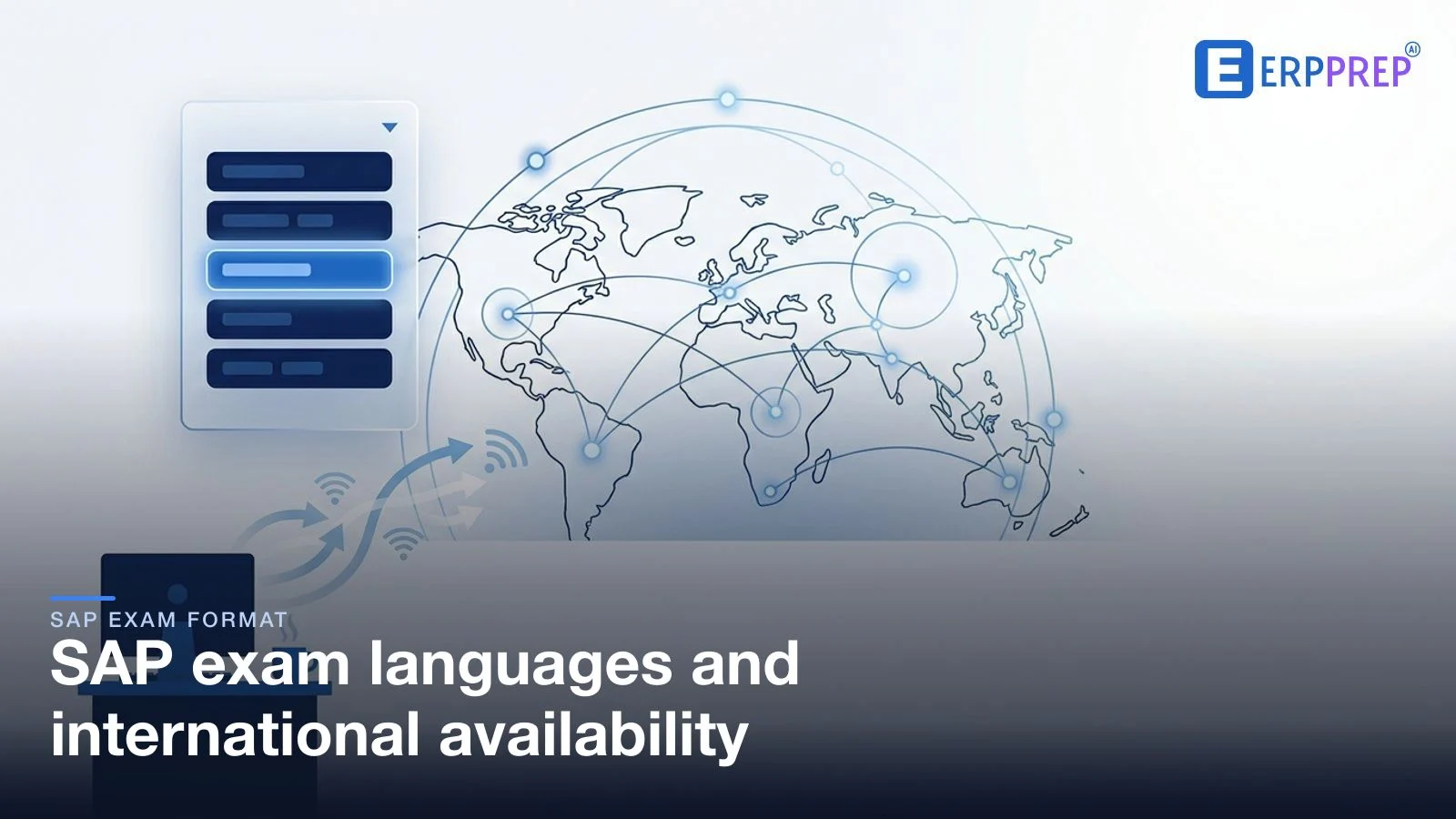
SAP certification exams are offered in a range of languages, but availability differs per exam — many newer performance-based exams are in English at the time of writing, with more languages sometimes added later. The reliable answer for any given exam is the language field on its own page at learning.sap.com. Online proctoring makes exams available in most countries, so language, not location, is usually the deciding factor.
"Which language is the exam in?" sounds like a small question, but for a lot of candidates it decides whether they book with confidence or hesitate for weeks. SAP® certifications are sat by people all over the world, and the honest answer is that language availability is set per exam — not once for the whole catalog. This guide explains what that means in practice: what languages exams tend to come in, why so many of the newer performance-based exams launch in English, how to check your specific exam, and how online proctoring has quietly made international access far easier than it used to be. It sits under the performance-based exam format guide and stays deliberately general, because the one source that is always current is the exam's own page.
Key takeaways
- Language is a per-exam setting, not a single rule for the whole SAP catalog — two certifications can offer different language sets.
- Many newer performance-based exams are English at launch, and some add languages later — so confirm rather than assume either way.
- The exam's official page is the source of truth for its current language field; blog posts and forums go stale.
- Online proctoring makes exams widely available across countries, so for most people language is the real constraint, not geography.
- Non-native English speakers can prepare deliberately — practise in the exam's language, learn the module terminology, and rehearse under time pressure.
What languages SAP exams come in
There is no single language that every SAP certification is offered in. Some exams list several languages; others are offered in fewer. The set is decided for each certification individually and reflects who typically sits it, when it was released, and how it has been maintained since. That is why a blanket statement like "SAP exams are in language X" is almost always wrong for at least some exams — the catalog is too broad and too varied for one answer to hold.
A useful way to think about it: the subject of an exam (finance, development, analytics, a particular module) is one axis, and the language it is delivered in is a separate one. A widely taken, long-established certification may have accumulated more language options over the years, while a recently introduced exam might start with a smaller set and grow. Neither pattern is guaranteed, which is exactly why the only dependable move is to read the specific exam's language field rather than reason from a general rule. We deliberately do not print a language list for any particular exam here, because those lists change and a static article would quietly go out of date.
Why many performance-based exams launch in English
The 2026 move to performance-based formats — the System-Based Assessment (SyBA) and the Scenario-Based Assessment (SBA) — reshaped what an exam is. Instead of a page of multiple-choice recall, these exams ask you to work through tasks or a connected business scenario. Building, validating, and maintaining that kind of interactive content is a bigger undertaking than translating a set of text questions, so it is common for a new performance-based exam to appear in English first at the time of writing, with additional languages considered later in its life.
Frame this as a tendency, not a law. "English at launch" is a pattern you will see often, but plenty of certifications offer more, and languages can be added after release. So the right posture is neither "it must be English" nor "my language will be there" — it is "let me check the language field for this exam today." If the performance-based format itself is new to you, the explainer on what SyBA and SBA actually test gives useful context for why the content is heavier to localize.
How to check a specific exam's language
This is the part that removes all the guesswork. Every certification has a page on SAP's learning site, and that page carries the current details for the exam — including the language field. To confirm the language for your exam:
- Open the certification's page on SAP's learning site (SAP, learning.sap.com).
- Find the exam's details section and look for the language field — it lists the language or languages the exam is currently offered in.
- If the field is unclear, or your preferred language is missing and you need it, contact SAP or the scheduling partner before booking rather than assuming.
The reason to trust that page over anything else — including this article — is that SAP maintains it, so it reflects languages added after launch and any changes over time. A forum post or a blog from last year can be confidently wrong. Make the official page your last check before you commit to a date, and the language question stops being a source of doubt.
Global availability via online proctoring
For many candidates the worry underneath "is it in my language?" is really "can I even take it from where I am?" Here the news is good. Online remote proctoring lets you sit many SAP exams from your own computer, supervised through your webcam, instead of traveling to a physical test center. That single shift has widened availability dramatically — you are no longer limited to countries and cities with a nearby center, and you can pick a time that fits your own schedule.
The key point is that language and delivery mode are separate settings. Online proctoring changes where and when you can sit an exam; it does not change which languages that exam is offered in. So a certification might be available to you online in your country while still being offered only in a limited set of languages — both facts live on the same exam page, and you should read both. If you are weighing how you will sit the exam, the deeper comparison in online-proctored versus test-center delivery walks through what each mode asks of you. As always, regional rules and the delivery modes offered can vary, so confirm the specifics on the official page.
Tips for non-native English speakers on a performance-based exam
If you will sit your exam in English and it is not your first language, that is completely workable — thousands of people do it every year — and a little deliberate preparation goes a long way. The performance-based format actually helps here in one respect: it rewards doing the work over decoding tricky wording. Still, reading speed and terminology matter, so prepare for them directly:
- Practise in the exam's language. Rehearse tasks and scenarios in the same language you will sit the exam in, so the phrasing and the SAP terminology feel routine rather than novel on the day.
- Learn the module vocabulary. Build a small glossary of the key terms for your area in the exam language. Recognising the standard names for processes and objects instantly saves precious reading time.
- Read carefully before you act. Watch for small but decisive words like not, except, or first — in a scenario they change what a correct action is, and they are easy to skim past under pressure.
- Rehearse under a timer. Reading in a second language can be a touch slower, so practise pacing so the clock never surprises you. Treat the on-screen time as a budget and keep moving.
- Use the connected structure in an SBA. Because later steps often build on earlier context, understanding the scenario's thread once is more efficient than re-reading each item cold.
Familiarity with the wording is, in the end, as valuable as the subject knowledge itself. The guide to managing time on a performance-based SAP exam pairs well with these tips if reading pace is your main concern.
Not sure how the format reads under time? The best way to find out — in whatever language you will sit — is to feel the doing-over-recalling style once in advance. Try a free sample.
Where to confirm language and availability
Everything in this article points to one habit: before you book, verify the language and the availability details on the exam's own page. That page on SAP's learning site is the single place that carries the current language field, the delivery modes, and any regional notes, and it is kept up to date as options change. Nothing else — not a general article, not a forum thread, not a screenshot from a year ago — can promise the same accuracy, because those sources cannot update themselves when SAP adds a language or adjusts availability.
So treat this guide as orientation and the official page as confirmation. Check the language field, note whether online proctoring is offered for your region, and if your preferred language is missing but essential, ask SAP or the scheduling partner before you commit. Do that, and the two questions that stall so many candidates — "what language?" and "is it available to me?" — both get clear, current answers. From there, your energy can go where it belongs: into rehearsing the format itself. The performance-based exam preparation guide covers that technique in depth, and when you want to see how it feels, try a free sample scenario and drill in your own time.
Frequently asked questions
- What languages are SAP certification exams offered in?
- SAP offers its certification exams in a range of languages, but the set is not the same for every exam. Some certifications list several languages; others are offered in fewer. Because the mix is decided per exam and can change over time, there is no single universal answer — the accurate list for any certification is the language field shown on that exam's own page.
- Are SAP exams English only?
- Not as a rule, but many of the newer performance-based exams are offered in English at the time of writing, with additional languages sometimes added later in an exam's life. Older or long-established certifications may already list more options. Rather than assume either way, confirm the languages on your specific exam's page, since English-only at launch is common but far from universal.
- How do I check what language my SAP exam is in?
- Open the certification's page on SAP's learning site and look for the language field in its details. That page is maintained by SAP and reflects the current options for that exam, including any languages added after launch. If the field is unclear or you need a specific language, contact SAP or the scheduling partner before you book rather than assuming.
- Can I take an SAP exam in my own language?
- Possibly — it depends entirely on which exam you are sitting. If your language appears in that certification's language field, you can select it; if only English is listed, that is the medium for now. Since the choice is fixed per exam, check the exam page early. If your preferred language is not offered, you can still sit the exam in an available language, most often English.
- Is the SAP exam available in my country?
- For most candidates, yes. Online remote proctoring lets you sit many SAP exams from your own computer in a wide range of countries, so physical test-center coverage is no longer the main constraint. Availability can still vary with local rules and the delivery modes offered for your exam, so confirm both the delivery options and any regional notes on the exam's official page.
- Any tips for non-native English speakers taking an SAP exam?
- Practice in the language you will sit the exam in so the terminology feels routine, learn the SAP module vocabulary in that language, and rehearse under a timer so reading speed is not a surprise. Read each task or scenario carefully before acting, watch for words like not or except, and use the on-screen time as a budget. Familiarity with the wording matters as much as the subject knowledge.
- Does online proctoring make SAP exams more widely available?
- Yes. Remote proctoring means you can be supervised through your webcam at your own desk instead of traveling to a center, which extends availability to places and schedules that a fixed test center could not serve. It widens where you can sit an exam, though it does not change which languages the exam is offered in — language and delivery mode are separate settings on the exam page.
- Where do I confirm the language and availability for my exam?
- Always the certification's own page on SAP's learning site. It carries the current language field, the delivery modes, and any regional notes, and it is updated as SAP adds options. Treat blog posts and forums as orientation only; before you book, verify the language and availability details on the official exam page or with the scheduling partner.
ERPPrep is an independent platform and is not affiliated with, endorsed by, or sponsored by SAP SE. SAP and other SAP products are trademarks of SAP SE, referenced here only to describe the certification exams ERPPrep helps you prepare for.
Ready to practise the way the exam tests?
ERPPrep provides original, performance-style scenarios and skill drills built for the 2026 SyBA and SBA formats. Try a free sample and judge the quality yourself.
Related guides
SAP exam check-in and ID requirements for online proctoring
What you need to check in to an online-proctored SAP exam — valid photo ID, the camera and room-scan environment checks, a clear desk, arriving early, how check-in flows, and how to avoid problems. Confirm current rules on learning.sap.com.
Online-proctored vs test-center SAP exams: what to expect
A calm, honest comparison of the two ways to sit an SAP certification exam in 2026 — online proctored from home vs a physical test centre. Requirements, environment rules, pros and cons, and how to choose the mode that suits you.
SAP exam accommodations and accessibility: what's available
A practical, reassuring guide to accommodations for SAP certification exams — the kinds of support that may be available, how and when to request one (usually before booking), documentation you may need, and where to confirm the current, authoritative process.