

How to prepare for a SAP SuccessFactors certification
A practical study plan for the SAP SuccessFactors module exams — build the Employee Central foundation, get hands-on with configuration, and rehearse the scenario-based format under time.
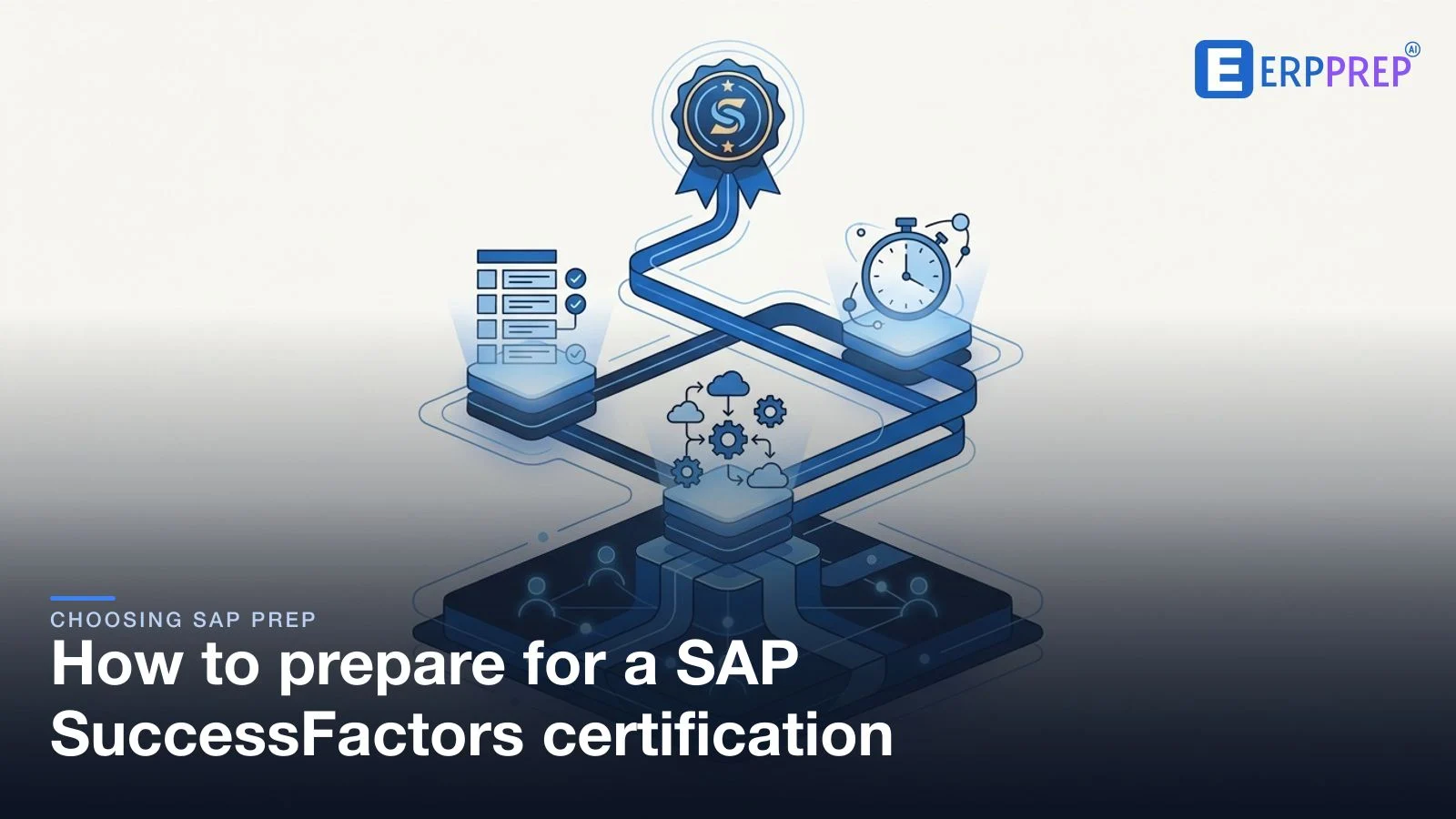
Prepare for a SAP SuccessFactors certification by building the Employee Central data foundation first, then layering your target module — Performance & Goals, Compensation, or People Analytics reporting. Learn the scenario-based format so you practise judgement, not recall; get hands-on with real configuration in an instance where you can; map your study to the module's skill areas; then rehearse full scenarios under time. Verify each exam's current format and cut score on learning.sap.com, since some are updating for 2026.
The SAP® SuccessFactors certifications sit at the heart of the human capital management track, and they cover a connected family of modules — Employee Central, Performance & Goals, Compensation, and People Analytics reporting among them. Because these modules share a common data foundation and a common exam style, a good study method for one transfers to the others. This guide gives you that method: what to confirm before you start, why Employee Central comes first, how to turn a module blueprint into a study plan, how to get hands-on, and how to rehearse for the format so you walk in prepared. For the wider picture, see how to prepare for SAP certification.
Key takeaways
- Employee Central is the foundation. The talent and compensation modules read from its people, employment, and foundation-object data, so a working grasp of it makes everything else easier.
- The format rewards judgement, not recall. The SuccessFactors exams that have published a format are scenario-based, so practise choosing and justifying the best action inside a business situation.
- Hands-on configuration is the differentiator. These exams reward doing. Practise the real work — templates, rules, imports, reports — in an instance where you can, or with faithful practice where you can't.
- Provisioning rights are a partner policy, not an exam gate. You can certify without them; they simply affect system access afterward.
- Timed rehearsal is the readiness signal. Full, timed runs tell you more than how confident you feel after reading.
The SuccessFactors exams at a glance
Before the method, here is the family this guide covers. Formats and cut scores below reflect what each certification page publishes — and a couple of these exams were mid-refresh, so always confirm the live detail on learning.sap.com before you book.
| Exam | Focus | Format & cut (confirm on learning.sap.com) |
|---|---|---|
| C_THR81 | Employee Central Core & Position Management | Format updating for 2026 — confirm on learning.sap.com |
| C_THR82 | Performance & Goals | Format updating for 2026 — confirm on learning.sap.com |
| C_THR86 | Compensation (newly available) | Scenario-based, single activity; 60% cut score |
| C_THR92 | People Analytics / Platform reporting | Scenario-based, single activity; 60% cut score |
Note the pattern: the exams that have published their current shape are scenario-based with a single graded activity and a 60% pass mark, while Employee Central and Performance & Goals were refreshing their format when this was written. Treat "scenario-based" as the working assumption for the family, and verify the specifics for your exam on the official page. For the format itself in depth, see what SyBA and SBA actually test.
Know the SBA format before you study
The most common mistake is preparing for the wrong kind of exam. A Scenario-Based Assessment does not ask you to recite definitions — it drops you into a business situation and asks you to make the configuration or advisory decision a consultant would make, then defend it against plausible alternatives. Compensation and People Analytics reporting both publish this shape: one scenario activity, graded against a 60% threshold. That format determines the kind of studying that pays off, so settle it first.
What does that mean in practice? It means every hour of study should end with you able to decide and justify, not merely recognise. When you learn how compensation worksheets and route maps are built, or how a Story report draws on a data source, don't stop at "what it is" — push to "which option is right here, and why are the others wrong." That habit is exactly what a scenario-based exam measures. For the underlying skill of reading and answering these questions, see how to pass SAP performance-based exams.
Start from Employee Central
Here is the single most useful structural insight for this family: the talent and compensation modules sit on top of Employee Central's data. Employee Central holds the core person and employment objects, the foundation objects that model your organisation, the business rules that automate data entry, and the imports that load it all. Performance forms pull employee and job data from it; compensation worksheets integrate with it and publish results back to it; reporting queries navigate its data. Learn that foundation and the module-specific work stops feeling arbitrary.
So even if your target is Compensation (C_THR86) or People Analytics reporting (C_THR92), spend early study time understanding how Employee Central Core (C_THR81) structures people, employment, and foundation data, how position management overlays an org structure on it, and how business rules and imports keep it consistent. You don't need to certify in Employee Central first — but you do need to understand it, because a compensation plan that publishes to Employee Central or a report that navigates its data makes no sense without that mental model.
Concretely, make sure you can answer: where does an employee's data live, how does a change flow through the employment record and workflows, and how do foundation objects and their associations shape what the talent modules can see? Those questions recur, in different clothing, across every module in the family.
Map the module blueprint
Once the foundation is in place, turn your specific module into a checklist. Each SuccessFactors certification page lists the skill areas the exam verifies, and those are your study spine. Rather than reading the learning journey front to back and hoping, convert the skill areas into a grid, rate your confidence on each, and steer study time toward the weakest rows.
The blueprints differ meaningfully by module, so map yours rather than a neighbour's:
- Employee Central Core (C_THR81) leans on the data model: foundation objects and associations, employee data and imports, workflows, event reasons, and position management. Your grid is heavy on data structure and transactions.
- Performance & Goals (C_THR82) centres on goal plans, performance form templates and their sections and permissions, calibration, continuous performance management, and 360 reviews. Template configuration and the review cycle dominate.
- Compensation (C_THR86) covers compensation plans and route maps, worksheets, budgets, eligibility rules and guidelines, and publishing data back to Employee Central. Reward strategy and plan configuration are the core.
- People Analytics reporting (C_THR92) spans Report Center, Story reports, table and canvas reports, and dashboards — building queries, data sources, filters, and outputs. It is the most tool-and-query oriented of the four.
Build the grid from the skill areas on your exam's official page, not from memory, and update your confidence ratings as you go. It keeps study honest and stops you over-investing in the parts you already know.
Get hands-on in an instance
These are configuration exams, so nothing beats doing the configuration. If you have access to a SuccessFactors instance — through an employer or an SAP partner — use it deliberately: build a goal plan template, configure a compensation plan and worksheet, create a Story report against a data source, set up a workflow and an event reason. The muscle memory and the "why did that behave that way" moments are exactly what a scenario-based exam rewards.
A practical note on access: SuccessFactors provisioning rights are generally granted only to registered SAP partner consultants once they certify. SAP states that customers and independent consultants, even when certified, are not given provisioning rights, and that there are no exceptions to that policy. Read that as it is meant — it governs what you can do in a customer system after certifying, not whether you can study for or pass the exam. If you don't have instance access, that is common and workable: lean on faithful practice that rehearses the same configuration decisions, and confirm the current policy wording on the certification page on learning.sap.com.
No instance to practise in? Scenario-faithful practice is the next best thing — it rehearses the same configuration judgement without a live system. Try a free sample and see whether it feels like the real decision-making.
Build a plan and rehearse under time
With the foundation, the format, and the blueprint understood, assemble them into a plan you can actually follow. A simple sequence works for every module in the family:
- Confirm the exam. Check your target exam on learning.sap.com and note its current format, cut score, and skill areas — some are refreshing for 2026, so don't rely on an older description.
- Ground yourself in Employee Central. Make sure the core data model is second nature before you go deep on the module, because the module depends on it.
- Map the blueprint. Turn the skill areas into a confidence grid and let study time flow to the weakest rows.
- Configure hands-on. Practise the real work — templates, rules, imports, reports — in an instance if you can, or with faithful practice if you can't.
- Rehearse full scenarios under time. In the final stretch, work complete scenario-style questions against a clock and review the reasoning behind every answer.
That last step is the one candidates skip and later regret. Knowing a module and performing under exam conditions are different skills. Timed rehearsal builds pacing, exposes the areas where you hesitate, and turns exam day into something familiar. Treat your accuracy and speed across several full, timed runs as your real readiness signal — it is far more reliable than how confident you feel after a reading session. For choosing practice that mirrors the format, see how to choose a legitimate SAP practice provider.
What to avoid
A few traps quietly waste preparation time or put your credential at risk. Steer clear of these:
- Dumps and "real question" claims. Anything advertising real, actual, or leaked exam questions is offering dumps — which endanger your certification and don't even work against a scenario-based exam, where there is no fixed answer key to memorise. Build the skill instead; it is the only thing that survives the format.
- Skipping the Employee Central foundation. Diving straight into a talent or compensation module without understanding the data it reads from leaves you memorising steps you can't reason about.
- Studying a module in isolation. Compensation publishes back to Employee Central; reporting navigates its data. Treating a module as a sealed box hides the integration points these exams love to test.
- Assuming an old exam shape. Several of these exams are updating for 2026. Confirm the current format and cut score on the official page rather than trusting a description from a year ago.
- Reading without doing. These are configuration exams. Passive reading builds recognition; the exam wants decisions. Balance every reading block with hands-on or scenario practice.
For the full list of preparation traps across SAP exams, see what to avoid in SAP exam prep.
Putting it together
The SuccessFactors family rewards a structured approach: confirm your exam's current format, build the Employee Central foundation, map the module blueprint, configure hands-on, and rehearse full scenarios under time. Because the modules share a data model and a scenario-based style, the method carries from Employee Central (C_THR81) to Performance & Goals (C_THR82), Compensation (C_THR86), and People Analytics reporting (C_THR92) alike. Deepen the approach with how to prepare for SAP certification, and when you're ready to test the scenario-based feel for yourself, try a free sample and rehearse the judgement these exams actually measure.
Frequently asked questions
- How long does it take to prepare for a SAP SuccessFactors certification?
- It depends on your starting point and the module. SAP's learning journeys for these exams are substantial — Employee Central Core and Performance & Goals each run to dozens of hours of recommended study, with Compensation and reporting somewhat shorter. A working consultant refreshing a familiar module needs far less than a newcomer building the Employee Central foundation from scratch. Plan in weeks of consistent study, not days, and let a timed rehearsal tell you when you are ready.
- Do I need access to a SuccessFactors instance to prepare?
- Hands-on configuration practice helps enormously, because these exams reward doing, not memorising. That said, provisioning rights for SuccessFactors are generally granted only to registered SAP partner consultants once certified — customers and independent consultants typically do not receive them. If you can practise in an employer or partner instance, use it; if you cannot, rely on scenario-faithful practice that rehearses the same configuration decisions and reasoning.
- Should I learn Employee Central before the other modules?
- Usually yes. Employee Central holds the core people, employment, and foundation-object data that the talent and compensation modules read from. Performance forms, compensation worksheets, and reporting all sit on top of that data model, so understanding how it is structured makes the module-specific work far easier to reason about. Even if your target is C_THR86 or C_THR92, a working grasp of the Employee Central foundation pays off.
- What is the best way to practise for a scenario-based SuccessFactors exam?
- Work complete scenarios end to end rather than skimming isolated facts. A scenario-based assessment asks you to make configuration and advisory decisions inside a business situation, so practise choosing the best action, justifying it, and understanding why the tempting alternatives are wrong. Reading the reasoning behind each answer is where the learning happens — a bare right-or-wrong key teaches you very little about the judgement these exams measure.
- Is partner provisioning required to get certified?
- No. You can study for and pass a SuccessFactors certification without provisioning rights. The provisioning-rights policy affects what you can do in a customer system after certifying — SAP generally grants those rights only to registered partner consultants, and states there are no exceptions. Independent or customer-side candidates can still certify; they simply won't receive provisioning access on that basis. Confirm the current policy wording on learning.sap.com.
- Is free study material enough, or do I need paid practice?
- SAP's own learning journeys and documentation are the authoritative free-tier foundation, and you should build on them. Independent practice adds value when it rehearses the exam's scenario format and explains the reasoning behind each answer — something reading alone rarely does. Judge any paid resource on whether it mirrors the format and teaches the why, not on price. A free sample is the fastest way to check that before committing.
- How important is practising under time?
- Very. Knowing a module and performing under exam conditions are different skills. Timed rehearsal builds pacing, surfaces the areas where you hesitate, and removes surprises on exam day. Do several full, timed runs in the final stretch of preparation and treat your accuracy and speed on those as the real readiness signal — more reliable than how confident you feel after reading.
- What should I avoid when preparing for a SuccessFactors exam?
- Avoid dumps and anything advertising real or leaked exam questions — they put your certification at risk and don't prepare you for a scenario-based exam that has no fixed answer key to memorise. Avoid pure fact-memorisation that skips the Employee Central foundation, and avoid studying a module in isolation from the data it depends on. Confirm the current format on learning.sap.com rather than assuming an older exam shape.
ERPPrep is an independent platform and is not affiliated with, endorsed by, or sponsored by SAP SE. SAP and other SAP products are trademarks of SAP SE, referenced here only to describe the certification exams ERPPrep helps you prepare for.
Ready to practise the way the exam tests?
ERPPrep provides original, performance-style scenarios and skill drills built for the 2026 SyBA and SBA formats. Try a free sample and judge the quality yourself.
Practice for these exams
Related guides
How to practise for SAP exams with AI stakeholder roleplay
SAP's SBA exams reward joined-up reasoning, not recall. Here's how practising with an AI stakeholder and a graded debrief builds that skill.
How to prepare for an SAP Business One certification
A practical, breadth-first study plan for the SAP Business One certification (C_TB120) — how to cover one integrated system and rehearse for a Scenario-Based Assessment.
How to prepare for an SAP Master Data Governance certification
A practical, format-faithful study guide for the SAP MDG (C_MDG) exam: master the SBA format, map the governance blueprint, practise reasoning through scenarios, and rehearse under time.